Off-topic: new toy=TIG welder!

   / Off-topic: new toy=TIG welder! #1  

davesisk

Platinum Member
Joined
Apr 18, 2002
Messages
862
Location
Raleigh, NC USA
Tractor
Massey-Ferguson MF 1220
Hey guys!

One of my "hobbies" is welding and basic metalworking. I started with a cheapo Harbor Freight gasless wire-feed welder (FCAW, flux-cored arc welder, like MIG but uses flux-cored wire) about 1 1/2 years ago. After I while, I figured out that it stunk, and went searching for a better process and machine. I tried quite a few (MIG, TIG, stick, etc.). I discovered that I really liked TIG ("Tungsten Inert Gas", very clean, very good welds with nice appearance and excellent penetration, ability to fuse pieces without using any filler...very cool), so I started searching for the "perfect" TIG unit for my needs/wants. Tried some Miller and Lincoln's, but was really impressed with an ESAB and an HTP unit. Looked for the ESAB used for about 6 months on ebay, no beans. Tried buying a cheap inverter stick power supply and adding a TIG torch and gas regulator to do scratch-start TIG, but found it didn't have enough power and duty cycle (but I did discover that I like stick better than FCAW, better welds and easier to see what you're doing). Finally decided it was time to buy the ESAB ($1470, not a cheap piece for hobby equipment). I think I made a good choice, I'll probably still be using this thing 20 years from now (softens the sticker shock a little bit). Anyway, this thing has DC output (steel, stainless, chrome-moly, and most other metals), AC squarewave output (for aluminum and magnesium), variable frequency in AC, high-frequency arc starting (very nice feature, don't have to scratch the tungsten on the workpiece and break it loose when it sticks)....in a nutshell, I can't see me being able to outgrow it. If I need to weld some tractor attachment that's just too thick to use TIG on, then I can switch the torch for the stick electrode holder, and let 'er rip (TIG and stick both use constant current power-supplies, so all TIG welders will also stick weld). This welder will handle any metal that is weldable (that's the welder as in the machine, not the weldor as in me.../w3tcompact/icons/smile.gif). TIG is slow (compared to MIG, sometimes compared to stick), but with a little practice you can get X-ray quality welds with very little effort, and cleanup (grinding, etc.) is either minimal or completely unnecessary (ie. gain time back!). TIG is such a clean process (not sparks, no spatter, no slag, etc.) that you could weld in a suit without burning holes in it.

OK, I've rambled enough. Had to post this somewhere where folks have a sense of humor. I post on a welding message-board occasionally, but those folks are the grumpiest bunch of posters I've ever seen! Anyway, helping a neighbor weld up a grill grate tommorrow, should be fun!

L8r,
Dave
 
   / Off-topic: new toy=TIG welder! #2  
Dave,

Interesting reading. I’ve been trying to decide on a “beginner’s” welder for my use. I don’t think the cheaper MIG welders will be work for the thick metal on the PT attachments. So, I’m now looking at a Lincoln AC/DC 225/125. From what I have read, it should work fine. And it will hold its resale value well if I ever decide to get something else or don’t use it enough. I really don’t want to spend more the $400 - $500 at this time. However, in the future, who knows.
 
   / Off-topic: new toy=TIG welder! #3  
Sounds cool /w3tcompact/icons/smile.gif

I've never used TIG. Just gas, stick and wire feed with and without gas. I only have a gas set and an old Sears buzz box for stick, but will definately look into TIG in a few years when I should be getting some more time. Thanks for the information.
 
   / Off-topic: new toy=TIG welder! #4  
davesisk, You stopped rambling before you told us the voltage, amps, duty cycle, and most importantly before you posted the pictures.

I'll look forward to you completing your post.
 
   / Off-topic: new toy=TIG welder!
  • Thread Starter
#5  
Martt:

Take a look at the Century's, there's several to choose from, they've been around for years and have a great reputation, and at least two of the models can be had for a little over $200. Also, Harbor Freight sells a 170 amp or so AC/DC stick welder for around $130 on sale. It doesn't have a great duty cycle, but stick moves quick enough that it shouldn't be an issue all that often.

I agree with you, although MIG has a lot nice features about it, stick works much better (unless you have a very high-powered unit) than MIG for really thick material. MIG is by far the fastest process, but there's moving parts (the wire feed mechanism) to adjust and maintain. With a stick machine, you open a pack of electrodes and go. I think comparing amperages, you get your money's worth with stick moreso than MIG. For instance, a Century 250 amp AC/DC stick welder can be had for under $600, while a similarly powered MIG is well over $1200. Stick isn't that hard to do (with a little practice), and I personally think that you can do a better weld with a little practice, simply because you can see the weld pool much better (no gas nozzle blocking your view). That said, MIG will produce a much nicer looking weld due to the gas shielding, but if you looking for really nice welds, go with TIG (which will also do stick). Just MHO, of course.

Good luck!
Dave
 
   / Off-topic: new toy=TIG welder!
  • Thread Starter
#6  
Spencer: You're right, I guess I left out some important details, eh?

ESAB Heliarc 161 AC/DC, 160 amps, 40% duty w/TIG, 35% duty cycle w/stick, DC and AC squarewave output, balance control (to change the percentage of electrode negative to electrode positive when using AC), variable frequency in AC (tied to amperage), inverter-based and draws only 27 amps @ 220V, completely solid state, has a high-frequency start and a lift-arc start mode for TIG, foot pedal contactor control/amp control, built-in gas solenoid valve. I like this machine!

See <A target="_blank" HREF=http://www.esabna.com>http://www.esabna.com</A>, go to products->catalog->arc-welding equipment->AC/DC power sources - Solid State-> Heliarc 161 AC/DC.
 
   / Off-topic: new toy=TIG welder! #7  
Just out of curiosity, I wonder what type of welder PT uses to build their stuff? When I took the factory tour, I didn’t notice. I’m sure they have several to choose from.
 
   / Off-topic: new toy=TIG welder! #8  
Dave:
We have managed to acquire an old (1986) Miller Dialarc. Although I think we've gathered most of the bits and pieces to make it work, we haven't a clue about basic settings. Have you come across a primer for beginners that is good on basic stuff like "for 1/4 inch mild steel, start with these settings... and if you see ......., increase (decrease)..." , etc.
Although we seldom can get anything clean enough for what I understand TIG requires, we'd like to develop at least some basic competence. Meanwhile, we're using the machine instead of our old buzz box for stick welding, primarily with 7018 rod.
 
   / Off-topic: new toy=TIG welder!
  • Thread Starter
#9  
Charlie:

There's a few good books available on arc-welding and most of them go into some detail on TIG. I'd suggest (as a start) the "Welder's Handbook", about $20 from Amazon, Home Depot, etc.

If you'll post some specs on the Dialarc, I'll try to post some more info if I know it. Does it have high-frequency start? (I'm thinking it does...) Built-in gas solenoid for TIG? Some sort of remote amp control (like foot pedal or thumb button)? Remote contactor control?

There's a couple of "rules of thumb" I've learned so far, so I'll list those:

1) Set the argon gas flow to around 15-20 cfh.

2) For mild steel, use DCEN (DC w/ TIG torch electrode negative, workpiece clamp positive).

3) You need about 1 amp for every 1/100th of an inch, although it depends on the joint type, and you can usually get by with less. A butt joint uses the least amount of power, a T-joint uses the next, and a lap-joint uses the most power (and it's usually where you really need the 1 amp per 1/100th inch). You can get by with less power if you 1) weld both sides and/or 2) make a V-groove at the joint, do multiple passes and add filler as you go, or both. Actually, let me re-phrase that: You need about 1 amp for each 1/100th inch of penetration. Small size pieces take less juice, big honking parts take more juice (they sink the heat faster). This is one of those things where there's so many variables, you just have to try it on some scrap to get the settings right so that you get good penetration but don't burn through the material. To increase the heat going into the work, you can also use Helium as the sheilding gas rather than Argon, but you'll use more gas (because it's lighter than air, you have to set the flow rate higher) AND it's more expensive to start with.

4) Use a tungsten electrode that's about half the thickness of the workpiece. Grind it to a point, then flatten the very tip. Grind it parallel to the direction you want the arc to go (parallel to the electrode). If you grind the tungsten perpendicular to the direction you want the arc to go (perpendicular to the length of the electrode) the arc will jump around. Don't know why, but it does! If you electrode keeps melting, 1) make sure you running the torch DCEN, and 2) move to a little larger tungsten electrode. If getting the arc started is really, really difficult, check that it's ground correctly (as in grinded, not grounded), and possibly move to a smaller diameter electrode.

The best way to learn it (what I've done) is to just get some practice time in. If the Dialarc has HF start, that's a major hurdle licked. If it doesn't, then you have to scratch start, and that takes a really light touch (you get the tungsten stuck, then break it loose, then start over, I can't do it consistently). Scratch starting with TIG is about twice as hard as scratch starting with stick, and it's a real pain. With HF start, you just bring the torch close to the workpiece, and a high-voltage spark will jump and then the arc will start...very nice feature.

The technical forum on the American Welding Society's site at <A target="_blank" HREF=http://www.aws.org>http://www.aws.org</A> is a good place to ask questions. Be forewarned though: some of the posters are very pleasant and helpful, and some of them are really cranky and seem to carry some major chips on their shoulders! Go figure. If you can ignor the cranky folks, you can get some good answers.

HTH,
Dave
 
   / Off-topic: new toy=TIG welder! #10  
Thanks a lot, Dave.
I'm printing your note, and will probably order the book right away. I know I've bought it before, but don't know where it is, and the last time I bought it was probably 1969. A lot probably hasn't changed, but maybe some has.
Keep us posted on your progress with TIG. If I can accomplish any, I'll do the same.
 
   / Off-topic: new toy=TIG welder!
  • Thread Starter
#11  
Hey Charlie:

Another thought...Miller has some training materials (video's and CD-ROM). I've bought both videos. They're expensive for what you get, but the "Intro to TIG" video was quite informative. The "TIG setup" video was pretty useless, IMHO. I haven't bought the TIG CD-ROM, but I have heard that it's quite a bit more info than the video, and it's cheaper. See <A target="_blank" HREF=http://www.millerwelds.com>http://www.millerwelds.com</A>...

Of course, I think the best training you can get is the equivalent of "seat-time"...fire it up and weld some scrap, you'll learn an amazing amount by trying some different type joints. If you can get the metal to puddle, then you've got enough juice going. If you're welding without filler (one of the nice things you can do with TIG), then you just push the puddle around with the force of the arc, and back off the amptrol to let it solidify (and repeat as necessary). One really nice thing is that you can see what's happening so well, since there's no spatter and sparks flying! The being able to see part is why TIG can product x-ray quality welds.

Can you tell I really like the TIG process? /w3tcompact/icons/smile.gif

HTH,
Dave
 
   / Off-topic: new toy=TIG welder!
  • Thread Starter
#12  
One of the most common automotive uses for TIG is chrome and stainless steel exhausts. What do you think, guys? Should I build some big honkin' chrome hot-rod exhaust for the PT-1418? /w3tcompact/icons/love.gif Can you see it?

Dave
 
   / Off-topic: new toy=TIG welder! #13  
davesisk, Thanks for the extra information and the link. I checked it out on their website and that looks like a great machine. You got a lot more machine than what I got for 2 grand, but I needed something portable that would work off of 120 or 240 volt.
 
   / Off-topic: new toy=TIG welder! #14  
Charlie,
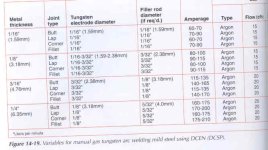
Here is a table from my "Modern Welding" text book. It shows the variables for welding up to 1/4" mild steel when using DCEN GTAW.

Good Luck!
 

Attachments

  • 54-228380-Mild_Steel_Table.jpg
    54-228380-Mild_Steel_Table.jpg
    26.4 KB · Views: 168
   / Off-topic: new toy=TIG welder! #15  
Dave,

I agree TIG is a sweet process. I have never tried it on sheet metal, but I suppose it would work well, especially since you can melt the base metal without adding filler material.

Our welding engineer used to scold me for 'walking the cup', hey, my free hand is not as steady as it used to be (come to think of it, maybe it was never that steady) Sharp tungsten works good as a toothpick, but a little rough on the teeth/w3tcompact/icons/smile.gif

Duane
 
   / Off-topic: new toy=TIG welder!
  • Thread Starter
#16  
New TIG project: gas log heat exchanger

OK, I think I have a first good TIG project lined up: a re-vamped gas log heat exchanger. I've already helped a neighbor make a new grill grate out of some tubing and expanded metal, but this one will require a little more precision I believe.

We have a wood burning fireplace right now. It's a masonary fireplace with glass doors, screen, blower, and wood grate/heat exchanger. I was surprised to recently discover that it's all one piece! Anyway, after our recent power outage from freezing rain, we decided to go ahead and get the gas logs we've been talking about for a year installed (I got tired of slonkin' out into the yard at 4am with tree limbs and ice falling around me to get more wood!) I've bought the gas logs and just have to get a plumber to come install them.

The issue is that I'd also like to keep the blower and heat exchanger deal. With a wood fire, that blower was VERY effective. However, it won't work well (if at all) with the gas logs. The gas logs would have to sit on top of the grate/heat exchanger, which would not only look kinda stupid, but the air circulating through the grate wouldn't get hot (gas log heat goes up!). I've looked at a couple of blowers/heat exchangers designed to work with gas logs, and they are kinda dinky and expensive. One ($250) sucks air from the top of the firebox and blows it out the front, which I'm not sure that I like. We'll be burning ventless gas logs, but we still plan to open the flue at least one click. (The instructions with the gas logs say that, even though they are ventless, open a window about an inch if they will be burning for a long period of time.) With all this in mind, I'd really rather not mix the gas log exhaust with the air in the room to such a high degree (a little is OK). I like the idea of sucking air out of the room, circulating it through a heat exchanger, then blowing it back into the room (which is what the current wood blower/grate/heat exchanger does). There was another model that sucks air from the bottom, circulates it to the top, then blows it out the top, but this one would require the gas logs to sit on top of it and I dont' think I'd like how that looks, plus this unit is $500. Ouch! Seems like a ridiculous price for such a simple thing...

So, what I intend to do is to cut the grate/heat exchanger off of the current door/blower/heat exchanger assembly (the grate/heat exchanger tubes are merely square tubing), weld up a new heat exchanger out of square tubing that will be positioned above the gas log fire (top back of the fireplace), then re-attach it to the blower. Sounds like a good TIG project, don't ya think?

I may get started on it this weekend. Should be a fun project, and instead of costing $100+ to replace the glass doors/screens + $250-500 for a blower, it'll cost about $50 worth of tubing (if that much) plus part of a weekend.

I think the current grate/heat exchanger tubing is 1" or so square and 1/16" thick, so I'll probably use the same thing. It doesn't need to be perfectly air-tight, just pretty good. I'm thinking simple butt-welds (some straight, mostly right-angle) throughout will be the best answer...

I know this is all hard to visualize, but the current heat exchanger is the grate that the wood sits on. I need it to be above the fire now rather than below it...I believe this will be quite a fun and useful project!

Thx,
Dave
 
   / Off-topic: new toy=TIG welder! #17  
Great table. Thanks.
 
   / Off-topic: new toy=TIG welder! #18  
<blockquote><font size=1>In reply to:</font><hr>


3) You need about 1 amp for every 1/100th of an inch,


<hr></blockquote>


Dave a good post but you dropped a zero. Corrected this reeds: You need about 1 amp for every 1/1000th (thousandth) of an inch for steel or aluminum.

In general:
Start with 1 amp for each thousandth of an Inch of thickness (0.001").
For inside fillet welds, increase amperage by 30%
For outside fillet welds, decrease amperage by 30%

For steel and aluminum use this amperage.
For stainless steel, decrease amperage by 30%.
For copper, increase amperage by 100%.
For bronze, decrease amperage by 50%.
 
   / Off-topic: new toy=TIG welder!
  • Thread Starter
#19  
Good post...you are correct. For 0.250", you need 250 amps (+/- 30-50% depending on the joint, metal mass, type of welder, type of filler, etc.) These really are just guidelines, though. I've lap-welded 1/4" thick flat stock to the 1" x 1.5" curl arm on the tractor with a 115V 85amp stick welder (6013 rods), so mileage really does vary...

Thx!
Dave
 

Tractor & Equipment Auctions

2019 International WorkStar 7300 4x4 Altec AA55 56ft. Insulated Bucket Truck (A60460)
2019 International...
Deere 310L (A53317)
Deere 310L (A53317)
ALLMAND NIGHT-LIGHT PRO 4 BULB LIGHT PLANT (A52706)
ALLMAND...
JMR STUMP/ TRENCHING BUCKET (A56857)
JMR STUMP/...
500 BBL FRAC TANK (A58214)
500 BBL FRAC TANK...
2017 Rogator RG1300B Dry Fertilizer Applicator (A56438)
2017 Rogator...
 
Top