New ym240d owner

   / New ym240d owner
  • Thread Starter
#41  
Heck, at this rate, I could simply machine the long pin to be 1/2 larger diameter just outside of the lift arm ball. That shoulder would do all the holding and placement of the lift arm. I could neck it back down again to accept the proper threaded sleeve auth the hub side. Eliminate the pin and washer completely and just build it in.
 
   / New ym240d owner #42  
Yes, that's what I was visualizing.

jimjumper's photo looks like the OEM one is made that way.
 
   / New ym240d owner #43  
Perhaps cotter pin was the wrong term. I was thinking more like this style.
At least 3/16”
I figure 3/16” would be sufficient to keep the arm inward. Maybe a flat washer between the pin and lift arm ball. View attachment 649995

I fear that even that style pin in place of a cotter pin will not hold up to the force that can be placed on the lower lift arms and pins holding them. Realize the size of lynch pins that are used to secure your lower lift arms to the implement pins. My tractor uses a similar pin with lynch pin to secure the lower lift arms at the differential housing. Also keep in mind that lynch pins are harden.
With all that in mind, if you have the capability of making pins on a lathe, you should also have tools to make very exacting measurements, my suggestion is to carefully measure, then cut threads and secure your long pins with nuts and lock washers. I could not tell you the last time I removed my lower lift arms. So ease of removal is very low on my list of concerns.

I should have read ahead! The shoulder ideal is a very good one!
 
   / New ym240d owner #44  
I fear that even that style pin in place of a cotter pin will not hold up to the force that can be placed on the lower lift arms and pins holding them. Realize the size of lynch pins that are used to secure your lower lift arms to the implement pins. My tractor uses a similar pin with lynch pin to secure the lower lift arms at the differential housing. Also keep in mind that lynch pins are harden.
With all that in mind, if you have the capability of making pins on a lathe, you should also have tools to make very exacting measurements, my suggestion is to carefully measure, then cut threads and secure your long pins with nuts and lock washers. I could not tell you the last time I removed my lower lift arms. So ease of removal is very low on my list of concerns.

I should have read ahead! The shoulder ideal is a very good one!
Yes, the original has a shoulder that keeps the arm from moving across the length of the pin. Also, and this is not original on my part, I connect my sway chains using a heavy padlock at each end. Keep the keys on the tractor key ring and it takes just a moment to take them on and off.
 
   / New ym240d owner #45  
I've thought about using a 1/4" load binder to make the sway assembly easier to attach/detach. But the ones with a decent rating are too long, and the only short one I've seen is rated only 250 lbs. It might be worthwhile to modify that version. Or the ratcheting type might be better.

Another project to consider ....
 
   / New ym240d owner #46  
I've thought about using a 1/4" load binder to make the sway assembly easier to attach/detach. But the ones with a decent rating are too long, and the only short one I've seen is rated only 250 lbs. It might be worthwhile to modify that version. Or the ratcheting type might be better.

Another project to consider ....

I would probably just put in a heavy duty chain link of the style that DOT approves for binder chain repair and use the quick pull pins on the end of the repair chain pin. Or a shackle/D ring to make a quick disconnect spot in the sway chain stabilizer. Once the pressure is relieved and the lower arm can be swung toward the sway chain the quick removal option should be quick to release.
Now the ratcheting load binder is one to think about for the top link and the tilt function on the 3 pt hitch!
 
   / New ym240d owner #47  
I would probably just put in a heavy duty chain link of the style that DOT approves for binder chain repair and use the quick pull pins on the end of the repair chain pin. Or a shackle/D ring to make a quick disconnect spot in the sway chain stabilizer. Once the pressure is relieved and the lower arm can be swung toward the sway chain the quick removal option should be quick to release.
Now the ratcheting load binder is one to think about for the top link and the tilt function on the 3 pt hitch!
I have that, and use it. But there's always too much tension to pull the pin until I loosen the length turnbuckle a couple of turns. Then if the new implement isn't perfectly aligned I need to loosen the turnbuckle, maybe the other one, quite a bit before I can get the pin back in.

Replacing that link with a very short load binder would make everything easier.

This photo is what's on the small YM186D. There's no room for a load binder. Hopefully the arms on the YM240 are long enough. Trying load binders there is something I've thought about for a long time. But now the backhoe is nearly never removed from the YM240 so I'll never get around to it.

Incidently Jmlcolorado this is a much better picture of that long hinge on the YM186D that keeps everything in the same plane. But the pin would need a lot of reinforcement to work on the more powerful YM240.

Also incidentally - this chain repair link used as a coupler is a stronger replacement for what I found on the YM186D when I bought it. The previous ones weren't OEM and both were badly stretched to where cracks had appeared beyond the pins. Apparently cast from bad Chinesium and never should have been sold for chain repair. These replacements in the photo (date 11-6-10) still look strong as new after 10 years use. The damage to the old ones illustrates how much force is applied there.

I'm bored, after nearly a month of lockdown here. :(

187210d1289955171-replacement-sway-chains-p1600792rnewshackle-jpg
 
   / New ym240d owner #48  
I have that, and use it. But there's always too much tension to pull the pin until I loosen the length turnbuckle a couple of turns. Then if the new implement isn't perfectly aligned I need to loosen the turnbuckle, maybe the other one, quite a bit before I can get the pin back in.

Replacing that link with a very short load binder would make everything easier.

This photo is what's on the small YM186D. There's no room for a load binder. Hopefully the arms on the YM240 are long enough. Trying load binders there is something I've thought about for a long time. But now the backhoe is nearly never removed from the YM240 so I'll never get around to it.

Incidently Jmlcolorado this is a much better picture of that long hinge on the YM186D that keeps everything in the same plane. But the pin would need a lot of reinforcement to work on the more powerful YM240.

Also incidentally - this chain repair link used as a coupler is a stronger replacement for what I found on the YM186D when I bought it. The previous ones weren't OEM and both were badly stretched to where cracks had appeared beyond the pins. Apparently cast from bad Chinesium and never should have been sold for chain repair. These replacements in the photo (date 11-6-10) still look strong as new after 10 years use. The damage to the old ones illustrates how much force is applied there.

I'm bored, after nearly a month of lockdown here. :(

187210d1289955171-replacement-sway-chains-p1600792rnewshackle-jpg

Yes those are exactly the chain repair link I mentioned and the keeper pin. If you have you sway chains tightened to the point there is no sway, you will have to loosen the sway chain to get any movement (slack) to remove that main pin.
However, when I was a kid (now 59), I was taught that removing all sway was a sure way to break something! Therefore, I would leave a bit of sway in the chains. How much will vary with what you are doing, but the maximum minimum or minimum maximum sway would be keep the sway tight enough that the lower arms/implement stays out from rubbing the rear tires at all levels of lift height. (And yes I realize that is vague.)
With a bit of sway (side to side movement) you should be able to relieve enough pressure to pull the pin (you may need to add a pull ring to the pin). You may need that wiggle/pull process to get the first pin pulled. Then you should be able to get the second one much easier as more inward sway will be available.
Hope this is helpful! Hard sometimes to put a visual thing into a word picture.

As for the longer lower arm support, if putting it on the same old sway chain attachment point, mill a long pin on an internal thread post and use that additional contact point for additional support. Some blue lock-tite should hold it together if there is no space to include a jam nut in the end of the lower arm pin.
 
   / New ym240d owner #49  
...I was taught that removing all sway was a sure way to break something! Therefore, I would leave a bit of sway in the chains.
Interesting! I had assumed that was the case, but then got my neighbor's advice to get the sway chains tight to where you can get just a tiny wiggle. (Any tighter accelerates wear). He's third generation running his own apple orchard, now converted to grapes, and he contracts my orchard and others to total 200 acres that he maintains - prune, disc, thin, spray, harvest. Up to a dozen full time employees live at his bunkhouse. I rely on his advice for things like this where my amateur work will never put the hours on my equipment comparable to what he experiences.

I can see how too-tight stresses everything so I leave slight slack to avoid that.

Getting the pin out of the chain-splice needs a little slack or it won't move. But getting the pin back in later needs a lot of slack, because I can't pull all the slack out of the other components - so I back the turnbuckle way off as the first step to swapping implements. Avoiding that is why a chain binder looks like a better alternative. I wish I could find very short chain binders rated over 2k lbs because I think the flimsy 500~750 lb ones would get destroyed.

Incidentally (I'm bored :) ) Here's a recent improvement. I cut down a HF bar magnet and welded it to the top edge of the q-hitch. Now when I pull that chain-splice clip and then its pin, I have a place to hold them so they don't fall down in the weeds. The magnet is strong enough that it also works for those longer pins that adjust the height of the q-hitch's hook.


613928d1563755507-harbor-freight-tools-dont-suck-20190721_153609rmagnetbarweldedtoqhitch-jpg
 
   / New ym240d owner
  • Thread Starter
#50  
That magnet idea is awesome!
I might have to use that idea :)
 
   / New ym240d owner #51  
Interesting! I had assumed that was the case, but then got my neighbor's advice to get the sway chains tight to where you can get just a tiny wiggle. (Any tighter accelerates wear). He's third generation running his own apple orchard, now converted to grapes, and he contracts my orchard and others to total 200 acres that he maintains - prune, disc, thin, spray, harvest. Up to a dozen full time employees live at his bunkhouse. I rely on his advice for things like this where my amateur work will never put the hours on my equipment comparable to what he experiences.

I can see how too-tight stresses everything so I leave slight slack to avoid that.

Getting the pin out of the chain-splice needs a little slack or it won't move. But getting the pin back in later needs a lot of slack, because I can't pull all the slack out of the other components - so I back the turnbuckle way off as the first step to swapping implements. Avoiding that is why a chain binder looks like a better alternative. I wish I could find very short chain binders rated over 2k lbs because I think the flimsy 500~750 lb ones would get destroyed.

Incidentally (I'm bored :) ) Here's a recent improvement. I cut down a HF bar magnet and welded it to the top edge of the q-hitch. Now when I pull that chain-splice clip and then its pin, I have a place to hold them so they don't fall down in the weeds. The magnet is strong enough that it also works for those longer pins that adjust the height of the q-hitch's hook.


613928d1563755507-harbor-freight-tools-dont-suck-20190721_153609rmagnetbarweldedtoqhitch-jpg

While my branch of the family is not actively farming now, the uncle that family still farms has 3 generations currently involved in the farming operation. That operation is a 6000+ acre row crow operation as of now and growing.
It is this group which as a kid included my father in the farming that taught me to leave a but of sway. Again I realize ‘a bit’ is a vague term. But it is one of feel, that I have adjusted during the process of the particular job. I will admit, I have never changed implements on a tractor with sway chains on the inside, but do understand the principle as it works in the ‘opposite’ manner of outside sway chains that I have.
With inside sway chains, some type of quick hitch would be mandatory in my opinion. I love my Pats style quick hitch that gives me freedom to adjust my lower arm width.
 
   / New ym240d owner #52  
I was running with a little slack like you describe until my neighbor commented. Maybe I should compromise and back them off a little.

One tractor has inner sway control (pictured) the larger tractor has outer which originates below the outer wheel bearings. I can't see that one style works better than the other for my HF q-hitch, pictured. Running without the q-hitch, the Outer style is simpler to switch implements because the arm can swing out free of tie implement's pin.
 
   / New ym240d owner
  • Thread Starter
#53  
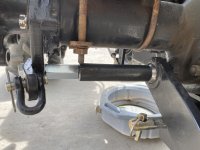
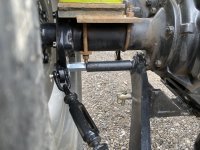
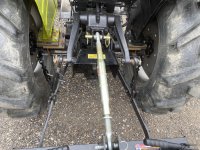
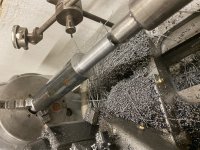
I decided to mess around with the lathe today and built some pins to relocate the 3 link bottom links back in the proper location.
Problem with the way the guy before “fixed” them was the slack adjusters and bottom links weren’t on the same plain. So the slack adjusters would bind up 3/4 of the way up, and be completely loose down low.
I also didn’t have but 50% range of motion on the 3 link.
I basically turned down a chunk of hot rolled bar to match the factory hole in the rear end, then continued with 7/8” for the bottom link to slide over. The outer portion I turned down to 5/8” which was what the internal diameter of the coupling nuts were when I removed the threads through half of them.
I left the other half threaded and drilled out the slack adjuster plates and ran a bolt through them.

Seem to be a viable repair. Time will tell. I figured having the bottom in double shear would be a lot better than the original single shear pin.


A9702C3E-0416-4CD6-A926-E93D527B4B43.jpeg35AF3631-5B97-4A5B-B328-6DAE77262A63.jpegA846AC73-7B79-40CF-90E3-A611BC6552B5.jpegBBD52F5D-C443-452A-9FDD-17CC6DE73249.jpegF5AFEBDC-FD1C-4FAD-986E-296AE69F06A7.jpeg


Best part is Ive regained full range of motion and the slack adjusters remain consistent all the way up and down :)
 
   / New ym240d owner #54  
Those pins look pretty much identical to the factory ones in my 240. I would caution to make sure the bolt is tight each time. If they work loose they either get snapped off or take out chunks out of the hub. Ask me how I know! :)
 
   / New ym240d owner
  • Thread Starter
#55  
Hum. Solid advice!

I used red lock tight on the bolts. Hopefully they won’t go anywhere ����

I would have preferred factory pins, but I doubt I’d find any.
Plus the previous owner welded the broken piece back on the rear end after he broke out the original pin so the threads were all messed up internally. Figures this would do the trick.
 
   / New ym240d owner #57  
Looks very good. Always good to have things in line with the original design. The red locktite should keep the bolts in place.
 
   / New ym240d owner
  • Thread Starter
#58  
I buried the blade in the dirt behind my shop. Enough to stop the tractor in low gear, 1st gear, 4 wheel drive with dif locked.
I’d say if it’ll hold up to that, i should be good.
I will probably avoid pushing anything in reverse though.
 
   / New ym240d owner #59  
Looks great, it is nice to have those tools for repairs like this. Good choice on the red locktite and agree with avoiding pushing anything in reverse. I don't know if it was jimjumper or another member but I do remember the post where someone did take a chunk out of there hub before.
 
   / New ym240d owner #60  
... remember the post where someone did take a chunk out of there hub before.
You might be thinking of me. I ended up replacing the axle assembly complete, because I don't have the lathe etc to make a long pin like JML did.

Photo - housing with chunk torn out. The pin's threads were bad and loose when I bought the YM240 in 2003. I cemented it in with red Locktite and forgot about it. A decade later it worked loose and I didn't notice it - until the backhoe overstressed the pin, when it was likely halfway unscrewed. Thread where I described replacing the axle housing.

JML that's great news that its back together! You're going to love it after you've worked out the other bugs.
 

Tractor & Equipment Auctions

ExMark Vantage 48in Stand-On Commercial Mower (A59228)
ExMark Vantage...
2020 CATERPILLAR 289D3 SKID STEER (A60429)
2020 CATERPILLAR...
17307 (A55853)
17307 (A55853)
Year: 2017 Make: Ford Model: Fusion Vehicle Type: Passenger Car Mileage: 101,691 Plate: Body Type... (A55853)
Year: 2017 Make...
2001 CATERPILLAR 140H VHP MOTORGRADER (A59823)
2001 CATERPILLAR...
JOHN DEERE ROW MARKERS - SET OF STACK FOLD 12 ROW 30 INCH ROW MARKERS (A55315)
JOHN DEERE ROW...
 
Top