My new Jinma

/ My new Jinma #81  
Kernopelli said:
Rob, think there is some kind of restriction on that circuit? Only thing I can think of since it only happens when you curl the bucket. Are the fittings or hoses a smaller I.D on that circuit or maybe there is something in the control valve causing a restriction.
Darryl,
I tend to agree with you since the fel lift and lower and dump show no signs of straining the engine like the curl does. All when the bucket is empty. So it's not like straining under a heavy load reaching the pr setting.
But then again, I don't know for sure so that's why I asked.
 
/ My new Jinma #82  
doxford jim said:
Hi Rob,

I think what you are experiencing with the hydraulics is system relief valve opening, when there is nofurther movement or place for the oil to go to. This in turn would put a load on your engine and may make it momentarily bog down a bit. I believe the hydraulic pumps are geared pumps, therefore positive displacement and the oil has to go somewhere - the relief valve would do the job.

I could be wrong of course, but that is what I believe is happening.

Jim
Jim,
I hear what you say, but as I replied to Darryl, it does it with no load in the bucket and rest of the fel functions are fine.
 
/ My new Jinma #83  
dfkrug said:
I don't quite follow your description, Rob.

I used a DA valve to operate a SA cylinder before. I have since converted
that cylinder (on my concrete mixer) to DA....it was pretty easy. Before
I converted it, I connected the A work port on the valve to the cyl, then
capped of the B port. When I operated the valve, sending oil to the cyl,
it filled up, raising the mixer. To lower the mixer, I moved the valve lever
to other way, which allowed oil in the cyl to return to the tank. The tractor
pump pumped thru the relief valve in the aux valve, which was set about
1500 psi. A bit of engine strain, but for a very short time, while the
cyl contracted. I prefer DA cyls.
Dave, you got it right.
I was doing exactly what you describe, using her DA rear remotes to operate a SA cylinder, except her dump trailer would not lower using that method. Now my friend Scott has the same dump trailer as her, and he did that and it worked for him. So perhaps when empty, there was not enough down pressure for Loretta's to work? I didn't try it with a full load (didn't occur to me) because I'd dumped it already. I can try it to see if that's the issue. Anyway, I'm installing a SA valve with power beyond for the dump trailer.

Anyway if the bkt curl function is slow, and it is not trying to move
something heavy, then I think there is most likely a restriction inside the
valve itself, or a QD connector. Have you checked those? The system
relief valve is most likely opening, but that is not the cause itself because
the engine is straining and the system relief valve is in parallel to the
curl work ports. Normal curl action with no load should be fast with no
engine strain.

I agree with that and the others who have suggested that possibility. I didn't check the QD's for restriction yet though, that is a good idea. I was not ready to tear the fel valve apart, but may have to now that several guys have suggested a blockage (as I suspected).
 
/ My new Jinma #84  
bluechip said:
Jinmas have a relief valve at the 3 point lift. The problems come from installing the loader, using quick connects with check valves, between the pump and the lift box. Usually the loader valve will have a PR valve as well.

If the engine loading is excessive, the PR valve may not be adjusted properly or may not be functioning. But a change in engine RPM will be noticed as the pressure in the hydraulics gets to the PR valve setting.
Chip,
I think her fel valve has a pr in it. My question is this, if the other functions (same valve...same pr) work fine, then why would the curl be the only function showing signs of immediate engine strain with no load in the bucket. That is puzzling me. That's why I think it's a restriction or some debris in the valve affecting the curl only.
Correct me if my thinking is out of line.
 
/ My new Jinma #85  
3RRL said:
So perhaps when empty, there was not enough down pressure for Loretta's to work?

Now you are warm. That is the prob I had with my SA cyl, too. If
you count on weight only to retract your cyl and your dump bed is
empty and fairly vertical, I can see that you may not be able to
overcome the initial friction.

A SA valve will provide a return path for oil with out blocking the other
work port and pumping oil thru the relief. But it does not overcome the
above problem.

When I opened up my SA cyl, I noticed the piston had bi-directional
seals so all I needed to convert to DA was welding a fitting to the
air bleed on the dry side of the cyl. The piston seal does not have to
be very good anyway as that side does little work.

As for the hyd hose QDs, those cause probs all the time when not fully
seated.
 
/ My new Jinma #86  
dfkrug said:
Now you are warm. That is the prob I had with my SA cyl, too. If
you count on weight only to retract your cyl and your dump bed is
empty and fairly vertical, I can see that you may not be able to
overcome the initial friction.

A SA valve will provide a return path for oil with out blocking the other
work port and pumping oil thru the relief. But it does not overcome the
above problem.

There is enough weight for the dump trailer to come down when I plug right into the return to sump though. I got a hose and screwed it into the side of the hydraulic tank with a QD on the other end. What I do is, I use the rear remotes to push the dump trailer up. Then unplug from the rear remote and plug into that return to sump line.
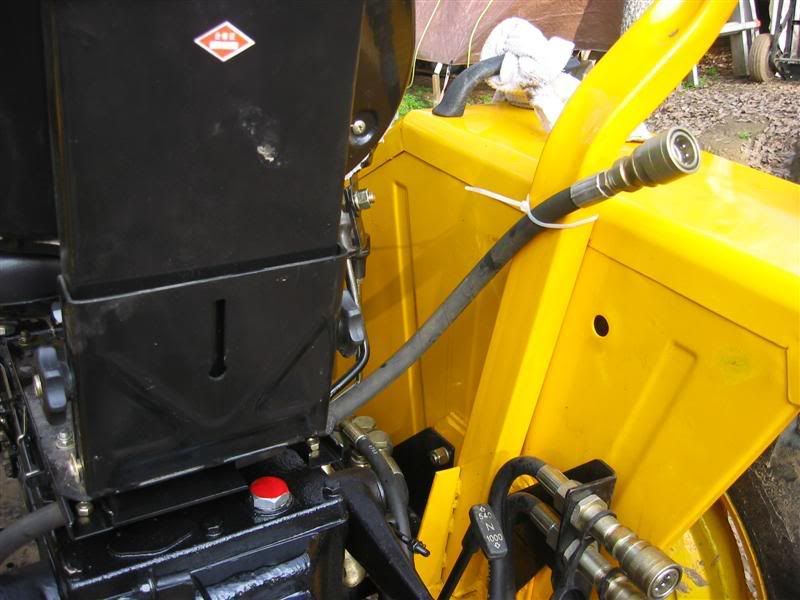
Here's a picture of it. This will all be easier since I already ordered a SA valve for the dump trailer. Once installed, it will be easier to work and be dedicated.

 
/ My new Jinma #87  
Regarding the fel valve... that is a concern of mine.
Not so much that it is jerky and hard to feather, but the curl on it and that it may not be plumbed correctly from the factor. You guys know I'm in favor of using power beyond to power the next valve in line. I know it can be done without PB, but that will sooner or later cause a problem in the system. The valves won't work right and are subject to back pressure they are not designed for. It only has 6 hoses in it and I'm pretty sure it's not the last valve in line....probably the first? I'll have to check all the hose routing.

Also, regarding the pressure relief in the Jinma system. Chip and a couple others said there was a pressure relief in the 3pt valve, so I'm assuming that is correct, right? There is also one in the fel valve and I've seen it. The valve I'm adding for the SA dump trailer also has a pressure relief in it.

Here is my understanding of that ...
Theoretically, the only time you use the hydraulic system to build pressure is when you use a control valve to operate a cylinder or motor. Otherwise, being an open center system, the fluid would would just circulate through. So if all your valves have their own PR in them, you are fine. But that PR inside that valve is specific to that valve only, and ONLY works for the pressure that valve creates, not for the rest of your hydraulic system.... At least that's how I understand it. So if that PR is faulty or not set correctly (too high) then you could dead head the pump anyway.

Is that right?
Or do the PR in the valves protect the whole system? I'm not sure what the answer is ... I'm asking because on my Kama I have a solenoid operated true third function valve. It has only 4 ports in it and no pressure relief valve as far as I know. But when I use the grapples to fully closed or open, the system by passes. You can hold down the button and not get any more closing or opening, even if you hold it down for a while. As far as I know, my Kama does not have a pressure relief valve for the system either. The lines and hoses just go through all the valves that DO have PR in them though. That's why I'm asking if any body knows how the PR in the valves work.

The biggest problem of pumps blowing up comes when those other valves are taken OUT of the system, like disconnecting the fel QD'S, then start the tractor which starts the hydraulic pump. With no pressure relief anywhere now, the system could dead head and ruin the pump. So for those reasons, it's always a good thing to have a pressure relief valve plumbed right after the high pressure line of the pump or before the first valve. But I'm still interested whether or not the PR in each valve protects the rest of the system or not.

If they don't, then why does my grapple bypass? And if they do, then all the valves would by pass at whatever the least PR setting is in that system, right? Personally, I don't know.
Hows that for a question?
 
/ My new Jinma #88  
3RRL said:
But I'm still interested whether or not the PR in each valve protects the rest of the system or not.

If they don't, then why does my grapple bypass? And if they do, then all the valves would by pass at whatever the least PR setting is in that system, right? Personally, I don't know.
Hows that for a question?

The RV in your spool valve and the RV on your tractor both protect the
hyd system, or actually the one with the lowest actuation pressure will.
This is why I always check pressures with a guage after installing anything
new into my main hyd circuit. Often the new valve is set too low, which
robs something else (e.g. FEL) of pressure.

There is another kind of RV found in some valves: a work port relief or
anti-cavitation or shock valve. This would protect ONLY that work port
with the valve closed. Your hoe valves have these.

Finally, do you remember our discussion a few years ago about PTO pump
hyd circuits? THAT kind of circuit has no system relief valve, so you must
have good working and properly set RV on the spool valve.

Each hyd pump in the system makes only one circuit, where oil can go on
only one path, the one of least resistance. (Unless there are 2 paths of
exactly the same resistance.)
 
/ My new Jinma #89  
To isolate the valve from the rest of the circuit, just swap the lines for the curl function, now if it is sluggish to dump, but quick to curl you know where to check, if not, its in the hoses or cylinders themselves, or even possibly a mechancal bind.
 
/ My new Jinma #90  
bluechip said:
To isolate the valve from the rest of the circuit, just swap the lines for the curl function, now if it is sluggish to dump, but quick to curl you know where to check, if not, its in the hoses or cylinders themselves, or even possibly a mechancal bind.
Great suggestion Chip.
Thanks for the insight.
 
/ My new Jinma #91  
Rob, if Bee is like my 284, the pump on mine came loose and ate up the square shaft on the end of the pump. There are two bolts through the front of the engine that attach to the pump. Keep an eye on them. I bought a new pump from Tommy, then took the old one to work and welded and machined a new square on the shaft of the old one. I wanted to get an upgrade pump when I bought the new one and there isn't one available for the 200 series Jinma. Mine really isn't all that slow but faster is always better, right? Anyway, keep an eye on those bolts coming loose. My Koyker FEL has the power beyond on it, I haven't used it yet but plan to in the future. I bought the sleeve (if I can find it).
 
/ My new Jinma #92  
Bill,
I will keep an eye on those bolts then. Thanks for the heads up.
BTW, her hydraulics are pretty fast. I looked at her pump(s) and I thought she had the -314 pump, which I believe was the same specs as what came on my Kama in 2005. What is yours, Bill?
 
/ My new Jinma #93  
Rob, mine is a CBN-E314-200, $179.00 on Tommy's site. Maybe Loretta's is upgraded already from mine. Mine is fast enough like it is but since I had to buy a pump, I tried to do an upgrade and Tommy said that one wasn't available. I think the rebuild kits were $25 when I bought one, I can't remember for sure.
 
/ My new Jinma #94  
Wasn't the input shaft on your pump, splined? The one on mine is a square drive. Maybe 3/8" thick and about 3/4" tall.
 
/ My new Jinma #95  
Bill,
Are you talking about the one on my Kama? Yes, it is a splined shaft. I haven't taken Loretta's off (yet) so I don't know what hers is like.
 
/ My new Jinma #96  
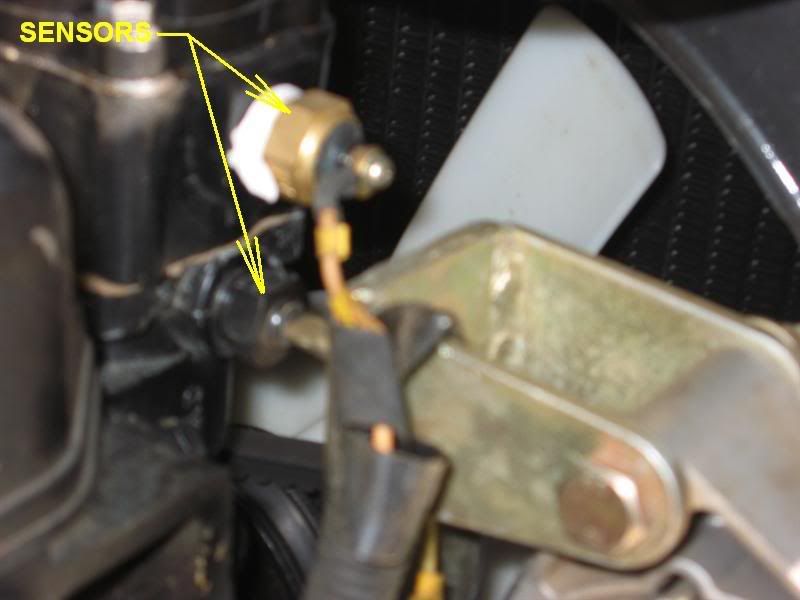
We still have the problem that the temperature gauge is not reading the water temperature correctly... or at least that's what we think. In an earlier post, doing the thermostat repair, we found nothing wrong with it nor with the way it fits. After re-assembling the temperature gauge showed the engine heating up, but it has quit working again.
I showed photos of the 284's thermostat sensors back then and here are a couple new ones.
This tells me she has two of them it seems?


One is on the housing where the radiator hose goes to and the other is below, as shown in the last photo above. It is on the water pump intake. I don't know enough about the sensors and how to check if they work or not? Ronald at Ranch Hand Supply suggested that the Teflon tape might not let the sensor read correctly, so I will try removing the tape to get a better contact.

Another fact is when the engine has warmed up, the top radiator hose and housing is warm (hot) to the touch, but below the thermostat, where the 2nd sensor is located the water pump and engine are noticeably cooler.
So my questions are:
-Why does it have 2 sensors and how do they work?
-Which one should the temperature gauge read?
-How do you check them to see if they are working or faulty?
-Why did it work after I opened it, checked the thermostat and closed it up?
-Do you think it's a bad thermostat (although it worked after re-assembly)?
Any other suggestions?
 
/ My new Jinma #97  
I am not sure why you have two sensors. I am sure my 2003 model has only one. If you remove the wire from one and touch it to ground with the switch on you should see the gauge move.

Chris
 
/ My new Jinma #98  
Thanks for the reply Chris.
Once I see the gauge move by doing that, I'll know the gauge and wiring is good.
But then how could I tell if the sensor is good or not?
Is there a test I can do with an ohm/voltage meter to the sensor itself?
 
/ My new Jinma #99  
3RRL said:
-Why does it have 2 sensors and how do they work?
One for the temp gauge, one for the EGR? Two sending units, and (if I'm right about the EGR) two destinations. That means you should have a 50/50 chance of getting the wires right. Or have you already tried reversing the connections?

//greg//
 

Marketplace Items

2012 John Deere 328D Compact Wheel Loader Skid Steer (A61572)
2012 John Deere...
2024 Bobcat T86 (A60462)
2024 Bobcat T86...
24in pin on excavator tooth bucket (A61307)
24in pin on...
2023 Freightliner Cascadia 116 S/A Day Cab Truck Tractor (A61573)
2023 Freightliner...
1998 CHEVEROLET 1500 LONG BED PICKUP TRUCK (A59905)
1998 CHEVEROLET...
2013 International WorkStar 7400 4x4 Altec AM650 50ft Material Handling Insulated Bucket Truck (A59230)
2013 International...
 
Top