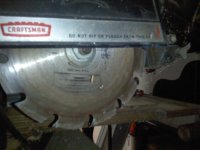
Metal Cutting Saw

   / Metal Cutting Saw #21  
I'm worried about this. I don't know what thickness of metal the metal blades are rated for.

There are round metal cutting blades made for very slow rpm Scotchman type saws. They also have fast rpm saws for aluminum and work very good.
 
   / Metal Cutting Saw #22  
I'm worried about this. I don't know what thickness of metal the metal blades are rated for.

There are round metal cutting blades made for very slow rpm Scotchman type saws. They also have fast rpm saws for aluminum and work very good.

I have a mechanic buddy that has one of those skill type circular saws made just for metal cutting. I know he cuts 1/2 in regularly, but I dont have any ideal as to the maximum thickness he can cut. Please keep up informed of your results. For cutting aluminum, I have another buddy that uses his Dewalt sliding chopsaw, (made for wood), and a regular saw blade (old one) for aluminum angle and thin tube. I back peddle everytime I see him do it, but It seems to work okay .
 
   / Metal Cutting Saw
  • Thread Starter
#23  
We all know common sense isn't as common as it maybe used to be. Sometimes I think a substantial fraction of the remaining common sense in this country is concentrated in the TBN readership. I really appreciate the considered, experience-based comments, especially for this topic, where I know for sure I am pushing the envelope on my own experience.

The blade is obviously the main concern. In coming up with this approach I read a fair amount about other metal cutting saws and blades. Here are the main issues that I identified.

RPM. The Makita 5 3/8 blade is rated at 4600. The DeWalt motor turns at 3425.
Tooth speed. This is a function of RPM and blade diameter. Slower is better for thick mild steel. The range for six of the most commonly available metal saws is 4082 feet/minute (Makita 12" chopsaw) to 7745 feet/minute (Milwaukee 8" skilsaw style). Tooth speed in the Makita/DeWalt application is 4817 feet/min, that is toward the slow end of the range.
Tooth Design. See photo below. The Makita blade uses a carbide tooth that is mechanically locked into the metal blade and also has a very restrictive controlled feed design. And has a lot of negative hook. All three features add to safety.
Binding. I never had the Makita cordless bind, even when cutting 2" x 4" aluminum channel. In the DeWalt application the blade is perfectly square and rigid in relation to the table, so vertical binding is not likely. You can see in the earlier photos that I use a fence on the left side of the cut but not the right side. This eliminates the possibility of horizontal binding.
Self-Feeding. This is a big problem with radial arm saws when used according to manufacturer's directions. That is, if you start the cut with the motor head at the column and pull it toward you through the work. Especially if the saw is the least bit out of adjustment. The blade will try to climb onto the material and jump toward you. This is very demoralizing. After one or two such episodes (30 years ago now), I stopped using the radial arm saw that way. Pushing through wood in the normal (skilsaw) way is much easier and safer. I am sure that goes double for metal.
Heat Buildup. I never experienced this with the Makita cordless including 6" cuts in 1/2" mild steel and 12" cuts in 3/4" aluminum. For intermittent use I don't expect it to be a problem on the radial arm saw.

Specifically on cutting thick stock. The Makita literature, like everything these days, has about 4 pages of "do not" guidance. Apart from specifiying the maximum depth of cut (2"), there is no other reference to material thickness. Clearly it is intended for tubing, light channel, metal roofing, etc. But as others have noted, folks have been using metal blades in skilsaws for thick stock for a number of years.

All things considered, I feel reasonably sure this application is safe for the purposes I intend. Especially with a heavy duty shroud if things go wrong. Will provide an update after the first project, which is cutting out the components of a mechanical thumb for the B21.
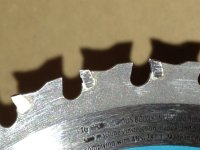
tooth.jpg
 
   / Metal Cutting Saw #24  
Well, I really want to know how it works out as I am seriously considering doing the same setup with my craftsman. Since you have already volunteered to be the guniea pig, I intend to wait and see how well it works for you before I try it. Personally, I think as long as you dont overspeed the blade, and you are using a blade specificly designed to cut metal, as well as use a few other common sense approaches, such as the heavy clamping you have incorporated in your design and not trying to cut to fast, then this type of setup should work. If it works, I want to know how well, if it fails, I also want to know why. I think for any thick stuff I would be cutting, I would probably stick with my plasma cutter or oxy/acet torch and a straight edge. I really would want the radial saw to work properly for cutting compound angles with a little more accuritcy than I can with a torch, not to mention not having to grind.
 
   / Metal Cutting Saw #25  
Common sense says the blade should cut into the wood or steel from the top edge.

On just about all saw cutting machines, if the motor is to the left of the blade, the blade cuts counter clockwise. If the motor is to the right like wood miter chop saws, the blade turns clockwise and throws wood chips to the back. There may be exceptions.

If you use the radial saw motor as it comes from the factory, the blade is cutting from top down when you pull it into the material.

I believe the intended purpose is to pull the saw into the work and sling the wood chips or steel particles to the back.

If you push the radial arm saw blade into wood or steel with the blade turning counterclockwise, you will cut from the bottom up of the material.

If you desire to push the blade, then flip the blade around so the cut is from the top down.

As I said before I use my 14 in Dewalt steel cutting chop saw to cut various thickness.

I am sure it would cut several inches thickness, but I am doing that cutting from top down. I have cut 1 in by 4 in steel with the 1 in steel vertical and it sliced through it fine, and the cut looked like someone had filed the edges.

Even the abrasive saws cut from the top down.

When cutting steel, the work should always be secured real good.

Cutting wood, you can get by with cutting from the underside which is what you are doing as you push.

Just about all saws throw the cuttings to the front.

I know how I cut and I believe it is the right way, but we all have choices.

Having said all that, it is your saw and you can do what you want.
 
   / Metal Cutting Saw #26  
FYI, a radial arm saw is probably the most dangerous tool in your shop. Cross cutting is not the issue. If you turn it to rip DON' T stand in the path of your material. The saw can throw a piece of material 300 mph. My brother was running one in his garage and the 2x he was ripping shot out, almost tearing out his side and the board went through a grille and radiator of his '94 f250 p/u. Be very careful.
 
   / Metal Cutting Saw #27  
That brings up a good point.

Which direction would you rip the wood, using the saw to cut down or cut up?
 
   / Metal Cutting Saw #28  
First thing: get online with the manufacturer and download or purchase an operators manual. That said, I believe it is turning down into the top if the material. That's how it can grab and throw the material. Please be careful with this saw and what is in the path, both directions, of this saw. Please be careful.
You may be able to turn this saw "both" ripping directions. In fact I think you can on all of them. That being the case it's dangerous in both rip directions.
 
   / Metal Cutting Saw #29  
JJ, you cant compare a chopsaw, table saw, or skill saw to a radial arm saw. I dug into the storage to get to my radial armsaw to take this pic. 1229131459.jpg I dont know if you can read it in the pic because of the glare, but it says Do Not rip or plunge from this end. I trust the manufactor on this and have seen the results of ignoreing this advise. Yes the blade is turning in the same direction as it would with a chop saw, cutting from top down, as it appears in this pic, but you actually cut fom the back side of the blade so it is cutting from bottom up. The reason you dont pull a radial saw thru the material is because the saw is running on a rail, back to front and if a saw tooth graps hold on the wood, it will launch the saw toward the operator pretty violently. A chop saw blade is fixed to the motor so it can only be raised up and down, a table saw blade is fixed, but a saw sticking can throw the wood back toward the operator, but not the blade. Nether of those type of saws has the ability to launch the actual saw at the operator, unless something breaks. Pulling a radial arm saw thru the wood is the number one reason people get hurt with this type of saw.
 
Last edited:
   / Metal Cutting Saw #30  
Mud stopper, I tried to say it, but you did a much better job. Thanks. If anyone is reading this, please listen to us and heed our warnings. I like a radial arm saw, but the thing can kill you. Be careful and we can all talk together next year.
 
   / Metal Cutting Saw #31  
As far as the kick back, a lot of saws have anti-kickback apparatus, and it is self explaining. The kickback pawl is on the backside of the blade guard.

My only point is the way the blade cuts into the material.

This excerpt is from a Sears 10 in radial arm saw manual.

The cut is then made by pulling the carriage forward
until saw blade cuts through the work. When the cut
is complete, the saw should be returned to the back of
the radial arm and the switch turned "OFF".

It doesn't say anything about an option to push cut.

Although some of you can and will do it.

I don't intend to argue about this.

There is the right way and your way.

Do what you will. Those broken carbide teeth coming back at you might get your attention.

Totally not true: You said

Pulling a radial arm saw thru the wood is the number one reason people get hurt with this type of saw.

Rules are rules, and if you disobey, you might suffer the consequence.
 
   / Metal Cutting Saw #33  
I read the articles, but it does make things more confuseing. In the pic I posted, off and actual radial arm saw, it plainly says to not cut from one end. On this saw, that end as the saw is in the pic, would be pulling the saw thru the wood. So that means what exactly. Further reading also the point was made that pulling the saw thru the wood could cause the saw to climb out of the wood and more or less, launch like I said toward the operator. Then it went on to say to properly use, you should pull the saw thru the wood, but keep a slight push to hold the saw back. I suppose the push to hold the saw back is intended to keep the saw from climbing and launching, I dont know. What I do know for a fact cause I have done it, pulling the saw thru the wood to make a cut can cause the saw blade to launch dangerously toward the operator. With that said, I also read about the proper type of blade to use on a radial saw would be one with a negative rake. Since I bought my saw used, I dont know what kind of rake the blade has and that could very well be what caused my saw to act like it did. Acting like it did, launching the saw toward me is the very reason I have it stuffed in the back of the shop not being used. I still think it is one of the most dangerous saws I have ever used.
 
   / Metal Cutting Saw
  • Thread Starter
#34  
Two of my brothers-in-law were also contractors in southern California. The three of us didn't agree on much, but we all agreed the radial arm saw was dangerous, and we all three set them aside as soon as the motorized miter boxes came out. And it is dangerous pulling or pushing. The main danger pulling is the "climb up and jump at you" motion. You should have a negative hook blade and everything properly adjusted, but it will still happen if the blade runs into a dense spot or gets a bit pinched in front. The main danger pushing is lifting the workpiece and throwing it and maybe part of you too across the shop. A workpiece clamp is good to have either way. As for ripping, I only tried it once, and it was so scary that I bought a table saw the same day. Hope all have a very happy New Year.
 
   / Metal Cutting Saw #35  
J_J has a lot of the right answer: the antikick back pawl assembly. Secondly get the instructions, read and practice when the saw is turned off to gain a little experience, but last, put it out into the street and let the garbage truck take it or run over it. Serious
 
   / Metal Cutting Saw #36  
I don't disagree with much of anything that's already been said, but I'd like to add -

I've been using a Sears 12" commercial radial saw off and on since 1973, and have only had a couple of slight scares in the process - both were "climb-overs", both could have been avoided if I'd NOT gotten in a hurry, NEITHER resulted in any broken/bleeding body parts.

Climb cuts need to be taken slow enough to let the blade do its work, or the saw WILL try to climb the material. Things to keep this from happening are a sharp blade with negative hook, NOT trying to pull (or allow the saw to come out on its own) faster than the blade can cut.

A properly maintained saw will have a carriage stop at the end of the arm so it can only travel so far.

One of the best pieces of advice I ever got (don't remember where, but NOT in the manual) is "NEVER cross your arms" - just think about what would happen if you were trying to hold the RIGHT end of a board with your LEFT hand and the saw kicked back.

Before I got a table saw, I would occasionally rip with the radial - I only tried it ONCE without adding a full face shield and leather welding jacket to the process - it wasn't that it was so scary, just irritating having all that crap blown back in yer face - still, haven't used the RAS for ripping since the table saw arrived.

Speaking of which, ask any 10 table saw owners to show you 10 fingers without having to hold at least ONE up TWICE - unless they ALL are rich enough to buy a SawStop, there's a pretty good chance it won't happen.

Granted, I'm probably one of the most "****" guys I know, and I have friends that I wouldn't let use the RAS - sooo, like anything, they're not for everybody. I'm personally gonna keep mine, which is why I bought a second one cheap to mod for a "radial plaz" instead of using the one I already had.

I think the bottom line is this, and I try to live by it (since I'd like to live a while longer) - even a simple screwdriver can KILL you if you don't hang your "stupid" hat at the door when you come in the shop - add power tools to the mix, and you can get it over even quicker.

And no, I'm NOT calling anybody stupid, nor am I recommending you use any tool you don't feel safe with. Only that ANY tool is safer and works better if you do your best to understand its correct, proper and SAFE use and don't get distracted EVER, no matter WHAT tool you're using.

Wishing all a happy and SAFE New Year... Steve
 
   / Metal Cutting Saw #38  
I have a Dewalt that is a vicious saw. When I bought it the dealer took his and very slowly cut 1" plate. I've cut /2" and this puppy is a bad...!
 
   / Metal Cutting Saw #39  
BukitCase, I own a table saw and Have used it to build the cabinets in the house I live in now, as well as the house I used to live in. I use it all the time on projects. I still have all ten fingers, but I really think its more thumbs than fingers sometimes. I actually bought the RAS because I thought it would make cutting those long cross cuts and angles a little more easier. This is the first RAS I have owned or used, and most likely will be the last. The thought of making a metal saw out of it sort of captured my attention, but I really think your ideal of adding a plasma cutter to the saw is probably a better ideal. Right now, I dont have any plans to do anything with the saw. I intend to see the end results of your's and the OP conversions, before I do anything. I still believe to cut metal with a saw blade, it will probably be safer to push the saw thru the metal instead of pulling it because of climbout, and I dont think making long rip cuts is a good ideal at all. Pushing the saw and supplying adequate clamping to keep the metal on the cutting bed should work. One thing that might help would to be make a skid, like on a skill saw, that could be adjusted to rest on top of the metal as its being cut. This should keep the metal from lifting off the saw table and make the RAS work similar to a skill saw on a rail.
 
   / Metal Cutting Saw #40  
A wonderful idea, I've had one for years, didn't know what to do with it, now I do. My local welding supply had a 10" blade for cutting mild steel meant for abrasive saws. I wonder how it would work?
 

Tractor & Equipment Auctions

iDrive TDS-2010H ProJack M2 Electric Trailer Dolly (A59228)
iDrive TDS-2010H...
2008 Freightliner Allegro Bay Class A Motorhome (A59231)
2008 Freightliner...
2020 CATERPILLAR 306 CR EXCAVATOR (A60429)
2020 CATERPILLAR...
Bigfoot Plastic Baler (A57148)
Bigfoot Plastic...
2006 CATERPILLAR 320CL EXCAVATOR (A59823)
2006 CATERPILLAR...
2019 Dodge Charger Sedan (A59231)
2019 Dodge Charger...
 
Top