Metal Cutting Saw

/ Metal Cutting Saw #1  

downsizingnow48

Elite Member
Joined
Jul 29, 2013
Messages
2,749
Location
Sacramento, California
Tractor
Kubota B21
I've been using a Makita cordless metal saw (5 3/8") for a while, it works great. Clamp a speed square to run against and get a good cut every time. But I wanted a setup similar to a sliding miter saw, to make repetitive accurate square cuts on fairly wide stock without a lot of setup. Didn't see anything on the market. Wood cutting miter saws spin too fast. Dedicated 14" metal saws such as the Makita and Milwaukee are limited to about 4 1/2" width of cut. And costly. Same goes for horizontal bandsaws. I did see one metal cutting miter saw advertised, but it was a bit pricy and I couldn't find one to look at. Didn't want to buy it sight unseen, especially since it didn't seem to have a sturdy clamping mechanism. I have a Makita 14" abrasive saw, which is fine for many purposes, but it is noisy, dirty, hot, and none too accurate.

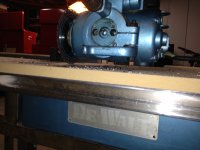
I used to have an old MBC DeWalt radial arm saw, but gave it away a long time ago, shortly after I bought my first sliding miter saw. The miter saw was a lot more useful for the work I was doing at the time. After considerable thought I decided the DeWalt would have made a decent metal cutting saw. The motor turns at about 3400 rpm vs 3600 for the Makita cordless. It is built very well and has adjustments for everything. It has a 5/8" arbor so could use the Makita or other modern metal cutting saw blades. It took a while but I found a 1952 DeWalt MBC in the back room of a theater production company, used for making sets. It is on a nice 9 ft welded stainless steel table, perfect for my intended use. Everything was out of adjustment and sloppy, and the ways hadn't been cleaned for years, so it didnt cut at all well and nobody wanted to use it. But it was essentially in new condition. I don't know if the old DeWalts could ever wear out in normal use. Anyway I got the saw and table for $120. About the price of a tank of gas. After cleaning and adjustment, and with a good Freud blade, it makes glass-like perfectly square cuts in pine and hardwood.

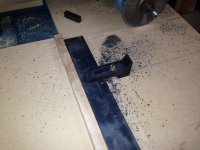
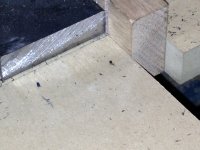
I made a few changes to set it up for metal cutting. These are shown in the pictures. First a continuous sheet of good quality 3/4" MDF, screwed to the metal frame to make the front table. Second, a strong clamping arrangement at the back of the saw to hold the back table and fence solidly. Third, an arrangement similar to a milling machine for clamping the work near the blade. The clamping screw goes through the welded metal frame so it does a good job of clamping. The pictures show a length of 1/2" x 4" mild steel. The saw cuts quite smooth and fast, with little vibration, although from the cut it looks like I need to fine-tune the "heel/toe" of the blade a bit. With the 5 3/8" Makita blade the saw has about 7/8" clearance under the motor, plenty for me as I can't imagine needing to cut steel thicker than 1/2". The Makita blade is very thin, minimizing chips. The chips seem to stay on the table for the most part although I will fabricate some kind of collector.

I'm posting this because I have read a fair number of threads on cutting metal. This is an option that I haven't seen written up, although I am sure I am not the only one to give it a try.
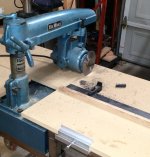
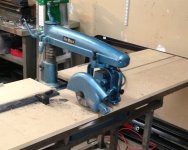
saw1.jpgsaw3.jpgsaw6.jpgsaw5.jpgsaw4.jpg
 
/ Metal Cutting Saw #2  
Just a heads up, watch the blade as it might throw teeth.

Metal cutting blades for steel are mostly made for slower saws than wood cutting saws, like the Rage series.
 
/ Metal Cutting Saw #4  
Perfect! Just a heads up for others then :)

That was a fantastic price for that saw. Not sure if I'd have the balls to use a radial arm saw on steel though, but I'm extra cautious.
 
/ Metal Cutting Saw #5  
Great find... I'm jealous and only a 100 miles away!
 
/ Metal Cutting Saw
  • Thread Starter
#6  
Actually the makita blade is rated at 4500 rpm. So the DeWalt application has a substantial margin of safety.
 
/ Metal Cutting Saw #7  
wonder what rpms the craftsman 10in radial saw turn. Got one setting in the basement I bought a few years ago and have never used. Uhm, need to do a little investigating.
 
/ Metal Cutting Saw #8  
Makita makes a 7 1/4" metal cutting blade that I have been using for about 15 years in a wormdrive skilsaw It has the higher RPM rating like you would need and it would give you a little more capacity for cutting tube or channel stock with your saw. Bosch also make a similar blade in the 7 1/4" size both have the 5/8" round arbor hole or the diamond knockout. In my skilsaw it is really portable and can be just as accurate as cutting plywood or solid lumber and almost as fast.
 
/ Metal Cutting Saw
  • Thread Starter
#9  
Thanks for suggestion on blades. For the radial arm saw I started out with the small makita blade because small diameter and thin width puts least stress on 60 year old DeWalt motor. As you say the 7 1/4 blade will be much more capable for tubing angle channel. will probably change to that now I know the setup works.
 
/ Metal Cutting Saw #10  
I am just wondering how are you keeping your saw from digging in the metal and launching the blade toward you. I am supposing that you are pushing the blade thru the metal and not pulling to make your cuts.

Makita 7 1/4 blade is rated for 3600rpms
 
Last edited:
/ Metal Cutting Saw #11  
Unless that metal cutting blade has a significant negative hook I sure wouldn't pull it into the stock. By pushing it you would have the same condition as using the blade in a Skill Saw.

As has been stated, it's possible for the teeth to break 'even with wood cutting' so I hope the lack of guard was just for photographic clarity.
 
/ Metal Cutting Saw
  • Thread Starter
#12  
All useful important points.
On the guard, yes I use it. I have been using wood saws of every description much of my working life and still have all original parts in decent condition. Saw safety for me is Rule 1, 2 and 3. For this application, now that I now it works, I will make a full shroud to contain chips and possible loose teeth.
On the blade, the Makita has significant negative hook and also a controlled feed design. So it is relatively easy and safe to use. Probably all metal cutting blades are similar.
On push or pull. I push the blade. Until now, I haven't used a radial arm saw in probably 20 years. But in the old days on wood, I pushed it through the work rather than pull. I don't know why the manufacturers instructions were to pull the blade. It is much easier and safer to push in the usual way. That is true even if using a proper radial arm saw blade for wood, which should have zero or negative hook.
Another point on saw setup. Radial arm saws were always a bit finicky. All adjustments need to be well snugged up to avoid jumping, chattering, wandering. That goes double for metal cutting. I set it up a bit tighter than I would have for wood. For anyone considering this application I would recommend Jon Eakes book. He provides detailed setup instructions and photographs for DeWalt, Rockwell, and Craftsman radial arm saws. It costs about $15 on his website and is worth every penny. Radial Arm Saws

Again, thx for feedback.
 
/ Metal Cutting Saw #13  
Another concern I have is heat build up when cutting metal. Never having used a metal cutting circular saw, I am totally ignorant in this reguard. I know even when cutting wood that blades can heat up. I am also interested in how well the radial saw works cutting compound angles in bar or tube stock. I think my craftsman will cut lumber upto about 16-18 inches wide and is capable of cutting long angles and bevels at the same time. Is this capability retained when cutting metals? I realize I will lose some thickness cutting because of the smaller dia blade, and I think I read that the Makita blade was rated for a thickness cut of 2 1/2 in ferrous metals, way thicker than I would ever cut in bar stock, but with working with rd or sq tube????
 
/ Metal Cutting Saw
  • Thread Starter
#14  
I've used the Makita cordless on various shapes and thicknesses, never noticed heat buildup. For intermittent use I wouldn't anticipate an issue. On compound cuts -- I don't intend to use the radial arm saw for anything other than simple flat cuts in metal. It should be OK for simple miter cuts too, although I have never needed to cut a miter in metal. I wouldn't attempt compound cuts in metal. For wood, my 15 year old Bosch sliding bevel miter saw does perfect compound cuts, and never needs any setup, so I wouldn't use the radial arm saw for that either.
 
/ Metal Cutting Saw #15  
I sure thought whether you pushed or pulled a radial arm saw is whether the blade rotation is rotating toward you for normal radial saw. The saw should bite into the material as you pull..

If you push a radial arm saw, you have to reverse the blade.

Either way, I would lock the material down and pull or push real slow.

My 14 in Dewalt metal cutting saw drops down into the metal and slings the pieces to the back, which means the blade is cutting from top down.
 
/ Metal Cutting Saw #16  
I sure thought whether you pushed or pulled a radial arm saw is whether the blade rotation is rotating toward you for normal radial saw. The saw should bite into the material as you pull..

If you push a radial arm saw, you have to reverse the blade.

Either way, I would lock the material down and pull or push real slow.

My 14 in Dewalt metal cutting saw drops down into the metal and slings the pieces to the back, which means the blade is cutting from top down.

With a Radial arm saw, I think if the blade took a bite as it is pulled into the material, you would face a real danger of the blade getting a bite and launching violently toward the operator. I have seen it happen with wood, pretty sure it could be worse if cutting metal. Pushing the blade thru the material would have a lifting effect on the piece being cut, which I assume the reason the OP added extra heavy clamping to his radial saw. I think the lifting effect can be minimized with proper cutting depth setting of the saw, just like adjusting cutting depth with a circular saw. I dont think you would have to reverse the blade but I'll wait on the OP to verify how he mounted his blade. With a chop saw like your 14in dewalt, or my Makita for that matter, the material is securely clamped to the saw table and the blade is fixed so that it can only go up and down. On a Radial, the saw is fixed for depth of cut, ( it is adjustable up and down), but the saw travels on a rail to transverse across the piece being cut. With 18inches of travel, thats a lot of room for the blade to jump if it was to get in a bind. I havent tried cutting metal with a radial saw, but I am pretty certain if I do, I will be pushing the blade thru the material and not pulling.

There is another thread on here somewhere where they where using a radial saw to mount a plasma cutter in place of the saw. I am going to look for that thread. I think the plasma cutter ideal might be a safer way to make the cuts than a saw blade.
 
/ Metal Cutting Saw
  • Thread Starter
#17  
Very true. Keeping the material locked down tight is important. One of the pictures shows the milling machine clamp I use. Tightening up all the adjustments of the saw also important. No movement in the material, no movement in the saw. Then a slow steady cut into the material.

If you start a radial arm cut with the motor head out at the end of the arm, close to you, and push away from you toward the column, the blade rotation and cutting action in relation to the material is the same as a sliding miter saw or skilsaw.
 
/ Metal Cutting Saw #18  
Mudd, I've not built one yet - so far, it's just a brain fart and a sketch, although I've made some build notes in a separate file.

Right now, it's on Jim Gherkin's compressor thread starting here

http://www.tractorbynet.com/forums/welding/294946-i-am-looking-air-compressor-11.html
at post #105 -

but I'll start a separate, appropriately titled thread in Welding forum sometime soon (not sure when I'll get started on the actual build, there will likely be others ahead of me til I get a couple other projects out of my face but I'll start the thread so it's easier to find... Steve

Oh, I'm also considering a higher speed rated metal blade for the same saw, if it doesn't hold up I'll only be out the price of the smaller blade, instead of several hundred for a saw and $100-150 for 14" blades.

One plus if the saw blade holds up - it's nearly impossible to cut a 45/45 notch out of square tube on a CHOP saw without cutting too deep or not deep enough - with a radial, you could set a 45 deg. bevel and then reverse the piece - then when you bend the piece, you'd have a smooth outer corner with only 3 sides welded - This would have the added benefit of leaving you a "pre-made gusset" from the piece that's removed...
 
/ Metal Cutting Saw #19  
See what you get for hijacking a thread on air compressors. And all this time I thought you had already got your radial plasma cutter built. LOL

Anyways, I did find this vid on Utube, re-purposed radial arm saw - YouTube of a radial saw cutting metal. They used an abrasive blade instead of a metal blade. Also found a radial converted to a cnc router, but didnt save the link.
 
/ Metal Cutting Saw
  • Thread Starter
#20  
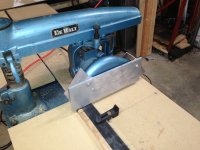
Here is an update showing the blade shroud I put together this morning. An aluminum plate covers the open operator side of the guard. It is carried on studs attached to the original guard. The studs make use of existing 10-32 threaded holes probably intended for a lower guard of some kind. The shroud can be adjusted up and down and rotated to suit the work. The side plate carries two guard extensions front and rear, made from aluminum channel. They can also be adjusted to suit the work. With the shroud in place, chips stay under the shroud or go out the front. A few drop out the back at low speed. Now that this essential safety element is in place, I can start to use the saw as planned, for flat wide steel and aluminum. Thanks for various comments focused on safety, I appreciate that.

shroud1.jpgshroud2.jpg
 
 
Top