Kubota L4330 - Loader bolts missing / threads mashed / stripped threads

/ Kubota L4330 - Loader bolts missing / threads mashed / stripped threads #21  
With careful installation and use they are a strong and viable repair. They demonstrate well in the lab and other situations where assembly is well controlled. Their nature of "no inherent structural form" is much more demanding of this than are threads in parent metal.

Working during assembly and disassembly with slight offsets, misalignments, dirt, dings in the bolt, etc can easily damage the 1st thread or two, or cause binding at some point down in the hole to spin and unseat the threadform. The repaired hole is then in jeopardy and very likely to surprise you later - maybe trying to go out or in with the bolt. The helicoil needs replacement and youre likely working thru a hole that is too small to replace it thru. A conventional bolting situation into parent metal is more durable, tolerant of much greater damage, and easier to correct promptly [often by just firmly enforcing the original correct lead in with an undamaged hi grade bolt lubed with moly].

Preserving this real world advantage, even greatly widening it is often easier than you might think. Making use of pitch crossovers within or between sizes in the US or metric, or the US and metric systems can allow this. Just go to the next bigger bolt with same pitch. Between system conversions match ~ exactly at 20tpi [1.25], 16 [1.5], 10 [2.5]. ... So you can find cases that allow you to pilot into the original helix with a slightly larger std tap. Some are; #] 1/2 x 20 into 12 x 1.25M, #] 7/6 x 20 into 10 x 1.25, #] 3/4 x10 into 18 x 2.5M, #]12 x1.25M into 7/16 x 20, #] 10 x 1.5 into 3/8 x 16 ...

Going larger, and hence more rigid is good as a rule in the service we are dealing with here. Some cases, such as where thermal expansion affects preload, you do not want to force rigidity in place of compliance offered by the original bolt size. Here, use of a helicoil into a usually softer more mobile metal like aluminum preserves compliance and extends the threadform to engage enuf of the parent metal for good strength. If helicoils ever can be universally deemed good it is in this type of application involving weaker metals.
larry

Nice to know.
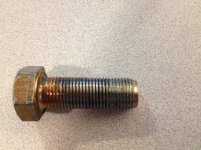
 
/ Kubota L4330 - Loader bolts missing / threads mashed / stripped threads #22  
The reamer and tap for preparing a hole to receive a helicoil is several inches long and is generally not suitable for blind holes. A common application for helicoils is renewing spark plug threads, which are through-holes. A sizing reamer first pilots on what's left of the old threads, and reams out the hole. The next section of the tool taps the new threads using the end of the reamer flutes to guide and center the tap. All of this takes a tool that for a 16-19mm bolt size would be about 4" or 5" long, too much for a blind hole that's likely only 2-1/2" deep, if that.

Here's a slightly different idea that builds on other posts here:

To take full advantage of the existing holes, the threads can usually be extended somewhat. This is because the original threads are not fully formed for the full depth of the hole. Taps are tapered so in blind holes they leave a full diameter or more of incomplete threads. Machinist have a special tool called a "bottoming tap" that can be turned into a threaded hole to finish the incomplete threads at the bottom of the hole. Then a full length bolt can use all the threads, helping solve the problem. The bottoming tap may need to be guided and/or carefully advanced, but it will work much better than trying to oversize the whole thing from scratch. Best to have a machinist look at this with you.

Another thing I'd mention - be real sure of the diameter and thread pitch of any taps and/or new bolts you use. Take a bolt out that hasn't given any problems and carefully compare the size and thread pitch. Some bolts on my tractors are 1.25 mm pitch, others are 1.5 mm, even though they are the same diameter. They look the same at first glance and can create a real mess if mixed up. You might even find that someone has forced a mismatched bolt into a hole already.

90% of the heli-coil inserts we use are in blind holes. Normally we just have a local machine shop come in and install them since we are too busy and but all of our repair kits come with bottoming taps. The biggest problem we have with blind holes are people using bolts too long and when they tighten them up it mushrooms the end making it very hard to remove.
 
/ Kubota L4330 - Loader bolts missing / threads mashed / stripped threads
  • Thread Starter
#23  
Thanks everyone.

My bolts are only 1.75" long, I took a picture but at my work I am not allowed to access tinypic or sites to upload pictures. The threads in the center of the bolt are flattened.

The bolts are also 8.8 which I am told by my ex-kubota dealer are grade 5 bolts, not grade 8.

I agree with your comments, longer bolts could and should have been used from the start.
I will try the tap / hardened bolt idea first for the M16 by 1.5 and see if I can save what I have with out having to drill out to M18 size.

The holes are not thru holes, looks to me like the loader bolts to the engine or a large casting that is bolted to the engine.

Thanks everyone.
 
/ Kubota L4330 - Loader bolts missing / threads mashed / stripped threads
  • Thread Starter
#24  
bolt kubota.jpg

I tried uploading picture of the bolt that I took out - this one is not as bad as the others.
 
/ Kubota L4330 - Loader bolts missing / threads mashed / stripped threads #25  
I had a similar experience with my Kioti DK40/KL401 loader. Discovered one bolt missing and another one or two very loose. The loose bolts had some thread damage as I recall. I got a few replacement bolts from the dealer then gently retapped the threads in the block. I think mine was M18. I then simply reinserted the new bolts, torqued to spec and used medium strength Loctite. No problem in the past three years.

Pretty sure the problem was related to installation and my failure to check tightness each year. It is now part of my oil change drill.
 
/ Kubota L4330 - Loader bolts missing / threads mashed / stripped threads #26  
View attachment 323614

I tried uploading picture of the bolt that I took out - this one is not as bad as the others.

New looking bolt with lots of motion. We really need to identify the problem with your loader setup. If it was only that it was never tightened then putting back everything truly tight will cure it unless parts have been bent because of it. If its poor fitment or missing braces it could be an entirely different or only a compounding problem source. Poor fitment adds up to the same thing as not tightening. The interfaces must fit to each other neutrally so that they are clamped by all the bolt tension rather than squeezed toward each other for the 1st portion of tension. Your assembly may have been hanging on the bolts instead of being clamped by them. -- It looks new. Who did the assembly and how many hrs is on it? If a dealer, or Kubota, did that a few hrs ago you should be dealing with them.

Unfortunately, going up to 18mm is a huge change from your 16mm. 11/16 x 16 and M17 x 1.5 are standard threads but there doesnt seem any demand for bolts so not readily available.
larry
 
/ Kubota L4330 - Loader bolts missing / threads mashed / stripped threads #27  
.......If helicoils ever can be universally deemed good it is in this type of application involving weaker metals.....
I believe Porsche routinely used helicoils (or similar threaded inserts) for the spark plugs in their aluminum heads for years - maybe still?
 
/ Kubota L4330 - Loader bolts missing / threads mashed / stripped threads #28  
View attachment 323614

I tried uploading picture of the bolt that I took out - this one is not as bad as the others.

Much better than I'd hoped.... Movement of the loader mount but not much damage from the engaged portion of the thread. And it looks like the bolt didn't even back out much - which is what I'd feared. This is very good so far. From the looks of that bolt you may have caught the problem in time and maybe no lasting damage. If the others don't look too much work just clean out the threads in the block (see previous message), install new bolts, torque well, and continue.
rScotty
 
/ Kubota L4330 - Loader bolts missing / threads mashed / stripped threads #29  
I believe Porsche routinely used helicoils (or similar threaded inserts) for the spark plugs in their aluminum heads for years - maybe still?
Wouldnt doubt it. Plugs threaded into aluminum should be done with a coating of anti sieze on threads. Cant trust everbody to do it so put a steel insert in. I thot case serts/keen serts/time serts were used for this mostly because they have a solid wall and are more difficult to damage when installing the plug. May not be room for the "serts" in Porsche heads. Helicoils are smaller OD. :confused3:
larry
 
/ Kubota L4330 - Loader bolts missing / threads mashed / stripped threads #31  
The damaged bolt pictured may not be representative of the more damaged bolts, BUT it does present the possibility that threads furthest into the holes may not have been in use with the current length of bolts used from the factory.
So, again I would want to know what is the maximum bolt length is that would fit the existing holes and see if that length bolt will screw into EACH hole until it has reached maximum or very close to max depth. I would do this without the loader bracket being in the way while 'testing' your easiest fix.
I would put aside all the theory about helicoils, machinists, etc., and focus on what exists to work with on the machine. Bottoming taps are a useful tool for this situation.
If using the existing holes with longer bolts of the same diameter, pitch, etc. becomes unrealistic, THEN I'd look at the myriad options presented in this thread.
I'd spray each hole with something like Brakleen and then dry with compressed air, inspect each hole and access the damage on an individual basis, then proceed, working my way up from easiest to most damaged to give you practice in technique. Clean the tap frequently and check progress. Oil the tap threads frequently too.
 
/ Kubota L4330 - Loader bolts missing / threads mashed / stripped threads #32  
Yeah. Thats the kind of insert Id go to if there was not a close upsize bolt I could rethread the casting to take directly. ... Those solid wall inserts are not generally a high grade steel. Not really necessary even with a Gr8 bolt if you have 5 or 6 [coarse] or 7 or 8 [fine] threads engaged, but Id sure like to see em in Grade 5 equivalent steel.
larry
 
/ Kubota L4330 - Loader bolts missing / threads mashed / stripped threads #33  
I would buy the correct size tap and try to repair the threads. Make sure you get a bottoming tap. When you run it into the hole you can see how deep the threads go so you'll be able to tell if you can go with a longer bolt.
 
/ Kubota L4330 - Loader bolts missing / threads mashed / stripped threads #34  
I would buy the correct size tap and try to repair the threads. Make sure you get a bottoming tap. When you run it into the hole you can see how deep the threads go so you'll be able to tell if you can go with a longer bolt.
While a bottoming tap will be needed to get full threads close to the bottom of the hole you usually will go with a plug or spiral point tap first. These have a more tapered tip to spare the tap stress of cutting the full thread abruptly. Then you follow that with the bottoming tap to complete the last partially cut threads left by the tapered tap. Best to use high speed steel taps. They are agood bit tougher to make breakage much less likely.

Scottys method of chasing and reforming damaged threads is meant to avoid cutting excessive metal from the deformed threads, leaving a more original hole. A strength class 12.9 socket head capscrew would be applicable here. Regardless -- taps or thread reforming -- a good feel for the job variables is priceless and unfortunately is near impossible to impart to one who has little or no experience. Tapping with good taps is the most straightforward.
larry
 
/ Kubota L4330 - Loader bolts missing / threads mashed / stripped threads #35  
........ Regardless -- taps or thread reforming -- a good feel for the job variables is priceless and unfortunately is near impossible to impart to one who has little or no experience. .....
larry

I agree. This thread seems to have given birth to two different conversations. One is on how "Nvr-Enuf" should best go about repairing his loader mount, and the other conversation is on the best way to repair internal threads damaged beyond repair. Judging from the picture of the bolt in message # 24, I'd say that the original loader bracket mounting problem seems near to be solved.

But we still have a ways to go on the subject of tapping and thread inserts. No matter which insert is chosen, it seems that tapping is the skill that is needed most. So I've been thinking about how to teach tapping. Hopefully without all the mistakes it took me to learn it.

I also agree with Spyderlk that tapping it is all about "feel"; after some 50 years I've messed up enough threads to finally almost become passable with my tapping. Although I messed up one hole in a batch of custom seat brackets in 1/2" mild steel just a week ago. Still learning, and at the same time struggling with how to teach it. Best way is probably to watch someone who knows how. Better make that someone other than me... :)/

Lacking a handy teacher, if it were me trying to teach myself I'd try tapping some coarse-threaded through-holes first into some aluminum, then into mild steel, and finally into hi-nickle cast iron block material. That would be very easy material progressing do darn hard. Using material as thick as the tap will do. Then go back and do the same three metals again but with blind holes....always feeling for the importance of keeping it straight, lubed, and how often to backing out & clean chips.

To start I'd stay under 1/2" diameter thread just because that size is about the upper limit for easy enough hand tapping in hard material while still being able to learning to "feel". And I'd do my learning with the tap vertical and maybe use some sort of guide to hold things perpendicular. A square block with a tap-diameter size clearance hole drilled through it is priceless for that.

After a go at those threads and materials, I'd either do the same with fine threads, or more likely get impatient and move directly to doing the same materials but with bigger taps in the 3/4 & 1" diameter range - those being sizes most likely to be used to mount loader frames to engine blocks. These big taps require a whole different feel because of the pure muscle needed to turn 'em.
Luck, rScotty
 
Last edited:
/ Kubota L4330 - Loader bolts missing / threads mashed / stripped threads #36  
I agree. This thread seems to have given birth to two different conversations. One is on how "Nvr-Enuf" should best go about repairing his loader mount, and the other conversation is on the best way to repair internal threads damaged beyond repair. Judging from the picture of the bolt in message # 24, I'd say that the original loader bracket mounting problem seems near to be solved.

But we still have a ways to go on the subject of tapping and thread inserts. No matter which insert is chosen, it seems that tapping is the skill that is needed most. So I've been thinking about how to teach tapping. Hopefully without all the mistakes it took me to learn it.

I also agree with Spyderlk that tapping it is all about "feel"; after some 50 years I've messed up enough threads to finally almost become passable with my tapping. Although I messed up one hole in a batch of custom seat brackets in 1/2" mild steel just a week ago. Still learning, and at the same time struggling with how to teach it. Best way is probably to watch someone who knows how. Better make that someone other than me... :)/

Lacking a handy teacher, if it were me trying to teach myself I'd try tapping some coarse-threaded through-holes first into some aluminum, then into mild steel, and finally into hi-nickle cast iron block material. That would be very easy material progressing do darn hard. Using material as thick as the tap will do. Then go back and do the same three metals again but with blind holes....always feeling for the importance of keeping it straight, lubed, and how often to backing out & clean chips.

To start I'd stay under 1/2" diameter thread just because that size is about the upper limit for easy enough hand tapping in hard material while still being able to learning to "feel". And I'd do my learning with the tap vertical and maybe use some sort of guide to hold things perpendicular. A square block with a tap-diameter size clearance hole drilled through it is priceless for that.

After a go at those threads and materials, I'd either do the same with fine threads, or more likely get impatient and move directly to doing the same materials but with bigger taps in the 3/4 & 1" diameter range - those being sizes most likely to be used to mount loader frames to engine blocks. These big taps require a whole different feel because of the pure muscle needed to turn 'em.
Luck, rScotty

Some of you guys are obviously very experienced machinists. Most of us however are simply guys with tractors, not machine shops, and we are limited pretty much to field repairs unless we turn over the project to a dealer. My experience with the almost identical bolt backing out problem on my loader was that a good enough repair could be made with Harbor Freight metric taps, a new OEM bolt and a few dabs of Loctite.

While that equivalent of a bailing wire repair may be scoffed at in water cooler discussions by trained machinists, I do think it is important to let the OP (and others) know that "good enough" fixes are possible without prior experience (I had to go out and buy the metric taps and blue Loctite in my case). Even more important, it is critical to publicize the root cause of these problems: failing to check bolts regularly.

You machinists are helping to educate us but it can be a bit intimidating to think that one needs to spend a week or two practicing before trying to clean out a simple bolt hole with a tap. Common sense and using limited force would seem perfectly adequate preparation IMO. And of course, an ounce of prevention....
 
/ Kubota L4330 - Loader bolts missing / threads mashed / stripped threads #37  
SNIP.........You machinists are helping to educate us but it can be a bit intimidating to think that one needs to spend a week or two practicing before trying to clean out a simple bolt hole with a tap. Common sense and using limited force would seem perfectly adequate preparation IMO. And of course, an ounce of prevention....

Well said. That's just the point I was trying to make....although you made it much better and thanks for being so forceful.
I agree completely that cleaning out a simple bolt hole with either a new tap or using a hardened bolt with some slots cut into it is easy and usually good enough. It's also always the first thing to try. I do that most times too. Check my back messages here.

It's a completely different thing when we start talking about drilling out existing threads so that we can tap an oversize - horizontally into a cast steel! - that I gotta point out doing that is not trivial. In fact, there is a chance it won't be any improvement. At least not the first time done.
rScotty
 
/ Kubota L4330 - Loader bolts missing / threads mashed / stripped threads #38  
I agree. ... I also agree with Spyderlk that tapping it is all about "feel"; after some 50 years I've messed up enough threads to finally almost become passable with my tapping. Although I messed up one hole in a batch of custom seat brackets in 1/2" mild steel just a week ago. Still learning, and at the same time struggling with how to teach it. Best way is probably to watch someone who knows how. Better make that someone other than me... :)/

Lacking a handy teacher, if it were me trying to teach myself I'd try tapping some coarse-threaded through-holes first into some aluminum, then into mild steel, and finally into hi-nickle cast iron block material. That would be very easy material progressing do darn hard. Using material as thick as the tap will do. Then go back and do the same three metals again but with blind holes....always feeling for the importance of keeping it straight, lubed, and how often to backing out & clean chips.

Luck, rScotty
:thumbsup: Yeah. And then we have the issue of retapping a damaged hole. This can range from trivial to catastrophic. Getting a fluted tap to start in the old thread can be a challenge - a good hard bolt may "find" the thread more easily and reform the beginning so the tap just falls into it correctly. Then youre home free? :confused:? ... Not if there is a section in the hole that has broken free but sorta stayed in position. If it moves as the fluted tap crosses it it can jam the tap to be stuck in the hole. Inspect the hole very carefully for this before risking a tap into it. Asymetrical distortions also become an issue as they interact unequally with fluting. A fluteless tap would be much less risky. That, or a hard bolt using a moly lube. A "fix" in that chipless way also makes the very most of whats remains of the original. Unfortunately thread forming/fluteless/chipless taps in large sizes are uncommon.
... And all of this stuf [except the hard bolt] is expensive proportional to degrees of escalation.
larry
 
/ Kubota L4330 - Loader bolts missing / threads mashed / stripped threads #39  
:thumbsup: Yeah. And then we have the issue of retapping a damaged hole. This can range from trivial to catastrophic. Getting a fluted tap to start in the old thread can be a challenge - a good hard bolt may "find" the thread more easily and reform the beginning so the tap just falls into it correctly. Then youre home free? :confused:? ... Not if there is a section in the hole that has broken free but sorta stayed in position. If it moves as the fluted tap crosses it it can jam the tap to be stuck in the hole. Inspect the hole very carefully for this before risking a tap into it. Asymetrical distortions also become an issue as they interact unequally with fluting. A fluteless tap would be much less risky. That, or a hard bolt using a moly lube. A "fix" in that chipless way also makes the very most of whats remains of the original. Unfortunately thread forming/fluteless/chipless taps in large sizes are uncommon.
... And all of this stuf [except the hard bolt] is expensive proportional to degrees of escalation.
larry

I know you are trying to be helpful and to pass on your considerable knowledge but sometimes vast experience with difficult cases can overpower the simple situation faced by most of us in common situations where retapping is necessary. Reading you guys is a bit like asking a neurosurgeon how he manages headache and then hear a reply on the technical challenges of difficult brain surgery cases. Sometimes the best answer is "take two aspirin and call me in the morning"!!!:D
 
/ Kubota L4330 - Loader bolts missing / threads mashed / stripped threads
  • Thread Starter
#40  
I have removed the loader brackets on both sides of the tractor, cleaned the threads, blown out with compressed air. The right side is worse than the left side. There are 4 holes that bolt the bracket to engine. I have drilled and re-tapped two of the 4 with M18 using a bottom tap. Even with a bottom tap, you still can not tap 1/4" from the bottom of the hole based on the taper of the tap. The other two holes will be a challenge since there is a large brace that will not allow me to get my 90 degree drill in between in order to drill out the existing holes. The brace did not obstruct the upper holes. I trying to get my hands on a smaller 90 degree drill.

I think the main reason why I had this issue was because I added the sub frame connector brackets and likely did not get the bolts that were long enough. That being said, I have a wide variety of the stock size for the holes I do not need to drill out and M18 bolts for the holes I did drill and re-tap.

Torque specs - what is the ft lb torque that I should apply to the loader bracket bolts? I will use loctite and torque that kubota states for the M16 and use that same torque for the M18. If anyone has this torque spec, please respond - thanks.
 

Marketplace Items

2017 Dodge Charger Sedan (A61574)
2017 Dodge Charger...
2019 WABASH DVLSHPC 53X102 T/A DRY VAN TRAILER (A59912)
2019 WABASH...
DRAGON 500 BBL ACID TANK (A58214)
DRAGON 500 BBL...
2006 John Deere 250D 25 Ton Articulated Dump Truck (A59228)
2006 John Deere...
2022 CATERPILLAR 259D3 SKID STEER (A64279)
2022 CATERPILLAR...
2010 KMC 3376 Peanut Combine (A61307)
2010 KMC 3376...
 
Top