hydraulic splitter sizing

/ hydraulic splitter sizing #1  

marks

Silver Member
Joined
Jan 19, 2005
Messages
107
Location
San Luis Obispo, CA
Tractor
JD 870
I'm considering the purchase of a splitter, and independent of the tonnage rating, is there some other limiting factor that would impact the maximum diameter. Most of the wood is pine and eucalyptus and less than 24" in diameter, however there are some rounds up to 30".
 
/ hydraulic splitter sizing #2  
Your ability to lift the pieces of wood into place.

Does your splitter tilt to work vertically? If not, lifting a 24-30" round that is 20" or more long sounds like a lot of weight.
 
/ hydraulic splitter sizing #3  
marks said:
I'm considering the purchase of a splitter, and independent of the tonnage rating, is there some other limiting factor that would impact the maximum diameter. Most of the wood is pine and eucalyptus and less than 24" in diameter, however there are some rounds up to 30".

Just wondering how much wood you are splitting annually? I split all hardwood here in New England and some of the big pieces can get to be pretty darn heavy to lift up onto the splitter. Usually end up building a stepping ramp to get the big ones up.

I think you also want to check the gpm of the pump and capacity of the reserve tank. My splitter has a 6.5 HP engine, 16 gpm pump and the oil tank is a little over 5 gallons and 10 sec cycle time. The cylinder is 4" diameter and has a 24" stroke and it is rated for 25" log.

It came with a four-way splitting wedge which is nice with the right size wood, but I hardly ever use it. Just don't like the pressure that it put onto the splitter. Guess I am a bit of a chicken to stand that close to this thing under that much force.
 
/ hydraulic splitter sizing #4  
When splitting large diameters, the cylinder rod is not pushing straight out, the wood is trying to force the rod off of the cylinders centerline. The most common repair I see on log splitter hydraulics is a bent rod. All things being equal, or close to it, buy the splitter with the larger diameter rod.
 
/ hydraulic splitter sizing #5  
I have split the big 30"-36" plus rounds of cottonwood and other NW woods. Always using the typical 18-22 ton 4" cylinder hydraulic splitters with a single wedge that flip to vertical and the wedge travels on the ram.

The large large rounds never sit really square on the foot of the splitter but that's OK since there is a guide that keeps the ram tight to the beam. As long as I get a decent bite on the huge round with the wedge then the round will partially split. Then grab the maul and finish the split.

Even the largest 35 ton splitters are often rated for a round which is the same diameter as their wedge so the splitter's rating is meaningless. I've never known anyone who was limited by the 4" ram model splitters unless they wanted to use a 4 or 6 way wedge. A larger hydro pump will speed the ram up.
 
/ hydraulic splitter sizing #6  
When shopping for one, take their tonnage ratings with a large dose of salt.

The bypass on the hydraulics is normally set at around 2500 - 2700 psi. Therefore the only thing affecting the 'push power' is the size of the cylinder (as long as the motor has enough power). A bit of math will show that the quoted figures are considerably optimistic.

Another point is that the size of the motor or pump has nothing to do with the tonnage rating. A bigger pump will result in faster cycle time, a bigger motor will push longer before it stalls but keep in mind that limitation imposed by the bypass.

Most splitters are built with a 4" cylinder. A 4 1/2" could be better but IMO a 5" is overkill. Cylinder size also has an effect on cycle time: bigger=slower.

I infest a firwood/logger forum and the rage over there is to add hydraulic lift tables to handle the big rounds. Not a difficult project if you can weld.

Harry K
 
/ hydraulic splitter sizing #7  
Highbeam said:
Even the largest 35 ton splitters are often rated for a round which is the same diameter as their wedge so the splitter's rating is meaningless. I've never known anyone who was limited by the 4" ram model splitters unless they wanted to use a 4 or 6 way wedge. A larger hydro pump will speed the ram up.

Errm...no, the rating on the splitters is with the ram stalled, i.e., the max pressure the ram can exert. The size of the round has nothign to do with it.

Harry K
 
/ hydraulic splitter sizing #8  
Wayne County Hose said:
When splitting large diameters, the cylinder rod is not pushing straight out, the wood is trying to force the rod off of the cylinders centerline. The most common repair I see on log splitter hydraulics is a bent rod. All things being equal, or close to it, buy the splitter with the larger diameter rod.
Cylinder should have a swivel built into the fixed end and also on the ram end, so there should be no bending moment exerted on the rod - just the standard 'in line' column buckling forces. Forces on a splitter cylinder are much more predictable than those on a loader cylinder because there is no possibility of pressure higher than relief. Thus a rod rated for the cylinder nominal force will be fine if the cylinder is properly set up [floating] on the splitter. Splitters not designed this way would be abuse to the cylinder and should be avoided. I cant imagine a cyl manufacturer condoning usage in a design situation where the rod was going to see bending moments beyond incidental small ones caused by swivel alignment tolerances.
larry
 
/ hydraulic splitter sizing #9  
marks said:
Most of the wood is pine

Just curious (to you or anyone else) why split pine? are you using it in a fireplace? (I always thought pine was bad for a fireplace?)

:confused:
 
/ hydraulic splitter sizing #10  
SPYDERLK said:
Cylinder should have a swivel built into the fixed end and also on the ram end, so there should be no bending moment exerted on the rod - just the standard 'in line' column buckling forces. Forces on a splitter cylinder are much more predictable than those on a loader cylinder because there is no possibility of pressure higher than relief. Thus a rod rated for the cylinder nominal force will be fine if the cylinder is properly set up [floating] on the splitter. Splitters not designed this way would be abuse to the cylinder and should be avoided. I cant imagine a cyl manufacturer condoning usage in a design situation where the rod was going to see bending moments beyond incidental small ones caused by swivel alignment tolerances.
larry

Nice try, but swivels have nothing to do with the rod bending. They bend on a splitter because the rod is extended far out of the cylinder housing and more force is placed on the rod than it can handle. So, it bends. Kind of like pressing a 2"x4" piece of lumber against a wall. It doesn't matter what you do to the ends, it will bend in the middle.

The further the rod is extended, the easier it is for a catastrophe. The closer the piston gets to the gland, the easier it is for everything to bend. Same principal as an extension ladder, collapsed, it's very strong. Extend them all the way and they get shaky.

Cylinder manufacturers rarely have any input as to the engineering of the equipment their cylinders are manufactured for.

As for no possibility of pressure higher than relief, you have got to be kidding me. When you have a gnarly piece of wood that builds pressure on the piston end approaching relief, then the wood pops, the piston goes flying forward, exerting all this force on the rod/gland end of the cylinder. I would bet that pressure spikes on the rod/gland end approach double the relief valve pressure.
 
/ hydraulic splitter sizing #11  
Wayne County Hose said:
When splitting large diameters, the cylinder rod is not pushing straight out, the wood is trying to force the rod off of the cylinders centerline. The most common repair I see on log splitter hydraulics is a bent rod. All things being equal, or close to it, buy the splitter with the larger diameter rod.

Wayne County Hose said:
Nice try, but swivels have nothing to do with the rod bending. They bend on a splitter because the rod is extended far out of the cylinder housing and more force is placed on the rod than it can handle. So, it bends. Kind of like pressing a 2"x4" piece of lumber against a wall. It doesn't matter what you do to the ends, it will bend in the middle.

The further the rod is extended, the easier it is for a catastrophe. The closer the piston gets to the gland, the easier it is for everything to bend. Same principal as an extension ladder, collapsed, it's very strong. Extend them all the way and they get shaky.

Cylinder manufacturers rarely have any input as to the engineering of the equipment their cylinders are manufactured for.

[[[As for no possibility of pressure higher than relief, you have got to be kidding me. When you have a gnarly piece of wood that builds pressure on the piston end approaching relief, then the wood pops, the piston goes flying forward, exerting all this force on the rod/gland end of the cylinder. I would bet that pressure spikes on the rod/gland end approach double the relief valve pressure.]]]
My post was to the 1st of your posts above. Perhaps I misunderstood your meaning. You dont seem to be supporting that post in the latest post, so maybe I did. The second post is on and off the mark; a] it is very important that the cyl body and the rod end float/pivot wrt each other so that the cyl axis and the extending rod can follow a straight line between 2 points, else flexure or misalignment in the assembly will cause a true bending moment, b] as you say, extension of the rod makes that 'straight line' more and more floppy, c] cyl manufacturers would be negligent to make generic pivot end cyls with rods too small to tolerate full extension/floppiness at full rated pressure with end mounts in decent alignment, d] [[[log pop will cause a quick acceleration of the ram, as you say, but that quick motion merely quickens the unobstructed flow of fluid from the small side back to the reservoir - so pressure on that side goes from 0 to 100psi maybe -- but for the sake of discussion, even if it transiently snapped above relief pressure it could not buckle the rod since pressure on that end counters rod extension - - only the seals would suffer]]], e] open tandem center valves such as used on loaders seal off the cyls when centered, so can allow very high pressure on cyls from bounce or push when the valve is centered. Splitter valves are plain open center, and vent both working ports to reservoir when centered - no overpressure allowed here.
larry
 
/ hydraulic splitter sizing
  • Thread Starter
#12  
Thanks for all the insights, you've all been very informative especially considering my limited knowledge on this topic. Accordingly, I'll atempt to provider greater detail as to the intended usage.

Having installed the fireplace during construction in 2001, the building codes severely limited the number of choices, in fact this fireplace is actually considered to be a wood burning heater. Not only does it draw outside air for combustion, and has a blower to circulate the inside air around the firebox, it also has a catalytic converter that diminishes the byproducts of burning pine and the like. In any event, I'll still assess the deposit build up on the flue pipe on an annual basis.

All in all, it works extremely well and heats the home much faster than the propane alternative. The one draw back is that the fire box is small, and 14" is the longest stock that well reasonably fit and the max diameter is about 6 inches.

Considering that the bark beetle killed four beautiful 80' pine trees in the front yard, and we've burned most of the smaller stuff. I'm now contemplating the best way handling the larger stuff, there is also some eucalyptus that needs to taken cared of, all of the trees were cut more than two years ago. Since the weather on California's Central Coast isn't all that drastic, we use less than a cord per season. In total, there's probably six cords of wood.

Having missed the prime opportunity for cutting and splitting the eucalyptus, I'm somewhat dreading this task as I hear that it hardens as it seasons. What's the best way of doing this, is it best to cut and split what is needed for the current season, for to cut all the rounds and rent a splitter and store the wood. How should it be stored?

Also, it's my thought to use a splitter that can be used vertically, hence limiting the amount of heavy lifting. Northern Tool offers some reasonably priced splitters, that would make things more convenient than having to take the rental track.

Thanks again for your input.
 
/ hydraulic splitter sizing #13  
SPYDERLK said:
d] [[[log pop will cause a quick acceleration of the ram, as you say, but that quick motion merely quickens the unobstructed flow of fluid from the small side back to the reservoir - so pressure on that side goes from 0 to 100psi maybe -- but for the sake of discussion, even if it transiently snapped above relief pressure it could not buckle the rod since pressure on that end counters rod extension - - only the seals would suffer]]], e]
larry

Have you ever had a pressure gauge on both the inlet and outlet of a cylinder at the same time? I can tell by this statement that you never have.
 
/ hydraulic splitter sizing #14  
Wayne County Hose said:
Have you ever had a pressure gauge on both the inlet and outlet of a cylinder at the same time? I can tell by this statement that you never have.
Well youre right. Ill have to try it. Cant see why thered be much on sump return ever cuz it wastes power and artificially limits the force available from the cyl. Also, with a std open center valve the cyl would extend in centered position if the return line pressure were high [even 100psi] since both inlet and outlet are connected to the return.
larry
 
/ hydraulic splitter sizing #15  
I do it everyday.

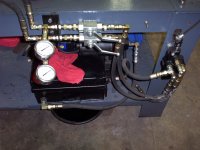
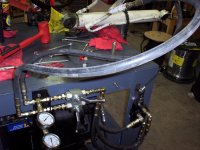
Second pic is a Yanmar excavator cylinder undergoing a pressure test after resealing.

In a perfect, textbook world, the "drain" side of the cylinder would have zero pressure. Unfortunately, the world is not made of textbooks.
 

Attachments

  • 100_1582.jpg
    100_1582.jpg
    263.3 KB · Views: 134
  • 100_1584.jpg
    100_1584.jpg
    277.5 KB · Views: 130
Last edited:
/ hydraulic splitter sizing #16  
I would think with the small amount of wood that you are talking about maybe you should check your local rental places and see what it would cost to rent a spitter for a weekend project.

I am sure if you have all of the wood cut to size that it would be an easy task to split at least enough for a couple of years worth of wood burning.

Just my two cents?

Wayne
 
/ hydraulic splitter sizing #17  
Wayne County Hose said:
Nice try, but swivels have nothing to do with the rod bending. They bend on a splitter because the rod is extended far out of the cylinder housing and more force is placed on the rod than it can handle. So, it bends. Kind of like pressing a 2"x4" piece of lumber against a wall. It doesn't matter what you do to the ends, it will bend in the middle.

The further the rod is extended, the easier it is for a catastrophe. The closer the piston gets to the gland, the easier it is for everything to bend. Same principal as an extension ladder, collapsed, it's very strong. Extend them all the way and they get shaky.

Cylinder manufacturers rarely have any input as to the engineering of the equipment their cylinders are manufactured for.

As for no possibility of pressure higher than relief, you have got to be kidding me. When you have a gnarly piece of wood that builds pressure on the piston end approaching relief, then the wood pops, the piston goes flying forward, exerting all this force on the rod/gland end of the cylinder. I would bet that pressure spikes on the rod/gland end approach double the relief valve pressure.

True that a rod can bend. I watched one bend on a shop built "shover" (used to push one piece of tubing inside another for a strengthener). Happened so fast that it was a 30 degree bend before the operator could stop it. Easily avoided by putting a simple strap 'loop' over the nose end of the cylinder w/ends welded to the armature.

While there may be some 'shock' from the block splitting suddenly, there will be no pressure 'spike' The instant the rod begins to extend, the pressure is on a rapid downward course. The rod will also not 'fly forward' - it won't move any faster than it will under no-load conditions (unless you have an air bubble somewhere in the pressure side).

Edit: The rod _can_ 'shoot forward' but only as far as the slack in the pin holes and in the slide will allow - a small fraction of an inch. That I have seen almost every time I split wood.

Harry K
 
Last edited:
/ hydraulic splitter sizing #18  
turnkey4099 said:
True that a rod can bend. I watched one bend on a shop built "shover" (used to push one piece of tubing inside another for a strengthener). Happened so fast that it was a 30 degree bend before the operator could stop it. Easily avoided by putting a simple strap 'loop' over the nose end of the cylinder w/ends welded to the armature.

[I]While there may be some 'shock' from the block splitting suddenly, there will be no pressure 'spike' The instant the rod begins to extend, the pressure is on a rapid downward course. The rod will also not 'fly forward' - it won't move any faster than it will under no-load conditions (unless you have an air bubble somewhere in the pressure side).[/I]
Edit: The rod _can_ 'shoot forward' but only as far as the slack in the pin holes and in the slide will allow - a small fraction of an inch. That I have seen almost every time I split wood.

Harry K


Wow, 20+ years of training and experience down the drain.
 
/ hydraulic splitter sizing #19  
turnkey4099 said:
Errm...no, the rating on the splitters is with the ram stalled, i.e., the max pressure the ram can exert. The size of the round has nothign to do with it.

Harry K

Uh yes Harry, there are 22 ton splitters out there (HF for example) that are "rated" for an 8" round which is absolutely silly and should not be a factor in deciding on a splitter. You didn't seem to notice when you said, "errm...no," but we do in fact agree.

As far as the cylinder rod bending outward it is called buckling and can happen even when both ends are pinned. Something has to give and the ram can buckle out if it is not adeqautely sized for the load.
 
/ hydraulic splitter sizing #20  
turnkey4099 said:
Edit: The rod _can_ 'shoot forward' but only as far as the slack in the pin holes and in the slide will allow - a small fraction of an inch. That I have seen almost every time I split wood.
Harry K
I agree with the main part of your post. This shoot forward thing tho has nothing to do with slack in the pins or slide. It is instead the release of energy stored in the mechanism - aka flex of beam, hose expansion, cylinder body expansion, ram compression, flex of the pins, fluid compression, torsion on the pump and engine shaft, etc. It all amounts, as you describe, to an extremely short movement. If the system relaxation occurs instantly there is an extremely short duration pressure spike on the unloaded side of the cyl. Look at it with an unfilled pressure gauge and youll see more of a pressure jump than there is. A fluid filled gauge would give better perspective. Many parts of the system would suffer if this instant release situation were prevalent, however it is very rare that this energy is released precipitously and so the detrimental effect falls in the noise. Maybe the splitter lasts 10 minutes less because of it. Altho a true effect, it is inconsequential here.
larry
 
 
Top