Here comes Beryl

   / Here comes Beryl #61  
We had 5.3 inches in Marshall county Indiana. Fortunately it was getting dry before the hurricane hit and the ground soaked it up but the river bordering my place has escaped its banks.
 
   / Here comes Beryl #62  
Is anybody near Toronto Canada? My brother lives there and he's claiming that he got 8 inches in 4 hours. I'm struggling to believe this since I had 6 1/2 inches in 24 hours, and I'm a lot closer to where Beryl hit the US then he is way up in Canada.

Hmm, I wonder if somebody's leg is being pulled;
Lists 45mm (1.75") on July 10th. I could see double that for some local downpour, but 4X seems abnormally different.
Wunderground showed even less.

All the best,

Peter
 
   / Here comes Beryl #63  
LOTS of road closures due to washouts here in northern New England. Central Vt. really took it on the chin again...a lot of steep mountainsides and narrow valleys=recipe for disaster. Both Rt. 2 and 302 (primary E-W across the northern part of the state) closed due to numerous washouts. A lot of those roads had just been repaired after another deluge one year (to the day) ago. N.H. fared a little better, but highway crews will have their hands full for the rest of the summer.


   / Here comes Beryl #64  
In NH as well. We got slammed, but luckily no property damage at my place.

I was able to go south from where I live, but it's doubtful I'll be able to go north easily for another couple of days until more side roads are repaired.

The pictures being posted by the various area FDs are nuts.

I luckily live on what I think is the only town owned paved road here. It's 'thinner', but passable in both directions.

SR-135 is either gone or wrecked and the irony was NH DOT was replacing/repairing all the culverts in Lancaster in preparation for repaving.

The town crews are earning their keep, that's for sure.

Some pics here. Some I hadn't seen yet.

 
   / Here comes Beryl #65  
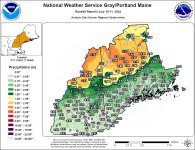
Rain totals from yesterday.

This is on top of almost daily heat/humidity induced T-storms. Already saturated ground and already flooding culverts finally got too much rain to keep going.
 

Attachments

  • 450644482_861432416013870_5008251625580845039_n.jpg
    450644482_861432416013870_5008251625580845039_n.jpg
    518.3 KB · Views: 94
   / Here comes Beryl #66  
Here,s a report on how it effected the Montreal area.

 
   / Here comes Beryl
  • Thread Starter
#67  
Hmm, I wonder if somebody's leg is being pulled;
Lists 45mm (1.75") on July 10th. I could see double that for some local downpour, but 4X seems abnormally different.
Wunderground showed even less.

All the best,

Peter
Thank you for this. He has a history of saying things that haven't proven to be accurate. Saying that he received 8 inches of rain there in Toronto, after I got 6 1/2 inches here in Texas, just seemed ridiculous.
 
   / Here comes Beryl #68  
Central Point Energy video on the outage.


Expect to have around 80% of customers online by Sunday afternoon.
 
   / Here comes Beryl #69  
On the natural gas/generator topic, is gas service subject to weather related problems and widespread electrical issues?
Here, a very long way away from the lone star state (maine) we had a 4 day outage from a kinda freak 18" very wet snow the first week of this past April. Being the most wooded state in America (they say), despite massive trimming efforts the past 5 years or so we loose power quite often. There's limited NG in some of the cities but that's it. Too much granite to be financially practical. I selected a 20kw diesel unit that uses .5 gallon/hour and have a 200g tank as the generator base, then there's a couple of 275's (gallon) always close to filled for heating and tractors.
Glad to hear that pretty much everyone here got by in pretty good shape. 👍
Consider your choice of fuel carefully considering it's availability in emergency conditions is what I'll trying to say.😉
 
   / Here comes Beryl #70  
On the natural gas/generator topic, ...
Consider your choice of fuel carefully considering its availability in emergency conditions is what I'll trying to say.😉
X10. I know folks who blew through their entire (large) tank of propane three days into what turned out to be a two week outage, who then weren't refilled for a month.

Sometimes, conserving, and breaking out the candles isn't such a bad idea either...

All the best, Peter
 
   / Here comes Beryl
  • Thread Starter
#71  
My generator is duel fuel. Gasoline or Propane. I have the hose and fittings for two different propane tanks. I have three 20 pound tanks, and two 100 pound tanks. So far, we've only used the propane for cooking on the BBQ Grill. If I cannot find gasoline, the 100 pound tanks are my emergency backup.

Here in East Texas, there are Natural Gas pipelines everywhere. It's amazing how many rural neighborhoods have Natural Gas in their homes. I have it run to my mom's house, which I built just behind my house, but it's not run to my house yet.

I already have too many things to get done that are must do projects, but that has become a priority all of a sudden. I really need to get a bigger generator for the entire house, and the Natural Gas line installed so I don't have to worry about running out of fuel.
 
   / Here comes Beryl #72  
My brother lives in Conroe and still doesn’t have power back. He had several trees down and lost his greenhouse.

He was telling me that a lot of folks there have generators on natural gas and they are having pressure problems because of how many generators are running. I gave him a duel fuel 12kw generator that I bought for our dad. He runs on gasoline.
 
   / Here comes Beryl
  • Thread Starter
#73  
Darn, that kind of deflates my bubble. I'm still going to go with it, and a bigger generator, but I'll keep my 10K duel fuel generator as a backup. I also have the little Honda generator. I might turn into a Generator collector!!!!
 
   / Here comes Beryl #74  
We have 2 gas easements on our property, but they wouldn't run from either of them to the house. Something about pressure.
 
   / Here comes Beryl #75  
In VT, we had the remenents of Beryl hit on the 1 year anniversary of last years devastating flooding. Our area was hit much harder than last year. Almost all dirt roads washed out to mostly impassable. The power of water is beyond belief, even when you are standing next to the destruction. 3'+ gullys crossing roads are the norm. 8' deep wash out common. Being up high up a ridge, we only experienced inconvenience, while our community below will be dealing with the effects of the storm for weeks to months. Some, like last year, will be dealing for a long time. We do have a great community, with everyone helping out in any way they can. VT Strong...
 
   / Here comes Beryl #76  
A little late to this thread but it's been busy around here. I think the power company, Sam Houston Electric, had something like 95% outage once the smoke cleared. Huge number of trees down but they brought in around 1000 linemen and they have been working non-stop. There are still a number of people out of power in the greater Houston area, including our son and family in Galveston. I spent Tuesday and Wednesday cutting and clearing trees off fences then fixing the fences, moving cows, and all the fun that comes with that stuff. It was plenty hot and humid, especially for someone who is not a youngster anymore, but I got it done.

Edit: we got power back on Thursday about 6 pm.

About two years ago I designed and built our solar system, which powers about 80% of our needs. We have a NG 27kw Generac which is more than capable of running everything but we could have gotten by without it. I let it run because, well, I have it so why not use it. So for us personally, it was pretty much business as usual. The biggest issue was we lost water service and we're on a local water company. They had some problems with generators for their wells or something but we got water back Tuesday afternoon. We have stock ponds so the cattle were fine but I was glad to get a shower Tuesday night. Putting in a well is high on our priority list but there's a waiting list. When I do the well I'm going to install enough solar and batteries to run it separately so that should give us a solid backup for water and let us use it for the cattle, garden, etc., year round.

I've seen a lot of complaints about the POCOs not being prepared enough but there's not a lot of practical affordable ways to prepare for hundreds of thousands of trees down. My solution is to have my own power sources but of course that's not something everyone can do. What you can do, however, is keep some basic preps. Even a small generator will help. A week or two supply of food and water is always a good idea. Make sure you have gas for the generator BEFORE the storm arrives. A little prep goes a LONG way when SHTF, even on a relatively minor scale like this one.
 
   / Here comes Beryl #77  
My generator is duel fuel. Gasoline or Propane. I have the hose and fittings for two different propane tanks. I have three 20 pound tanks, and two 100 pound tanks. So far, we've only used the propane for cooking on the BBQ Grill. If I cannot find gasoline, the 100 pound tanks are my emergency backup.

Here in East Texas, there are Natural Gas pipelines everywhere. It's amazing how many rural neighborhoods have Natural Gas in their homes. I have it run to my mom's house, which I built just behind my house, but it's not run to my house yet.

I already have too many things to get done that are must do projects, but that has become a priority all of a sudden. I really need to get a bigger generator for the entire house, and the Natural Gas line installed so I don't have to worry about running out of fuel.
While there may have been some improvements, many Texas natural gas facilities froze during the not so recent snow event. I know that improvements in winteriziation were mandated, but from what I have read, many facilities are not in compliance. So, I personally would not count on natural gas being there when you absolutely need it.

YMMV...

All the best,

Peter
 
   / Here comes Beryl #78  
...

I've seen a lot of complaints about the POCOs not being prepared enough but there's not a lot of practical affordable ways to prepare for hundreds of thousands of trees down. My solution is to have my own power sources but of course that's not something everyone can do. What you can do, however, is keep some basic preps. Even a small generator will help. A week or two supply of food and water is always a good idea. Make sure you have gas for the generator BEFORE the storm arrives. A little prep goes a LONG way when SHTF, even on a relatively minor scale like this one.
I'm glad that the hurricane wasn't too bad for you personally.

Professionally, I occasionally have been tasked with disaster planning, and I do take issue with the POCO comment. In my view, the Texas PoCos are most certainly responsible for poor line maintenance, and preparedness. I do recognize that ERCOT has made the power issues in Texas worse than they need be, but that is not the whole issue. Texas is a hurricane prone area, so at a minimum there are tree trimming recommendations to get trees far enough from lines not to fall on power lines. Flying debris is a different issue, but one that can be mitigated by undergrounding the power lines. If you like your tree lined neighborhoods, put the wires out of the way. It is not rocket science.

That CenterPoint PR video above is a case in point. The tree that the power pole became entangled with was only a few feet away from the pole, and the pole itself was clearly in poor condition. (I.e. should have been replaced.)

There are some areas in the world that do better with hurricanes. Even Florida has some helpful building requirements in their building code. Unfortunately, Texas isn't a role model in my book for disaster planning or response. I do use Texas events as case studies for others to learn from as I think that there is a lot to be learned, starting back at the Galveston hurricane. I just wish folks would learn from the experiences, and not repeat history. I hate to see folks suffer needlessly.

I have similar thoughts and feelings about living in earthquake / wildfire / flood / tornado regions and not taking at least some precautions there as well.

All the best,

Peter
 
Last edited:
   / Here comes Beryl #79  
I'm glad that the hurricane wasn't too bad for you personally.

Professionally, I occasionally have been tasked with disaster planning, and I do take issue with the POCO comment. In my view, the Texas PoCos are most certainly responsible for poor line maintenance, and preparedness. I do recognize that ERCOT has made the power issues in Texas worse than they need be, but that is not the whole issue. Texas is a hurricane prone area, so at a minimum there are tree trimming recommendations to get trees far enough from lines not to fall on power lines. Flying debris is a different issue, but one that can be mitigated by undergrounding the power lines. If you like your tree lined neighborhoods, put the wires out of the way. It is not rocket science.

That CenterPoint PR video above is a case in point. The tree that the power pole became entangled with was only a few feet away from the pole, and the pole itself was clearly in poor condition. (I.e. should have been replaced.)

There are some areas in the world that do better with hurricanes. Even Florida has some helpful building requirements in their building code. Unfortunately, Texas isn't a role model in my book for disaster planning or response. I do use Texas events as case studies for others to learn from as I think that there is a lot to be learned, starting back at the Galveston hurricane. I just wish folks would learn from the experiences, and not repeat history. I hate to see folks suffer needlessly.

I have similar thoughts and feelings about living in earthquake / wildfire / flood / tornado regions and not taking at least some precautions there as well.

All the best,

Peter
I won't argue that there are things that the POCOs could have done better. There are always things that could have been done better in just about any industry.

For the record, prior to retirement, one of the things the company I owned provided was assistance with disaster planning, with a heavy emphasis on hurricane disaster. We were right on the coast, which presents additional challenges, mostly regarding storm surge and higher winds.

My point is that there is only so much you can do that is practical cost-wise and within the scope of what the POCO can address. Vegetation management on right of ways is absolutely a must, and there is definitely a lot of room for improvement there. But I have seen firsthand that much of the damage to the lines came from downed trees which were not on the right of way. Those trees, outside the purview of the POCO, are the responsibility of the property owner. I'm not talking about the power line from the street to your house, which are always a problem. I'm talking about large trees close to transmission lines causing damage. We had a ton of those over the several counties serviced by our co-op. One of the things that impacts this is the length of time between storms. For much of this area it had been nearly 20 years since the last serious hurricane. Without a storm to thin out the weak trees you end up with an area ripe for disaster as those weak trees give up and uproot or snap off. The same thing happened when Rita came in in 2005 and we had serious power outages from tree damage even 150 to 200 miles north of the coast. Then Ike came through in 2008 and yeah, we had serious storm surge. I was on the coast then and saw the water damage firsthand. But the wind damage was much less, because Rita had already cleared many of the weak trees.

Another factor that often is not considered is the sheer size of Texas. We're 1.65 times larger than California and if you're using Florida for comparison we're almost five times larger. The greater Houston area alone is over 10,000 sq miles. That's larger than some states and a hell of a lot of urban infrastructure to manage and protect.

Putting everything underground is not a practical option. I'm not going to get into all that for this conversation, but anyone who thinks it is should do a little research into all the problems you will encounter.

It all comes down to risk management. When doing risk assessments, we try to determine risk likelihood, potential damage, and risk mitigation. Likelihood is not even a question. It's going to happen so the chances are 100%. So it comes down to potential damage and options for mitigation. Simplified, that means what is it going to cost to fix it versus what would it take to protect against it. From there it's a balancing act because the cost to completely protect everything is well beyond anything we could afford.

Could the POCOs and the co-ops do a better job? Absolutely. Have they been intentionally negligent across the board? I don't think so. I think they have worked within the budget and constrictions they have and tried to do the balancing act. Sure, you know there is some greed and corruption here and there, just like any industry and all of politics. But overall, with the scope of services provided and the resources available to provide them, I think they have done a fair job.

I hear a lot of complaining but what I don't hear much of is specific solutions and now to finance those solutions.

My two cents, and it's not my intention to offend anyone. Just provide some perspective.
 
   / Here comes Beryl #80  
When we built this house, we paid extra to bury the power lines from the road to the house. We're in the Piney Woods and I know if a branch takes our our power, we would be pretty low on the list to get power back just for us.

I've got an electric easement cutting across my whole property. Those are all suspended and surrounded by trees.

The co-op didn't cut it often, but they will come out if a branch is threatening a line. Since we're here, I keep them cut as a preventative. Fewer people on our property is better.
 

Tractor & Equipment Auctions

Preliminary Listing / Full Catalog Coming Soon! (A53317)
Preliminary...
2017 Toro Workman HDX-D Diesel Utility Cart (A59228)
2017 Toro Workman...
John Deere S350 (A60462)
John Deere S350...
MASSAGE CHAIR (A58214)
2021 Allmand Bros Maxi-Lite II 20kW S/A Towable Light Tower (A55973)
2021 Allmand Bros...
500 BBL FRAC TANK (A58214)
500 BBL FRAC TANK...
 
Top