Oil & Fuel Help needed finding the air bleed port

   / Help needed finding the air bleed port #1  

fnoergaard

New member
Joined
Mar 10, 2012
Messages
3
Location
Denmark
Tractor
IH B-275, Power Trac PT-425
Hi again,

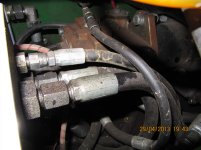
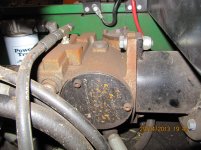
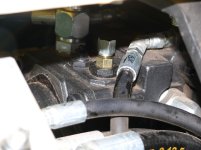
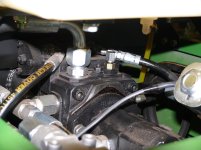
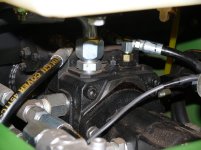
I've changed the hydraulic filter on my PT-425, and need to bleed the air out of the hydraulic pump.
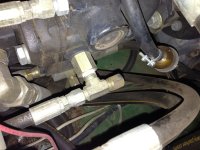
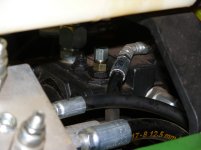
It's a Bondioli&Pavesi model HP P2. I can't find the air bleed port.

I've tried the owners manual, but it's useless, as it describes another pump.
Also I've searched this forum, but none of the discussions seems to relate to my pump.

Some posts mentions a hydraulic hose used for bleeding air, which was supplied by Power Trac with the tractor. I did not get a hose when I bought my 425 - can I bleed it without one?

Any help will be greatly appreciated.
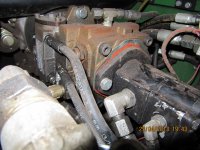
IMG_1137.jpgIMG_1138.jpgIMG_1139.jpgIMG_1140.jpg
 
   / Help needed finding the air bleed port #2  
You can bleed it either with a hose with the right JIC fitting (at least on mine) or even stretch a rubber or tygon tube over the fitting you have.

Ken
 
   / Help needed finding the air bleed port #3  
Hi again,

I've changed the hydraulic filter on my PT-425, and need to bleed the air out of the hydraulic pump.
It's a Bondioli&Pavesi model HP P2. I can't find the air bleed port.

I've tried the owners manual, but it's useless, as it describes another pump.
Also I've searched this forum, but none of the discussions seems to relate to my pump.

Some posts mentions a hydraulic hose used for bleeding air, which was supplied by Power Trac with the tractor. I did not get a hose when I bought my 425 - can I bleed it without one?

Any help will be greatly appreciated.
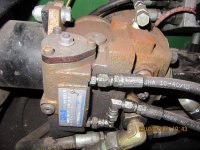
View attachment 315440View attachment 315441View attachment 315442View attachment 315443

I think you should use a hose to bleed the pump unless you want a mess of oil all over the place.

It goes like this....
Once you find the bleed port, you put the bleed hose fitting on the bleed port and run the hose into your hydraulic tank and submerg the open end of the bleed hose in the hydraulic fluid to cover the open end well.
You disconnect the spark plugs so the engine cannot start up.
Crack open the bleed port fitting
You crank the engine for 5-10 seconds and stop.
While cranking, you watch the air bubbles come out of the hose end in the hudraulic tank.
You wait a minute or two for the starter to cool down, then repeat the cranking for another 5-10 seconds.
Watch bubbles.
Wait.
Crank.
Watch.
Wait.
Crank.
Repeat, repeat, repeat until no more bubbles come out of the open hose end in the hydraulic tank.
Close the bleed port.
Remove the hose.
No mess no fuss.
I can't see how you would bleed it without a hose and not make a mess.
 
   / Help needed finding the air bleed port #4  
As for the location of your bleed port....
The bleed port on mine is on the side of the pump.
I have a cable operated pump on my 2001 model PT425. My cable attaches to the mechanism on the top of the pump.
Power Trac converted to a hydraulically operated pump sometime after 2001.
I thought the hydraulically operated pumps had the mechanism on the top of the pump as well, but could be mistaken.
From your pictures, it appears the hydraulically operated mechanism is on the side.
Could your pump be installed 90 degrees rotated and thus, your bleed port may be on the bottom now?
 
   / Help needed finding the air bleed port #5  
I think your bleed port is the capped end of the t connection at the top. Don't hold me to it but it seems to me to be the logical choice as no other port has a cover.
 
   / Help needed finding the air bleed port #6  
I think your bleed port is the capped end of the t connection at the top. Don't hold me to it but it seems to me to be the logical choice as no other port has a cover.
Unless its on the bottom. ;)
 
   / Help needed finding the air bleed port #8  
I think you should use a hose to bleed the pump unless you want a mess of oil all over the place.

It goes like this....
Once you find the bleed port, you put the bleed hose fitting on the bleed port and run the hose into your hydraulic tank and submerg the open end of the bleed hose in the hydraulic fluid to cover the open end well.
You disconnect the spark plugs so the engine cannot start up.
Crack open the bleed port fitting
You crank the engine for 5-10 seconds and stop.
While cranking, you watch the air bubbles come out of the hose end in the hudraulic tank.
You wait a minute or two for the starter to cool down, then repeat the cranking for another 5-10 seconds.
Watch bubbles.
Wait.
Crank.
Watch.
Wait.
Crank.
Repeat, repeat, repeat until no more bubbles come out of the open hose end in the hydraulic tank.
Close the bleed port.
Remove the hose.
No mess no fuss.
I can't see how you would bleed it without a hose and not make a mess.

MR, This is the procedure I've used since you posted them a few years ago. But I do not understand the need for the line that says: Crack open the bleed port fitting???
 
   / Help needed finding the air bleed port #9  
Are you referring to how far to open the bleed port?
 
   / Help needed finding the air bleed port #10  
Are you referring to how far to open the bleed port?

No, I forgot that the older machines are different that mine. On my 2010 PT 425 the bleed port has a cap on it. Once the cap is removed and the supplied hose with fitting is screwed on its open and ready. Thee is no additional "cracking" of anything required. The rest of the procedure is identical.
 
   / Help needed finding the air bleed port #11  
No, I forgot that the older machines are different that mine. On my 2010 PT 425 the bleed port has a cap on it. Once the cap is removed and the supplied hose with fitting is screwed on its open and ready. Thee is no additional "cracking" of anything required. The rest of the procedure is identical.

Thinking about it, I believe mine is like that too. Remove the cap and the port is open. Yikes! How quick the mind goes. :confused3:
 
   / Help needed finding the air bleed port #12  
Thinking about it, I believe mine is like that too. Remove the cap and the port is open. Yikes! How quick the mind goes. :confused3:

Same here on my 2005. I didn't have the "supplied" bleed hose last time I changed filters. But didn't need it. I just took some 1/4" gas hose, and just threaded it onto the tee where the cap threads on. No need for a fitting on it, since it isn't under pressure. Might have put a hose clamp on, just in case.

Below is a picture of my bleed connection. The right hand (aft end) of the tee-fitting has the cap you remove to install the bleed hose.

IMG_0066.jpg
 
   / Help needed finding the air bleed port #13  
I know this is an old post, but thought it might help some people out that have a PT425 out there. I know, or lets say I hope it was the correct point it directed me to on my 2015 machine.

I took the cap off the top, and hooked the line up and ran it into the tank, took the spark plugs out (figured it would crank a bit easier that way) and cranked until I had nothing but oil with no bubbles.

I might also make a note for those who don't know, get you a pan ready to put under the machine, as it will have oil come out the filter when you take it off, and drain out the hole in the front of the pan. (I wish i would have thought of that before I did it), and also you will need a oil filter wrench that will go around the 3 3/4" size, I just had the old style with the handle on it, and have now ordered one I can slip over it and use a 3/8" rachet to loosen it.

Below are a couple of pictures of what kind of pump they are using now.

p1010475.jpg p1010478.jpg p1010480.jpg p1010482.jpg
 
   / Help needed finding the air bleed port #14  
I've always laid some paper towels under the filter area, then just cracked the oil filter loose, then slipped a gallon size ziplock back around it, loosen it all the way and let it fall in the bag. I keep the bag there for a bit to let anything that comes out of the filter mounting location drip into the bag as well. Works great. Someone on this forum told me about it, so thanks to whoever you are!
:laughing:
 
   / Help needed finding the air bleed port #15  
I've always laid some paper towels under the filter area, then just cracked the oil filter loose, then slipped a gallon size ziplock back around it, loosen it all the way and let it fall in the bag. I keep the bag there for a bit to let anything that comes out of the filter mounting location drip into the bag as well. Works great. Someone on this forum told me about it, so thanks to whoever you are!
:laughing:
 
   / Help needed finding the air bleed port #16  
I did the Ziplock bag trick on the engine oil filter, but this one is a lot closer around it, and I was having a hard enough time using the wrong oil filter wrench (until the new one gets in) to even think much about it. I was going to try the Ziplock Bag on this one, but it had a LOT of oil come out and I think next time I will just let it loose enough to start dripping out and leave it for any hour or so. I use the Oil Eater stuff and it does a good job of cleaning up, but have thought about a pressure washer but everything I work on is a long way away from the water, and have to drag 100 or more feet of hose to hook it up, and then I know it would be hard for me in the chair to drag the pressure washer around, as most have 2 wheels you kick it back on to roll it around, and is hard enough trying to roll the chair around in rough conditions many times. :D
 
   / Help needed finding the air bleed port #17  
I can't do the ziplock trick on my Kohler's engine oil filter. Its' on the side and is usually pretty much empty once I leave it off for 10 minutes, as it drains back into the case.
 
   / Help needed finding the air bleed port #19  
Your 1850 must have a LOT More room then the 425 does. Heck, you are doing all you can to snake a regular band wrench with a handle around and between the hoses to get to the bottom of the filter to get it on, then you have to slide it all the way up to be able to turn it, so why I have ordered one of the band wrenchs you can use a 3/8 square socket on, in hopes it will be a bit easier on the next change.

I would guess you were talking about changing the hydro filter here, and not the oil filter.
 
   / Help needed finding the air bleed port #20  
Yes since this was a bleed port thread, I thought we were talking about the hydraulic oil filter. For me, the hard one is the hydraulic oil filter. I do not remember what I do for the engine oil filter - I have a variety of filter wrenches including the style that go on the end which are nice when they work.

I did add a small ball valve and hose to the engine oil drain - I snake the hose through the tub hole to drain. When not changing the oil, there is also a plug in the hose as well as a band around the spring loaded valve handle as a backup safeties. I would hate to lose an engine for convenience.

Ken
 

Tractor & Equipment Auctions

2012 Vermeer V500LEHD Vacuum T/A Towable Trailer (A55973)
2012 Vermeer...
2026 tilt trailer (A56859)
2026 tilt trailer...
CAT D8 (A58214)
CAT D8 (A58214)
2013 Ford E-150 Passenger Van (A59230)
2013 Ford E-150...
MACK T/A DUMP TRUCK (A58375)
MACK T/A DUMP...
SEMI AUTOMATIC QUICK CHANGE FOR MINI EXCAVATOR (A58214)
SEMI AUTOMATIC...
 
Top