Haying with compact tractor

   / Haying with compact tractor #61  
It's been pretty wet here too, seems to rain every day. This is double rinsed red clover hay. Good for cows or other ruminants. No good for horses, so it's no good for me. Hoping to move it quick. Send me a message if you are in central Wisconsin and would like 40 small squares of cow hay.

I posted an ad Saturday night, and it was sold by 6:30 AM the next morning, and I think I have a new customer. A very happy one too. I was starting to second guess myself for not cutting yesterday, it was sunny all day, and today it was sunny most of the day, but then about 5PM we got hammered with rain. It's looking like we'll get a few clear days later this week, so I'll cut what I can when I can.
 
   / Haying with compact tractor
  • Thread Starter
#62  
Well I cut Friday AM and just got done raking an hour ago. hay is almost dry. I hope to start baling at about 3 today and beat the rain. Most of this is cow hay, with a few bales of horse hay mixed in, based on what I saw raking.
 
   / Haying with compact tractor #63  
Cloudy and overcast today, and it's not raining but spits a bit now and then. I have about 200 bales worth on the ground that was cut Thursday and Friday. It's not dry enough yet. I made a few bales this morning, and ended up cutting them open and spreading them out again. If it was a sunny today it would have been enough. Hope I don't lose it all, some of it is really nice hay.

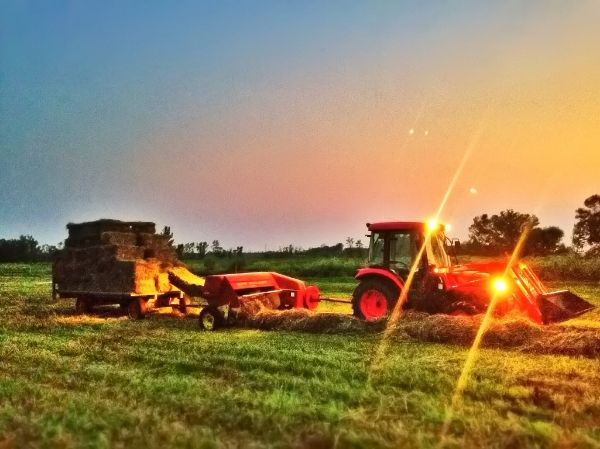
I took this last night:

979A3D82-079B-4BC7-A1C9-28730329E2EB_zpsfnongh0x.jpg
 
   / Haying with compact tractor #64  
I cut hay 2 days ago with a Yanmar 19hp using a 4' Kuhn disc mower. Just done raking it now with my recently restored wheel rake and now father has gone out to bale it with our Massey Ferguson 135 and NH 276 baler - we are reckoning on around 100 bales/acre on some fields! We have had a pretty good year for hay so far.
Here's our MF 135 and NH 65 baler working a couple weeks ago doing a some of the first hay this year https://www.youtube.com/watch?v=wKniDXtwZdg
 
Last edited:
   / Haying with compact tractor
  • Thread Starter
#65  
I cut close to 12 acres today. I hope to rake and bale middle of next week
 
   / Haying with compact tractor
  • Thread Starter
#66  
Averaged 175 bales and hour and got 225 off the property. Hay did get rained on 1/4 inch, but were dry the next evening. I need a small grapple to help me load out now, as throwing bales on a pallet or in the back of my truck, took more out of me than I thought
 
   / Haying with compact tractor #67  
Averaged 175 bales and hour and got 225 off the property. Hay did get rained on 1/4 inch, but were dry the next evening. I need a small grapple to help me load out now, as throwing bales on a pallet or in the back of my truck, took more out of me than I thought

With my baler the chute goes right onto the wagon. If I'm running by myself I have to stop every so often and go back there and stack the bales, but if I have a wagon jockey helping out we make pretty good time. It's a LOT more work to drop them on the ground and pick them up later. If you are going to make hay solo you're better off with a thrower and a few kick wagons.
 
   / Haying with compact tractor #68  
Cloudy and overcast today, and it's not raining but spits a bit now and then. I have about 200 bales worth on the ground that was cut Thursday and Friday. It's not dry enough yet. I made a few bales this morning, and ended up cutting them open and spreading them out again. If it was a sunny today it would have been enough. Hope I don't lose it all, some of it is really nice hay.

I took this last night:

979A3D82-079B-4BC7-A1C9-28730329E2EB_zpsfnongh0x.jpg

Couple of questions and comments. What did you cut it with? You left half the plant in the field. I bet it was a sickle barmower or mower conditioner and you cut with the wind. Always cut against the way the wind blows the plant unless it's a disc machine and keep the cutter bar is an agressive position nose down, Adjust the cut height with the skid shoes always. I can see it's too wet to bale.........if I was in a have to bail that situation, I'd be applying greensaver to the material as it travels into the bailer. I keep an applicator on my bailers (round and square) all the time just in case. Proprionic acid (buffered) allows you to bale at 20%RM so long as the bailer can stand the strain.

Another old girl (bailer that has been around the field a time or two. Appears to be a Hayliner 66 which in it's day was a good machine (I had one starting out and sold it to a hobby farmer and found out later that the original owners manual and shop manual which I had, was worth more than the bailer itself. The issue with an old bailer is everything is chain drive and chains stretch with use and ocassional maintenance. Everything gets sloppy and your bales get sloppy too. New balers are all gear drive. Knotters remian the same except hardened bill hooks are SOP now. Even my new 575 uses the same gearbox your old girl uses. If it's good, keep it.

I never have any attachment on the loader arms in the field. It's cumbersome. Both my large frame Kubota's have loaders that are a PITA to remove but the 2 pin hitch is always empty of an attachment.

I don't care if you do a couple acres or a couple hundred, the one investment anyone making hay needs to make right off, is a moisture tester, handheld or shoe, in bail chamber mounted. While I can look at that forage and tell that bailed, it's gonna get hot and in a month look like it has a bad case of dandruff, but I've been ready to run forage that looks fine and feels fine but my Delmhorst tells me the RM is too high to ble without spoilage.

My Delmhorst wasn't a cheap date (typically 325 bucks for the handheld unit, 2 probes and a case) but they are a lifesaver and I use it at hay auctions to 'discredit' unscruplous sellers. Amazing what happens when the moisture threshold is set at 18% RM and the alarm goes off....

The one I have plugs in via a coaxial cable to sensor shoes in my bailers do I can monitor in real time, the RM of the hay being bailed and if it exceeds a pre set level, I can activate the Greensaver.

You always want to bale small squares below 15%RM but above 10% because at 10% or below the plant shatters from the plunger action and you loose the nutritive value of the forage but above 15%, the compaction of the plunger squeezes the juice out, the bale becomes damp inside, heats up and molds, or worse, sets your barn on fire.

Same occurs with rounds but below 10%, leaf shatter becomes critical and it's hard to start a bale forming, especially in long stemmed forage like Orchard grass.

I can pretty much tell by sight (looking at the baler working) if the forage is right for baling. If it's right, there will be a bit of dust occuring from the plunger action. Not much. Same with rounds. If the round baler is running in a dust cloud, you are shattering the plant and bailing stems. No one wants stens.
 
   / Haying with compact tractor #69  
With my baler the chute goes right onto the wagon. If I'm running by myself I have to stop every so often and go back there and stack the bales, but if I have a wagon jockey helping out we make pretty good time. It's a LOT more work to drop them on the ground and pick them up later. If you are going to make hay solo you're better off with a thrower and a few kick wagons.

Personally, I fon't like a thrower and bale wagons. Chucked bales are a PITA, bale wagons are expensive, more than hay racks and a thrower is more mjechanical stuff to wear out or break.

I looked at a Kuhn system a couple years back and bought a Long Grapplator which is an accumulator and loader/unloader just for emergencies in cas my crew can't for some reason handle the bales. I put every bale on the ground and then come back with a driver (me), one guy on the wagon stacking and two on the ground, one on each side of the wagon, typically, 300 small squares per wagon, running 2 wagons with 2 more unloading.

My crew can load and unload 2500 in a regular day btw.
 
   / Haying with compact tractor #70  
Couple of questions and comments. What did you cut it with? You left half the plant in the field. I bet it was a sickle barmower or mower conditioner and you cut with the wind. Always cut against the way the wind blows the plant unless it's a disc machine and keep the cutter bar is an agressive position nose down, Adjust the cut height with the skid shoes always. I can see it's too wet to bale.........if I was in a have to bail that situation, I'd be applying greensaver to the material as it travels into the bailer. I keep an applicator on my bailers (round and square) all the time just in case. Proprionic acid (buffered) allows you to bale at 20%RM so long as the bailer can stand the strain. Another old girl (bailer that has been around the field a time or two. Appears to be a Hayliner 66 which in it's day was a good machine (I had one starting out and sold it to a hobby farmer and found out later that the original owners manual and shop manual which I had, was worth more than the bailer itself. The issue with an old bailer is everything is chain drive and chains stretch with use and ocassional maintenance. Everything gets sloppy and your bales get sloppy too. New balers are all gear drive. Knotters remian the same except hardened bill hooks are SOP now. Even my new 575 uses the same gearbox your old girl uses. If it's good, keep it. I never have any attachment on the loader arms in the field. It's cumbersome. Both my large frame Kubota's have loaders that are a PITA to remove but the 2 pin hitch is always empty of an attachment. I don't care if you do a couple acres or a couple hundred, the one investment anyone making hay needs to make right off, is a moisture tester, handheld or shoe, in bail chamber mounted. While I can look at that forage and tell that bailed, it's gonna get hot and in a month look like it has a bad case of dandruff, but I've been ready to run forage that looks fine and feels fine but my Delmhorst tells me the RM is too high to ble without spoilage. My Delmhorst wasn't a cheap date (typically 325 bucks for the handheld unit, 2 probes and a case) but they are a lifesaver and I use it at hay auctions to 'discredit' unscruplous sellers. Amazing what happens when the moisture threshold is set at 18% RM and the alarm goes off.... The one I have plugs in via a coaxial cable to sensor shoes in my bailers do I can monitor in real time, the RM of the hay being bailed and if it exceeds a pre set level, I can activate the Greensaver. You always want to bale small squares below 15%RM but above 10% because at 10% or below the plant shatters from the plunger action and you loose the nutritive value of the forage but above 15%, the compaction of the plunger squeezes the juice out, the bale becomes damp inside, heats up and molds, or worse, sets your barn on fire. Same occurs with rounds but below 10%, leaf shatter becomes critical and it's hard to start a bale forming, especially in long stemmed forage like Orchard grass. I can pretty much tell by sight (looking at the baler working) if the forage is right for baling. If it's right, there will be a bit of dust occuring from the plunger action. Not much. Same with rounds. If the round baler is running in a dust cloud, you are shattering the plant and bailing stems. No one wants stens.

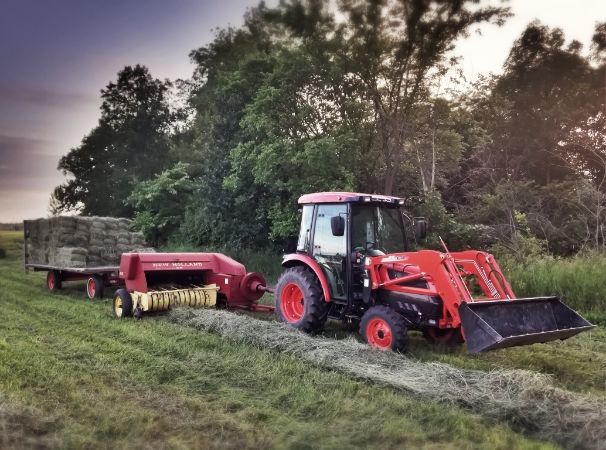
Actually this section was pretty good, mostly grass and very little clover. It had dried down well and made decent hay.

I have a Haybine, and I cut it high on purpose because the hay was so tall it was getting pulled into the rollers before getting cut. One of the side effects of having rain pretty much every day since early May. I should have started mowing back in early June, but wasn't able to start until the first week in July. The ground was wet too and if I cut lower the anthills would jam up the rolls. It was a pain in the donkey but I have to work with what I have. At least it wasn't lodged. I did leave a lot of grass in the field but it will be there for the next cutting. I mow at 3.5-4" anyway.

It's a s68 Super Hayliner. It works pretty well, at least as well as a stock Hayliner from 1958 can. When I was growing up we used an early 1950's vintage IH baler my dad bought for $100. We made a lot of good hay with that old baler.

I left the loader bucket on because I can put a dozen b ales in the bucket. It comes in handy if they fall off the front of the wagon. because I can stack them in one place without having to unhook everything. It's also a handy place to put scrap twine, tree branches, the occasional thistle, etc. I'm a one man operation, if I was haying more than 6 acres I would take the loader off. Then again, if I was haying more land I would also have better equipment.
 
   / Haying with compact tractor #71  
I understand now, you have a sickle bar mower conditioner. I have one too. Don't get used much, I prefer the DiscBine for many reasons, mainly speed and it's no concern how tall it is (been dealing with the same weather patterns you are).

I like the SB mower/conditioner for 3rd cut. I can 'shave' the ground with no plugging issue and it gives a better cut but overall, a discbine is better.

I prefer not to leave anything but stubble.

I ran a 66 for years but the chains are a PITA. The new generation balers have no chains, all gear drive except the hydraulic pump for bale tension and the packer forks and they bale at least 3 times as fast or about half as fast as round baling plus the pickups are much wider but like anything else, you need a steel hinged wallet for one. You can get one point greasing for the knotters (which I don't because I don't trust single point greasers, hydraulic tougue swing (nice) and knotter blowers.

There are 3 disadvantages to a disc machine. One, you must run a cab tractor because with a disc machine, if you hit a rock or limb in the field, it's coming forward, out from under the mower and you don't know which way its going to go... and Two, disc mowers are real susceptible to getting old poly bailer twine under the cutting heads (tirtles) and wrapped around the output shaft causing premature seal failure. preventave maintenance for me is every year before I put the machines up for the winter, I pull the heads on the disc machines and check the upper seals and remove any poly twine that might be there. Just square bailing in a field and missing a bale and then cutting later can have a serious and costly consequence. If my 575 misses a bale (rarely but it does), I always take the strings and put them in the twine box to dispose of later. A sickle bar don't have that issue but a disc certainly does. Three is, it takes some power to spin a discbine, about twice what an equal width sickle bar mo-co takes. The disc makes up for it in speed, I can mow very tall forage, forage that would plug your machine, at 6-8 mph (or as fast as I can stay in the seat...lol) and it never plugs unlike a sickle bar machine does. That in itself makes it great for heavy first cut scenario's. I used to dread first cut with the twisted from the spring wind, overly tall forage. Now, thats a non-issue.

When I pull the heads, I change the cutterbar oil and reverse the knives if needed plus I check the wear on the skid plates and deflectors on each cutterhead. Sounds like a lot but it's reall an easy job and much less upkeep than a sickle bar mower. Np knife sections to change, no guards to deal with. I run an SCH double cut on my sickle machine which I like because the SCH bar has no adjustable hold downs to set.,
 
Last edited:
   / Haying with compact tractor
  • Thread Starter
#72  
Well another 57 bales in the barn (second cutting) only problem I had this time was with the sickle mower balling up at the inside shoe. So I need to check my set up once again :)
 
   / Haying with compact tractor #74  
That's some weird stacking! How in the heck do you keep much of a load on a wagon stacking them like that?? lol

SR
 
   / Haying with compact tractor #76  
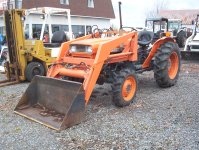
I put up a lot of hay using a Kubota L305DT. Worked the dog snot out of that tractor

google image
1484012200-1.jpg
 
   / Haying with compact tractor #77  
wish the M6800 had the high/low PTO selector. That old 305DT you could put the PTO in high range and run the engine down lower RPM and still maintain 540 pto speed. The M6800 engine has to run pretty fast to get 540 PTO speed which sucks when you're running a brush hog on light grass or a small tiller where you don't need much HP
 
   / Haying with compact tractor #78  
Exactly. I have a 30yo B6100D with a 3-speed PTO and you can throttle down for light work, but my new L4600 only has 1 speed so you have to rev the crap out of the engine to get blade speed.
 

Tractor & Equipment Auctions

2011 KENWORTH T370 (INOPERABLE) (A58214)
2011 KENWORTH T370...
John Deere 4-Bottom Plow (A56438)
John Deere...
2005 JOHN DEERE 160C LC EXCAVATOR (A59823)
2005 JOHN DEERE...
iDrive TDS-2010H ProJack M2 Electric Trailer Dolly (A59228)
iDrive TDS-2010H...
Honda EM3500S Portable Gasoline Generator (A59228)
Honda EM3500S...
204158 (A57193)
204158 (A57193)
 
Top