Garage Renovation question

/ Garage Renovation question #1  

BrentD

Silver Member
Joined
Dec 12, 2008
Messages
224
I've got a little 2-car detached garage that was apparently built around the same time my house was back in the 1930's. It's got a dirt/gravel floor and has tongue and groove siding on the outside. One side of the garage has sunk about 5 inches since I bought my house and since the garage is dark and dirty it doesn't get much use. It's probably safer to put my cars under the metal carport.

What I've been thinking about, however, is somehow pouring a concrete floor under the garage. Maybe start by lifting the walls one at a time and supporting them then pouring a curb under them with steel left sticking out far enough to join with the steel for the rest of the garage floor.

Normally I'd just tear the building down, but I've got a bit of a problem with local codes.... When my garage was built it's overhang was right on the property line so the outer garage wall is about 12 inches from the property line. City codes require any new construction to be at least 5 feet from the property line and there's not enough room between the house and the garage to move it over and still allow a walkway into the back yard. I spoke with the city inspector and he says I can do anything I want to with the existing garage without a permit, as long as it is not expanded or moved from it's current location.

So my question to you guys is, is this practical? Has anybody ever done this? If I go to the trouble of pouring the floor, would it be worth my time to dig a pit on on one side so I can more easily work on my vehicles? Any tips, pointers, etc?
 
/ Garage Renovation question #2  
We had the same situation with a 100yr old garage at our last house. Pole barn type frame, loft above, lean-to shed (big enough for small car) on the side. Two walls one foot from property line. I was young and tied up with work at the time so I hired a contractor to A-straighten the whole thing, B-pour a concrete curb/foundation, around the walls and C-pour a concrete floor in the main structure and the side shed.
When I got home the first night the building was straight (well almost). When I got home the next night they had poured a floor using the outer walls as a form. The frame poles were left in the concrete floor. I wasn't happy but the concrete was set.
That was about 30 years ago and the structure is still there. When we sold ten years ago all we had done in addition to the floor was new roofing......(and wiring, and some heating,etc)
 
/ Garage Renovation question #3  
If you get into a pit situation then you are opening a real can of worms. To be safe you will need explosion proof lighting, exhaust fans etc (gas fumes are heavier than air). If you have the head room you might be able to design some fold out ramps that you drive up. Even a 4" depression in the middle so you have "creeper" room. Your ramps could be hinged into this depression giving a level floor.
One thing that I always seem to need is an overhead hook that will hold an engine, ATV, skidoo, etc. Again its a question of headroom. Could you put a beam accross?
 
/ Garage Renovation question #4  
I've had the same situation with several 1920's detached garages. No way the city would ever permit new construction. In fact, my neighbor was over zealous and he with 2 buddies tore his garage down one weekend... after a year of trying, with much expense and paying an architect, he gave up and had to build his new garage in a new location and lost valuable yard space.

What I did was buy enough 3/4 threaded rod washers and nuts to raise the garage 6" above grade and poured a new slab. No freeze problems in CA so I didn't go with any special footings. It's been over 25 years and nothing has moved or cracked.

I pressure washed the inside and painted the wood a month later after it had plenty of time to dry out. That along with two windows made it a very usable and functional space.

I also ran a cable for 3 #10 wire for power and a phone line.

You're on the right track...

No pit option for me... not allowed anymore and city requires commercial application for variance.
 
/ Garage Renovation question #5  
I had to replace the concrete grade beam on one wall of our barn built in the 30's. Turned out to be easier than I worried about. I was worried about coming up with enough jacks to lift the building and then I saw how to do it with posts and wedges which was no real problem.

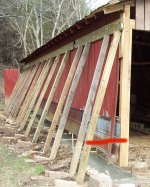
I attached a ledger 2 x 6 with bolts into the top of the wall and then used 4x4 posts set at an angle to jack the wall up. I only raised the wall enough to clear the old grade beam foundation. The 4x4 posts rested on a 2x10, and an oak wedge was driven in with a sledge hammer between the 4x4 posts and the 2x10 to raise the wall off the bad foundation. The old concrete grade beam was pretty easy to break out. Then I cleaned up the footer with a shovel, set forms and poured a new footer. Then laid block. My wood sills were also shot, and I had to replace them, too.

During the time I was doing the prep work, I also put concrete blocks under the walls to further stablize them.

You may not do yours the exact same way, but the point is that it can be done without necessarily having to buy a bunch of steel and jacks.
 
/ Garage Renovation question #6  
Archemedes said it best: "Give me a big enough lever, and I can move the world".

The trick is being able to support the wall and leave enough clearance to dig, form and pour a footing. If the structure is still sound, I say go for it. I just got done(almost) insulating, paneling and adding new shop lighting to my detached garage. The difference in usefullness and comfort in the space, particularly when it is cold and wet outside is incredible. A small Kerosene heater makes it comfortable to work in less than an hour. It is so nice now, I may even get some projects done this winter...
 
/ Garage Renovation question #7  
Ultrarunner's method is also a good one. Plus, if done right, the threaded rod supports the building until the pour.
 
/ Garage Renovation question #8  
my sister has a exact same type of garage you were talking about. she lives in a historic zone and she cant modify the outside, she cant tear down and rebuild deu to new zoning codes. her garage sits right on the edge of property line. Half of the floor is gone, just dirt and the other half was rotten wood floor over dirt. I went in and ripped out the wooden floor, had contracter come in with bobcat to dig new footers and pour new foundation walls. I covered the dirt floor with plastic and installed wooden I joists 16 OC and installed new plywood flooring on top. If you want to use as car storage, If the foundation is ok- then just have a new floor poured. IF not then now is the time to bite the bullet and have the walls, foundation fixed.
 
/ Garage Renovation question #9  
This picture may help visualize one way of lifting the wall. I added a red line in the picture where bracing could be added to further stabilize the wall once it is up. I probably should have added this brace about every four feet or so, but didn't think of it until now.

Keep in mind that I removed a concrete grade beam that was about three block high. I didn't lift this wall 18" into the air. I did remove a sag where the wall had sunk because the foundation had given way, and I straightened a bow out of the wall.

If your garage is located in an area where vandals might come along and knock your braces out, then I'd be thinking about supporting the wall with temporary cribbing, concrete block, all thread or something else until I was ready for the pour.

If you try to lift all four walls at once, you will have to add more bracing to be absolutely sure the building isn't going anywhere until you set it down on the concrete.
 

Attachments

  • barn wall.jpg
    barn wall.jpg
    212.1 KB · Views: 1,883
/ Garage Renovation question
  • Thread Starter
#10  
2manyrocks: That is exactly what I was thinking about. The building itself doesn't currently have ANY concrete at all. The two side walls have their posts sunk at least 4 feet deep into the ground. I've never dug down any further to see exactly how deep they go.

There is one slight problem that may complicate matters however. A few years ago I was having some inside remodeling done at a time when I was not in a position to do the work myself. While I was at work, my dad was sort of overseeing the work. He took it upon himself to ask the guy doing the work to see if he could level out my garage, then left. When I came home from work I discovered that the guys idea of leveling out the garage was to pry the top plate of one of the side walls loose, hammer cut pieces of 2x4 to the side of the existing studs to extend them up and then set the roof back down on them. He even totally disregarded the wiring I had done and stretched it to the point that every circuit shorted out and tripped my main 200 amp circuit breaker. When I asked him about it, he said it was fine when he left. I find that rather strange since he should have realized there was a problem the minute the lights and all the power tools stopped working. :mad::mad::mad:

As it stands now, I'm not sure if that wall is still even nailed to the studs anymore. Sometimes I think it's being held up by the sheer force of the will of the rats that have taken up residence while it's been unused due to no power, no lights, no floor, etc, etc.

Anyway, thanks so much for the ideas. At least I know it can be done, and has been done. Will probably nix the pit idea but may instead see if I can't come up with some sort of folding ramp system as was suggested.
 
/ Garage Renovation question #11  
Do you think you could get away with moving it about 6" from its location? If you can; set new 4x 6 posts just outside one wall and just inside oppisite wall and using floor jacks; pick up and shift entire building onto new posts and plate.
 
/ Garage Renovation question #12  
City codes require any new construction to be at least 5 feet from the property line and there's not enough room between the house and the garage to move it over and still allow a walkway into the back yard. I spoke with the city inspector and he says I can do anything I want to with the existing garage without a permit, as long as it is not expanded or moved from it's current location.

It's this kind of nonsense that ticks me off about codes.
Sure glad i don't have any here.

L . B .
 
/ Garage Renovation question #13  
I had to repair a house with a clay tile roof that was distroyed by termites. Roof was ok, but every wall had to be replaced.

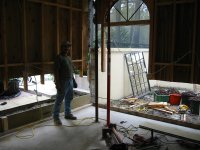
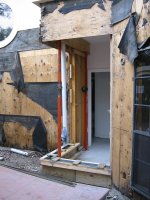
Went down to the rental house and got some large jackstands. Went to the lumber yard and got some long beams. Then a 4x4 and a hydraulic jack were used to lift structure and the jackstands held it.

I know you want to pour a slab, but you should jack from inside, and then provide final support from outside.
 

Attachments

  • 103-0337_IMG.JPG
    103-0337_IMG.JPG
    516.2 KB · Views: 281
  • 104-0418_IMG.JPG
    104-0418_IMG.JPG
    577 KB · Views: 248
  • 102-0236_IMG.JPG
    102-0236_IMG.JPG
    545.7 KB · Views: 211
/ Garage Renovation question #14  
I had to repair a house with a clay tile roof that was distroyed by termites. Roof was ok, but every wall had to be replaced.

Went down to the rental house and got some large jackstands. Went to the lumber yard and got some long beams. Then a 4x4 and a hydraulic jack were used to lift structure and the jackstands held it.

I know you want to pour a slab, but you should jack from inside, and then provide final support from outside.

I just want to make sure I have sequence correct.. You poured the slab first, raised the structure and then put down a foundation?

Wedge
 
/ Garage Renovation question #15  
man, that is some serious termite damage.....

around here, most of the old garages built in the 20s and 30s are sinking or sagging. they are also mostly built for either carriages or smaller old cars and nothing but a subcompact will fit in them. my wife's corolla was a good fit for one we had that is now a rental house. over time the old garages sink unevenly into the clay ground we have here. older footings weren't dug deep enough or wide enough, i guess.

it's good to know something could be done if we had too. i am looking at buying a house right now with a garage floor in similar condition. the walls are actually being held square with two sections of threaded bars that extend all the way across the existing floor and pull in on the walls to keep them from spreading at the base. owners in the past just know where the bars are and drive over them to park the car. not the best solution from a neatness perspective, but does the job and was easy to put in place.

amp
 
/ Garage Renovation question #16  
If you are in a position of repair only because of setbacks on property lines be careful of lifting it any amount.
I rebuilt my old rotten, rat-infested garage on exactly the same footprint but with teh new roof structure it was a little higher.
My neighbour took the opportunity to claim i built it outside the old perimter and that now the back wall is a huge monster! (5% larger than the old wall). With his lies ( a complainer doesn't have to provide proof) the municipality turned down my application for variance. So far it has cost me a year and $20k. I have a tarped over structure with a Stop Work Order sign on it!

BTW the neighbour extended his garage 10' into the setback.....
 
/ Garage Renovation question
  • Thread Starter
#17  
Fortunately I'm on good terms with all of my neighbors who would be in a position to complain. A couple of years ago I was intending to tear down my garage and workshop and build a new structure. Variances here can only be granted for 2 feet off of the 5' limit so I figured that in to the new structure. The city has to send out questionnaires to all the neighbors for input before the variance is approved. All of my neighbors were fine with the plan and the one neighbor that would be affected the most even offered to help out with the construction. The variance was approved (valid as long as construction started within 1 year) but I never found the time or the funds to get the work done. To try to build now I'd have to go back through the variance and permit process again.

I'd much rather build on my parents 50 acres about 10 miles out of town, but again, funds is the big limiter there.
 
/ Garage Renovation question #18  
It is possible to (1) pour a concrete slab just inside of where the footer/wall foundation would be, (2) raise the building straight up off the slab with a jack; and (3) pour footers and wall foundation in that sequence. Based on the post by 8934, I think he is also suggesting that the exterior walls should be braced. This approach is certainly an improvement over the termite eaten structure he started with.

Another possibility is to get a house mover to put the structure on steel and lift it up for you.

A combination of methods and sequences may be needed depending on your structure and what you have to work with. Whatever you do, be sure you can handle the work safely. You haven't gained anything if you get yourself or someone else hurt.

Anyone wanting to do this has to determine why the building is sinking and make the needed correction. In my case, the concrete grade beam was crumbling and was too narrow to start with. So a wider footer was poured.

Although my tractor was used some in the process to remove the remains of the grade beam, this is largely a pick, shovel, and wheelbarrow operation.

I think I recall that BrentD is also dealing with a post foundation. Removing the posts from underneath the wall will present some clearance issues. The building may have to be raised and then a section of posts cut off, posts pulled up further, sections cut off, etc. until the entire post is out. The alternative is to leave part of the posts and pour a thick enough footer to carry the load regardless of the posts rotting out later, I suppose.

demansoft brings up a good point about the possibility that the codes people might go nuts if the building appears to have been made taller in the process. Even if you set it down exactly at the same level, it may look taller once you eliminate the sagging. I suppose you could always establish a reference point and set it back down to that reference point if the final height might be an issue.

The other issue is having access to your neighbor's property to work on your building. It's a blessing that your neighbor is cooperative. Neighbors change. Code inspectors change. Codes change. You may want to get this done when folks are still friendly. If you get a neighbor later who won't let you work off his property, it could makes things more difficult.

My Grandmother had one of these narrow garages with a dirt floor. It had been extended to make a double car garage and had been extended to make it longer. I asked my Dad about it, and he said it was built when cars first came out and they were much narrower and shorter than cars built in later years.
 
/ Garage Renovation question
  • Thread Starter
#19  
The posts will probably be a problem. I was thinking of getting everything braced, then digging out from the inside and cutting them off with a chainsaw and using a tractor to pull out the stumps. My only problem with that is that my carport butts up against the garage and my dad's Ford/NH 1715 doesn't have a fold-down ROPS. I'd have to take it completely off to be able to work under the carport with it.

As far as the cause for the sinking... I really have no idea. The walls are not widening out, they're going straight down into the dirt. Digging down a couple of feet next to the posts I can't see any visible rot or damage to the posts. The odd thing is that the kitchen end of my house that is about 12 feet from the edge of the garage is also sinking. There is one beam about midway thorough my kitchen that appears to mark where the sinking stops. Everything from that beam on out has dropped maybe an inch since I've lived in the house. (And of course it just happens to be under the only seam in the linoleum that I had installed when I bought the house) It's almost like a fault runs though my property between the house and the garage. I know there are stories about at least one subdivision here in town being built on top of a stream. The stream used to run through town, and when they decided to build the subdivision they dropped large-diameter concrete pipe into the creek bed and piled dirt on top of it. That was done back in the early 1900's or so I'm told. Nobody seems to know for sure which subdivision sits on the underground stream now, of if it's even still there. I do know I'm about 5 blocks from the now filled in swimming pool that was originally fed by that stream, so I guess I could be on top of it.
 
/ Garage Renovation question #20  
I think the post pulling is best done with a farm jack and chain around the post or something like that instead of a tractor so you can feel what you're doing before something gets out of hand.

Now the rest of your post raises potentially bigger issues. Maybe you need to pull out your homeowner's insurance policy and take a look at what it covers?
 
 
Top