FEL Lift capacity

/ FEL Lift capacity #61  
I am saying the front tire sidewall will show reduced bulge when the heavy 3 point weight is raised'

That means a reduction in the weight placed on the front tires. we are not saying the same thing.

because you have stated that adding weight behind the rear axle INCREASES weight on the front axle and that is not correct.

Oh cross post .. OK.. Glad you got it
Unless he's driving around balanced on his front wheels I guess............
 
/ FEL Lift capacity #62  
maybe it’s confusing because a tractor isn’t a single fulcrum, it has two fulcrums...

I lift a bucket full of dirt, my back tires come off the ground, 0 pounds are on the rear tires.

I put a 200 pound rear ballast on, back tires are still off the ground, 0 pounds on rear tires, 200 more pounds on the front axle.

You have to be able to put enough on the rear ballast to make the rear end the fulcrum point, to begin to actually take weight off the front end, front fulcrum point, which is a lot of weight.
 
/ FEL Lift capacity #63  
Its not really alot of weight at all.

I guess if you are into owning a compact tractor rated to lift 1000#, and dont want to put any weight on the back, and are happy with your meager 200# of lift capacity.....and constantly bouncing the rear off the ground when digging in a pile, then more power to you.

However much weight you put up front.....you arent gonna go wrong putting that much on the back and even some more. After all, the back tires, axle, hitch, hydraulics, etc are all rated for ALOT more weight than the front.

This is just a case of worrying for nothing being afraid to use your tractor as a tractor. Like being worried about hauling 500# in a half ton pickup because it might be too much and shorten its life.

You keep replying with the misconception that everyone is running around with the back tires in the air and there is a single fulcrum. As long as the back tires are on the ground....the rear axle is a fulcrum. And it dont matter if its 1 pound or 1000 pounds.....putting weight BEHIND the rear axle WILL take weight off the front axle.

For a tractor the size of your workmaster 35.....1000# on the back aint gonna hurt a thing, its gonna be alot more useful with the front loader, and its gonna be much safer. Not sure why that is so hard to grasp. You would be doing exactly what it was designed to do
 
/ FEL Lift capacity #64  
Lol LD1.... my numbers previously where just for example..

I have a 1,000 pound concrete ballast on the back of my workmaster 35, to keep the back tires on the ground when I pick up a full bucket of aggregate, or when I’m ripping tree stumps out with the front forks.

Guess we will have to agree to disagree..
 
/ FEL Lift capacity #65  
There is one thing for DAM sure - I don't have Rim Guard(1550#) in the rear tires and a 1050# rear blade on my M6040 to save my front axle from potential damage when lifting heavy objects. The fulcrum effect of the rear blade on the front axle does help but overall it is minimal. That front axle had dam well better be able to take the full load - period, and it does.

The loaded rear tires and the rear blade - in my mind have no bearing, what-so-ever, on reducing the load seen by the front axle. Its there strictly to keep my A** firmly planted on the ground.

If you are thinking you need enough weight on the 3-point to save your front axle from potential damage - somewhere you have crossed wires.
 
/ FEL Lift capacity #66  
The loaded rear tires and the rear blade - in my mind have no bearing, what-so-ever, on reducing the load seen by the front axle. Its there strictly to keep my A** firmly planted on the ground.

If you are thinking you need enough weight on the 3-point to save your front axle from potential damage - somewhere you have crossed wires.

I agree, rear ballast and or loaded tires simply help keep the rear on the ground, making it safer.
 
/ FEL Lift capacity #67  
For those who understand, no explanation is necessary. For those who don稚 understand, no explanation is possible.
 
/ FEL Lift capacity #68  
MAYBE everyone is misunderstanding me... talking over the Internet is difficult..


Rear ballast weight does go onto the rear axles, but some of that added weight also transfers to the front when you have your FEL loaded.
 
/ FEL Lift capacity #69  
MAYBE everyone is misunderstanding me... talking over the Internet is difficult..


Rear ballast weight does go onto the rear axles, but some of that added weight also transfers to the front when you have your FEL loaded.
With rear ballast and nothing in the loader the front axle weight is reduced, by adding weight to the loader you are increasing the front axle weight, the only way to increase the front axle weight beyond that of unballasted would be to lift enough weight with the loader that the rear tires weight decreases below that of the unloaded and unballasted state. A properly ballasted tractor will run out of hydraulic capacity well before that happens.

It's two fulcrums working against each other.
 
/ FEL Lift capacity #70  
Try something. Take a 2x4, 8 ft long. Place a fulcrum under it, 2 ft from the end. Place a bathroom scale under the other end. Make note of the scale weight.

Now place a 5 lb weight on the end opposite from the scale. Make note of the weight shown. The more weight added, the less weight will show on the scale but it isn't a 1 lb loss for every 1 lb added. But, no matter how much weight is added, some weight will be taken off the scale.

I'm no engineer, but a tractor doesn't have a single fulcrum in the middle. A better test would be, take an 8-inch long 2x4 (most tractors are roughly twice as long as they are wide) and put TWO fulcrums under it very near each end. Would be curious as to the results! :)
 
/ FEL Lift capacity #71  
Jcoon is right. Especially when it comes to bouncing around a worksite. It makes the middle of the tractor take a lot of bending force. Probably not enough to break in two but definitely something to consider.

His point was why overload or run at full max? Take 2 trips and be safe as well as keep your tractor lasting longer.

¬---^--0---
 
/ FEL Lift capacity #72  
I haven’t read this whole thread but I’ve read at least a dozen before. It takes a substantial amount of weight on the back to lighten the front axle load. Anyone who thinks adding something simple like a box blade is saving the front axel is wrong. My tractor loader still has the hydraulics to lift the back end off the ground with loaded tires and a box blade. It doesn’t take a genius to see the base tractor weight plus 1000 pound is harder on the front end than just the base tractor weight. I’ve done at least 2 small scale demonstrations with a plastic loader.
 
/ FEL Lift capacity #73  
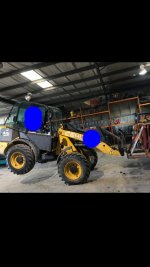
Here’s a picture a buddy send me. I’m sure if he had another 1000 pounds of counter weight and was actually able to lift the load the front axle load would be less, right? IMG_4615.JPG
 
/ FEL Lift capacity #74  
The distance the rear ballast is from the rear axle affects the load on the front axle also. My 472 Brown would get the front end light on my 4610 SU. It was a 6 foot cutter and leveraged the weight further back from the rear axle. I think it weighed around 1100#.
 
/ FEL Lift capacity #75  
MAYBE everyone is misunderstanding me... talking over the Internet is difficult..


Rear ballast weight does go onto the rear axles, but some of that added weight also transfers to the front when you have your FEL loaded.

I still aint sure if you get this or not. So I am gonna try one last time to spell it out. I think you get it. Because as long as your hydraulics are strong enough to lift the @$$ of the tractor, then yes, the more weight ultimately adds to the front end.

Tractor comes with just a bare machine and no ballast.

No ballast. 4000# tractor + loader. Loader can only lift 400# before the rear end comes off the ground. 4400# is now on front axle

Add 400# rear ballast. This allows you to lift 700# with the front end loader before rear end hikes. 5100# is now on front

Add 600# ballast. This allows you to lift the full max 1000# of the loader, but the rears are just floating. for all intents everything is on the front. We now have 5600# on the front.

5600# is the MOST the front is gonna see. ANY additional weight above and beyond the 600# is now gonna start reducing the front axle load and adding it back to the rear.

800# on the rear (200# more than just floating the rear end). Lets say that additional 200# of ballast transfers 150# back off the front end. We now have a total tractor weight of 5800#, but only 5450# now on the front.

Lets jump to a 1200# weight This might transfer another 300-400 off the front. So now we have a tractor with a total weight of 6200# and only 5000# over the front when in MAX lift mode. and keeping 1200# on the rears as opposed to very little.

These numbers arent representative of anything, just for illustration purposes.

But I think the issues lies with you thinking that just because I add more weight to the back automatically means I am gonna lift more weight up front as a result. And yes.....if thats what I do, then yes, thats more weight on the front.

I am talking about like for like. Let me end with a simple question to see If you have a good grasp.

If I have a 2000# pallet I want to move with my pallet forks....and I put my 1200# rear blade on I can move it. I can ALSO put my 1600# mower on (same weight center behind rear axle) and move said pallet. Which one is gonna have the least load on the front axle?
 
/ FEL Lift capacity #76  
OK guys see the problem is you’re putting words in my mouth all I ever said at the beginning was that putting a rear ballast on the tractor will put more weight on the front end as you have proven with your numbers at the beginning you wrote 4400 pounds is now on the front axle at the end you’re at 5000 pounds over the front axle. And at one point in your example we were at 5600 pounds on the front axle .
 
/ FEL Lift capacity #77  
OK guys see the problem is you’re putting words in my mouth all I ever said at the beginning was that putting a rear ballast on the tractor will put more weight on the front end as you have proven with your numbers at the beginning you wrote 4400 pounds is now on the front axle at the end you’re at 5000 pounds over the front axle. And at one point in your example we were at 5600 pounds on the front axle .

The problem is you act like you dont understand the physics, or english I guess.

Putting more weight on the rear end of the tractor will NOT put more weight on the front end as you claim it will.

WHY, because you DIDNT elaborate.

Putting more weight on the back "CAN" increase the load on the front "IF" you choose to lift more with the loader as a result.

IF you simply need to move a 500# pallet......and you choose to do it wit nothing on the back.....or choose to do it with 500# on the back.....adding the weight is NOT going to put more weight on the front axle.
 
/ FEL Lift capacity #78  
Putting more weight on the back "CAN" increase the load on the front "IF" you choose to lift more with the loader as a result.

THANK YOU LD1 for trying to explain this completely basic physics problem.

Let me add one more caveat, "Putting more weight on the back "CAN" increase the load on the front "IF" you choose to lift more with the loader as a result." AND, only if you CAN lift more weight. If your loader relief valve is already kicking in, additional rear ballast will REDUCE front end weight by using the rear axle as a fulcrum.

Any weight behind the rear axle moves the center of gravity rearward on the tractor, reducing front end weight. JCoon is only right IF and WHEN the rear axle comes off the ground from lifting too much. BUT! If you have sufficient rear ballast, the rear NEVER comes off the ground before the relief valve hits, thus, reducing front end stress. It's that simple.
 
/ FEL Lift capacity #79  
I had two paragraphs of the most simple answer I could conceive - but I gave up. You MUST understand the basic principles of physics even to understand the simplest answer.

Jcoon - you are just going to have to take it on faith. Putting weight on the 3-point WILL DECREASE the weight on the front axle.
 
/ FEL Lift capacity #80  
I think I get it now. It's all about how the weight is balanced between front and rear.

4000# bare tractor, no FEL, no rear implement. Weight is *approximately* equal on front and rear axles.

Add a FEL + load totaling 1000# to the front, you have not only added 1000# to the front axle, you have also transferred *some of the rest of the tractor weight* to the front, due to the front wheels acting like a fulcrum. And if the rears come off the ground, you have transferred ALL of the rest of the tractor weight to the front wheels.

Now add 1000# implement to the rear, and you've rebalanced the tractor, causing the weight to be more evenly distributed between front and rear. You have effectively *reduced* the weight on the front wheels.

So.....with a 1000# load on the front, a 500# implement on the rear would reduce the load on the front, and a 1000# implement on the rear would reduce it more, etc. etc. keep adding weight to the rear and eventually the front end lifts off the ground, removing ALL of the weight off the front. A wheelie. :)

Is that sort of it?
 

Marketplace Items

2015 KOMATSU D61PX-23 CRAWLER DOZER (A60429)
2015 KOMATSU...
YANMAR VIO35-5 UNIVERSAL EXCAVATOR (A60429)
YANMAR VIO35-5...
2014 Freightliner M2 106 Palfinger PK22002EH 6 Ton Knuckleboom Flatbed Truck (A55973)
2014 Freightliner...
Year: 2019 Make: Nissan Model: NV200 Vehicle Type: Van Mileage: 88,557 Plate: Body Type: 4 Door Van (A55853)
Year: 2019 Make...
TANK MANIFOLD (A58214)
Case Titan 3530 (A61307)
Case Titan 3530...
 
Top