Generator Electrical Engineering Question

/ Electrical Engineering Question #41  
"Not arguing, just interested in this last sentence, I know that the small Honda gensets such as the 2000 and 3000 inverter units tie the outputs together when you chain them together. Always thought that odd is this the same principle?"

The small hondas are DC generators driving an inverter. Totally different.

 
/ Electrical Engineering Question #42  
Please let us know what the Tech. says, I would really like to know what the phase is supposed to be.

E/S
 
/ Electrical Engineering Question
  • Thread Starter
#43  
E/S-Will post after I make contact with a tech. Dropped the end bells off this morning to have new steel sleeves put in. Machine shop owner said "no problem in matching to the bearings".
David
 
/ Electrical Engineering Question
  • Thread Starter
#44  
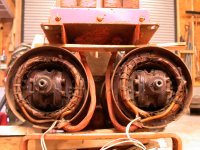
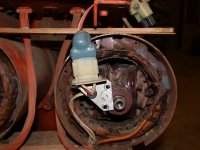
Took some time tonight and added pictures of both units brush end showing the armature locations. Second picture shows the sealed voltage regulator.
 

Attachments

  • DSCN4803.JPG
    DSCN4803.JPG
    663.4 KB · Views: 144
  • DSCN4805.JPG
    DSCN4805.JPG
    691.9 KB · Views: 142
Last edited:
/ Electrical Engineering Question #45  
dangier_VA.. When you get the gear back together and try it take readings from the individual units .. It almost sounds like one unit is trying to pick up the whole load.. I'll give Generac a call next week and see if they have any information on this unit,,
 
/ Electrical Engineering Question #46  
The heads are in series therefore they should be in phase (zero deg) to produce maximum voltage. 180 deg appart will produce zero voltage.
 
/ Electrical Engineering Question #47  
I ran your set-up on a simulator. (Electrical circuit simulater program) If you are wired in series, the polarities are reversed, and the phases are 180 degrees off, you will indeed get 240 volts. Here's the interesting part, if your phases are off by 10 degrees, you should only see a few volts drop at a 5K resistive load. I'm not sure if the circuit will post, but at 10 degrees, or 170 degrees out of phase, you still get 239 volts.
 
Last edited:
/ Electrical Engineering Question
  • Thread Starter
#48  
Attached is a crude diagram of my unit. I had said it was in parallel since each coil furnishes a leg to the breaker. Looking at the diagram it could run each way.

Still trying to wrap my head around the following statement:
"The heads are in series therefore they should be in phase (zero deg) to produce maximum voltage. 180 deg appart will produce zero voltage."

From my simple understanding, heads in 0 degrees would produce a single sine wave but double amperage, and heads at 180 degrees would produce a double sine wave and half of the amperage. Does this make sense. Which is better?
 

Attachments

  • generac wiring diagram.pdf
    4.3 KB · Views: 184
/ Electrical Engineering Question #49  
I am not a good source beyond theory, but it looks like a split phase transformer setup which in my limited expierence fits your set-up. Each phase is 115, and puts out 230 when added together. I think your good with the set up, the regulaters may not keep your voltage tight because of their age, or configuration. Probably not a good source for sensitive electronics. Get a tech's opinion first...
 
/ Electrical Engineering Question #50  
I did a simulation to illustrate the meaning if 180 degrees phase difference.The voltages at any moment in time cancel each other out unless one's polarity is reversed. Each phase is a different color. I then did one at 20 degrees out of phase to show both phases closer in sync. If you are 180 degrees out, and reverse one phase's polarity, you will only see one line on the scope. The phases are added, tthey add the peak voltages at a moment in time. View attachment 172983

View attachment 172984
 
/ Electrical Engineering Question
  • Thread Starter
#51  
mbohuntr-Fits in with what I am thinking. Many thanks-how extensive is that program?
David
 
/ Electrical Engineering Question #52  
It's called Multisim, It will do everything from simple AC/DC to radio and digital simulations.
 
/ Electrical Engineering Question #53  
I ran your set-up on a simulator. (Electrical circuit simulater program) If you are wired in series, the polarities are reversed, and the phases are 180 degrees off, you will indeed get 240 volts. Here's the interesting part, if your phases are off by 10 degrees, you should only see a few volts drop at a 5K resistive load. I'm not sure if the circuit will post, but at 10 degrees, or 170 degrees out of phase, you still get 239 volts.

It all depends how you connect the windings of each head together. If you connect them such a way that both are in the same direction both heads have to be 0 degrees. If you reverse one of the windings (as in the simulation) you have to offset one head by 180 deg.
 
/ Electrical Engineering Question #54  
wow.. that's odd. many ups types actually LIKE the sine wave that a genny puts out.. vs the sinusidal or stepped square wave that inverters put out. must be some noise on the waveform or a grounding issue that the ups didn't like.

soundugy

Just thought of something else-We have a 1500 watt ups for the computer, router, and satellite equipment. The last January's power outage, the ups did not like the power from the generator and would not switch over. Had not had an extended power outage before and didn't notice that. We have extended capacity batteries and they last a day or two.
In checking the 60 cps, my meter is reading a solid 60 cps on utility power. I can run the meter all around and zero in at 60 cps easily with the rpm adjustment, so I think the meter is close enough.
 
/ Electrical Engineering Question #55  
wow.. that's odd. many ups types actually LIKE the sine wave that a genny puts out.. vs the sinusidal or stepped square wave that inverters put out. must be some noise on the waveform or a grounding issue that the ups didn't like.

soundugy

Is it possible the inverter clock pulse (Digital to Analog) runs slower on some inverters giving you a choppy waveform?
 
/ Electrical Engineering Question #56  
dangier_VA.. Talked with Generac today... and as I thought it is an old unit and not in there computer setup.. I told they guy your questions, #1 voltage being high 127 and 129.... He admitted yes but not that bad.. #2 that you had a bearing issue and were worried if you skipped a tooth putting it back in,, He said not to worry about skipping ..

Other comments he had were that if you had a bearing issue in one of the heads this could cause a voltage problem.. because of the rotor not running in a perfect circle. ?? another thing he said was allot of the older pto gen sets ran at 58 to 59 hertz. and that kinda makes since with the ups issue you had too.. Ups's don't like high volts but don't mind a little less hz.. He said to try setting your rpm more for the voltage but keeping the hz within limits..

Hope this helps..
 
/ Electrical Engineering Question
  • Thread Starter
#57  
hr3-Many thanks for following up on the generator. The shop called today and the end bells are finished with new bearing sleeves. Will get them tomorrow and look at putting everything back together this weekend and will post results.
Did Generac give you any indication as to the year?
Thanks again,
David
 
/ Electrical Engineering Question #58  
Re: Electrical Engineering Question
hr3-Many thanks for following up on the generator. The shop called today and the end bells are finished with new bearing sleeves. Will get them tomorrow and look at putting everything back together this weekend and will post results.
Did Generac give you any indication as to the year?
Thanks again,
David

No he didn't sorry,, but most times when they "chuckle" it's about 20 years old,, when they "Laugh" it's over 30.. He chuckled,,,:laughing:
 
/ Electrical Engineering Question #59  
My educated guess is that they are identical heads wired in series but the phases have to be correct which I'm assuming you didn't fiddle with (wiring that is). The voltage imbalance is neglectable as each head may not be perfectly wound possibly causing more or less voltage on one or the other or (and this is a guess) that your resistive load is across the 240 volt. If you could put the same load on each generating head you could see if you get the same loaded voltage from each head with the identical load. Frequency within reason (a few hertz) is irrelavent to most household devices with some electronics being the exception. Good luck and thanks for all the info. I stand to be corrected if I stated something wrong.


Thanks
Steve
 
/ Electrical Engineering Question #60  
Frequency within reason (a few hertz) is irrelavent to most household devices with some electronics being the exception.

Exactly. If you ever been to a grid distribution center, the frequency fluctuates more or less, same for voltage.


Marketplace Items

2005 Peterbilt 357 Truck (A55973)
2005 Peterbilt 357...
2017 Hino 268 Cab and Chassis Truck (A59230)
2017 Hino 268 Cab...
2004 Freightliner FL70 Garbage Truck, VIN # 1FVABTCS64HM47795 (A61165)
2004 Freightliner...
LIMA MAC 60KW GENERATOR (A58214)
LIMA MAC 60KW...
2007 GMC C7500 24FT BOX TRUCK WITH ROLL UP DOOR (A59904)
2007 GMC C7500...
2016 Chevrolet Silverado 1500 Single Cab Pickup Truck (A60352)
2016 Chevrolet...
 
Top