Generator Electrical Engineering Question

   / Electrical Engineering Question #1  

dangier_VA

Silver Member
Joined
Sep 27, 2005
Messages
180
Location
Page County, VA
Tractor
Kubota L3901, L3130
Had an occasion to use my pto generator due to a power outage a few days ago. Sounds like a bearing was failing in the brush end. It is an old Niagara Power (Generac), dual 7500 watt power heads for 15,000 watt capacity. Rated for 115/230 volts, 60 cycles at 3600 rpm (540 rpm pto speed).
In pulling the pto speed increaser apart, the large driven gear that drives each power head came off with the case. In order to not loose the armature locations, I marked them as they were. Both had turned some when the gear case was pulled apart as the teeth are cut an an angle on the gears. When I put the gear case together, my marks were a little off for the armatures to be exactly 180 degrees out to produce 230 volts in tandem. I lined up both armatures exactly 180 degrees out (My marks were about two teeth off on the driven gear). Today I test ran the generator and noticed the following: While running the pto speed to produce 60 cycles, the voltage outputs were 127/129 volts (hot to neutral-both legs), and 250 volts (hot to hot). Too high!!! These readings were taken while unit was under a 5000 watt resistive load.
Now the question--Were the armatures on purpose not at 180 degrees apart to derate the generator to the correct voltage? Guess I need to pull down and slip the gears a few teeth and try again.
I still have the bearing noise.... Bearing housing is worn larger than the bearing external diameter. Tried peening with a punch and need to do more.

 
   / Electrical Engineering Question
  • Thread Starter
#2  
...Thinking about this a little more. Am I right in thinking that the armatures should be 180 degrees out for max power and the individual voltage regulators should control the voltage output as needed. As long as the rpm is correct for the 60 cps.
I cleaned and checked the wiring connections while I was in there. Could that have changed something?
..Still thinking
 
   / Electrical Engineering Question #3  
I have no experience with a double head generator but I wouldn't think the rotating members would need to be timed. I would assume there is a voltage regulator that has some adjustment. That said I don't think your voltages are high enough to be a concern. I've always heard +/- 10% is acceptable.

Kim
 
   / Electrical Engineering Question #4  
Sir
A few pics would be of interest, you may not be the first to have taken the generator apart so do not rely on what you have found.The worn end bell repair by center punching will not last forever. Use a C3 grade bearing which are for electric motors, they have a more relaxed tolerance and 2RS ( two rubber seals ) are fine, ZZ means steel shields only for high heat.
Craig Clayton
 
   / Electrical Engineering Question #5  
How do you know it was 60 Hz? Not by the tractor's rpm indicator, I hope....
 
   / Electrical Engineering Question
  • Thread Starter
#6  
zzvyv6-Nope, by power/cps meter.

KWentling-The generator gets the 220/240 volts from the paralleling of the power heads with the wiring (one leg from #1/one leg from #2) to the breaker. Would it make sense to get the max use of the magnetic field? The other leg from each power head is grounded.

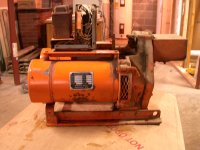
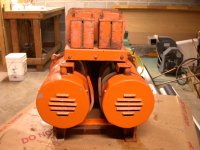
Craig Clayton-I have pictures of the complete unit (attached). Did not take pictures when it was broken down. I may have to go to a larger bearing and have a machine shop bore out the end bell. Right now I have about .20 slop.
 

Attachments

  • DSCN2931.JPG
    DSCN2931.JPG
    850.2 KB · Views: 292
  • DSCN2930.JPG
    DSCN2930.JPG
    867.3 KB · Views: 292
   / Electrical Engineering Question #7  
I may not totally understan this but I will throw my opinion out there.

Each head is supposed to generate 120v.

It shouldn't even matter if the two heads arent 180 degrees appart, IF you never use 240v from it. The fact that you are getting 250V is die to each head making more than 120V each. Changing the timing will drop the higher voltage reading, but wont be 180 appart, which may be worse for whatever you run than just having 250V. Most everything you buy that is 240V can run on +/- 10%. Which would be 216v-264v and you should be fine. But the root cause of your problem lies in each individual head making more than 120v, and NOT the timing of the two units.

If you have an accurate meter, verify that you are indeed getting 60Hz. If you are getting more than 60, slow the RPM down till you get 60 and then re-check the voltage. Too many RPM's will give you more HZ but will also increase the voltage slightly.
 
   / Electrical Engineering Question #8  
If you really want to check the "timing", an oscilloscope would easily show the two waveforms.
 
   / Electrical Engineering Question #9  
dangier_VA,, Do you have any readings from before you took it apart?? What are the voltages with no load??? Model and ser. num. off unit would be nice too..
 
   / Electrical Engineering Question #10  
I second the motion to use an ocilloscope to check this out. Its not the voltage of frequency that you should be concened about, but the phase content. Chances are that there was a hiccup in the sinusoidal waveform at around zero volts that's going to worry the circuit of any motor or trnasformer that its hooked up to. Such a unit will run extra hot because of this waveform deviation and will probably cause premature failure in its windings or worse, a fire.

You may have actually fixed the condition. Just like extra pressure won't hurt a garden hose if its a good quality deal, the extra voltage won't either as long as it doesn't jump the insulation insulation. The glitch in the waveform though will have serious consequences.

Be carefull to make sure the windings and armatures are also symetrical. The gears may not reflect the true symmetry of the two alternators. The gears may have been adjusted to give perfect correlation.
 
   / Electrical Engineering Question #11  
One thing I am not reading is what the voltage was before you disassembled the generator, maybe the 127-129, 250 is normal.

Bill, not everyone has access to an O-scope, nor the ability to use one. Even better yet, a Fluke 434 power analyzer.
 
   / Electrical Engineering Question #12  
You are less then 5% high, you are within the parameters that your utility company has to provide so don't worry about it. When you take it back apart make sure that you are 180 out when the gears are meshed together all the way, with this type of gear the two will be out of time when the teath are first engaged but when it slides all the way down the shaft rotates and changes the timing.

Soot
 
   / Electrical Engineering Question
  • Thread Starter
#13  
Transit-We ran the generator last January for 5 days straight (off at night), and as I recall the readings were 124/125 volts per each leg and 240 volts combined.

hr3-If memory serves me right, the no load voltage was around 127/128 in January. The generator (alternator) is brand named Niagara, with Generac in small letters on the bottom of the name tag. Model # 5403-3, serial #0161083.

Many thanks for the responses. I only moved the gears what would amount to two teeth from one power head to the other. Would that small adjustment caused the increase in voltage? Should the voltage regulators maintain a setting of 115 volts per power head as listed on the data tag? Should the regulators be checked?

I think I am going to look into brush end bearings with a larger diameter and have the end bell bored out for proper fit. Just have to get the old bearing off. No puller space, so modifying a auto alternator pulley puller and hope it will have the strength.
 
   / Electrical Engineering Question
  • Thread Starter
#14  
Just thought of something else-We have a 1500 watt ups for the computer, router, and satellite equipment. The last January's power outage, the ups did not like the power from the generator and would not switch over. Had not had an extended power outage before and didn't notice that. We have extended capacity batteries and they last a day or two.
In checking the 60 cps, my meter is reading a solid 60 cps on utility power. I can run the meter all around and zero in at 60 cps easily with the rpm adjustment, so I think the meter is close enough.
 
   / Electrical Engineering Question #15  
If your two waveforms are not in phase, your voltage and power will suffer. I would talk to a generac tech and get their input.
 
   / Electrical Engineering Question #16  
If your two waveforms are not in phase, your voltage and power will suffer. I would talk to a generac tech and get their input.

Ditto... I'm thinking you are out of phase.
 
   / Electrical Engineering Question #17  
I think I am going to look into brush end bearings with a larger diameter and have the end bell bored out for proper fit. Just have to get the old bearing off. No puller space, so modifying a auto alternator pulley puller and hope it will have the strength.[/QUOTE]

Just have the machine shop (preferably a motor shop) sleeve the housing back to the original bearing size. We do that all the time at the shop I work at. Make sure they use a bearing chart and get the proper fit. A C3 bearing should be a push in fit with no rocking or turning in the housing. Your talking of center punching the housing fit made me cringe.

Lots smarter generator people here than me. I've worked in motor shops for the last 30 years as a machinist and I don't remember ever seeing a generator like yours come through the shop. We have a generator guru at the shop. If I can think of it I'll question him about it. Cycles can be checked with an electric clock plugged into the generator compared to a watch second hand. Done that before to get engine RPM correct on the farm. Then adjust the voltage regulator to get the voltage right.

Kim


Kim
 
   / Electrical Engineering Question #18  
I'm wondering what you are measuring the voltage with?
Many meters will read AC voltages all over the place if it isn't a really pure sinusoidal waveform. Most generators I've looked at with a scope aren't that pure and clean.
Do the generators even have any sort of voltage regulators? Some don't.
 
   / Electrical Engineering Question
  • Thread Starter
#19  
Checking the power voltages with a Fluke digital meter. Double checked with an older Simpson analog meter. Both were within 2 1/2-3 volts.
Appreciate the responses.
David
 
   / Electrical Engineering Question #20  
zzvyv6-Nope, by power/cps meter.

KWentling-The generator gets the 220/240 volts from the paralleling of the power heads with the wiring (one leg from #1/one leg from #2) to the breaker. Would it make sense to get the max use of the magnetic field? The other leg from each power head is grounded.

Craig Clayton-I have pictures of the complete unit (attached). Did not take pictures when it was broken down. I may have to go to a larger bearing and have a machine shop bore out the end bell. Right now I have about .20 slop.

Probably better off having a sleeve inserted. The housing might not have the strength if you bore it out to the next bearing size. The housing can be bored out to, say, .050" oversize and a sleeve inserted and locked in with Lock Tight Sleeve Retainer. If you go to a larger bearing you have the armature shaft diameter to contend with also.

Rob


Tractor & Equipment Auctions

Crown RM6025-45 4,500 LB Stand-On Electric Forklift (A59228)
Crown RM6025-45...
VOLVO A40D OFF ROAD DUMP TRUCK (A60429)
VOLVO A40D OFF...
Caterpillar D5G LGP (A53317)
Caterpillar D5G...
2021 UTILITY VS2DX 53FT DRY VAN (A59905)
2021 UTILITY VS2DX...
2023 NEW HOLLAND WAGON TONGUE AND LOADING CHUTE FOR NEW HOLLAND SQUARE BALERS (A55315)
2023 NEW HOLLAND...
2004 TAKEUCHI TL140 SKID STEER (A60429)
2004 TAKEUCHI...
 
Top