Driveway sinking

   / Driveway sinking #1  

nrc17gto

Silver Member
Joined
Mar 7, 2011
Messages
129
Location
Mt. Juliet, TN
Tractor
Bobcat 753, Ford 555D, Kubota L2800
Hi TBN!

I admittedly did not know a lot about building a road when I started clearing and getting ready for the shop build a long time ago. So now that we actually have the house built (for about a year now) I was hoping to get it in a lot better shape for the winter. The driveway (road) is about 1800' long in total. The first section has pretty large rock on it with fines that has held up pretty well but there were some problem spots where water was running down the middle (because I was a newbie) on the second section so I created drainage on the sides and a few small trenches cutting across the driveway to divert it to those trenches where necessary. I should mention that some of this driveway is running uphill/downhill so the water can really gain some speed. I also had water ponding in front of my shop and no driveway yet running from the shop to the basement garage. So I dug out (also expanding) all of the area in front of the garage to get it graded so that it would better drain the proper direction away from the driveway. This got rid of the ponding issue. I then had 3 truck loads of 1.5" crusher run brought out. Two of these were spread on the second section to the shop, the third stockpiled. After boxblading the two spread loads that section of driveway is working pretty well. I have to do just a bit more to it but is way better than it used to be.

So here is the issue and where I need some experience. I spread the third load on the area in front of the shop and around to the basement garage. Graded it all with the box blade and compacted it with my bobcat (also compacted the dirt underneath with my bobcat the best I could). Looked great! I noticed immediately after it got some moisture in it that when driving on it cars just SINK IN. I mean bad. Like nearly getting stuck in it. I am feeling a bit defeated at this point but I really need to get it fixed before winter gets any closer and sets in. Here are some options I am thinking of.

- Get much larger rock (maybe 2.5"-3"?) and spread it all across this area and compact, wait til spring and put the crusher run down if needed
- Get driveway fabric and put down then rock
- Concrete the whole area (not the whole driveway), I want this eventually but not sure I can afford it before winter
- Asphalt the whole area (should be lower cost than concrete but got an estimate on the entire driveway of $42k!)

Any other thoughts are welcome. Our dirt area in the back of the house is all muddy all the time too, very frustrating. I am thinking that may be because of our high clay content in the middle TN area. Not sure if I sow some good grass out there in spring if it will tie it all together or if I need to get top soil first.

Attached a picture. The driveway over to the basement garage goes off to the right but it did not have gravel on it yet.

Thanks as always,
Nick
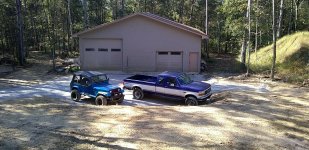
image000000_10.jpg
 
   / Driveway sinking #2  
Did you remove all the organic material where the driveway is before laying down the crusher run? If you still have an organic layer, which it sounds like, nothing short of full removal or concrete will fix the problem. A road needs to be brought down to a stable surface and then built back up.

This forrest service manual is one of the best sources of information on how to prep, crown, drain, and maintain a road.

https://www.nrs.fs.fed.us/fmg/nfmg/docs/mn/roads.pdf
 
   / Driveway sinking
  • Thread Starter
#3  
Hi Snobdds,

Yes, there was nothing but dirt there and some larger rocks before I put the new gravel down. It seems to just be sinking into the dirt and not forming a good base as I had hoped.

Thanks,
Nick
 
   / Driveway sinking #4  
I added a FS manual which will give you some good ideas. The forrest service put a lot of time, research and money into developing roads. Good read if nothing else.
 
   / Driveway sinking #5  
I agree with Snobdds thoughts. You need to remove the crusher run and then dig down to solid stable ground. I always put down a layer of 3/4" stone first and pack it down. Then follow with a layer of crusher run, which will work its way down through the 3/4" enough to give you a firm road.
 
   / Driveway sinking #6  
Some dirt cannot be compacted with any hope of longevity. Also, moisture content in the dirt at the time is critical. Too dry is as bad as too wet. Actually, in some ways it's worse. Dirt that is too wet will tell you it's not compacting the more you try to work it, will get spongy. Dirt that is too dry will fool you. It will display characteristics of a great compaction. Then the first time it gets rained on it will show you that it's not compacted well at all. I elevated 1/4 mile of roadway, in some places 15ft, this Summer. Dirt was too dry. Compacted great at the time. First rain it showed me it was not compacted. Finally with traffic and continuing to add gravel I've got a solid roadbed. But don't get over to the shoulder edge!!!!! Still soft there.....
 
   / Driveway sinking #7  
You are in for a learning experience.
Rocks, dirt, clay and water. If your base soil is high in clay content and you get high moisture content from normal water movement
you will always have problems. Above grade water is somewhat controllable by ditches and drainage, water that migrates thru the soil
is extremely difficult to control, sometimes drain tiles and gravel filled ditches can divert it from areas you are concerned with.
Where I live we have clay and hardpan when it becomes saturated it loses all support ability, my driveway has been in use for 50 years
and depending on the soil moisture some places will become quite elastic and non supportive. In the spring when the ground thaws I have
3 locations that will actually move under foot, when a vehicle drives on it, it will flex downward from the load and then float back up, this has had
gravel, crusher run and rock added for years the stone seems to actually migrate downward and the hardpan clay upward, highway fabric has been the
only somewhat permanent solution I have seen. My recommendation would bet to lower the grade 8-10 inches from your desired final grade put down
heavy road fabric and cover with gravel or stones and rock dust, some places may need stone and drain tile to try and dry it out. One problem with
road fabric is it will allow the road base to migrate downhill on steep grades.
Good Luck
 
   / Driveway sinking #8  
From the picture it looks like the ground is sloping toward the front of your shop. That would channel water there before it worked its way to the side. I'd suggest drainage ditch sloping around your drive and crowning your drive to remove water before it soaks in and creates a below surface muck spot. -Drainage ditches/culverts around the perimeter of the drive and shop to channel water away around what you want to stay hard and dry might work to reduce flowing surface and below grade water.
Goodluck.
 
Last edited:
   / Driveway sinking #9  
Until you get a better base that is stable, I wouldn't think about concrete or asphalt. Last year I put in a few hundred feet of a new drive and where I pulled several stumps, I put in a couple tons of limestone rip rap (5"-12" large stone) in each hole then #1-2 limestone overall, which has been completely stable.

So other than a big excavation...adding larger #1-2 stone (different names different places) and letting that settle with possible fabric and more stone is something to consider along with grading/drainage as mentioned.
 
   / Driveway sinking #10  
The problem isn't with the material you are putting down. You must divert all water run off from other areas before it reaches your drive then give rain that fall's on the drive a way to run off BEFORE laying down material. If drainage is bad,you will never have decent driveway or parking. A word to anyone planning to build on undeveloped land,do all the grade work and create drainage BEFORE doing anything else. This is a job for a crawler tractor. A newly compacted dirt drive should be at least 12" higher than surrounding area before laying the first rock.
 
   / Driveway sinking
  • Thread Starter
#11  
So sounds like I need to get a better look at my water flow during a rain to see what I can change. Get that fixed, remove the existing rock that I can, add LARGE rock to it and grade appropriately. I really appreciate all the fast replies. Let me know if there are other thoughts please.

Nick
 
   / Driveway sinking #12  
At this point I wouldn't remove any material unless funds are exhausted and I have lots of spare time,just be smart with what kind and how much to add. "Crusher run" or whatever the term used earlier is subjective and can mean any size or combonation of sizes. What you want now is smaller material that can fall down in and around what's on top right now. That "LOCK"S"the larger rock togeather to prevent some of the wiggle when tires pass over. If top layer is 2" or larger,it might be best to cover with 1/4tr" then wait until it settles then top again with fines (the material a little larger than masonary sand that is produced when any size rock is being crushed. River sand will work in a pinch but is smooth and rounded which is inferior to jagged edge fines. Hope that's as clear as muddy water. OOPs,I shouldn't mention muddy.:duh:
 
   / Driveway sinking #13  
Hi TBN!

I admittedly did not know a lot about building a road when I started clearing and getting ready for the shop build a long time ago. So now that we actually have the house built (for about a year now) I was hoping to get it in a lot better shape for the winter. The driveway (road) is about 1800' long in total. The first section has pretty large rock on it with fines that has held up pretty well but there were some problem spots where water was running down the middle (because I was a newbie) on the second section so I created drainage on the sides and a few small trenches cutting across the driveway to divert it to those trenches where necessary. I should mention that some of this driveway is running uphill/downhill so the water can really gain some speed. I also had water ponding in front of my shop and no driveway yet running from the shop to the basement garage. So I dug out (also expanding) all of the area in front of the garage to get it graded so that it would better drain the proper direction away from the driveway. This got rid of the ponding issue. I then had 3 truck loads of 1.5" crusher run brought out. Two of these were spread on the second section to the shop, the third stockpiled. After boxblading the two spread loads that section of driveway is working pretty well. I have to do just a bit more to it but is way better than it used to be.

So here is the issue and where I need some experience. I spread the third load on the area in front of the shop and around to the basement garage. Graded it all with the box blade and compacted it with my bobcat (also compacted the dirt underneath with my bobcat the best I could). Looked great! I noticed immediately after it got some moisture in it that when driving on it cars just SINK IN. I mean bad. Like nearly getting stuck in it. I am feeling a bit defeated at this point but I really need to get it fixed before winter gets any closer and sets in. Here are some options I am thinking of.

- Get much larger rock (maybe 2.5"-3"?) and spread it all across this area and compact, wait til spring and put the crusher run down if needed
- Get driveway fabric and put down then rock
- Concrete the whole area (not the whole driveway), I want this eventually but not sure I can afford it before winter
- Asphalt the whole area (should be lower cost than concrete but got an estimate on the entire driveway of $42k!)

Any other thoughts are welcome. Our dirt area in the back of the house is all muddy all the time too, very frustrating. I am thinking that may be because of our high clay content in the middle TN area. Not sure if I sow some good grass out there in spring if it will tie it all together or if I need to get top soil first.

Attached a picture. The driveway over to the basement garage goes off to the right but it did not have gravel on it yet.

Thanks as always,
Nick

View attachment 527934
It will take some work and money but in the Pacific northwest the recipe is 1. Dig out the soft material down to hard pan 2. Put down good quality road cloth. 3. One to two feet of 4x8 quarrel spalls. 4. Pit run gravel then finally topped with crushed material to finished grade.
The 4x8 spalls allows the water to flow, the fabric keeps the soft material from pumping through. The whole thing works to distribute vehicle load. My last job before retirement involved the above process on a large parking lot over clay for a refinery in Anacortes WA.
Even this would pump if repeatedly run over by loaded trucks, but we were loaded to 105,500, empty trucks weighing 40,000+/- caused little problem.
 
   / Driveway sinking #14  
Without 3D it sure looks like you have created a potential swamp in front of your shop. As others wrote - drain the swamp. I'd suggest a channel drain right in front of the building with other drains off to the side.
 
   / Driveway sinking
  • Thread Starter
#15  
It is not really as bad as it looks. It was before. It has slope from the right side to the left side but it obviously still retaining water and keeping it soft. I will get to work on more water diversion and see where it takes me. Thanks all.
 
   / Driveway sinking #16  
The problem isn't with the material you are putting down. You must divert all water run off from other areas before it reaches your drive then give rain that fall's on the drive a way to run off BEFORE laying down material. If drainage is bad,you will never have decent driveway or parking. A word to anyone planning to build on undeveloped land,do all the grade work and create drainage BEFORE doing anything else. This is a job for a crawler tractor. A newly compacted dirt drive should be at least 12" higher than surrounding area before laying the first rock.

Good points. I'll add, a crawler tractor does NOT, I repeat NOT compact soil. By design it spreads it's weight over many square inches of track, totally against all compaction principles.
 
   / Driveway sinking #17  
Also, when adding fill dirt, compact by layering. If you have a 4' fill, add 1', compact then another 1' until you reach grade.
 
   / Driveway sinking #18  
So sounds like I need to get a better look at my water flow during a rain to see what I can change. Get that fixed, remove the existing rock that I can, add LARGE rock to it and grade appropriately. I really appreciate all the fast replies. Let me know if there are other thoughts please.

Nick

I am slowly getting 1500' of old logging road graded and stoned. I always go out during a rain and see how the water is draining when i work the road. Tells me what and where i need to do more slope work and possible culvert pipe to transfer water.
 
   / Driveway sinking #19  
Check the levels/slopes in front of the garage. Looks like the water has nowhere to go. You might have to revise the pad so the natural drainage off of it can flow away so you get a dry base. Then plan on how or what surface material you want.

Till you get your surface drainage figured out further surface work is just miss spent time & $.
 
   / Driveway sinking #20  
I once had a graveled driveway that had spots that would become ruts into the clay underneath. I kept filling the ruts with crusher run limestone and it finally stopped settling after a few seasons, and became a hard surface.
 

Tractor & Equipment Auctions

2012 SOUTHERN  130 BBL VACUUM TRAILER (A55745)
2012 SOUTHERN 130...
1999 Thompson H3 S/A Towable Vacuum Water Pump (A59228)
1999 Thompson H3...
2018 CASE 340RT TRACKED TRACTOR (A60430)
2018 CASE 340RT...
2013 ORTEQ ENERGY GN182 GOOSENECK HOSE TRAILER (A58216)
2013 ORTEQ ENERGY...
500 BBL FRAC TANK (A58214)
500 BBL FRAC TANK...
TANK MANIFOLD (A55745)
 
Top