dodge man
Super Star Member
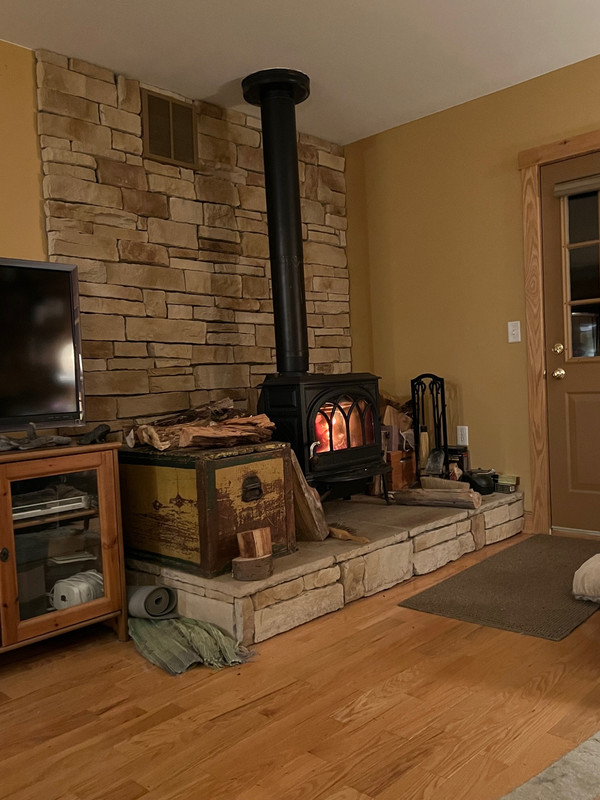
I think the logic of fan blowing up during the winter is the hot air up high gets forced down at the edges of the room and washes down the walls to get down lower in the room. Or so I’ve read.


Almost never works as folks imagine it should. The trouble is that most houses have insulated ductwork running thru unconditioned space, with an air handler also in a cooler basement or attic, and it's sucking in air that's only maybe 80 - 85F from the ceiling above the stove.
The losses going thru the cold ductwork are enough that the air blowing out the other end is too cool.
If you happen to design your own house and place all ductwork and air handler inside the insulated envelope, then of course it can work, and I know at least two people who did exactly this. But in any house you didn't design specifically for this purpose, it's usually a losing battle.


Even with high ceilings, up is often preferred. Either direction does the same job of breaking up stratification, moving cold air up to displace the hot down around the perimeter of the room, or forcing the hot air straight down. But the reason people prefer upflow in cold winter is that it avoids having any air blow straight onto you, making you feel colder when it's not excessively warm.Down during the cold months and off during the warm/hot months.
This is due to a very high 'cathedral' ceiling.
True! But people often don't like the feel of 70F air blowing onto them out of heating registers. Heck, I remember older people around here complaining about air a little warmer than that blowing onto them from registers, when people first started converting from furnaces (120 - 140F) to heat pumps (90 - 110F).This can no doubt be true in some cases WinterDeere, but even if the 85* air near a return drops 15* before being distributed to the cooler rooms it's still removing warm air from where it's too hot, and moving it to rooms that are cold so win win.
Also true! But wood stoves have pretty limited firepower, so most of us heating by wood are doing all we can to avoid putting heat into any space other than our primary targets. Most "large" stoves hold only 700k BTU of hardwood, and while you have some control over the rate at which that's doled out, pushing for higher outputs means shorter burn times and more frequent need for reloads. I'm usually damn tired of reloading stoves by mid-winter!And the 15* that is "lost" is warming a basement, unheated wall cavity, etc. Of course if warming a vented attic it's wasted.
True! But people often don't like the feel of 70F air blowing onto them out of heating registers....
So yes, you're pushing even colder air out of the room, which does heat the home. But it might still be uncomfortable for anyone in the room subjected to that airflow, unless you have a variable speed air handler and can dial down the velocity to reduce this effect.
Also true! But wood stoves have pretty limited firepower, so most of us heating by wood are doing all we can to avoid putting heat into any space other than our primary targets. Most "large" stoves hold only 700k BTU of hardwood, and while you have some control over the rate at which that's doled out, pushing for higher outputs means shorter burn times and more frequent need for reloads. I'm usually damn tired of reloading stoves by mid-winter!
I find the look positively ghastly!This can no doubt be true in some cases WinterDeere, but even if the 85* air near a return drops 15* before being distributed to the cooler rooms it's still removing warm air from where it's too hot, and moving it to rooms that are cold so win win. And the 15* that is "lost" is warming a basement, unheated wall cavity, etc. Of course if warming a vented attic it's wasted.
In my case all ductwork within the house walls, floors, and crawl space is encapsulated in foam so it really works well for me. This shows some of the ductwork in the crawl where the air handler is.

That is the best solution. If you have a ducted forced air furnace, just run the furnace fan to move the wood stove heat throughout the house. Once I discovered that, I quit using the ceiling fans.Once the living room is comfortable I have the ceiling fan on gently moving air up and the thermostat set to "fan on" which runs the air handler at slow speed to circulate the heat throughout my small 2-story house. Note the return above the stove.
I agree. The objective with running the furnace fan is to distribute the air, not necessarily blow hot air . It takes the excessive heat from the room with the wood stove and moves air throughout the house. In order to work well, you need to program the fan to run at least every 30 minutes for awhile and leave it running 24/7.This can no doubt be true in some cases WinterDeere, but even if the 85* air near a return drops 15* before being distributed to the cooler rooms it's still removing warm air from where it's too hot, and moving it to rooms that are cold so win win. And the 15* that is "lost" is warming a basement, unheated wall cavity, etc. Of course if warming a vented attic it's wasted.
In my case all ductwork within the house walls, floors, and crawl space is encapsulated in foam so it really works well for me. This shows some of the ductwork in the crawl where the air handler is.

Our stove is in our basement. Not optimal for the upstairs. I ended up putting a duct above the stove and running a length of 8" flexible duct across the basement ceiling to a heat register in the living room. Then I put a high temperature duct booster fan in the duct. Finished it off with a greenhouse fan thermostat set to cool.THAT IS SOME GOLD RIGHT THERE!! Now lets hope I remember!!
I wish we could of had a return above the stove. Our new addition has mini splits. But I will still try to run the fan over in the old half to see if it draws it over there.
I might have to buy the wife a couple drying racks.
What stove, and do you have any exposed concrete? Most modern stoves accomplish a large part (majority?) of their heat transfer via radiation, which if in the presence of any exposed concrete tied to earth, just gets gobbled up and sunk into the earth. But throw up some insulated wall board and lay down carpet on a pad to shield the concrete from that radiation, and you have a pretty good chance of most of that energy finding its way upstairs!Our stove is in our basement.
That sound like a good little system. I am not judging you, I am genuinely curious. Why do people put wood stoves in the basement? There must be some good reasons, because plenty of people do it. Space, cleanliness, heat rises, etc. For us, our wood stove is as much aesthetic as it is for heating. But living in SE TN we can have that luxury. For you yankees I know wood stoves can be all about business.Our stove is in our basement. Not optimal for the upstairs. I ended up putting a duct above the stove and running a length of 8" flexible duct across the basement ceiling to a heat register in the living room. Then I put a high temperature duct booster fan in the duct. Finished it off with a greenhouse fan thermostat set to cool.
When the temp in the basement gets up to 78, the fan comes on and blows warm air up to the living room. After the fire goes out and the room gets down to 74, the fan shuts off. Works pretty well..

When I was a kid, we had a wood burner that had a blower and it connected to the furnace ducts. Being that the house was old we went through a bunch of wood. We would chuck the wood into the basement through the little coal window which was easy enough. Then we would sweep up and stack the wood so the mess stayed down there. Yes, heat rises but blowing the heat through the ducts is what heated the house., I am genuinely curious. Why do people put wood stoves in the basement? There must be some good reasons, because plenty of people do it.

The reasons we put it in the basement are:That sound like a good little system. I am not judging you, I am genuinely curious. Why do people put wood stoves in the basement? There must be some good reasons, because plenty of people do it. Space, cleanliness, heat rises, etc. For us, our wood stove is as much aesthetic as it is for heating. But living in SE TN we can have that luxury. For you yankees I know wood stoves can be all about business.

Now that I've had back surgery, I won't be splitting the same as I used to. I had some rounds that were 3' in diameter. I'd build a ramp out of split wood and roll them up onto the splitter by hand, then halve them. Then quarter, etc... I'll never be doing that again.Personally, I am looking forward to a heat pump system just to be able to circulate a tiny bit of air, quietly, at all times.
It is fun to see how creative you have gotten in maximizing the captured heat from your wood stoves. It brings back great memories of heating with wood.
All the best,
Peter
Sorry about your back.Now that I've had back surgery, I won't be splitting the same as I used to. I had some rounds that were 3' in diameter. I'd build a ramp out of split wood and roll them up onto the splitter by hand, then halve them. Then quarter, etc... I'll never be doing that again.
I also used to make a table out of rounds on cut ends next to the splitter, then use the tractor bucket to set rounds on the table and slide them across to the splitter. Even that sounds rough, now.
So I'm thinking of getting a truck bed crane and mounting it on the splitter. Then just one cylinder that will lift up and down. A length of cable with lifting tongs. Then I can dump rounds next to the splitter, use the tongs to lift them up onto the table, split and repeat. Anything too heavy to lift by hand will be grabbed by the tongs. We'll see how it goes.
Really, an engine hoist crane would work just fine but a truck crane can pivot.
The problem with a log lift as I see it, is that let's say I mount it on the right side. Now I have to get all my wood on the right side of the splitter all the time. And if a large piece would fall off the left side, I'd have to figure out how to get it to the right side again.Sorry about your back.
Add a log lift to your splitter? Or an infeed table? Personally, I love using the PT bucket as lift/table for large rounds and logs.
I try to spare my back whenever I can, and the PT is such a great force multiplier for me.
All the best, Peter