Big Barn
Super Member
- Joined
- Aug 20, 2013
- Messages
- 7,047
- Location
- Victoria, B C
- Tractor
- More than 40 over the years. Ten at any one time. Mostly Ford and New Holland
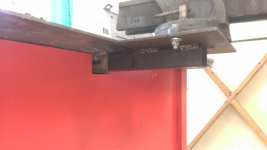
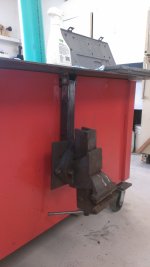
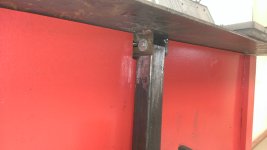
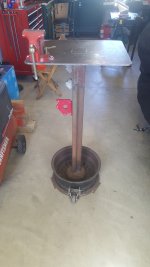
I love the idea, but from this angle it looks like a shin buster!View attachment 545158
i like it so the vise on the bench flips out of the way. so for the big projects you can slid flat across table.
View attachment 545159
you notch end of tube so it flips down. and cut slot for through bolt.
View attachment 545160
you get to the end of the slot it stops the tube from coming out and acts as pivot. vise flips down out of the way

Sorry to hear about the fire. I love Wiltons as well, picked this one up off Craigslist for a song a few weeks back. No date stamp on it, but I narrowed it down to within the first few years of production.
It's very beat up, but will eventually make it onto an exterior work bench with a thick steel top, until I get a garage...
 Getting closer!
Pretty much finished my table yesterday. What a huge improvement in working conditions. Until now, any welding work I've done at home has been either on a pair of saw horses with a piece of plywood on them, or just grovelling about on my knees on the blacktop. At some point it might see some paint, but I doubt it.
The top is 3/8" thick 3' x 4' steel with a 2-1/2 x 2-1/2 x 1/4 frame under it. There's at least a 2-1/2" clamping area all around. Cable hangers are pieces of large EMT with some 3/8" allthread to keep the cables on. Floor jack idea stolen from an earlier post here is a must - I work in the (sloping) driveway. I don't worry about having the table itself level because I haven't worked on anything that squares didn't suffice.
The vise is bolted on with 4 bolts and if I find the need to use the entire table more than a few times, I'll do something with a piece of receiver for it. The drawer is made from an unused electrical panel can found in a pile of stuff at work. Flat bar on one side provides a place to hang clamps, and serves as a handy place to connect a ground. The wheels are swivel on one end only (floor jack end) and are large enough to roll over the difference in elevation to get it into the garage easily.
First project was repairing the 6' scraper blade we were using on the Ford this week at the church. It appears the factory welds didn't have very good penetration. Several just peeled off one side, and it looked like two of the 7 different welds actually grabbed both sides. One ripped a small piece of the horizontal square tube out and one vertical weld broke, leaving half the weld on each piece. What is quite remarkable is that this blade was used for 10 years on the B7500, then 5 more on the Ford 1210 before it came apart.
For the most part, the factory welds were very convex and looked like caterpillars seeking refuge in the joints of the metal. I cleaned all the old stuff off and added a piece of flat bar where the heavy vertical square tube connects to the lighter horizontal tube that runs on the back side of the blade. Since the work is being done outdoors, I'm using flux core. And because I need practice, the welds were done in whatever position the blade was in. The reinforcement was welded in the vertical position.
 Notice the little wheel in the front. I got tired of dead lifting it after about a year, welded a little wheel on it I had, tip the table back on, and drive it where I need to go! ) - ... Steve
Things that will decide whether the narrow width is gonna be a problem -
terrain(smooth/level = good, rough/sloped = BAD)
caster size - you got that covered, unless you're on sloped/gravel (or worse)
Center of gravity - lower is better; which is why, if you're gonna mount the vise on the long side, you might wanna consider Truck Diagnostics' post # 62, this thread, and ONLY move the table with vise hanging LOWER - either that, or reserve a place on your LOWER SHELF for the vise, and ONLY move table with the vise down lower - (less of a PITA than a tip-over
Where you push/pull on the table to move it - the LOWER the force is applied, the less likelihood you will tip it (might wanna consider something like a "wagon tongue" handle that attaches just above the casters, and push/pull with THAT) - in the same vein, push/pull LENGTH-WISE will be TWICE as stable as moving the table SIDEWAYS.
Example - I can tip my 3'x7', 1" thick table (approx. 900#) over BY HAND pushing sideways (not easy, but doable) - but NO way can I do that LENGTHWISE...
These are considerations I would look at if building a portable weld table; but YOUR level of OCD is probably lower than mine
Does the table have to be 36" tall? Mine is, and when I clamp something in the bench vice that is on the tabletop and start with a new weld rod, the project is a little to high for comfort. I could have been happy with a 32" table height, and I'm 5'11".

Does the table have to be 36" tall? Mine is, and when I clamp something in the bench vice that is on the tabletop and start with a new weld rod, the project is a little to high for comfort. I could have been happy with a 32" table height, and I'm 5'11".