You are using an out of date browser. It may not display this or other websites correctly.
You should upgrade or use an alternative browser.
You should upgrade or use an alternative browser.
building a new house
- Thread starter socallly
- Start date
- Views: 20588
More options
Who Replied?
/ building a new house
#61


RobJ
Elite Member
Wow sure is nice to have a forklift to sit that ply up on the roof. When I did my house I clocked myself at about 15 minutes per sheet. Throw it up, spot a couple nails to hold it up on the roof, walk around and upstairs, silde it into place, staple, staple, repeat..60-70 sheets or so.
But your roof looks pretty mild, 4-12 maybe 5-12. The steep parts of mine are 10-12. Once you slip...you won't stop, shingles or not.
But your roof looks pretty mild, 4-12 maybe 5-12. The steep parts of mine are 10-12. Once you slip...you won't stop, shingles or not.
Attachments

who your roof is pretty steep.Mine is 5/12 and yes the boomlift will spoil you quick.Thanks for sharing your picture.RobJ said:Wow sure is nice to have a forklift to sit that ply up on the roof. When I did my house I clocked myself at about 15 minutes per sheet. Throw it up, spot a couple nails to hold it up on the roof, walk around and upstairs, silde it into place, staple, staple, repeat..60-70 sheets or so.
But your roof looks pretty mild, 4-12 maybe 5-12. The steep parts of mine are 10-12. Once you slip...you won't stop, shingles or not.

EddieWalker
Epic Contributor
Great pics and progress!! They re moving right along nicely.
I'm curious on what you are doing on that back porch? The posts are on piers, which I'm assuming means you are doing something other than a concrete pad?
Eddie
I'm curious on what you are doing on that back porch? The posts are on piers, which I'm assuming means you are doing something other than a concrete pad?
Eddie
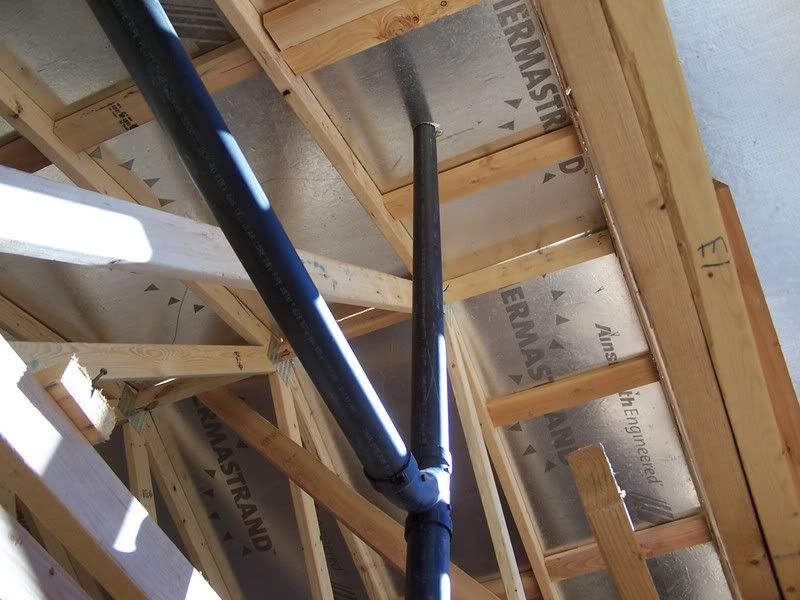
Busy busy busy.We roughed in the plumbing friday and put all the black pipe in today,over the weekend my framer put arches in the hallways and cleaned things up abit.Tommorrow I will start boxing and roping the romex voice and data and speaker wire.The pics are from friday I will post some new one's this coming weekend I was inspired by the other post on the temp power pole so I thru in a pic of my pole I made......




_RaT_
Super Member
- Joined
- Apr 19, 2000
- Messages
- 5,855
- Location
- Peoples Republic of Northern CA.
- Tractor
- Kioti 3510-SE HST
Thanks, very clear pictures. I was interested in particular in the PEX plumbing shots.
EddieWalker
Epic Contributor
I can't tell for sure what your fascia boards are made of. Looks almost like plywood. Are you going to cover them with another material, or is it dry enough in your area that you don't have any issues with them rotting? I've replaced quite a few fascia boards and soffits because of this on homes here, but we get over 4 ft of rain per year and have very high humidity.
What I really don't understand is why you have the edge of your roof decking a different material than the osb?
The PEX sure looks nice. I've never used it, but I'm seeing it more and more. It's got me to thinking I'll have to give it a try.
Thanks for the update,
Eddie
What I really don't understand is why you have the edge of your roof decking a different material than the osb?
The PEX sure looks nice. I've never used it, but I'm seeing it more and more. It's got me to thinking I'll have to give it a try.
Thanks for the update,
Eddie
the fascia is 2x6 and the end of the roof is 1x6 shiplap it gives a clean look from the undersideEddieWalker said:I can't tell for sure what your fascia boards are made of. Looks almost like plywood. Are you going to cover them with another material, or is it dry enough in your area that you don't have any issues with them rotting? I've replaced quite a few fascia boards and soffits because of this on homes here, but we get over 4 ft of rain per year and have very high humidity.
What I really don't understand is why you have the edge of your roof decking a different material than the osb?
The PEX sure looks nice. I've never used it, but I'm seeing it more and more. It's got me to thinking I'll have to give it a try.
Thanks for the update,
Eddie
EddieWalker
Epic Contributor
OK, so you're not putting in a soffit?
Are you venting through the spaces between the trusses and leaving the ends exposed from the underside?
The last house I built, I used a low profile ridge vent that was just about invisable. I don't know what your plans are, but with a composit shingles, it's the cleanest venting system I've come across.
Eddie
Are you venting through the spaces between the trusses and leaving the ends exposed from the underside?
The last house I built, I used a low profile ridge vent that was just about invisable. I don't know what your plans are, but with a composit shingles, it's the cleanest venting system I've come across.
Eddie
_RaT_
Super Member
- Joined
- Apr 19, 2000
- Messages
- 5,855
- Location
- Peoples Republic of Northern CA.
- Tractor
- Kioti 3510-SE HST
EddieWalker said:OK, so you're not putting in a soffit?
Are you venting through the spaces between the trusses and leaving the ends exposed from the underside?
The last house I built, I used a low profile ridge vent that was just about invisable. I don't know what your plans are, but with a composit shingles, it's the cleanest venting system I've come across.
Eddie
I thought the fascia looked like regular dimensional lumber. Out here they use a lot of hem fir for fascia. There is a fascia that works really that well won't split, twist or warp nearly as easy as dimensional lumber. Its LVL veneer fascia. It comes in 5/4 or 1.5" sizes in 16 or 20 foot lengths (maybe even longer). I don't know about really tough conditions like high humidity, but I suspect it will hold up. The 1x6 sheathing on the overhang is very typical and sometimes on stick framed roofs where you can really finish the tails nicely it looks much nicer then a soffit.
EddieWalker
Epic Contributor
Looking at the pictures again, I can see that it's not framed for a soffit, but I also don't see any places to vent under the eves. It's all blocked in.
I don't think one way looks any better than another. Soffits are more work and expense that you really never notice anyway. The only advantage I can think of them are that it gives the brick a good place to end and there's fewer places for wasps to build nests, or dirt dobbers to build there homes.
Eddie
I don't think one way looks any better than another. Soffits are more work and expense that you really never notice anyway. The only advantage I can think of them are that it gives the brick a good place to end and there's fewer places for wasps to build nests, or dirt dobbers to build there homes.
Eddie
rox
Veteran Member
Okay I'll bite, what is a shear panel? i saw it in the picture. Also what is PEX plumbing?
_RaT_
Super Member
- Joined
- Apr 19, 2000
- Messages
- 5,855
- Location
- Peoples Republic of Northern CA.
- Tractor
- Kioti 3510-SE HST
EddieWalker said:Looking at the pictures again, I can see that it's not framed for a soffit, but I also don't see any places to vent under the eves. It's all blocked in.
I don't think one way looks any better than another. Soffits are more work and expense that you really never notice anyway. The only advantage I can think of them are that it gives the brick a good place to end and there's fewer places for wasps to build nests, or dirt dobbers to build there homes.
Eddie
I agree, there are very nice versions of both soffit and non soffit. The typical venting is to leave every 3rd or 4th freeze block flat on the top plate and put in a screen. Wasps are notorious for making homes on rafter tails which as you point out can be a good reason for a soffit in many areas.
EddieWalker
Epic Contributor
rox said:Okay I'll bite, what is a shear panel? i saw it in the picture. Also what is PEX plumbing?
Rox,
Sheer panels are the OSB, or plywood that's used at the corners of the walls. They provide what is called, sheer strength, to the walls. In the old days, they used to cut in diagnal boards at the corners to stop the walls for "racking." A wood frame wall with twist and turn on you unless you lock it into place. The sheer panel does this. In some parts of the country, you just do the corners, but in other areas, you do the entire house.
PEX is the new type of tubing that's being used in homes for the water lines. The red is for hot water and the blue is for cold water. You run the lines to a "manifold" and then branch out from there. In the pictures, you can see the manifold is a copper tube with multiple lines coming off of it. One line would have come from the water heater to it, and then all the other lines go to there respective valves.
The advantage is that it's all one line. Pipe is not flexible and a leak can occur at a joint. The more joints you have, the greater your odds are on a leak. Homes also move around more than most people realize. Having flexible water lines can just about cut out all possibility of a rupture.
If it works like it's predicted, it should become the standard in every home over the next decade. Copper is just too expansive and difficult to work with. PVC is easier and cheaper to work with, but isn't univerasally accepted. Lots of places won't let you use PVC for your water lines in a home.
The biggest drawback to PEX is the tool to connect the lines with. It's expensive. I've never done it myself, so I have no other first hand knowledge. My next home probably won't use it, but I'm still thinking about it. I still like PVC, but can see the advantages of PEX.
Eddie
_RaT_
Super Member
- Joined
- Apr 19, 2000
- Messages
- 5,855
- Location
- Peoples Republic of Northern CA.
- Tractor
- Kioti 3510-SE HST
EddieWalker said:Rox,
Sheer panels are the OSB, or plywood that's used at the corners of the walls. They provide what is called, sheer strength, to the walls. In the old days, they used to cut in diagnal boards at the corners to stop the walls for "racking." A wood frame wall with twist and turn on you unless you lock it into place. The sheer panel does this. In some parts of the country, you just do the corners, but in other areas, you do the entire house.
PEX is the new type of tubing that's being used in homes for the water lines. The red is for hot water and the blue is for cold water. You run the lines to a "manifold" and then branch out from there. In the pictures, you can see the manifold is a copper tube with multiple lines coming off of it. One line would have come from the water heater to it, and then all the other lines go to there respective valves.
The advantage is that it's all one line. Pipe is not flexible and a leak can occur at a joint. The more joints you have, the greater your odds are on a leak. Homes also move around more than most people realize. Having flexible water lines can just about cut out all possibility of a rupture.
If it works like it's predicted, it should become the standard in every home over the next decade. Copper is just too expansive and difficult to work with. PVC is easier and cheaper to work with, but isn't univerasally accepted. Lots of places won't let you use PVC for your water lines in a home.
The biggest drawback to PEX is the tool to connect the lines with. It's expensive. I've never done it myself, so I have no other first hand knowledge. My next home probably won't use it, but I'm still thinking about it. I still like PVC, but can see the advantages of PEX.
Eddie
Eddie, PVC in the house for water lines? One nice thing about PEX over copper is that it is far more tolerant of acidic water. With copper the acidic water will etch the pipe eventually causing it to fail.
EddieWalker
Epic Contributor
Rat,
Yes, there are areas here where PVC is acceptable to code. CPVC for hot water lines.
Another disadvantage to copper is the lead is no longer in the solder and it's not as strong a seal. A journeyman plumber doing a home will often have a small leak someplace. It might not be in every home, but I bet it happens in at least one out of ten homes.
I remodel and repair homes. The biggest cause that I've seen for bathroom leaks is the manifold behind the tub and shower. It's the place that always seems to leak. It's just drop and not enough to be noticable, but over 20 or 30 years, it rots out the joists and even the wall studs.
I have a job next week where this happened in the laundry room. The copper has been leaking for over 20 years and the interior wall studs and sill plate are rotted away. The sheetrock is held in place by the walpaper covering it!!! Lucky for the homeowner, the house has a slab foundation, so it's an easy repair.
If you really want to talk about water line problems, then iron pipes are the worse. Most are just about closed off from mineral buildup. 1/2 inch and 3/4 inch lines with enough open space in them that you can only get a few toothpicks through them. It's just a matter of time until tens of thousands of homes will no longer be able to get water and need all new water lines.
Eddie
Yes, there are areas here where PVC is acceptable to code. CPVC for hot water lines.
Another disadvantage to copper is the lead is no longer in the solder and it's not as strong a seal. A journeyman plumber doing a home will often have a small leak someplace. It might not be in every home, but I bet it happens in at least one out of ten homes.
I remodel and repair homes. The biggest cause that I've seen for bathroom leaks is the manifold behind the tub and shower. It's the place that always seems to leak. It's just drop and not enough to be noticable, but over 20 or 30 years, it rots out the joists and even the wall studs.
I have a job next week where this happened in the laundry room. The copper has been leaking for over 20 years and the interior wall studs and sill plate are rotted away. The sheetrock is held in place by the walpaper covering it!!! Lucky for the homeowner, the house has a slab foundation, so it's an easy repair.
If you really want to talk about water line problems, then iron pipes are the worse. Most are just about closed off from mineral buildup. 1/2 inch and 3/4 inch lines with enough open space in them that you can only get a few toothpicks through them. It's just a matter of time until tens of thousands of homes will no longer be able to get water and need all new water lines.
Eddie
rox
Veteran Member
I like that PEX, i can see how without joints you have zero leaks. That looks like a really cool product.
_RaT_
Super Member
- Joined
- Apr 19, 2000
- Messages
- 5,855
- Location
- Peoples Republic of Northern CA.
- Tractor
- Kioti 3510-SE HST
EddieWalker said:Rat,
Yes, there are areas here where PVC is acceptable to code. CPVC for hot water lines.
Another disadvantage to copper is the lead is no longer in the solder and it's not as strong a seal. A journeyman plumber doing a home will often have a small leak someplace. It might not be in every home, but I bet it happens in at least one out of ten homes.
I remodel and repair homes. The biggest cause that I've seen for bathroom leaks is the manifold behind the tub and shower. It's the place that always seems to leak. It's just drop and not enough to be noticable, but over 20 or 30 years, it rots out the joists and even the wall studs.
I have a job next week where this happened in the laundry room. The copper has been leaking for over 20 years and the interior wall studs and sill plate are rotted away. The sheetrock is held in place by the walpaper covering it!!! Lucky for the homeowner, the house has a slab foundation, so it's an easy repair.
If you really want to talk about water line problems, then iron pipes are the worse. Most are just about closed off from mineral buildup. 1/2 inch and 3/4 inch lines with enough open space in them that you can only get a few toothpicks through them. It's just a matter of time until tens of thousands of homes will no longer be able to get water and need all new water lines.
Eddie
I have ripped open three shower walls where the line leading to the head leaked. It was never pressure tested on that side of the valve. You should always cap the shower line and open the valve for pressure testing. It only leaks when the shower is on but over the years, it does a lot of damage.
dmccarty
Super Star Member
Our new house, well its two years old but its still the new house, we used PEX. The plumber pressurized the system with air and had a pressure gauge mounted. Checked after the weekend was up. No leaks. I don't know if that was just him or if code required him to do this. He also did something similar for the waste pipes. We are on a slab and the waste pipes are buried not only under the concrete but under roughly 4 feet of 67 stone. And it might have a 12-24 inches of concrete over it as well.
He tested the waste lines for leaks as well. I can't remember if he just filled the system with water and check the level or if he pressurized the system as well. I'm thinking he pressurized it.
The only problem we had with PEX was his apprentice, who no longer works for the plumber. He somehow managed to get dirt in the lines and that clogged up some of the screens on the faucets and shower heads. I know it was the apprentice because I walked into the bathroom while the plumber was fixing the problem and muttering rather loudly about his helper.
Later,
Dan
we used PEX. The plumber pressurized the system with air and had a pressure gauge mounted. Checked after the weekend was up. No leaks. I don't know if that was just him or if code required him to do this. He also did something similar for the waste pipes. We are on a slab and the waste pipes are buried not only under the concrete but under roughly 4 feet of 67 stone. And it might have a 12-24 inches of concrete over it as well. He tested the waste lines for leaks as well. I can't remember if he just filled the system with water and check the level or if he pressurized the system as well. I'm thinking he pressurized it.
The only problem we had with PEX was his apprentice, who no longer works for the plumber.
He somehow managed to get dirt in the lines and that clogged up some of the screens on the faucets and shower heads. I know it was the apprentice because I walked into the bathroom while the plumber was fixing the problem and muttering rather loudly about his helper. Later,
Dan
Classic blame it on the new guy excusedmccarty said:The only problem we had with PEX was his apprentice, who no longer works for the plumber.
Later,
Dan
That master plumber should have known better than to have the shower heads and screens installed on the faucets the first time he turned on the water.


