Boom bent?

/ Boom bent? #21  
IF an attempt is made to straighten you have the potential to make it worse.

Hard for me to advise you what to do because most people dont have access to a machine shop, lathe, mill, precision measuring stuff, and a big stock of steel.

But, the pin bosses (at the tips of the loader arms) need to be in alignment with one another or you will have accelerated pin wear and/or binding.

So if it were me....and I was attempting to straighten loader arms that were too close to fit the quick hitch, the first thing I would do would get a piece of TGP round that was the same diameter as my loader pins. A round bar that fits tight in the pin bosses. And make sure it can go through BOTH. If it doesnt...something is bent and tweaked. Not only do you need the proper spacing between the loader arms to fit the SSQA adapter, but equally important is that the pin holes are in alignment with each other.

Put it this way....even though the two pins are separate pieces.....you need to pretend it is one long pin
 
/ Boom bent?
  • Thread Starter
#22  
Thank you all for the great feedback and suggestions. I think I've located the issue. Starting starting to wonder if I really caused this or if I just happened to notice it recently. For reference, the tractor is basically brand new. I'm paranoid by nature and just assumed I had done something to break it, but this looks more like something that would happen if the loader was strapped incorrectly...

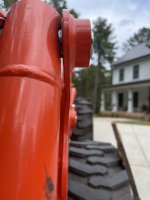
I took the SSQA off. It goes on/off relatively easily. No major misalignment from what I can tell. Of course, it's hard to tell when dealing with something that massive, but I didn't have to use any hammers or anything to get it off or on (ignore the sledge and the board in the pic... I grabbed them just in case). Pins came out with some initial knocks with the back end of a socket wrench and then I could pull them out by hand (using a rag for grip). Excluding the driver's left side cylinder, the loader arms slide easily into the SSQA.
 

Attachments

  • IMG_1290.JPG
    IMG_1290.JPG
    1.5 MB · Views: 473
  • IMG_1289.JPG
    IMG_1289.JPG
    2.9 MB · Views: 204
/ Boom bent? #24  
Thank you all for the great feedback and suggestions. I think I've located the issue. Starting starting to wonder if I really caused this or if I just happened to notice it recently. For reference, the tractor is basically brand new. I'm paranoid by nature and just assumed I had done something to break it, but this looks more like something that would happen if the loader was strapped incorrectly...

I took the SSQA off. It goes on/off relatively easily. No major misalignment from what I can tell. Of course, it's hard to tell when dealing with something that massive, but I didn't have to use any hammers or anything to get it off or on (ignore the sledge and the board in the pic... I grabbed them just in case). Pins came out with some initial knocks with the back end of a socket wrench and then I could pull them out by hand (using a rag for grip). Excluding the driver's left side cylinder, the loader arms slide easily into the SSQA.

I'm with LD1 on this....I cannot tell from the photos if it is bent or made that way or even maybe OK. But the first step is to figure that out.

And since it comes off easily I'd follow his suggestion to see if the various bushings and mounting points line up. Best way I can think of to do that is get some nice straight 5 and ten foot lengths of EMT 1/2 and 3/4" metal tubing at Home Depot. They are straight and cheap....then take the loader off, and put those lengths of EMT through the bushings from side to side and then stand back and see if you can determine if and where the bend is.

You aren't going to rest until you know if and where it is bent. But I'd bet you either have something you can fix easily, or use as is. As you suspect, a lot of the time it involves how the loader is bolted to the frame.

But whatever it is, you need to line up those mounting points in a perpendicular plane in order to see it better. Some long straight metal tubing rods will do that.
rScotty
 
/ Boom bent? #25  
No insurance. Had no idea this was even a thing until Friday when I first posted. God my dealer sucks…

Anyways, tried a few things this weekend. The top right pin mount I bent a little but not enough to cause a major issue like this. I think it’s a combination of things. Weather didn’t cooperate this weekend and I didn’t have help. Will work on it some more next weekend.

Any tips on straightening assuming I can figure out what’s bent? Comealong and a big tree/hammer?

How do you know this is a new condition? It seems to me the left loader/cyl interface or the left cyl base itself may have been welded up with a small angular misalighnment. You can check the cyl by turning it a half turn. A little messy but quick.

It does
look as if the arm is bent. That would be straightened in a controllable fashion using a porta power diagonally from the rt arm torquetube junction across and down to the left arm pin end.
 
Last edited:
/ Boom bent? #26  
img_1290-jpg.715591


I can say with certainty that the curl cylinder attach lug is bent. The one on my MX doesn't have that kink in it. Not sure how I would fix that. Probably a lot of heat, a prybar and a big hammer.
 
/ Boom bent? #27  
Me again - from post #2. Since it goes on/off relatively easily, I'd put it back together and not worry about it. Its a tractor, not the Hubble. Loaders are only approximately square and parallel. They don't need to be perfect - they function fine when close enough.
 
Last edited:
/ Boom bent? #28  
It looks to me like this could've happened via some serious stress was placed on the left side boom while dragging backwards. Basically the bend in the boom was slightly straightened, causing a slight buckling on the reinforcement web.
Is there a similar buckling on the inside web? Are there any sides of stress in that joint behind the web, or in any of the welds attaching it?
5ihdQBbFh2VTp9s.png


If there's any such signs, I'd look at having it repaired/strengthened.
If not, and things go back together easy enough, I'd use it as-is, but keep an eye out for further signs on either side.
 
/ Boom bent? #29  
It looks to me like this could've happened via some serious stress was placed on the left side boom while dragging backwards. Basically the bend in the boom was slightly straightened, causing a slight buckling on the reinforcement web.
Is there a similar buckling on the inside web? Are there any sides of stress in that joint behind the web, or in any of the welds attaching it?
View attachment 715941

If there's any such signs, I'd look at having it repaired/strengthened.
If not, and things go back together easy enough, I'd use it as-is, but keep an eye out for further signs on either side.
img_1290-jpg.715591


I can say with certainty that the curl cylinder attach lug is bent. The one on my MX doesn't have that kink in it. Not sure how I would fix that. Probably a lot of heat, a prybar and a big hammer.

Too bad we we dont have a view showing the other portion of that ear. I think it may be bowed inward a little. What I conjecture visually from your catch is that the ear is effectively twisted slightly CCW. That pin is probably in a bind. - Is it? Even if not quite, the alignment offset referenced from the other ear turns out to be enuf to cause the cyl skew observed. If deemed necessary I believe that micro kink could be taken out using two cheater augmented 24" "crescents" from HF. Careful control of action - reaction to select the position where bending takes place. Mild steel or brass shims on their jaws to prevent marring the ear.
 
/ Boom bent? #30  
Having straightened a fair amount of implements, I don't think I've seen many or any that were improved by impact or by beating on them.

What usually works is applying leverage with a long "cheater" in small steps until it is bent back to some usable shape. Because all bending - both the original bend and the repair - stretches the metal, you have to plan how to deal with the fact that any bent metal is never going to go back to it's original location.

Sometimes you have to redrill a hole or offset a bushing or modify a pin. I've more than once had to go over to the unbent side and deliberately bend it to match the repaired side..
Whatever it takes so that the pins end up in the same plane.

The good news is this loader frame isn't all that heavily constructed. The ears look to be fairly easy to move. With some sturdy clamps and long cheaters I think you could improve things.

In the oil field we bent fittings into place using big crescent wrenches that had tapered handles so that they could be inserted into ten foot lengths of pipe. Then one person could bend fairly heavy metal. Your bend looks much easier than that.
rScotty
 
/ Boom bent? #31  
Having straightened a fair amount of implements, I don't think I've seen many or any that were improved by impact or by beating on them.

What usually works is applying leverage with a long "cheater" in small steps until it is bent back to some usable shape. Because all bending - both the original bend and the repair - stretches the metal, you have to plan how to deal with the fact that any bent metal is never going to go back to it's original location.

Sometimes you have to redrill a hole or offset a bushing or modify a pin. I've more than once had to go over to the unbent side and deliberately bend it to match the repaired side..
Whatever it takes so that the pins end up in the same plane.

The good news is this loader frame isn't all that heavily constructed. The ears look to be fairly easy to move. With some sturdy clamps and long cheaters I think you could improve things.

In the oil field we bent fittings into place using big crescent wrenches that had tapered handles so that they could be inserted into ten foot lengths of pipe. Then one person could bend fairly heavy metal. Your bend looks much easier than that.
rScotty

Hard impact from a hammer smashes the metal, stretching it. Heavy impact, indirectly applied, thru soft steel, aluminum, brass or wood, is not so intense as to stretch the metal. A heavy sledge swung moderately is the preferred force application tool for that method. A reaction mass is needed but must be situated so as to avoid a pinch point.

For metal up to about 3/8" I prefer using 2 crescents in cases where there is enuf flange depth for good purchase. The wrenches are "crossed" , forcing/twisting in opposite directions a little bit at a time on alternating sides to put the metal back in line w/o any overbending. I extend 24" wrenches about 8' or however much needed to bend with a 'delicate' touch to maximize control of the manipulation. I will use ~ 1/2" high strength steel shim to extend and/or widen force application of the wrench jaws where prudent and possible, to help control exact bend points. I will also use softer metal shims ~1/8" in the "stack" to avoid surface damage to the target metal. With the benefit of experience it is often possible to remove slight bends so that you cant tell they were ever there.

Being able to afford the patience is the greatest boon. After all, Perfect being the enemy of good enough is still the friend of Better.
 

Marketplace Items

Kubota RTV X1140 (A60462)
Kubota RTV X1140...
2015 John Deere 350G Excavator (A60352)
2015 John Deere...
2019 GALYEAN EQUIPMENT CO. 150BBL STEEL (A58214)
2019 GALYEAN...
2012 PETERBILT 367 (A60736)
2012 PETERBILT 367...
Wooden Table (A61569)
2020 PETERBILT 567 (A60736)
2020 PETERBILT 567...
 
Top