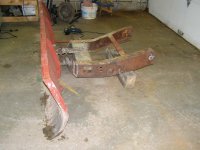
Basic pusher blade for my '47 Massey

/ Basic pusher blade for my '47 Massey #1  

Coolnorth

Bronze Member
Joined
May 7, 2009
Messages
82
Location
Dryden, Ontario, Canada
Tractor
Massey Harris Model 20, IH 240 Utility
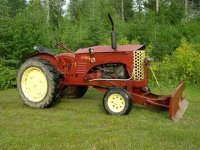
After being rushed into trying to build something for last winter and having attempt # 1 fail miserably, attempt # 2 barely make it through the winter, I am at attempt # 3 which seems to be the right direction.
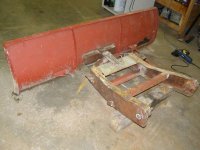
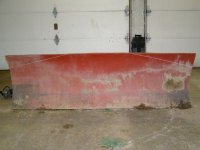
My Dad found a blade in a friend's yard. It had been an "on again off again" project for the guy - you could see the different attempts made on it over time, but the pivot plates were out of alignment and not parallel with the cutting edge. The blade form itself was excellent in curve, looking like the original idea was right on target, able to roll the material it is pushing.

The next thing was to adapt it to my 1947 Massey Harris Model 20. With lots of scrap metal in the yard to choose from, I found the best thing to use once I realized it was 2 matched sections from a Chevy truck frame, 1/2 of a radio rack base, some 2" angle, 3" x 1/2" plate and 4" channel iron. Also some other bits and pieces like 3/4" and 1" pipe, 3/4" round bar, 1" round bar.

I don't have photos of it going together, but closer to complete photos, below.

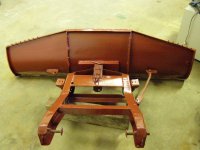
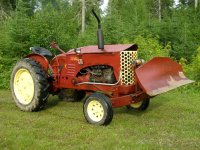
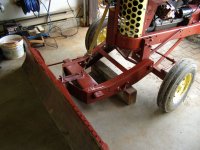
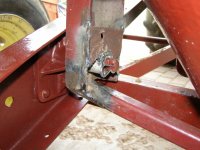
The 2 sections of truck frame are cut from the front of a 4 wheel drive truck, flipped upside down, with the rack base plate welded in across the front of the assembly, 2" angle welded across for bracing underneath and near the back, plate steel added out as a "nose" to give room for the blade to pivot. I've used the spring shackle mounts for the pivot bushings with some reinforcement.

The last major part of the project was to reshape the blade itself to decrease weight and give it a bit more of a "look". I'm no pro welder :( and I've seen much more professional work on the forum. but after trying this assembly out and having it work is quite promising! :D

A few things left to do like add some points for adjusting the blade angle, maybe a quick-swing arm for holding the blade up while being stored, and also to upgrade to hydraulic lift, not electric winch.
 

Attachments

  • Side view full.JPG
    Side view full.JPG
    126.8 KB · Views: 288
  • rear left full.JPG
    rear left full.JPG
    131.4 KB · Views: 273
  • cut line full.JPG
    cut line full.JPG
    105 KB · Views: 205
  • main pivot bushing.JPG
    main pivot bushing.JPG
    129 KB · Views: 248
  • Post cut paint rear.JPG
    Post cut paint rear.JPG
    148.8 KB · Views: 527
  • Post cut left rear.JPG
    Post cut left rear.JPG
    131.6 KB · Views: 237
  • inside view bushing.JPG
    inside view bushing.JPG
    133.2 KB · Views: 236
/ Basic pusher blade for my '47 Massey #2  
Coolnorth...
Cool project, looks good and should hold up to most anything your '47 will do.
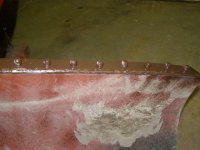
Rivets along the top edge are great, not many appreciate the practical, strong and functional 'rivet' .
 
/ Basic pusher blade for my '47 Massey #3  
That is a nice looking unit. when you mount it be sure to post the pictures. And the "look" came out just right.
 
/ Basic pusher blade for my '47 Massey
  • Thread Starter
#4  
Thanks for the compliments, guys. The rivets are part of a large clamp assembly from a wood-worker's shop. I needed to finish the top edge of the blade itself and that looked pretty "aggressive" to have those rivets sticking out. I used my MIG to weld them into place. The thing is that the edge of your blade never carries much material during a push and if you look at a Caterpillar dozer, there is a piece added at the top center of the blade, giving that similar look.

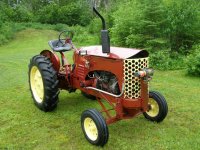
Here's a couple of pictures of the mount on the front of the tractor.

Graham

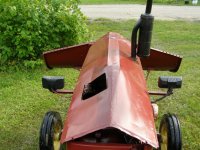
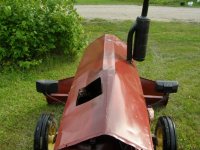
In case you're wondering, this tractor is a resto and came with no engine bay sheet metal - hence the odd hood.
 

Attachments

  • P6270154.JPG
    P6270154.JPG
    210.9 KB · Views: 306
  • P6270158.JPG
    P6270158.JPG
    209.7 KB · Views: 297
/ Basic pusher blade for my '47 Massey #5  
Neat job on the Massey! We had a Model 30 of the same era on our farm in the 1950's and I recall that it was a pretty good tractor.
 
/ Basic pusher blade for my '47 Massey
  • Thread Starter
#6  
My Dad's is a Model 30, early 50's model. He enjoys his and it works quite well.
Has a FEL (homemade trip style) with blade attachment. Had a ROPS installed with a complete roof incorporated.
 
/ Basic pusher blade for my '47 Massey #7  
That blade setup is really cool. I especially love the old truck frame. Nothin more satisfying than something you built yourself ....
 
/ Basic pusher blade for my '47 Massey #8  
Graham, looks like you are ready for the snow. :D Great job!
 
/ Basic pusher blade for my '47 Massey
  • Thread Starter
#9  
It's ready for snow, sand, clay, gravel. It works remarkably well! :D

Here's some more photos of the "thing" and yes, it is very satisfying to use the stuff kicking around the yard and get a great product from it! Thanks!

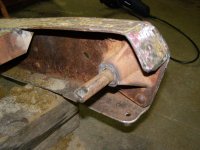
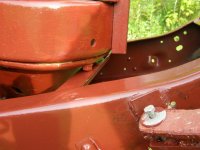
The pivot photo shows the inside construction of the frame mounted part of the assembly, but it is a poor photo re: depth/perception due to the slag and welding burns on the pre-existing paint which is a bit messy.

On the "max travel" photo, it shows the cross member touching the bolts on the tractor frame - I will be adding some sort of rubber bumper there to cushion the upper stop point.
 

Attachments

  • Op view blade up.JPG
    Op view blade up.JPG
    176.7 KB · Views: 177
  • Op view blade down.JPG
    Op view blade down.JPG
    176.8 KB · Views: 200
  • Blade down full view.JPG
    Blade down full view.JPG
    197.8 KB · Views: 286
  • Blade up side.JPG
    Blade up side.JPG
    212.8 KB · Views: 288
  • Blade up max travel.JPG
    Blade up max travel.JPG
    179.7 KB · Views: 202
  • Blade frame connection full.JPG
    Blade frame connection full.JPG
    140.3 KB · Views: 265
  • Pin retainer bushing pivot.JPG
    Pin retainer bushing pivot.JPG
    144 KB · Views: 402
/ Basic pusher blade for my '47 Massey #10  
Nice job!

I'm working on the same project--well nearly any way. I've got a 1945 Massey 81 narrow-front, row-crop that was my Grandfather's tractor. I added hydraulics to mine last winter, but I haven't made hardly any progress on building a snow blade. I like your blade, but I need a much different design because the 81 is a narrow front.

The ol' 81 is still running the original 6V electrics, so it wouldn't be able to handle that electric winch you've got anyway. I've also had a lot of problems getting parts for the distributor (rotor and cap). I think your 20 uses a later model distributor than my 81. I've got a later model distributor sitting on my bench waiting to be swapped in for the original when I get some time and my brother shows up with the timing light.

Are you serious about adding hydraulics? I can take some pictures of mine if you're interested. My method is kind of complicated, so you may not want to do it. . . .

I see your tractor may be a lot easier to put hydraulics on than mine was anyway. You've got a cover plate on the front of your engine opposite the governor. You'd probably just need to get an original hydraulic pump, and it would bolt right up! The 81 has the governor point towards the front of the tractor. I would have had to find a lot more parts to use OEM equipment.

Jim
 
Last edited:
/ Basic pusher blade for my '47 Massey
  • Thread Starter
#11  
Hi Jim,

Yes - the front cover plate, I've noticed in the shop manual that some models had the pump mounted there when they had the rear implement lift option (pre 3PH).
Does your 81 have a magneto in the place where my governor sits thus putting your governor on the front?

You could use my mount method on your tractor as it bolts directly to the frame, you'd just have to ensure clearances if you drop the mount as low as mine goes to avoid tire rub. You'd also have to move the first plow frame cross member forward a bit. Scrapping that idea altogether, you could use the method my neighbor did on his old Allis Chalmers, where he hung a braced brcket on either side of the differential, put pivots on those and then ran LONG shafts from the back of the tractor up to the blade (about 12 feet long). Pardon my quick drawing but it might help illustrating it.
 

Attachments

  • shaft plow.bmp
    700.9 KB · Views: 253
/ Basic pusher blade for my '47 Massey #12  
Does your 81 have a magneto in the place where my governor sits thus putting your governor on the front?

No, I don't have a magneto. There's nothing behind that lobe at all. I don't know why they put the governor on the front. . . . I guess that's just the way they did it at that time?


You could use my mount method on your tractor as it bolts directly to the frame, you'd just have to ensure clearances if you drop the mount as low as mine goes to avoid tire rub. You'd also have to move the first plow frame cross member forward a bit. Scrapping that idea altogether, you could use the method my neighbor did on his old Allis Chalmers, where he hung a braced brcket on either side of the differential, put pivots on those and then ran LONG shafts from the back of the tractor up to the blade (about 12 feet long). Pardon my quick drawing but it might help illustrating it.

Yeah, I think I'm gonna end up running long shafts from the back of the tractor. My front wheels swing out pretty wide when I turn. Also, I'm not sure about all that weight out there on the narrow front.

I recently bought a gray-market Yanmar, that'll probably be doing snowplow duty this year as it has a 5' loader bucket. So, the Massey project is on the back-burner right now. I'm still collecting parts, though. My brother has an old truck snowplow that I've spoken for. I also have a piece of 3" pipe for one of the side bars.

I'll try to get some pictures of what I did for hydraulics. Basically I made a custom 2-sheave pulley that replaces the pulley that drives the waterpump and generator. This pulley drives a hydraulic pump that is hanging off the left side of the tractor. I made my own reservoir that sits in front of the radiator. When it's done, all of the original sheet-metal will go back on and cover it up. I didn't have to bore any holes in the frame or otherwise modify any existing parts, so I think it's a pretty clean design. Now if I only had that snowplow part done!

Jim
 
/ Basic pusher blade for my '47 Massey
  • Thread Starter
#13  
No, I don't have a magneto. There's nothing behind that lobe at all. I don't know why they put the governor on the front. . . . I guess that's just the way they did it at that time?

Yeah, I think I'm gonna end up running long shafts from the back of the tractor. My front wheels swing out pretty wide when I turn. Also, I'm not sure about all that weight out there on the narrow front.

I recently bought a gray-market Yanmar, that'll probably be doing snowplow duty this year as it has a 5' loader bucket. So, the Massey project is on the back-burner right now. I'm still collecting parts, though. My brother has an old truck snowplow that I've spoken for. I also have a piece of 3" pipe for one of the side bars.

I'll try to get some pictures of what I did for hydraulics. Basically I made a custom 2-sheave pulley that replaces the pulley that drives the waterpump and generator. This pulley drives a hydraulic pump that is hanging off the left side of the tractor. I made my own reservoir that sits in front of the radiator. When it's done, all of the original sheet-metal will go back on and cover it up. I didn't have to bore any holes in the frame or otherwise modify any existing parts, so I think it's a pretty clean design. Now if I only had that snowplow part done!

Jim

Jim, I will have a look in my Massey manual and see if that can be put on the backside of the gear-train lobe, just out of curiosity. :)

I like your thinking on the hydraulic pump - I was NOT thinking at all about a dual sheave pulley setup. That would allow for more flexibility as far as optional accessories go. Can you say, "Power Steering"? OK, not really needed, but the thought crosses my mind.

What is a "gray market" Yanmar, might I ask? I saw a nice SCUT here on a landscaping job the other day...
 
/ Basic pusher blade for my '47 Massey #14  
I like your thinking on the hydraulic pump - I was NOT thinking at all about a dual sheave pulley setup. That would allow for more flexibility as far as optional accessories go. Can you say, "Power Steering"? OK, not really needed, but the thought crosses my mind.

Yeah, the dual sheave is pretty cool that way. It is a tight fit, though. There is *barely* enough room there behind the fan. Occasionally there is a "tick" sound as the fan blade kisses it as it turns. I don't think it's going to hurt anything as the both fan and pulley are heavy-duty. Hopefully they'll learn to get along. . . .

I saw a picture on Ebay or somewhere where a guy ran a shaft off of the lobe where the governor runs and used that to power an aftermarket hydraulic pump. He had it set up to angle off to the side with a universal joint. . . . I'm not sure how well that might work--just another idea from someone who's tried something different.

Say, have you ever thought of using a cultivator lift to run your cable instead of the winch? You're already using a cable to lift, You could just run the cable from the back of the tractor. They seem to go pretty cheap if you seem them on Ebay. I s'pose that might interfere with your slightly-modified seat though, too.

What is a "gray market" Yanmar, might I ask? I saw a nice SCUT here on a landscaping job the other day...

A gray-market tractor is one that was manufactured for sale in another country and then imported to the US as a used machine. The manufacturer doesn't support the tractor in the US as it doesn't have some of the safety features that are required by law. See Who Makes Yanmar Tractors?
 
/ Basic pusher blade for my '47 Massey
  • Thread Starter
#15  
Yeah, the dual sheave is pretty cool that way. It is a tight fit, though. There is *barely* enough room there behind the fan. Occasionally there is a "tick" sound as the fan blade kisses it as it turns. I don't think it's going to hurt anything as the both fan and pulley are heavy-duty. Hopefully they'll learn to get along. . . .

I saw a picture on Ebay or somewhere where a guy ran a shaft off of the lobe where the governor runs and used that to power an aftermarket hydraulic pump. He had it set up to angle off to the side with a universal joint. . . . I'm not sure how well that might work--just another idea from someone who's tried something different.

Say, have you ever thought of using a cultivator lift to run your cable instead of the winch? You're already using a cable to lift, You could just run the cable from the back of the tractor. They seem to go pretty cheap if you seem them on Ebay. I s'pose that might interfere with your slightly-modified seat though, too.


A gray-market tractor is one that was manufactured for sale in another country and then imported to the US as a used machine. The manufacturer doesn't support the tractor in the US as it doesn't have some of the safety features that are required by law. See Who Makes Yanmar Tractors?

Yikes! Well, eventually the fan won't "kiss" the sheave after a while - it's lips will bend or wear off. ;)
I heard an awful racket (from under the hood) the other night while pushing some sand off the yard, sounded like gears grinding - I think the fan blade contacted something while I was pushing the pile at an odd angle, maybe flexed the frame more than usual and touched the rad cradle - I cannot see any obvious damage but the kids all came running to see what happened.

I would love to find a lift unit for my tractor - I engineered the seat to stay out of the way of the lift - patterned off the old seat mount. Eventually I want to install a hydraulic lift cylinder on the plow as I've mentioned,maybe also a hydraulic angle control, too. I built an electric "spool piece" for controlling the lift, but of course, it's just "on-off-on" so feathering the blade is difficult. It took some thinking to utilize the original winch switch and create a control with a nice "touch" to it. It's all mounted in an old printer LPT switch box on the fender of the Massey.

OK, gray-market, I get it. I have a friend who was selling Toyotas, Hondas, etc from Japan - right hand drive, low milage, no rust. Our roads are treated with salt here in the winter so sheetmetal takes a beating and a "rust-free" used car sounds pretty attractive to many.
 
/ Basic pusher blade for my '47 Massey #16  
I took a few pics of the hydraulics that I added to my 81. They didn't turn out real well as my camera is pretty cheap, it was dark, etc. They're at:
My Massey Folder on Photobucket

Here's one of them:
Front2.jpg


Sorry for the size

Jim
 
/ Basic pusher blade for my '47 Massey
  • Thread Starter
#17  
Now I've got the picture. (no pun intended!)

That looks like an excellent idea for connecting hydraulics - the whole layout. Thanks for sending it along!

I may have to think about your layout a bit more - it could be the answer. I see you have the "velvet-ride" seating on your RC. (Boy, that was a marketing name, eh?) See the lettering page attached.
 

Attachments

  • MH22logos.jpg
    MH22logos.jpg
    65.2 KB · Views: 127
/ Basic pusher blade for my '47 Massey #18  
Now I've got the picture. (no pun intended!)

That looks like an excellent idea for connecting hydraulics - the whole layout. Thanks for sending it along!

Yeah, I'm pretty happy with it so far. I think it's pretty elegant as I didn't need to actually modify any existing parts. The sheetmetal will still fit on to cover everything up. There are a couple of parts that I will have to leave off--screen over the radiator, and half-moon shaped, sheetmetal baffle that sat on top of the steering gear.

Obviously it's not really tested as you can see I don't have any lines coming off the controls yet.


I may have to think about your layout a bit more - it could be the answer. I see you have the "velvet-ride" seating on your RC. (Boy, that was a marketing name, eh?) See the lettering page attached.

Yeah, the hardest part I would think would be that dual-sheave pulley. I hate to say what I paid for that! I bought a chunk of ductile cast from McMaster-Carr for something like $60. Then I spent almost 2 weeks machining it myself. The fit is pretty good, but being an amatuer like I am, it would be difficult for me to duplicate it.

re: the velvet-ride seat. The original was replaced when the springs gave way with somebody (probably grandpa) driving it. Luckily that did not do him in. I was talking to someone last year who hauled milk for many years. He told the story of coming upon an accident scene where the farmer was not so lucky. Apparently one of those flat-steel seat supports gave away while the unlucky fellow was pulling a fully loaded spreader. He tumbled off and under the wheels apparently. . . . The velvet ride is not original, but I don't want to risk an accident either.

Jim
 
/ Basic pusher blade for my '47 Massey
  • Thread Starter
#19  
Noting in your picture that belt to the pump...what is that? It looks segmented or something. Also, what is the advantage/disadvantage of belt vs. direct drive for hydraulics?

I know very little about cast iron, other than the fact you really cannot weld on it too much, without temperature control on the object (i.e. oven) and some pretty soft mig wire. Is the original front pulley made of cast? Could you center another sheave on it and weld it together?

The photo is the truck spring shackle bushing (cast) with 1 inch conduit welded into it. This worked better than the thermostat housing I tried to repair last year (also cast) by welding the fracture with my MIG. When it cools, little cracks and fissures start to happen as it cools too fast and thus ends up being more damaged. The bushing pictured never did any of that type of cracking at all. Hmmmm....
Graham
 

Attachments

  • Bushing and pin.JPG
    Bushing and pin.JPG
    133.4 KB · Views: 138
/ Basic pusher blade for my '47 Massey #20  
Noting in your picture that belt to the pump...what is that? It looks segmented or something. Also, what is the advantage/disadvantage of belt vs. direct drive for hydraulics?

I got that belt at Harbor Freight--interestingly, it's one of the few domestically manufactured items that I've found in that store! I chose that belt because:

1) I bought it before I had made the brackets, and it is adjustable for length. I didn't have to worry that it would fit!
2) I can put it on and remove it without removing the lower radiator hose.

These types of belts are also supposed to run smoother. I really don't care about that feature in this application, but woodworkers sometimes put them on their power saws for that reason.

As far as direct-drive vs. belt goes, I'm not an expert or anything. I do know that there is a risk of fatigue in the shaft of the pump if it is direct drive and you don't have a lovejoy coupler or universal joint or something in there. Belt drives wouldn't have that problem.

Likewise some hydraulic pumps aren't rated for the side-load that you'll be adding with a belt, so you have to pick a pump that can handle it. This pump is rated for belt.


I know very little about cast iron, other than the fact you really cannot weld on it too much, without temperature control on the object (i.e. oven) and some pretty soft mig wire. Is the original front pulley made of cast? Could you center another sheave on it and weld it together?

Yes, the original pulley is cast, and quite thin. There isn't much room in there either. Here's a drawing that I made of the original pulley.

MHPulleyOrig.jpg


There is basically zero clearance behind the pulley as it actually is inserted into the front of the engine. An oil seal rides on that portion. I just noticed that I left off a bevel that makes it easier to insert the pulley into those oil seals. Overall, I think the drawing is pretty accurate, though reverse-engineering was pretty hard. I did a lot of head-scratching to get the measurements, and I can't really say how accurate they are for sure. Take note of how thin that pulley is though. I've tried to show that with the dashed line on the lower view of the pulley. Those curves are all cast, too. There aren't very many good machined references until you get way to the outside of the pulley.

I couldn't weld it. I'm not a particularly good welder, though either. I find welding to be a very humbling experience, LOL! Though, I am quite persistant and eventually get what I want--it just takes a lot of grinding and "second" tries sometimes. . . .


The photo is the truck spring shackle bushing (cast) with 1 inch conduit welded into it. This worked better than the thermostat housing I tried to repair last year (also cast) by welding the fracture with my MIG. When it cools, little cracks and fissures start to happen as it cools too fast and thus ends up being more damaged. The bushing pictured never did any of that type of cracking at all. Hmmmm....
Graham

Gee, that sounds like my experience with welding water-pipe fittings! I tried to weld a coupler into that hydraulic tank. It didn't look too bad. I actually thought that it had worked until I filled it with oil, and it starting leaking! I had to tear it down and put a steel fitting in instead. I learned something though. Don't try to weld water-pipe fittings to make a tank!

Jim
 
 
Top