
I have enough weight on my rear tires that tipping is not a concern. That being said looking at the physics of it weight in the rear tires does nothing to alleviate load on the front axle, and could even make it worse. A ballast box or heavy 3pt implement behind the tractor would however reduce the load on the front axle. Curious how big of a deal this is. Normally I have something on the back of the tractor but many times it is light enough that it probably isn't doing much.
You are using an out of date browser. It may not display this or other websites correctly.
You should upgrade or use an alternative browser.
You should upgrade or use an alternative browser.
Ballast to prevent overloading of front axle
- Thread starter bdog
- Start date
- Views: 6742
More options
Who Replied?
/ Ballast to prevent overloading of front axle
#1

RjCorazza
Elite Member
You've got the right idea. Always have rear ballast when doing fel work. Loaded rears help keep the back end planted, where as 3 point ballast creates a fulcrum at the rear axle which takes some of the load off of the front axle.

RickB
Super Star Member
- Joined
- Sep 18, 2000
- Messages
- 15,190
- Location
- Up the road from Dollar General WNC
- Tractor
- Just a Scag
This is debated a fair bit. If the front axle is considered to be the fulcrum rear ballast does nothing to reduce the front axle load.
If you have enough rear ballast then the rear axle becomes the fulcrum point.This is debated a fair bit. If the front axle is considered to be the fulcrum rear ballast does nothing to reduce the front axle load.
Lineman North Florida
Elite Member
- Joined
- May 12, 2008
- Messages
- 2,771
- Location
- LaCrosse Florida
- Tractor
- Farmtrac 360 DTC with FEL & John Deere 5093E with FEL ,Kubota SVL 75-2
I've done FEL loader work with and without something attached to the 3pt hitch and loaded the bucket on my small tractor to the point that I would need to put it in 4x4 and I have never had a problem, maybe I have just been lucky.
RSKY
Elite Member
- Joined
- Oct 5, 2003
- Messages
- 2,784
- Tractor
- Kioti CK20S
In my younger years I once got a bushhog stuck under a very large fallen tree. My much younger years I assure you. When I couldn't get it out driving straight forward I tried to wiggle it out by raising and lowering the hog. I would raise the hog and the front end of the tractor would come completely off the ground then drop the hog and pop the clutch. Each time I would gain a few inches forward. I finally got the mower out. This was back in the late seventies or early eighties and that mower finally died last fall. I hadn't thought of it before but that is probably why the back wheel fell off later that year.
Anyway, consider the tree as ballast hanging off the 3-pt and I can see how adding weight BEHIND the rear wheels will take weight off the front axle and put less strain on it...... Unless you keep popping the clutch and banging it on the ground. That late sixties to early eighties Ford equipment was tough.
RSKY
Anyway, consider the tree as ballast hanging off the 3-pt and I can see how adding weight BEHIND the rear wheels will take weight off the front axle and put less strain on it...... Unless you keep popping the clutch and banging it on the ground. That late sixties to early eighties Ford equipment was tough.
RSKY

WranglerX
Super Member
I like rear ballast for FEL Work.... about 500-600 pounds....
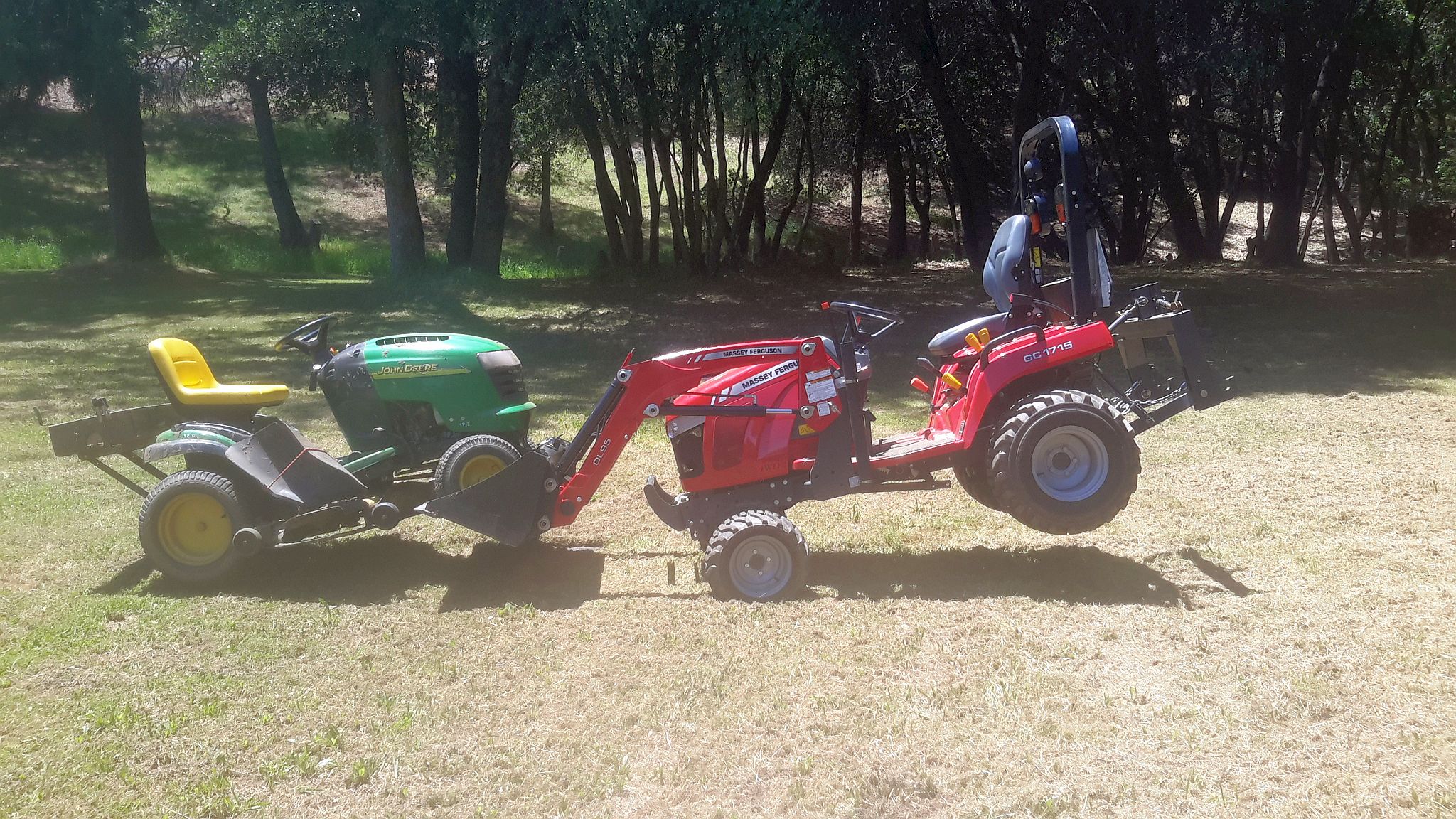
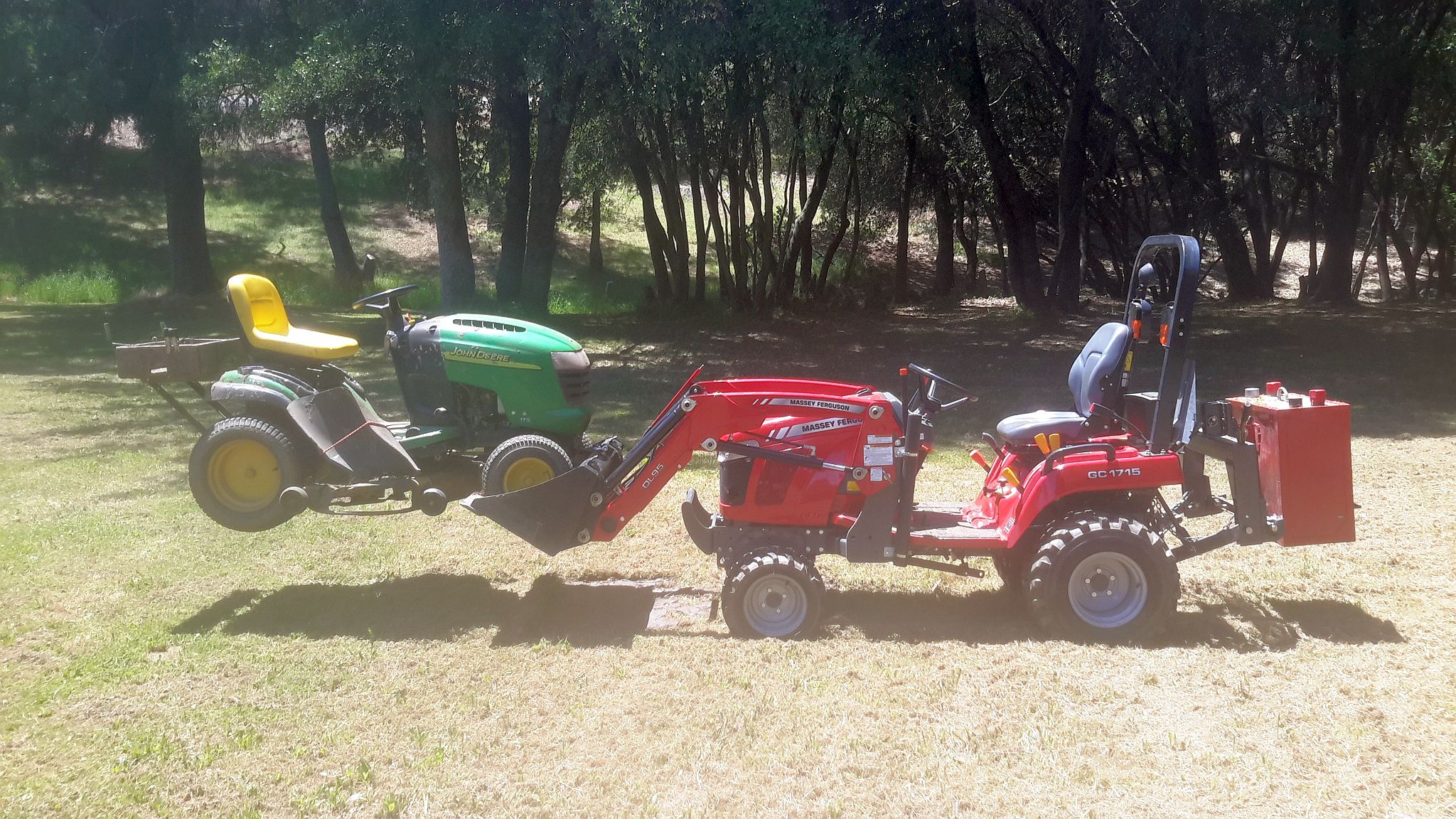
JD mower is 540 lbs by JD specs... Yes there is a low bumper on front of dead deere that is wedged under bucket lip....
JD mower is 540 lbs by JD specs... Yes there is a low bumper on front of dead deere that is wedged under bucket lip....

BoylermanCT
Veteran Member
- Joined
- Apr 1, 2013
- Messages
- 1,519
- Location
- Barkhamsted, CT
- Tractor
- Montana R2844, New Holland TC29D, Hustler X-One
"Yes there is a low bumper on front of dead deere that is wedged under bucket lip...."
You shouldn't have told us this. I was trying to figure out how the Deere was balancing so perfectly!
You shouldn't have told us this. I was trying to figure out how the Deere was balancing so perfectly!
RickB
Super Star Member
- Joined
- Sep 18, 2000
- Messages
- 15,190
- Location
- Up the road from Dollar General WNC
- Tractor
- Just a Scag
So you say, but why?If you have enough rear ballast then the rear axle becomes the fulcrum point.

5030
Rest in Peace
- Joined
- Feb 21, 2003
- Messages
- 28,967
- Location
- SE Michigan in the middle of nowhere
- Tractor
- Kubota M9000 HDCC3 M9000 HDC
I find it comical (and disturbing) what people do with small tractors and they actually survive. I'd never to that crap with my big tractors, never.

dodge man
Super Star Member
For years I went along without rear ballast, just loaded tires. I got a ballast box about 4 years ago and it helps a lot. Loaded tires don’t load the front axle at all nor the rear axle. Rear ballast will take quite a bit of weight off the front axle when doing end loader work.

Tx Jim
New Member
I agree rear tire/axle ballast doesn't lower FEL weight on frt axle BUT weight on 3 pt hitch definitely lowers weight applied to frt axle/tires. Several yrs back I took my Kubota M7040/FEL/rear bale fork & 2 rd bales to a public scale. i weighed my tractor with & without a bale on 3 pt. I located the tractor weighting info shown below. According to my research frt axle WITHOUT 3 pt counter balance exerts 610 more #s on scale.This is debated a fair bit. If the front axle is considered to be the fulcrum rear ballast does nothing to reduce the front axle load.
My M7040 & LA1353 loader with cast rear wheels weighs 7670#s
Same tractor/loader with bale on frt & rear 9630#s
Frt bale weighs 1090#s
rear bale weighs 870#s
Frt axle with bale on frt and bale on the rear 5380#s
Frt axle with bale on frt no rd bale on the rear 5990#s
Last edited:

oosik
Epic Contributor
I have RimGuard loaded rear tires. And a 1010# Rhino rear blade on the 3-point. I don't have the rear blade back there to SAVE the front axle. It's there so I can maintain rear tire traction when lifting loads with the grapple. The front axle is designed to carry a max specific load - I never get anywhere near that limit.
sea2summit
Super Member
Wow, where did you go to school and what is your highest level of education? Just curious.So you say, but why?
Hoobie
Silver Member
This is the perfect example of rear 3 point hitch taking weight off front axel. An extreme example but makes the point.In my younger years I once got a bushhog stuck under a very large fallen tree. My much younger years I assure you. When I couldn't get it out driving straight forward I tried to wiggle it out by raising and lowering the hog. I would raise the hog and the front end of the tractor would come completely off the ground then drop the hog and pop the clutch. Each time I would gain a few inches forward. I finally got the mower out. This was back in the late seventies or early eighties and that mower finally died last fall. I hadn't thought of it before but that is probably why the back wheel fell off later that year.
Anyway, consider the tree as ballast hanging off the 3-pt and I can see how adding weight BEHIND the rear wheels will take weight off the front axle and put less strain on it...... Unless you keep popping the clutch and banging it on the ground. That late sixties to early eighties Ford equipment was tough.
RSKY
Years ago when I had an 8n ford tractor if I lifted my bushog going uphill the front got so light I couldn't steer. Same effect.
The front axel is the fulcrum for the FEL weight. The rear axel is the fulcrum for the 3 point hitch weight. FEL is trying to pry the back up while the hitch weight is trying to pry the front up
Doc G
Bronze Member
Bdog, good thread -- this always deserves more conversation.
Let m = weight on your 3 pt hitch.
Let L1 = the horizontal distance between that weight's center of mass and your front axle.
Let L2 = the horizontal distance between your rear axle and front axle.
You will reduce the load (weight) on your front axle by an amount m*((L1/L2) - 1).
That's one reason why behind-the-tractor ballast is so important for FEL work. As you correctly surmise, rear tire ballast (weights or fluid) will do nothing to alleviate front axle load although it has other beneficial effects sometimes.
Let m = weight on your 3 pt hitch.
Let L1 = the horizontal distance between that weight's center of mass and your front axle.
Let L2 = the horizontal distance between your rear axle and front axle.
You will reduce the load (weight) on your front axle by an amount m*((L1/L2) - 1).
That's one reason why behind-the-tractor ballast is so important for FEL work. As you correctly surmise, rear tire ballast (weights or fluid) will do nothing to alleviate front axle load although it has other beneficial effects sometimes.

RickB
Super Star Member
- Joined
- Sep 18, 2000
- Messages
- 15,190
- Location
- Up the road from Dollar General WNC
- Tractor
- Just a Scag
Exactly my point from above. And we both have enough education and experience to understand your illustration is significantly different from those posted earlier with one fulcrum.Traditional lever diagrams are wrong for a tractor, which has two "fulcrums."
View attachment 696220
Bruce
RickB
Super Star Member
- Joined
- Sep 18, 2000
- Messages
- 15,190
- Location
- Up the road from Dollar General WNC
- Tractor
- Just a Scag
How many tractors do you own having one axle?Wow, where did you go to school and what is your highest level of education? Just curious.
View attachment 696153

ctgoldwing
Platinum Member
Seems to me. . .
allow me some assumptions in a make believe case.
Given
The distance from the bucket to front axle is 3', the distance between axles is 5' and the distance from the rear axle is 3'
If your counter weight was 0 and the bucket weight was 500lbs
There would be a moment of 3ft * 500lbs or 1500ft-lbs around the front axle
To offset that, the rear axle down force required for that moment would be 1500ft-lbs / 5ft or 300lbs would be relieved from the down force on the rear axle.
Don't believe that? Keep adding weight to the bucket until the rear wheels come off the ground (essentially putting 0 weight on the rear axle)
Putting counterweight on has exactly the same effect on the front axle.
Hey, I've been out of school a long time, I could be wrong but I don't think so.


