Any Electronics Gurus Out There?

   / Any Electronics Gurus Out There? #61  
A couple new developments just to make things more complicated and less complicated all at the same time:

I don't believe that I've mentioned that the LEDS flash and they also flash at different speeds depending on the distance from grade. They also change speeds when going thru a couple of zones and I think one of them is when going past the 2" departure from grade. I need to do some testing to see exactly where the speed changes occur. The owner's manual says nothing about all this.

Something that just occurred to me this evening is that we have pinouts on the receiver that go to the remote when attached via the cable. There are seven of them and one appears to be ground and one for the 12 volt charger and/or the 12 volt battery input. (The receiver has an onboard rechargeable battery or can also be powered by the tractor battery.) That leaves five pins for the five sets of LED's. Yes I feel very stupid for not realizing the connections for automation are right there in plain sight.

It gets interesting when one thinks about utilizing the different flashing speeds to change on/off times for the solenoid valve.

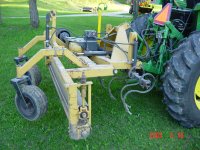
Edit: Added pic.

Well, that either adds simplicity or really complicates the situation. :laughing:

Flashing LEDs would be harder to key off of. Take a look at the signal on the connectors to the remote and see if it is solid or flashing would be the thing to look for, I guess.
 
   / Any Electronics Gurus Out There? #62  
There comes a point when you have more and more roadblocks and technical issues to overcome, that I just foresee the very real possibility of failure and abandon a project. Not intereted in spending lots of time, energy and money for nothing in the end. If there is a bright prospect for success, I go for it. Maybe wait for some unexpectd auction find.

Just looking over various E-Bay listings and the cost of some systems, a few hundred grand (used) blows my mind.
 
   / Any Electronics Gurus Out There?
  • Thread Starter
#63  
Points taken.
Another little tidbit is that the remote has sound effects also.
 
   / Any Electronics Gurus Out There? #64  
If a guy was real smart, you could figure out the radio data communication from the affordable stick-on Top Con unit. You would still need to wire limit switches, but the laser data would be wireless,
 
   / Any Electronics Gurus Out There? #65  
I don't want to be a killjoy, but I'll repeat that the hard part about this is the logic to control the movement of the blade. That's the only part that may turn out not to have a satisfactory solution, everything else is pretty routine.

If the sensor has a plug on it for the remote then what you want to do is find the matching plug. Probably both male and female so you can just chain the remote and have it still work. Reading a pulsing signal is not difficult for a microprocessor.

When the remote makes noise, is it just when the LED lights? IE is there just a buzzer in parallel with the LED? It could also be that the LED's are flashers and the signal is on all the time.
 
   / Any Electronics Gurus Out There? #66  
I don't understand. One relay controls upward motion of the harley edge, the other down. Laser receiver is mounted on edge. Grade is too high, harley lowers until grade is ok or until limit is engaged, grade too low, harley raises until grade is ok or limit is engaged. What logic? Am I missing something? No laser on receiver and harley makes no change. Slight timing damping but not too much to make system slow to respond.

I MAY be missing the obvious. But in my thinking this will keep the harley cutting depth at grade provided the laser signal is not lost and then the harley would just stay at the last position until recapturing the laser.

DSC00098.JPG

It wouldn't even be hard to mount a receiver on the harley near the operating cylinder. Of course on a high stick to clear the tractor.
 
   / Any Electronics Gurus Out There?
  • Thread Starter
#67  
I don't want to be a killjoy, but I'll repeat that the hard part about this is the logic to control the movement of the blade. That's the only part that may turn out not to have a satisfactory solution, everything else is pretty routine.

If the sensor has a plug on it for the remote then what you want to do is find the matching plug. Probably both male and female so you can just chain the remote and have it still work. Reading a pulsing signal is not difficult for a microprocessor.

When the remote makes noise, is it just when the LED lights? IE is there just a buzzer in parallel with the LED? It could also be that the LED's are flashers and the signal is on all the time.

I found, after receiving the remote and testing it this morning, that the audible feature is not working. I got a "used" price on it from Amazon and that may be why as it is probably a returned item. I will attach a pic of it as well as the receiver showing the end ports.

It seems odd that the receiver has a seven pin port and the remote has two four pin ports. One of the four pin ports attaches to the cable whose other end has seven pins to match the receiver's seven port. (The remote has five sets of LED's so not sure how they're getting that out of four pins--must be some logic involving pin combinations?)

I am curious what type of connectors these are if anyone knows. The second four pin port on the remote is for a cable from the 12 volt tractor battery which can be used to power both the receiver and remote or the rechargeable battery on the receiver can power both.

I will do some testing on the receiver to see if I can pick up an output signal(s) but all I have is a digital VOM.

The plot thickens.

Edit: Forgot about my old Simpson analog but doubt that would be any more capable.
 

Attachments

  • JOHNSON-RECEIVER-1.jpg
    JOHNSON-RECEIVER-1.jpg
    85.9 KB · Views: 81
  • JOHNSON-REMOTE-1.jpg
    JOHNSON-REMOTE-1.jpg
    76.3 KB · Views: 79
Last edited:
   / Any Electronics Gurus Out There? #68  
I think they are a canon connector. Bought them from the most wonderful company Digikey.
 
   / Any Electronics Gurus Out There? #70  
I don't understand. One relay controls upward motion of the harley edge, the other down. Laser receiver is mounted on edge. Grade is too high, harley lowers until grade is ok or until limit is engaged, grade too low, harley raises until grade is ok or limit is engaged. What logic? Am I missing something? No laser on receiver and harley makes no change. Slight timing damping but not too much to make system slow to respond.

I MAY be missing the obvious. But in my thinking this will keep the harley cutting depth at grade provided the laser signal is not lost and then the harley would just stay at the last position until recapturing the laser.


It wouldn't even be hard to mount a receiver on the harley near the operating cylinder. Of course on a high stick to clear the tractor.


The problem is the timing. The blade doesn't move instantly. If you activate the down relay for as long as the high light is on, the blade will continue to move down after the light comes off. In the worst case it will overshoot and now the low light is on, so the up relay activates. You get the blade wagging up and down and instead of a smoothing you create a washboard. So maybe you want to work in a delay where when the high light comes on you activate the down relay for a set time, then wait a set time, then check the light again. But how much time? That depends upon the responsiveness of the blade, which varies depending on your speed and the type of soil.

It may or may not be possible to control the blade based only on the lights. The only way -- or the only practical way -- is to experiment. My point is that you don't need a computer interface to experiment. In fact, it actually makes experimentation more difficult because you have a lot more parts to worry about. I'm going to repeat my recommendation from post #39 on page 4, which is to hook up a simple electrical interface to the blade and then go out and do some grading, and see if you can get satisfactory results using simple rules that use only the input from the lights.

You could even start out skipping the electrical interface to the height control and keep it real simple but my hunch is that the manual and electric differ significantly in their performance so lessons learned on one are not transferable to the other.
 
   / Any Electronics Gurus Out There? #71  
If timing is the issue, it must be an issue on many hydraulic machines. No way to predict what the terrain is going to do and have your cutting edge at the right height ahead of time. I mean, the electronics is instantaneous. It's the hydraulics that have to catch up.
 
   / Any Electronics Gurus Out There? #72  
If timing is the issue, it must be an issue on many hydraulic machines. No way to predict what the terrain is going to do and have your cutting edge at the right height ahead of time. I mean, the electronics is instantaneous. It's the hydraulics that have to catch up.

I've spent a big chunk of my life interfacing the physical world with the virtual world and yeah, that's how it goes. The difficulty is always understanding the physical world.
 
   / Any Electronics Gurus Out There?
  • Thread Starter
#73  
Well, that either adds simplicity or really complicates the situation. :laughing:

Flashing LEDs would be harder to key off of. Take a look at the signal on the connectors to the remote and see if it is solid or flashing would be the thing to look for, I guess.

The signal on the connectors appears to be solid. I did a little investigation at the four pin output of the cable that normally connects the receiver to the remote. This is four pins that operate the five outputs on the remote. It appears that they use combinations of more than one pin high at a time to make due if that makes sense.

Edit: I'm baffled as to why each of the outputs flashes at a different rate depending on exactly where the beam is relative to that arrow position. There even appears to the sequence like dots and dashes. It's almost as though they plan to use these outputs for automation of some kind.
 
Last edited:
   / Any Electronics Gurus Out There? #74  
The signal on the connectors appears to be solid. I did a little investigation at the four pin output of the cable that normally connects the receiver to the remote. This is four pins that operate the five outputs on the remote. It appears that they use combinations of more than one pin high at a time to make due if that makes sense.

Edit: I'm baffled as to why each of the outputs flashes at a different rate depending on exactly where the beam is relative to that arrow position. There even appears to the sequence like dots and dashes. It's almost as though they plan to use these outputs for automation of some kind.


It sounds like they're using some sort of serial data protocol to send a reading to the remote, and then the remote adjusts its output based on the reading. With four wires probably one is ground, one is power and two are data. What kind of voltage levels are you seeing with your voltmeter? Is there one pin that is always on and one that is always zero?
 
   / Any Electronics Gurus Out There?
  • Thread Starter
#75  
I'm seeing 6-7 volts. Will need to do some further investigating to see the pattern.
 
   / Any Electronics Gurus Out There? #76  
Seems like you trying to do proportional (PID) control using discrete (on/off) signals.
IMHO, for the application, it seems more appropriate to use analog signals (typically 4-20mA, 1-5 volts or 1-10 volts signals. Previously 3-15 psi pneumatic signals were used.)
There’s a whole slew of analog components (sensors and valve positioners) and simple PID controllers for these application where you don’t want the positioner (for the control valve) to “overshoot” what is being measured by the sensor. This is called “tuning” a control loop.

PID controller - Wikipedia
 
   / Any Electronics Gurus Out There?
  • Thread Starter
#77  
Seems like you trying to do proportional (PID) control using discrete (on/off) signals.
IMHO, for the application, it seems more appropriate to use analog signals (typically 4-20mA, 1-5 volts or 1-10 volts signals. Previously 3-15 psi pneumatic signals were used.)
There’s a whole slew of analog components (sensors and valve positioners) and simple PID controllers for these application where you don’t want the positioner (for the control valve) to “overshoot” what is being measured by the sensor. This is called “tuning” a control loop.

PID controller - Wikipedia

A proportional directional control valve would be great but they are very expensive.
 
   / Any Electronics Gurus Out There? #78  
I bet it's morse code. Up would be dit dit dah, dit dah dah dit.

That's the problem. Most modern stuff uses serial data and the (old school) DIYer is done. Impresses me how some guys can hack serial vehicle communications.
 
   / Any Electronics Gurus Out There?
  • Thread Starter
#79  
Some more investigation reveals that the reading between all possible combinations of the four pins shows voltage of 6.5 or 7.5 VDC. These readings DO NOT CHANGE regardless of where the laser is striking the receiver and which arrow is flashing.

There are eighteen receiver diodes at each of the four corners of the receiver "feeding" the five output flashers. The distance between diodes increases, probably exponentially, as they progress away from on grade. It's interesting that when dead center on grade the flasher is at slow rate and when moving even 0.040" off center, the flash rate increases dramatically.

Looks to me that hacking this in an "analog manner" would involve picking up the output from each of the 18 x 4 = 72 diodes rather than the "flashers".
 
   / Any Electronics Gurus Out There? #80  
At least we now know why these systems are so expensive to purchase complete. :laughing:
 

Tractor & Equipment Auctions

20FT X 30FT STEEL CARPORT (A58214)
20FT X 30FT STEEL...
2011 INTERNATIONAL DURASTAR 26FT NON CDL BOX TRUCK (A59904)
2011 INTERNATIONAL...
22FT Roadway Dry Van Pup Trailer (A56438)
22FT Roadway Dry...
2007 Frienghtliner B2 School Bus (A59230)
2007 Frienghtliner...
2014 GMC Sierra SLT 4x4 Crew Cab Pickup Truck (A59230)
2014 GMC Sierra...
2022 CATERPILLAR 330 EXCAVATOR (A60429)
2022 CATERPILLAR...
 
Top