Another bridge building question...

/ Another bridge building question... #21  
Holy moly, LD1 -- this fellow Buckeye thanks you for that wonderful tutorial! I truly appreciate it! I missed a few steps due to my unfamiliarity with it, and that makes all the difference.

Based on what these calculations are showing, I'm happy to read your assessment that the beams won't be the weakest link. And I somewhat agree with you that two beams should be enough, but with the way scrap prices are these days, it might not be that big of a hit to the wallet to just keep the extra two. At any rate, it's time for me to sharpen the pencil a little bit and spend some time with a structural engineering firm to figure out our best options.

Thank you so much to all for welcoming a newbie! Any and all ideas are still welcome....and certainly appreciated.

Thanks for the tutorial, it let me check how a beam I have would work for a cider press (very well) and how it would work for another location to help in the house :D

Aaron Z

No problem. ITs a pretty simple program. The stress, and deflection are both things that arent difficult to calculate by hand and its nice to know how to do it, but this takes all the guess work out. Thing I like most is their pretty extensive list of beams, channel, and angle iron.

And like I mentioned, if you know a little about what you are doing, and know some specs of wood, (or any material for that matter) you can use that program as well.
 
/ Another bridge building question... #22  
Isn't there a difference between static and dynamic loading?

Don't forget live loads for a bridge with vehicle traffic -- that is an important factor.

Aren't there also buckling considerations that are required?

Yes there is a whole lot more to it than just the static load the beam will hold. I am not worried as he is already said he is talking to an engineer. He was just wanting a little info so he can be better informed when talking with them.

Dynamic loading is impossible to figure. Too many variables. How fast is that concrete truck going to be moving when hitting the bridge, and any sudden elevation changes before/aft the bridge? or a perfect flat transition. Are they gonna have cheater axles down to help distribute the load? Thats why it will usually just be built with a safety factor. Those beams have a safety factor of at least 4x if only using 2. And thats only for 80k trucks. For most of the traffic the bridge will likely see, probably a 40x safety factor.
 
/ Another bridge building question... #23  
An engineer will want to know what material you already have for the bridge and what condition they are in . The live loads and dead loads have different multipliers or safety factors when used in the design calculations. Will your bridge be in the flood plane of the stream. A concrete deck will help with lateral restraint of the beams. Do you have access to both sides of the stream?
 
/ Another bridge building question... #24  
A word of caution to anyone using that beamboy program. It will not tell you everything. It is designed to be used by a competent person who understands the limitations of the program. There are several failure modes that need to be evaluated individually for structural members. Deflection is not the only concern. :thumbsup:

[/rant]
 
/ Another bridge building question... #25  
I
Yes there is a whole lot more to it than just the static load the beam will hold. I am not worried as he is already said he is talking to an engineer. He was just wanting a little info so he can be better informed when talking with them.

Dynamic loading is impossible to figure. Too many variables. How fast is that concrete truck going to be moving when hitting the bridge, and any sudden elevation changes before/aft the bridge? or a perfect flat transition. Are they gonna have cheater axles down to help distribute the load? Thats why it will usually just be built with a safety factor. Those beams have a safety factor of at least 4x if only using 2. And thats only for 80k trucks. For most of the traffic the bridge will likely see, probably a 40x safety factor.

There is a little more to bridge design than picking a safety factor out of the air.
 
/ Another bridge building question... #26  
I

There is a little more to bridge design than picking a safety factor out of the air.

Let's not get too convoluted here. The common safety factor for decades has been three. That allows for a lot of rust and other abuse before failure. Somebody fabricated these beams for the span length they are. Cut them off a bit shorter and you increase the safety factor. Try to weld a couple of them together and increase the span and you might have a problem but shorter is obviously better.
 
/ Another bridge building question... #27  
Let's not get too convoluted here. The common safety factor for decades has been three. That allows for a lot of rust and other abuse before failure. Somebody fabricated these beams for the span length they are. Cut them off a bit shorter and you increase the safety factor. Try to weld a couple of them together and increase the span and you might have a problem but shorter is obviously better.
typically beams like this are salvaged from another structure. You do not know the span length or spacing on the beams originally. There is also the weight of the beams and deck to support. An engineer will review several loading cases to determine what is the controlling factor for your bridge
 
/ Another bridge building question... #28  
I

There is a little more to bridge design than picking a safety factor out of the air.

That is why the OP is going to talk to an engineer. I dont know what kind of safety factor he is going to require.

But the beams he has, there will be a 4x safety factor for an 80k truck. If the engineer happens to require more than that, he may rate the bridge for less, or offer suggestions.

Engineering a bridge for a specific load certainly aint rocket science. He has some pretty large beams. He is gonna talk to an engineer, come up with a plan for footings and decking, and the bridge will be rated for a given load. Pretty simple.
 
/ Another bridge building question... #29  
That is why the OP is going to talk to an engineer. I dont know what kind of safety factor he is going to require.

But the beams he has, there will be a 4x safety factor for an 80k truck. If the engineer happens to require more than that, he may rate the bridge for less, or offer suggestions.

Engineering a bridge for a specific load certainly aint rocket science. He has some pretty large beams. He is gonna talk to an engineer, come up with a plan for footings and decking, and the bridge will be rated for a given load. Pretty simple.

Its not child's play either. There is a reason engineers have a 4 year school and a 5 year apprenticeship program to get their license to certify these structures. Plugging in numbers is simple. A simple beam calculation is simple. There is a whole lot more that goes into it than that.
 
/ Another bridge building question... #30  
There is a reason engineers have a 4 year school and a 5 year apprenticeship program to get their license to certify these structures. Plugging in numbers is simple. A simple beam calculation is simple. There is a whole lot more that goes into it than that.

True, but that allows an engineer to optimize. For example aircraft must be optimized for weight.vs.strength and the difference is payload, range and service life. When you already --- have --- the materials, just about all you need is validation. If the materials exceed the safety factors then it gets pretty simple. Perhaps within the realm of forum engineering. Adequate bridge designs happen all over the world without engineers or beamboy.

Your point is understood for "other projects".
 
/ Another bridge building question... #31  
I read all the posts and unless I missed it, I thought I saw one small mention of the stream and the flood plain. Do you know anything about this stream? I lived next to one of these innocent looking streams for about 8 years. It was a very small creek 90% of the time, but during bad thunderstorms or a lot of melting snow, it became a raging river. It can be a pretty scary thing, and it took out more than one homemade bridge my neighbors tried to build.

I went by there several years later, in front of the house on the highway there was a low water bridge. After I left the state came in and redid the bridge, putting in two huge square concrete culverts. Most people looking at it would think it's ridiculous and a waste of money for such a small stream, but whoever spec'ed it out must have been there during one of the storms we used to have.
 
/ Another bridge building question... #32  
True, but that allows an engineer to optimize. For example aircraft must be optimized for weight.vs.strength and the difference is payload, range and service life. When you already --- have --- the materials, just about all you need is validation. If the materials exceed the safety factors then it gets pretty simple. Perhaps within the realm of forum engineering. Adequate bridge designs happen all over the world without engineers or beamboy.

Your point is understood for "other projects".

:thumbsup: The only reason I get up tight about it is because I have a civil engineering degree. I have spent hours and hours on steel design even though I'm not a structural engineer. I do have a firm grasp of what goes into it and the simple tables are only as useful as what you know about them. I'll go back to my coffee now. :drink:
 
/ Another bridge building question... #33  
Most times a bridge is wanted on here, people suggest a flat-bed trailer or a flat bed RR car. A RR car is longer than 36' between axles, and the beams arent as heavy and they arent as wide as he wants.

I am acutally surprised no one has mentioned that yet.

Only issue that needs engineering IMO is the supports and the decking.
 
/ Another bridge building question... #34  
This is what we did back in '89. I went to an engineer and told him I wanted something that would handle highway loads in case something bad happened on my side of the creek that would require heavy vehicles to cross. We've had loads of blacktop, triaxle loads of crushed stone, concrete trucks, etc use it.
 

Attachments

  • IMG_0094.jpg
    IMG_0094.jpg
    1 MB · Views: 269
/ Another bridge building question... #35  
Steel beams can be very simple to design with as long as they stay within there plastic buckling range, basically the beam will fail by stretching and deforming downward. However there are many other ways of failure that can happen, thats why we (engineers) get paid to figure that stuff out so no one dies. If there is not enough lateral bracing the beams when loaded will fold over sideways, not a good day for anyone on it. Beams can fail all sorts of other ways but a w33x118 is a standard wide flange beam designed to specifically prevent many of them. Other than bending type failures shear is a major concern, however most W beams have very stiff webs, ive never seen that control a W beam bridge design. I do alot of county built bridges on gravel roads and that size of beam will make that span even as a 36 ksi steel. I would recommend using a concrete deck over wood. It will prevent the top flange of your beams from rusting out from being in contact with wood. Concrete also allows you to brace your top flange very easily by essentially casting your top flange into the concrete or using a shear connector. It didnt sound like you were needing a sealed set of plans so im assuming your bridge is on private property meaning you can pretty much put your beams wherever you want them. Generally DOT's will not allow load ratings for bridges based on assuming vehicles are where they are saposed to be, free will and all its basically impossible to predict what some yahoo's will do and hence we are forced to assume vehicles are anywhere on the bridge deck. This being private not public you could put your beams under that anticipated wheel loads but you better be dam sure everyone that could ever possibly drive on the bridge knows where to drive. Depending on soil types and rock depth there are a number of foundation options. A shallow spread footer that is also the bridge abutment would probably be the cheapest and simpliest but settlement or bank erosion could be a concern. Make sure not to rest your beams directly on the concrete. Concrete in contact with ground + shade under a bridge + rain + steel = rust and lots of it. I have condemned alot of bridges because the last foot of the beam was shot. Neoprene bearing pad would be best, but i would think on the cheap side used tire tread with the steel belts in it would work well. The beam needs to be free to rotate when loaded, if its on concrete you will end up creating pressure points on the uneven surface of the concrete. Best advice i can give you is talk to your engineer, make sure he is familiar with both bridge design and construction. Talk to your nearest rural county road department they will most likely have alot of experience with building small bridges similar to what your doing. LATERAL BRACING IS YOUR FRIEND DON'T SKIMP THERE.
 
/ Another bridge building question... #36  
And just so i can say i told you so...DONT WELD ON THE BOTTOM FLANGE NEAR THE MIDDLE OF THE BRIDGE... its not desirable even when done by professional welders which i am assuming you are not.

And btw ... you are most likely required to check with EPA, DNR, and Army Corps of Engineers about permits...but once you officially start that process and they know what your doing you will not be able to stop feign ignorance and simply build the bridge. So your call on that one, personally if its out of sight ide probably just build it and hope no one notices. EPA...? i cant remember which agency uses time lapsed satellite photos and computer programs to watch for changes in water ways like this, Just a heads up. And if they catch you they will raise holy **** about silt polution into the streams, certain fishes breeding patterns, some kind of snail, and my personal favorite trees that bats live in (apparently we dont have other trees for them to move to in missouri??? which is probably 50% trees...) have all been used to slow if not stop public work projects that ive been on.
 
/ Another bridge building question... #37  
And just so i can say i told you so...DONT WELD ON THE BOTTOM FLANGE NEAR THE MIDDLE OF THE BRIDGE... its not desirable even when done by professional welders which i am assuming you are not.

And btw ... you are most likely required to check with EPA, DNR, and Army Corps of Engineers about permits...but once you officially start that process and they know what your doing you will not be able to stop feign ignorance and simply build the bridge. So your call on that one, personally if its out of sight ide probably just build it and hope no one notices. EPA...? i cant remember which agency uses time lapsed satellite photos and computer programs to watch for changes in water ways like this, Just a heads up. And if they catch you they will raise holy **** about silt polution into the streams, certain fishes breeding patterns, some kind of snail, and my personal favorite trees that bats live in (apparently we dont have other trees for them to move to in missouri??? which is probably 50% trees...) have all been used to slow if not stop public work projects that ive been on.
Any welding on bottom flange is a bad idea
The bats over winter In dead trees or loose bark trees like hickory. They are endangered.
Ohio has numerous bridges with beams poured into abutments
In distant past I used to design bridges
 
/ Another bridge building question... #38  
Nice to know about the bats...always
wondered why the trees were so important...

Those beams cast in concrete are painted with industrial grade epoxy at the ends if you don't the beams rust out at the abutment.

Some thing else to consider...if you do go with a non composite concrete deck make sure to use at least a few shear connectors on top of your beam...even if it does not achieve composite action it will keep your deck tight to the beams and prevent it from rusting.
 
/ Another bridge building question... #39  
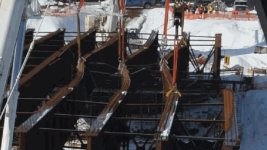
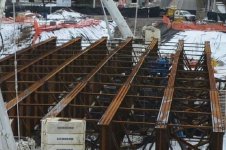
We don't need no engineering to place beams??

Or do we?

image.jpgimage.jpgimage.jpgimage.jpgimage.jpgimage.jpg

The three bent beams will be removed and repaired. It is though insufient cross bracing caused the failure.

Seems the supports didn't t fail!
 
/ Another bridge building question... #40  
Yikes...there's a lot of money down the drain...plate girders can be squirrly.
 

Marketplace Items

1990 INTERNATIONAL 3800 DAY CAB DUMP TRUCK (A58214)
1990 INTERNATIONAL...
84" HYD CURVED LOG GRAPPLE (A52706)
84" HYD CURVED LOG...
UNUSED 2026 INDUSTRIAS AMERICA HYD TITL TRAILER (A60430)
UNUSED 2026...
2008 TOYOTA Camry Solara (A59231)
2008 TOYOTA Camry...
International MaxxForce 6-Cylinder Turbo Diesel Engine with Transmission (A59228)
International...
Forestry Truck Grapple and Frame (A55851)
Forestry Truck...
 
Top