Thoughts on mega wind and solar projects

/ Thoughts on mega wind and solar projects #221  
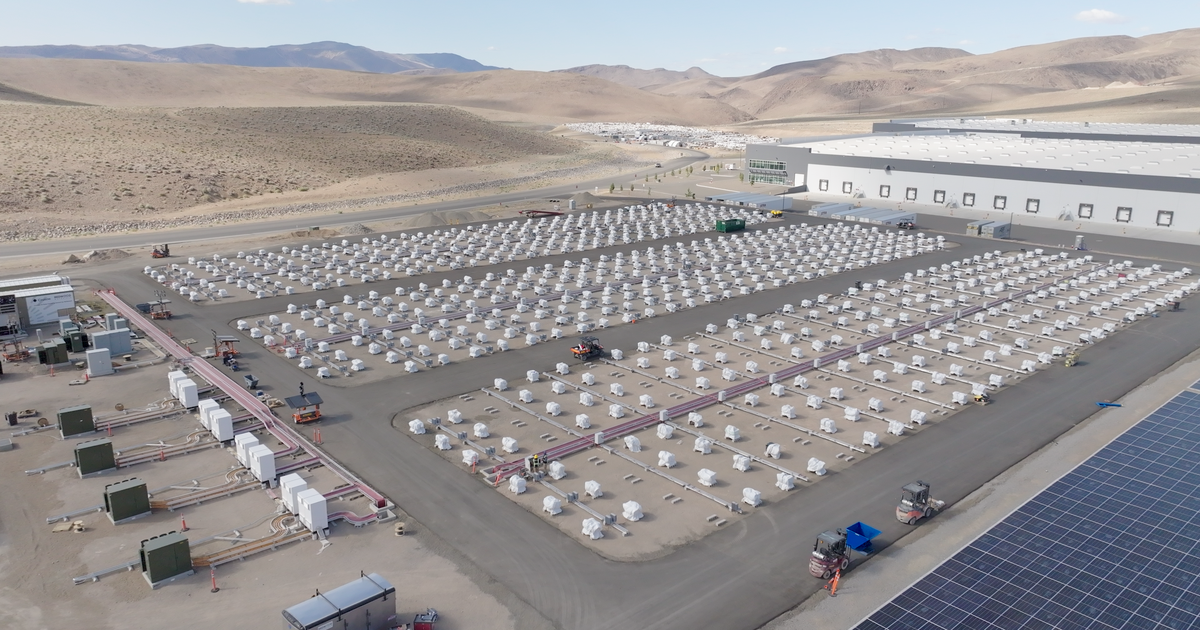
I’ve seen a few news stories on the local news about battery storage at some solar farms. The amount of batteries is huge. Basically dozens of semi trailers are full of batteries. It doesn’t seem practical to me.
Why? Most of us don't drive hand built custom vehicles, with all of the parts made special for our particular vehicle. I think that Henry Ford was on to something for cars, and it applies to batteries as well.

Having a containerized battery system reduces installation costs, and enables a factory to turn out zillions of the same product. It enables standardized everything. The site prep is pouring a foundation, attaching the cables to the terminals, and plugging in the control system.

You can go from foundation pads to functional system in hours. There is one permit process, and it is boilerplate. That alone saves megabucks over time.

Solar plus a battery farm helps a solar installation behave as a very flexible electrical generation system, able to provide power, or absorb excess at any time of day, not just when the sun shines. Utilities and customers love the stability. It is even better than have a base load nuclear or coal plant because they can absorb energy from the grid as well as provide it. Batteries make grid power quality better, and power distribution much easier for utilities.

All the best,

Peter
 
Last edited:
/ Thoughts on mega wind and solar projects #222  
Why? Most of us don't drive hand built custom vehicles, with all of the parts made special for our particular vehicle. I think that Henry Ford was on to something for cars, and it applies to batteries as well.

Having a containerized battery system reduces installation costs, and enables a factory to turn out zillions of the same product. It enables standardized everything. The site prep is pouring a foundation, attaching the cables to the terminals, and plugging in the control system.

You can go from foundation pads to functional system in hours. There is one permit process, and it is boilerplate. That alone saves megabucks overtime.

Solar plus a battery farm helps a solar installation behave as a very flexible electrical generation system, able to provide power, or absorb excess at any time of day, not just when the sun shines. Utilities and customers love the stability. It is even better than have a base load nuclear or coal plant because they can absorb energy from the grid as well as provide it. Batteries make grid power quality better, and power distribution much easier for utilities.

All the best,

Peter
I read something the other day that power grids relied on the stored power of spinning generators to level the loads and maintain frequency and moderate dips and surges on their grids. Now, batteries can do the same thing with no moving parts.
 
/ Thoughts on mega wind and solar projects #223  
I read something the other day that power grids relied on the stored power of spinning generators to level the loads and maintain frequency and moderate dips and surges on their grids. Now, batteries can do the same thing with no moving parts.
They do, and it works well. On a smaller scale, I have a large inertial mass backup generator that doesn't flinch when large loads get dumped on it. I think electronic control can deliver even higher quality power.

Between commercial users trying to load shift out of peak power rates, and home users trying to be self sufficient, and avoid peak rates, there's a fair bit of installed battery power around here. It's been rapidly expanding. Five or so years ago the utility for Northern California struggled on high temperature days, to the point of blackouts. Four years ago, the utility was asking for back fed battery power eight or ten times a year. Last year they scheduled one a month by contract, but no longer needed the power. Batteries across a power grid can do wonders for grid stability, and power quality.

They just installed a pair of feeder transmission lines in the major metro area near us. Both were fairly short lines, as in less than twenty miles. Both were high voltage DC, so AC to DC to AC. I suspect that the reason for DC lines was to maintain frequency and control reactive power, similar to what a spinning generator would do, but electronically and with tighter control.

Reading up on the short distance DC transmission lines seemed like a peek behind the curtain to me on the challenges of supplying quality power.

Lots of ways to ski a cat as they say.

All the best,

Peter
 
/ Thoughts on mega wind and solar projects #224  
Why? Most of us don't drive hand built custom vehicles, with all of the parts made special for our particular vehicle. I think that Henry Ford was on to something for cars, and it applies to batteries as well.

Having a containerized battery system reduces installation costs, and enables a factory to turn out zillions of the same product. It enables standardized everything. The site prep is pouring a foundation, attaching the cables to the terminals, and plugging in the control system.

You can go from foundation pads to functional system in hours. There is one permit process, and it is boilerplate. That alone saves megabucks overtime.

Solar plus a battery farm helps a solar installation behave as a very flexible electrical generation system, able to provide power, or absorb excess at any time of day, not just when the sun shines. Utilities and customers love the stability. It is even better than have a base load nuclear or coal plant because they can absorb energy from the grid as well as provide it. Batteries make grid power quality better, and power distribution much easier for utilities.

All the best,

Peter

Just make sure you factor this into the costs:

Not all solar farms are built where old power plants were. Also, many are not built near existing transmission lines.

One can brag about how cheap the imported panels and batteries are, but the power must be connected to transmission lines. Those seem to frequently overlooked as a significant added cost to building solar farms.

It aint just panels & batteries. Its much more
 
/ Thoughts on mega wind and solar projects #225  
Just make sure you factor this into the costs:

Not all solar farms are built where old power plants were. Also, many are not built near existing transmission lines.

One can brag about how cheap the imported panels and batteries are, but the power must be connected to transmission lines. Those seem to frequently overlooked as a significant added cost to building solar farms.

It aint just panels & batteries. Its much more
It is, you are right, but even with new transmission lines added in, the contracts are being signed at around $0.02-3/kWh. From the outside, the utility and the developers seem happy at that price, so folks seem to be making money at it. I know that my utility gets to sell that power to me at a significant markup.

The same utility is putting more purely battery systems across its grid, so they seem to believe that the ability to arbitrage power costs is worth it. I have seen installations that have publicly disclosed ROIs of two to three years.

All the best,

Peter
 
/ Thoughts on mega wind and solar projects #226  
It is, you are right, but even with new transmission lines added in, the contracts are being signed at around $0.02-3/kWh. From the outside, the utility and the developers seem happy at that price, so folks seem to be making money at it. I know that my utility gets to sell that power to me at a significant markup.

The same utility is putting more purely battery systems across its grid, so they seem to believe that the ability to arbitrage power costs is worth it. I have seen installations that have publicly disclosed ROIs of two to three years.

All the best,

Peter

So looking at it from a Capitalist perspective:
The developers of mass solar/wind energy fields are generating their solar power at substantially lower cost /kWh. That’s great.

Are the savings being passed on to the customer?

Cause all I hear is people screaming that their energy prices are “through the roof”. Especially in California & New Jersey, where green energy is a religion, not a utility.

So who wins here? Sounds to me like the power generation companies have found a lower cost way to produce electricity, but are they passing along the savings to the customer? Or are they just pocketing even more massive profits?

So who wins? The states like CA & NJ that get to tax the higher energy costs and make more money? Because green energy, as cheap as it’s alleged to be, is not looking like it’s going to be cheaper.

Looks like the poor could end up paying more?
 
Last edited:
/ Thoughts on mega wind and solar projects #227  
Not answering for Dodge man, but yes in the sense that the infrastructure is all in place. The railroads are there. The highways are there. The mines and quarries are there. The transmission lines are built. We made huge investments in them.
There is a level of practicality in that.
Simply abandoning them and tearing it all down makes no sense. We all recognize the promise and affordability of solar, but it makes more sense to keep the fossil fuel infrastructure in place and running when solar can’t, or if China won’t supply us with the solar panels or batteries in a time of conflict. China is making very hostile moves on Taiwan and other US allies. They are clearly involved in dark money schemes. That has to be factored into the process.

Few of us are moronic enough to believe China is not hostile to the US, but there are few out there. ;P

Importing Chinese solar panels, batteries, wire, switch gear and all the components related to going all solar has some impracticalities tied to it and certainly does nothing to help unemployment levels. Giving 100’s of thousands of fossil fuel workers pink slips and telling them to pound sand is impractical, too.
Coal power is simply too expensive compared to other options. All that infrastructure adds to the cost of power and it’s not cost competitive. The coal infrastructure is old and near end of life. Power companies aren’t going to modernize coal infrastructure at high cost when there are more economical alternatives. Not to mention the toxicity of coal mines and power generation waste to the air, soil, and water.
 
/ Thoughts on mega wind and solar projects #228  
So looking at it from a Capitalist perspective:
The developers of mass solar/wind energy fields are generating their solar power at substantially lower cost /kWh. That’s great.

Are the savings being passed on to the customer?

Cause all I hear is people screaming that their energy prices are “through the roof”. Especially in California & New Jersey, where green energy is a religion, not a utility.

So who wins here? Sounds to me like the power generation companies have found a lower cost way to produce electricity, but are they passing along the savings to the customer? Or are they just pocketing even more massive profits?

I live very close to New Jersey, and I’m subjected to all things New Jersey. They recently elected a governor named Mickie Sheril. She promised if elected, (paraphrasing) New Jersey energy bills would be higher. But she said that was the price to be paid for green energy.

So who wins? The states like CA & NJ that get to tax the higher energy costs and make more money? Because green energy, as cheap as it’s alleged to be, is not looking like it’s going to be cheaper.

Looks like the poor could end up paying more?
Green energy doesn’t cost more to supply. It’s cheaper. My power costs have been level for the past decade even though we now get a significant percentage of power in the grid from renewables. If NJ companies and taxes are jacking up the rates, this isn’t due to the cost of energy production.
 
/ Thoughts on mega wind and solar projects #229  
Green energy doesn’t cost more to supply. It’s cheaper.

Let’s say you are right, then wouldn’t your energy costs go down? Did you ever take an Econ 101 course?
If green energy is cheaper to produce, and your electric bill is “level”, then I’m sure even you could understand that means your green gods of power are pocketing more profit, right?
We know you are flush with cash & pension we taxpayers paid for, but do you think that’s cool to do to the poor?
Maybe there’s poor people who would like to see energy costs drop since the cost to produce green energy is lower, right?
My power costs have been level for the past decade even though we now get a significant percentage of power in the grid from renewables.
See above


If NJ companies and taxes are jacking up the rates, this isn’t due to the cost of energy production.

Correct, but what we are discussing is the cost to produce the energy. You claim green is cheaper. OK, fine. Have your energy bills gotten cheaper? Nope. Using your words, they are “level”. That means power companies have reduced input costs, but not passed the savings on to you.
Where’d the extra money go? It went in their pockets for higher profits.

On edit: I have no problem with Capitalism, but you can’t claim green energy is cheaper if all the savings get pocketed by the energy company, not the consumer.
 
Last edited:
/ Thoughts on mega wind and solar projects #230  
I wrote that the panels are now crazy cheap; batteries are still expensive, but prices are dropping year by year.
$4,500 for 16kw isn't bad.
I'll probably hold off on battery purchase for at least another year. I have a lot of work to do before the system will be ready for them anyway.
I am off grid, so I depend on the storage at night and in cloudy weather to keep from running the generator any more than necessary.
I could hook up to the grid, but the utility requires a 30 foot open path, "to the sky" for the power lines, which would have necessitated cuttin lots of trees and loss of privacy, so we went off grid to preserve privacy. One of the main reasons we bought the property, which incidentally, is within the city limits, but you would never know it from the looks of it.
 
/ Thoughts on mega wind and solar projects #231  
Coal power is simply too expensive compared to other options. All that infrastructure adds to the cost of power and it’s not cost competitive. The coal infrastructure is old and near end of life. Power companies aren’t going to modernize coal infrastructure at high cost when there are more economical alternatives. Not to mention the toxicity of coal mines and power generation waste to the air, soil, and water.
Even 20+ years ago, I couldn't understand how coal plants made money. Train loads of coal, coal unloading and storage, coal conveyors, pulverizers, pulverized coal conveyance, scrubbers, bag houses, ESP's, ash handling and the general wear and tear on the burner box and heat exchangers of an acid and particulate laden exhaust gas. Coal must have been so dirt cheap, compared to other fuels, to make it worthwhile.

NG and the frac gas boom certainly changed the economics with coal. I suspect PV's might make the same happen for NG in power generation. Certainly, the shipping of LNG to Europe and Asia is raising the costs of NG and making it better suited to thermal processes, rather than electric generation.

BTW: The world's largest NG combined cycle plant in Taiwan, that I mentioned earlier, gets all its gas from LNG ships. There is no pipeline to Taiwan.
 
/ Thoughts on mega wind and solar projects #232  
So looking at it from a Capitalist perspective:
The developers of mass solar/wind energy fields are generating their solar power at substantially lower cost /kWh. That’s great.

Are the savings being passed on to the customer?

Cause all I hear is people screaming that their energy prices are “through the roof”. Especially in California & New Jersey, where green energy is a religion, not a utility.

So who wins here? Sounds to me like the power generation companies have found a lower cost way to produce electricity, but are they passing along the savings to the customer? Or are they just pocketing even more massive profits?

So who wins? The states like CA & NJ that get to tax the higher energy costs and make more money? Because green energy, as cheap as it’s alleged to be, is not looking like it’s going to be cheaper.

Looks like the poor could end up paying more?
I understand that you have frustrations with renewables. Everybody has a right to a viewpoint.

However, I wouldn't shoot the producers for high customer costs. The high power costs are due to the utilities and the public utility commissions that allow the utilities high profits. California's PUC guarantees venture level returns on capital investment to the utilities. So it shouldn't be a big surprise that the utilities invest in as many capital intensive expensive projects as they can, whether or not they lower the cost to consumers. I can't fully blame the utility, as they are playing by the rules of the public utility commission.

Are high capital investing by utilities serving the interests of customers across the state? No, it clearly isn't. Why do you think so many Californians have invested in solar and batteries at the household level? Econ 101. Now, one might make the argument that the utility lobbyists have the PUC in their pockets due to the actions of elected governors, but that is different from power generation and distribution.

But the same is true of many business that have something akin to monopoly pricing. You want a one ton pickup? Great, there are basically three choices of manufacturers, and those pickups are all huge profit centers for the manufacturers. Ditto large SUVs. You want a flight into an airport served by one or two airlines, and the price per mile is multiples of nearby airports with competitors. That's Econ 1.

All the best,

Peter
 
/ Thoughts on mega wind and solar projects #233  
Let’s say you are right, then wouldn’t your energy costs go down? Did you ever take an Econ 101 course?
If green energy is cheaper to produce, and your electric bill is “level”, then I’m sure even you could understand that means your green gods of power are pocketing more profit, right?
We know you are flush with cash & pension we taxpayers paid for, but do you think that’s cool to do to the poor?
Maybe there’s poor people who would like to see energy costs drop since the cost to produce green energy is lower, right?

See above


Correct, but what we are discussing is the cost to produce the energy. You claim green is cheaper. OK, fine. Have your energy bills gotten cheaper? Nope. Using your words, they are “level”. That means power companies have reduced input costs, but not passed the savings on to you.
Where’d the extra money go? It went in their pockets for higher profits.

On edit: I have no problem with Capitalism, but you can’t claim green energy is cheaper if all the savings get pocketed by the energy company, not the consumer.
Consider this: more costly energy production would accelerate energy bills, not hold them level. The poor would have higher bills without cheaper energy production. Yes companies are reaping benefits of cheaper production; such is capitalism.

My pension was based on my contributions; there is nothing free and it is smaller than many corporate 401k annuities.
 
/ Thoughts on mega wind and solar projects #234  
I feel like I’m missing something on battery storage for solar farms. The pictures I see show huge numbers of containers with batteries. That makes sense an efficient way to bring them in. My problem is there are concerns for the rare earth elements for batteries, disposal and/or recycling of them at end of life. It seems like just one of these battery storage setups for a solar farm would be enough to build thousands of electric cars.
 
/ Thoughts on mega wind and solar projects #235  
They do. And part of the debrief was the multitude of ways in which Texas natural gas facilities were not prepared for below freezing temperatures or the potential surges in transmission needs.

I use the Texas freeze as a teaching case for disaster and emergency planning as it has lots of lessons. One of which there were many ways that small changes might have made a profound difference in the outcome.

I think that there were lots of folks at fault. Personaly, I would start with the minor detail that almost none of the Texas grid is attached to other grids, and so the state is unable to import additional power in times of energy stress. I understand the ethos behind that decision, but at some level, this was an own goal, as was the recent flood damage. I sincerely hope that lots of Texans learned from the deep freeze and did something meaningful to keep themselves safe and to protect themselves from disasters.

All the best,

Peter
Can add some finer details to that. This was not Texas first time in this rodeo. Prior -- in Feb 2011, we had a mini-test run. Deep Freeze, etc. Super Bowl in town, no less. Our existing Coal plants froze, and things were not yet so dependent on Gas. Major plants failed, and they had to re-route power (from the poors) to the Super Bowl site.

The take away was that those OLDER Coal Plants -- we went back and "Winterized" (better insulation on valves, more heat strip on piping -- on and on). Those ones stayed on during Winter Storm URI -- Feb 2021. However, they were older and dirty and some were already taken off-line awaiting their fate by 2021. (Videos below). The new(er) plants and the new(er) Frack Gas sites -- had not been through the Feb 2011 Deep Freeze. So they tended to Freeze. Not a big Coal fan -- but "only" about 30% froze-Failed. 70% made it through.

Meanwhile, typical review numbers was Gas was around 40% Fail, and Nukes were 25% Fail.

Here is the funny part, will probably get some howls on here . . .
Meanwhile Solar PV jumped UP. PV produces more when Cold, and Reflected Light from Snow increased production). So now Texas has built a LOT more Solar PV and is now leading the US in Solar PV.

Back in 2021, Governor Abbott and his Frack Gas buddies looked at the numbers, and that is when the Lies started. Wind was not even slated for much to fail from. Winter and Summer are our "slow" Wind times. We plan Big Wind for Spring, Fall, and more at night than day.

These are a couple of "my" older plants. We actually had them fixed up with Deep Freeze and (layers and layers of) EPA Air Compliance.

Big Brown Demolition (wait for the cattle moooo)

Monticello

==============

Grid Attachment for Texas is partly a factor of distance. Not just the political. We can run High Voltage AC only so far. Will do some details on HVDC -- on another comment I think you have . . .


/ Thoughts on mega wind and solar projects #236  
I feel like I’m missing something on battery storage for solar farms. The pictures I see show huge numbers of containers with batteries. That makes sense an efficient way to bring them in. My problem is there are concerns for the rare earth elements for batteries, disposal and/or recycling of them at end of life. It seems like just one of these battery storage setups for a solar farm would be enough to build thousands of electric cars.
Yes, you are right one grid size battery, e.g. one Tesla MegaPack (one of those semi sized bricks) , can store a lot of energy. A single MegaPack can store 3.9MWh of power. That 45-50+ vehicles worth of batteries, so lots, but not thousands of EVs.

The batteries do get recycled, as you are right, there is a great deal of residual value in "old" batteries, or electronics for that matter.

Several battery plants that were intended for EVs, or were producing batteries for EVs have switched to battery storage systems. E.g.
There's also recent articles in the NYT, and the Financial Times, but the links don't pass through here for free. You can find them on the web without charge.

Personally, I don't think it is a smart move on Ford's part, as they have zero experience in large battery systems or power, but that's not my affair.

@Phil Timmons Yes, long distance transmission lines are an issue, pretty much everywhere. We have had the Pacific DC Inter-Tie for decades. Pacific DC Intertie - Wikipedia
I think that it is worth a read for anyone who hasn't read it before as it gets into the details of why, and then how the "how" changed over time.

All the best,

Peter
 
/ Thoughts on mega wind and solar projects #238  
I feel like I’m missing something on battery storage for solar farms. The pictures I see show huge numbers of containers with batteries. That makes sense an efficient way to bring them in. My problem is there are concerns for the rare earth elements for batteries, disposal and/or recycling of them at end of life. It seems like just one of these battery storage setups for a solar farm would be enough to build thousands of electric cars.
The "rare earth metal" thing is largely FUD and investor and political hype.

There is a LOT of that (FUD) in this field. The FUD folks were claiming similar nonsense with Cobalt awhile ago, you may remember?

But the typical batteries are now: LiFePO4. Lithium + Iron + Phosphate. Nothing "rare" ;P in there. And yes, they are fully recyclable. Whole industry already set up around this.


As far as EVs and batteries with the Grid. Yes there is an emerging market in that, as well. Sometimes called "V2H" (Vehicle to House -- the EV backs up the house) and/or "V2G" (Vehicle to Grid). I like the house or local site option, as a UPS or deep night type thing (as or after most Generation turns to Solar PV) . . . but really Solar PV and Batteries are becoming so cheap, it does not matter.
 
/ Thoughts on mega wind and solar projects #239  
Coal power is simply too expensive compared to other options. All that infrastructure adds to the cost of power and it’s not cost competitive. The coal infrastructure is old and near end of life. Power companies aren’t going to modernize coal infrastructure at high cost when there are more economical alternatives. Not to mention the toxicity of coal mines and power generation waste to the air, soil, and water.

I’m not opposed to curtailing the use of coal. I think coal & NG are very reliable, abundant sources of power with infrastructure already in place.
What I think IS stupid is to uproot them and completely eliminate them for a source of power (wind/solar) that is not some kind of perfect solution. There are sound reasons for pumping the brakes on destroying reliable, in-place infrastructure and replacing it with all solar.

1. I gave my Mt St Helens example specific to solar. I didn’t even mention Canadian and US forest fires darkening the skies for long periods of time. We have been blanketed in 15” of snow for over 1 month here in the mid-Atlantic. What would those issues do to solar energy production?
2. The infrastructure for solar/wind is still comes largely from foreign countries, like China. They ARE hostile to us. You’d have to be a complete moron not to understand that. ;P
3. #2 also creates a jobs problem and a foreign dependence on critical infrastructure problem. We cannot allow ourselves to become dependent upon China to build our power grid.

4. The companies transitioning the power grid to solar is fine, but where’s the savings for the consumer? Even if solar was free, if you don’t pass the savings on to the consumer, all we did was create a few more billionaires.

A better solution is blended power sources and if we are to go mostly solar, to at least have it made in USA, even though the country is in someone else’s words has reached a level of “retardation” ;P
 
Last edited:
/ Thoughts on mega wind and solar projects #240  
I’m not opposed to curtailing the use of coal. I think coal & NG are very reliable, abundant sources of power with infrastructure already in place.
What I think IS stupid is to uproot them and completely eliminate them for a source of power (wind/solar) that is not some kind of perfect solution.

1. I gave my Mt St Helens example specific to solar.
2. The infrastructure for solar/wind is still comes largely from foreign countries, like China. They ARE hostile to us. You’d have to be a complete moron not to understand that.
3. This also creates a jobs problem and a dependence on critical infrastructure problem. We cannot allow ourselves to become dependent upon China to build our power grid.

4. The companies transitioning the power grid to solar is fine, but where’s the savings for the consumer? Even if solar was free, if you don’t pass the savings on to the consumer, all we did was create a few more billionaires.

A better solution is blended power sources and if we are to go mostly solar, to at least have it made in USA, even though the country is in someone else’s words mostly “retarded” ;P
I agree that we should manufacture panels domestically. But the economics must not be there to be competitive for US manufacturers. Natural gas will continue to be a major component of the power generation mix because it’s cheaper than coal. It’s why coal is dying fast. Not only is it environmentally damaging; it’s not economical anymore. The subsidies announced today are the only way that coal continues. Taxpayer money.
 

Marketplace Items

(APPROX. 100) UNUSED SDLANCH 6' CORRUGATED STEEL (A62131)
(APPROX. 100)...
2001 Kubota L3300F 35HP Utility Tractor with Caroni TC710 6ft. Rotary Brush Mower Attachment (A59228)
2001 Kubota L3300F...
Adams 8 Ton Blender (A63118)
Adams 8 Ton...
UNUSED JCT 4 PRONG BALE SPEAR (A62131)
UNUSED JCT 4 PRONG...
2020 Peterbilt 567 Quint Dump (A62613)
2020 Peterbilt 567...
2018 Toyota Tacoma Pickup Truck, VIN # 5TFRX5GN2JX129061 (A61165)
2018 Toyota Tacoma...
 
Top