Vicsec VC13 mini-excavator

   / Vicsec VC13 mini-excavator
  • Thread Starter
#41  
Nice analogy but not sure these things get too much speed :ROFLMAO:.
Travel speed is definitely slow, but the swivel/arm controls are fairly responsive. With a full bucket at full extension, the arm will have enough weight that rotating too fast will easily lead to tipping over the machine. That's true even with my bigger machine, and the same kind of thing happens with a fully raised front-end loader on a tractor. If you go slow, you can feel one side of the machine start to lift off the ground, and you can take action before things go sideways. Move too fast, and you're not going to be able to react in time....

I only need a small machine. There is also the VC-15 that's available near me, which is a little larger but I don't think by much. It has the pilot controls but from what I've seen they are not the real deal pilot controls.
Personally, I felt that the auction prices for the larger machines like the VC15 were disproportionately higher for a relatively marginal increase in power/size.
 
   / Vicsec VC13 mini-excavator
  • Thread Starter
#42  
Today's lesson: not all o-rings are created equal.

As I mentioned earlier in this thread, my VC13 developed a leak at the output port of the hydraulic pump, due to the factory-installed o-ring deconstructing itself. I had replaced that o-ring with one that I had on hand, and it solved the problem... temporarily, as it turns out.

The o-rings that I had available were your average nitrile butadiene rubber (NBR). These are supposed to be good up to 250°F, so one might think that would be good enough. What I forgot is that temperature is only one part of this equation; this part's location at the output of the pump means it is under very high pressure. The resulting combination of temperature and pressure caused the o-ring to deform and start to push through between the outer retaining washer and the fitting, resulting in a fresh leak in the same spot. The new failure looked identical to the one in the video that I linked.

Consequently, I visited my local Harbor Freight last night and picked up a pack of Viton® (fluoroelastomer) o-rings. This material is rated for 400°F and should withstand both the heat and pressure present in this system. To improve my odds against another failure in this spot, I also picked up a small tube of compatible grease; this will fill the void between the o-ring and the washers, providing a little extra seal and support. With luck, this solution should resolve this issue for the long term. Time will tell, but I definitely would recommend adding this to the long list of "things to check and upgrade when buying a new machine".

At this point, I suspect that this is a common problem with these machines, and it begs the question: why do NBR o-rings appear to be installed by the factory in this location, when it should be obvious by now that they will not survive? This line of thought then prompted a fresh theory about why these machines are prolific at auctions: they are being sold "as-is", so the manufacturers and distributors avoid virtually all possible warranty responsibilities. Accounting for future warranty claims can only raise the price tag for new machines. This brings us back to my initial assessment of these machines: you need to perform your own repairs, or it likely will be cheaper to buy a machine with a warranty.

On the bright side, the machine was super easy to tear down for this repair in the field, using only a single set of plain combination wrenches ranging from 12mm to 27mm. A socket set would make some steps go faster, but it's possible to avoid the extra weight when one must carry the required tools and supplies to the machine.
 
   / Vicsec VC13 mini-excavator #43  
Who is selling these at auctions? The auction company themselves or some one else? Auction sales avoid the need for dealers but who is actually putting these out for auction?
 
   / Vicsec VC13 mini-excavator #44  
Today's lesson: not all o-rings are created equal.
<snip>
Consequently, I visited my local Harbor Freight last night and picked up a pack of Viton® (fluoroelastomer) o-rings. This material is rated for 400°F and should withstand both the heat and pressure present in this system. To improve my odds against another failure in this spot, I also picked up a small tube of compatible grease; this will fill the void between the o-ring and the washers, providing a little extra seal and support. With luck, this solution should resolve this issue for the long term. Time will tell, but I definitely would recommend adding this to the long list of "things to check and upgrade when buying a new machine".

<snip>This brings us back to my initial assessment of these machines: you need to perform your own repairs, or it likely will be cheaper to buy a machine with a warranty.

On the bright side, the machine was super easy to tear down for this repair in the field, using only a single set of plain combination wrenches ranging from 12mm to 27mm. A socket set would make some steps go faster, but it's possible to avoid the extra weight when one must carry the required tools and supplies to the machine.
As a potential buyer - does anybody have a concise list (from this and other threads) of
"things to check and upgrade when buying a new machine".
and of critical tools to carry along?
 
   / Vicsec VC13 mini-excavator
  • Thread Starter
#45  
As a potential buyer - does anybody have a concise list (from this and other threads) of "things to check and upgrade when buying a new machine".
I have tried to use this thread to document all the upgrades and repairs that I have made to my machine. I think I have covered the bases, but I hope others will chime in to mention anything that I have missed. In my original post, I compiled my initial list mostly by scouring the epic thread that I referenced, but I did a lot of additional research and did not keep a list of source references. Your own needs may vary, so research each of the items to determine your own priorities.
and of critical tools to carry along?
These machines do not really have space for a toolbox. In my support vehicle, I usually carry a fairly standard set of tools for working on my various machines:
  • socket wrench set w/ extensions,
  • combination wrenches,
  • impact driver with socket adapters,
  • grease gun,
  • nitrile gloves,
  • paper/shop towels to mop up grease/fluids,
That said, I only use these machines around my farm, so it's a quick trip back to the shop in my UTV for anything else that I might need. The wrenches and shop towels are the minimum to do any meaningful work.
 
   / Vicsec VC13 mini-excavator #46  
These machines do not really have space for a toolbox.
So true.

I carry a lot of crap on my ATV, but rarely have the "right" tool for when I need one. I try to bring a pint or so of gasoline with me. Lasts a long time.

I park my mini in the forest and go to it in the ATV, but not when I drive it anywhere. Then ya have to walk.
 
   / Vicsec VC13 mini-excavator
  • Thread Starter
#47  
Finally, I started to level out a couple of paths near the shelter, as the mini was able to squeeze between a fence and structure where the bigger machine could never reach. However, it was around this time that I noticed the hydraulic fluid level had dropped considerably. Upon examination, I found there is a small drip at the output of the hydraulic pump. While doing research about these machines, I found a video of someone who experienced the same problem while breaking in their machine. The root cause there was an o-ring that got crushed between the two washers that seal that fitting.
I had to tear down the machine to replace the o-ring again. Afterward, I took it out again for a few hours, and it started leaking again. Apparently, I need to find better o-rings?

I was double-plus careful when installing it, so I am certain that it did not get crushed. Instead, it seems that the hydraulic pressure forces the o-ring to be pushed out between the outer washer and the fitting.
 
   / Vicsec VC13 mini-excavator
  • Thread Starter
#49  
Any photos?
Unfortunately, I did not have my camera with me, and I was in a hurry to fix the machine to get some work done. So no pics this time.

After a little bit of research, this sounds like an "extrusion failure". I believe that the Viton o-ring that I used was too soft (probably 75A). At the very least, I probably need to use a harder o-ring (90A), but I also have discovered that "backup rings" and "face seal o-rings" exist. Still digging into possible options, but maybe someone might have seen this problem and can offer the best solution.
 
   / Vicsec VC13 mini-excavator #50  
Unfortunately, I did not have my camera with me, and I was in a hurry to fix the machine to get some work done. So no pics this time.

After a little bit of research, this sounds like an "extrusion failure". I believe that the Viton o-ring that I used was too soft (probably 75A). At the very least, I probably need to use a harder o-ring (90A), but I also have discovered that "backup rings" and "face seal o-rings" exist. Still digging into possible options, but maybe someone might have seen this problem and can offer the best solution.
OK, after watching the video, I see what's going on. This is a fitting problem and not a pump seal problem.

I have not had this happen with any of my metric (DIN) o-ring fittings. I have had problems with SAE ORB (O-ring boss) O-rings and back-up washers, but they work a little differently.

Does there seem to be excess clearance on the smooth part of the fitting where the O-ring seals? I mean clearance between the O-ring ID and the fitting.

You may have a poorly-made no-brand fitting. You might try a new fitting, or a thicker o-ring.
 
   / Vicsec VC13 mini-excavator
  • Thread Starter
#51  
After more research, I believe that the pump outlet port fitting is DIN 3852-H (adjustable o-ring style); it has a locking nut, backup washer, and retaining ring. From that, I think a DIN 3869 profile ring (aka "D-rings") might be the best solution, particularly since the backup washer does not fit snugly on the fitting shank. The two o-rings that I installed have both been extruded through that gap between the backup washer and the fitting. The D-Ring profile has a flat top and outer radius; those surfaces would seat flush against the backup washer and retaining ring, respectively.

Assuming that analysis is correct, it looks like there are plenty of suppliers that provide these in Viton/FKM. But to pick the right one, I need to tear the machine down again and measure the fitting's OD and the washer's ID and thickness. With luck, I can find a local hydraulic parts supplier with the one that I need in stock, so I don't have another weekend or two of machine downtime.

If I can't find a suitable D-ring locally, I will try to find a standard FKM o-ring with 90A hardness. If I can't find either, I might try to limp along with another FKM o-ring (probably 70A) from the kit that I have on hand. Otherwise, I will be stuck waiting for suitable parts to be delivered.
 
   / Vicsec VC13 mini-excavator #52  
After more research, I believe that the pump outlet port fitting is DIN 3852-H (adjustable o-ring style); it has a locking nut, backup washer, and retaining ring. From that, I think a DIN 3869 profile ring (aka "D-rings") might be the best solution, particularly since the backup washer does not fit snugly on the fitting shank.
Just looking at the spare metric O-ring fittings I have, and the DHH catalog, it seems the fittings that need to be "clocked" have to have a backup washer in addition to the retaining ring. So, in comparing a straight fitting to a 90-degree fitting (e.g. 6068 vs. 6069), the straight one has no backup washer.

All my spare fittings have a snug 0-ring.
 
   / Vicsec VC13 mini-excavator
  • Thread Starter
#53  
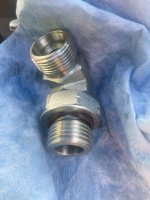
I just went out and pulled the fitting to measure the seal dimensions. This time, I brought my camera and took a photo of the failed ring in the fitting. You can see from the picture of that the O-ring was pushed between the gap between the backing washer and fitting. Again.

Based on some quick measurements with my calipers, the fitting OD is ~18.12mm, the retaining ring ID is ~23.6mm, and the retaining ring thickness is ~1.75mm. Based on those measurements, I’m thinking an 18.5mm ID o-ring with 2.0 (or 2.4?) mm cross-section will compress properly and fill the space.
 

Attachments

  • IMG_3600.jpeg
    IMG_3600.jpeg
    3.7 MB · Views: 57
   / Vicsec VC13 mini-excavator
  • Thread Starter
#54  
Just looking at the spare metric O-ring fittings I have, and the DHH catalog, it seems the fittings that need to be "clocked" have to have a backup washer in addition to the retaining ring. So, in comparing a straight fitting to a 90-degree fitting (e.g. 6068 vs. 6069), the straight one has no backup washer.
I just checked discount hydraulic hose, and it looks like this fitting is a 5069L? Viewing the various sizes available made me realize that I forgot to measure the thread pitch while I had it off the machine. Guessing it is M22x1.5?

I also had the thought that this failure might relate to engine speed? Specifically, is pressure proportional to RPMs? Could I be causing an over-pressure condition by operating the machine with the throttle wide open? Maybe the upper limit needs to be adjusted downward? I still need to do a pressure test and adjust the main RV, so this line of thinking might bump that up on my priority list.
 
   / Vicsec VC13 mini-excavator #55  
I also had the thought that this failure might relate to engine speed? Specifically, is pressure proportional to RPMs?
No.

But everyone should do a pressure test when they first get their machine and set the main RV to 2400-2500psi. Most are set way too low.
 
   / Vicsec VC13 mini-excavator
  • Thread Starter
#56  
I have ordered some 90A FKM o-rings that I hope will be less prone to extrusion failure.

In the meantime, I realized that there might be a trick to installing this fitting in a way that reduces the chance of this type of failure. Since this side of the fitting installs into the pump horizontally, the backup and retaining washers will be pulled downward by gravity, so they rest on the top of the fitting. That means there will be zero gap at the top of the backup washer and double the average gap at the bottom. That’s probably where the extrusion happens. I need to be sure that the washer is centered (so the gap is even all around) before tightening down the nut.
 
   / Vicsec VC13 mini-excavator #57  
   / Vicsec VC13 mini-excavator
  • Thread Starter
#58  
I continue to have leaking issues at the pump output, so this weekend I took a deep dive into the world of o-rings. If you find yourself in this situation, there are a couple of resources worth investigating:
  • Parker O-Ring Handbook: A comprehensive guide to o-ring materials, applications, static and dynamic sealing designs, back-up rings, and material compatibility. Something like this should be required reading when engineering with o-rings.
  • Apple Rubber Gland Calculator: Interactive tool for determining the proper design of o-ring glands (the groove/channel in which the o-ring seats). I have been using this tool to check the fit of different o-ring sizes in the gland created by the stack up of my fitting's backup washer and retaining ring.
Based on these tools, here are some quick notes relevant to my current situation:
  1. In this application, the o-ring is being compressed axially (top to bottom) in a static configuration to seal internal pressure. The compression "squeeze" should be between 10-40% of the cross section (CS). Too little, and it won't seal properly; too much and it will fail prematurely via deformation or extrusion.
  2. The ID of the o-ring should be smaller than the OD of the fitting shaft, such that the o-ring seals tightly; however. the difference should be less than 5%.
  3. The elastomer materials generally are considered incompressible, so the volume of the o-ring remains nearly constant when squeezed. In this case, axial compression results in radial expansion. Meanwhile, the volume of the o-ring should not exceed 90% of the volume of the gland. For uniform o-rings and glands, this ratio can be calculated by looking at the cross sectional area. The CS area of the o-ring is a circle (A_ring = ½ × CS × π²), and the CS area of the gland is a rectangle ( A_gland = (OD - ID) × H). Thus, the ratio of cross sectional areas should be A_ring / A_gland < 90%.
As stated in a previous message, my fitting gland is defined by its 18.1mm shaft and the retaining ring (23.6mm ID x 1.75mm H), creating a gland groove that is 2.75mm W x 1.75mm H. By applying the above rules, the following o-ring requirements emerge:
  1. The CS must be between 2.2mm and 2.4mm.
  2. For my ~18.1mm fitting shaft, I should find an o-ring with an ID between 17.2mm and 18mm.
  3. The Apple Rubber tool calculates the volume ratio automatically when given the other parameters.
After playing with the Apple Rubber tool, I cannot find any existing o-rings that meet all of these constraints. If the CS is too small, there's not enough squeeze; if it's too big, the ring has too much volume to fit properly in the gland. The FKM o-rings that I have been using from HF measures 17.5mm x 2.56mm; these produce both too much squeeze (32%) and too much volume (105%), so I'm not surprised that I have been seeing extrusion failures.

That said, the diagram on the tool page contradicts constraint #2; it shows the o-ring being pushed outward (into the retaining ring). This leaves a gap along the shaft, which would allow the fluid to leak past the backup washer. So I'm not sure of anything at this point.
 
   / Vicsec VC13 mini-excavator #59  
  1. The ID of the o-ring should be smaller than the OD of the fitting shaft, such that the o-ring seals tightly; however. the difference should be less than 5%.
Are you ready to try an all-new fitting yet?
 

Tractor & Equipment Auctions

2022 John Deere R4023 (A60462)
2022 John Deere...
2015 Acura ILX Sedan (A59231)
2015 Acura ILX...
INTERNATIONAL FLAT BED TRUCK (A52707)
INTERNATIONAL FLAT...
EZ-GO Electric Golf Cart (A60462)
EZ-GO Electric...
Pat's QH and hydraulic top-link.
Pat's QH and...
Deere 310L (A53317)
Deere 310L (A53317)
 
Top