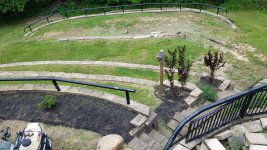
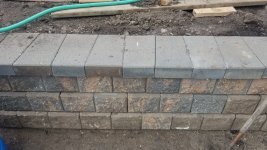
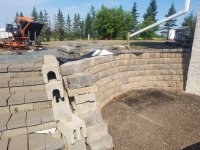
Who knows about stacked-block retaining walls?

   / Who knows about stacked-block retaining walls? #21  
Muhammad is somewhat of an expert in wall building himself…..
Maybe ask him for his advice.
🤔
 
   / Who knows about stacked-block retaining walls? #22  
"The bottom row can’t kick out because there will be a paver-floor against the house holding it."

What that really means is that if the bottom row has enough pressure behind it, it will push on the paver-floor which will in turn push on the house. The pavers are too light to develop very much friction against the ground.

YOU REALLY DO NOT WANT TO DO THIS. You especially do not want to do it if there is a basement under the house. The top of a basement wall is the weakest part.

I am an engineer and have built many retaining walls.

In my part of the country we would put "3/4 inch crushed clean" rock behind the wall.

The reason water is devastating to a retaining wall is that the soil is treated as a liquid with a density of 40 pounds/cubic foot when designing the wall. (Obviously the soil has greater density than this, but it is semi-solid, and 40 pounds/cubic foot is a good approximation of the forces it produces.) If water is not drained from behind the wall it adds another 62.4 pounds/cubic foot. If the water freezes the forces become very large.
 
   / Who knows about stacked-block retaining walls? #23  
I'm sorry that I don't have anything to add on building your wall however, I'd also be a little concerned about the 2 trees that seem to be with in fill that is requiring the wall.

Trees typically trees don't like to have their trunks buried, has the fill around their base always been there?
 
   / Who knows about stacked-block retaining walls? #24  
View attachment 2478550
They tip back one inch for every 6” up.

Thanks very much for all the suggestions and wisdom.

As you can see I’m building this from old blocks, and not solely because they’re cheaper. They’re almost “not” cheaper because of the physical labor to get them. But I didn’t have to pay 10% tax either. Including other reasons for it to look like it was done “long ago”.

It would have been wise to sandwich some geotextile flaps between the layers, leave them hanging out there for the retaining wall but that’s a first-timer for ya.

For tiebacks I was thinking of driving rebar rods and then figger a way to attach to the blocks.

I don’t have space for a drain pipe at the bottom. Have to put it at the 3rd course. There could be water here if my driveway drains “go unmaintained”. I think everyone knows that driveway drains eventually ALL “go unmaintained.”

The bottom row can’t kick out because there will be a paver-floor against the house holding it. And if what I read about geotextile soil retention is true- the bank won’t push. What do you guys think about that? Have any of you observed geotextile lifts behavior (or failure) over “years”?
If you don’t have space for your drainage pipe at the bottom, you din’t have room to build a lasting wall! All you will build is a mess that will fall—sooner than later.
Rebar is a poor choice for what I always called a deadman. This “deadman” needs to interlock with the wall, extend several feet into the hillside then have a T-bar interlocked with the extension. These should have compacted soil all around it for at least 1’ on all sides.
Water is it biggest enemy on a retaining wall.
Lots of good advice in comments which you seem to want to disregard.
In my opinion an I have build about 100 retaining walls over the years (unfortunately, I did not have the internet to advise me in early years and I had a few walls fail some very quickly), if you plan to do what you described, plan to rebuild within a couple of years—rebar for wall stability is useless, rebar bends easily and by itself is too small to havre any resistance, it is made to add to concrete. 3 courses of blocks prior to drainage pipe means 18” of wall at its most critical location, holding water—approximately 8.5 lbs per gallon, then you have the freeze factor your area has freezing temps. Experience (personal and from others here) says don’t implement your plan.
Sorry to be do negative, but you have already put in a lot of work, do you want to redo part of what looks like a good start on the hillside?
 
   / Who knows about stacked-block retaining walls? #25  
Airbiscuit showed the proper use of geotextile fabric, between the blocks, level into the fill area, to hold the wall back (useless if not attached). Not clear what your fabric would actually accomplish. My 1600 blocks are 90+ pounds each, filled in and behind with 57 stone gravel, with fiberglass pins securing the blocks together (yours have a lip on the back). Blocks with the rear lip aren't designed for high walls (some say two feet max), and I'm curious if placing geotextile fabric under the lip defeats its purpose. As LD1 stated, 57 stone is used in and behind those blocks, and you need a drainpipe at the bottom. However, my instructions stated compacted 21A stone footer 12" below the wall, which keeps the footer from retaining moisture. My four-foot and above walls required 12" below grade.
 

Attachments

  • 2416222eca944f449d31cf9c18501a75.jpg
    2416222eca944f449d31cf9c18501a75.jpg
    10.8 MB · Views: 176
  • 0001.jpg
    0001.jpg
    35.2 KB · Views: 162
  • 20230518_161236 (2).jpg
    20230518_161236 (2).jpg
    8.6 MB · Views: 174
  • wall2_11.jpg
    wall2_11.jpg
    184.3 KB · Views: 147
   / Who knows about stacked-block retaining walls? #26  
Make sure you put in deadman tiebacks and backfill with something that will drain well, Not sand. 3B gravel would be good, 2B is also OK.
 
   / Who knows about stacked-block retaining walls? #27  
I see water issues from the start, the drain from a gutter and one from the washer discharge probably. I have little experience in the wall, my railroad tie retaining wall was 3 feet high and replaced after 25 years, is tilting over now after only 10 years. But I will say put some treated stringers from the bottom of stairs out to end of house, deck boards over them will allow you some room for drain tile and stone under the wooden walkway, I see water problems down to edge of house regardless of your retaining wall.
 
   / Who knows about stacked-block retaining walls? #28  
As a general engineering contractor I think you need to follow the manufacturer’s installation procedures. Which is like the drawing included by airbiscuit. First thing I see is the black pipe connecting to a pipe that goes behind your wall. Where does the black pipe come from? Is it all solid liquid tight or? Like others said you can’t depend upon pavers and the house to become a structural item. To answer the backfill question again 3/4 drain rock. Impervious plug at the top is a must as you don’t want to introduce surface water to a subsurface drainage system. One thing about this discussion that I hear a lot is the use of the term geo-fabric. Before you start using the fabric you need to study the different types and use the appropriate type in the location/s as needed. Every type has a purpose. You also should protect the area between the proposed wall and the house from any water from other areas (like downspouts) and make it drain away from the house and the wall. Seems like you may need to backup a bit in this project.
 
   / Who knows about stacked-block retaining walls? #29  
After thinking about this a little more and remembering some of my issues with trees over the years, I think that for this to work, you need to remove the trees. It's probably the hardest thing to do, but there is no such thing as a good tree next to a house.

If the trees are gone, the retaining wall becomes an easy project. If the trees are gone, the house isn't in danger of falling branches, or even worse, the tree falling over. Nothing from the tree will fall on the house. Mostly they are cosmetic. Some people think they add shade to keep the house cool, but it's not enough to be measurable.

Overall, trees close to a house are a bad idea no matter where the house is. Trying to build a retaining wall between a tree and a house, with the tree being on the upper side of the wall is asking for trouble. Maybe not right away, but it's a good bet that somewhere in your future, you will wish you had removed the trees.

On my land, I've removed trees that I really liked. I tried talking myself out of removing them because they were such nice trees. But looking back, I'm really struggling to remember them, and now that they are gone, I don't miss them like I thought I would. In the last 20 years of having my land, I wish I had taken out more trees. But where I live, trees are like weeds, and we have too many of them.
 
   / Who knows about stacked-block retaining walls? #30  
It seems like you're using the fabric to keep the dirt back. I believe it's intended to hold the wall in place, with the backfill being securely compacted in layers. That said, I don't think those blocks are designed for a wall tall enough to require geotextile fabric.
 
   / Who knows about stacked-block retaining walls? #31  
As a home inspector,I see a lot of failing retaining walls. My advice is to try to have your top ground layers made with clay that slows the water absorbsion somewhat. Topsoil on top will soak in the rain but the clay will transport the water toward the wall, assuming you have the slope towards the wall. Make sure your clay later transports the water over the wall and not behind it. It's been my experience in this area that the wall can act as a dam and the whole hill behind the wall becomes saturated and puts pressure on the wall. A drainage plane is a great idea but if it plugs up you don't know. Allowing the ground water to flow over the wall reduces pressure on the wall by keeping the hill dryer. I also used pl premium to glue the blocks together.
 

Attachments

  • 20210714_133651.jpg
    20210714_133651.jpg
    6.5 MB · Views: 143
  • 20210711_102943.jpg
    20210711_102943.jpg
    9.8 MB · Views: 159
   / Who knows about stacked-block retaining walls? #32  
It seems like you're using the fabric to keep the dirt back. I believe it's intended to hold the wall in place, with the backfill being securely compacted in layers. That said, I don't think those blocks are designed for a wall tall enough to require geotextile fabric.

There are walls like that, question is how good is the compaction as it is built. There is also a wall like that known as Hilfiker which is wire. He is putting a wall over a wall. Probably should have started differently way before now. I agree about the trees they should also have been removed long ago. Sorry.
 
   / Who knows about stacked-block retaining walls? #33  

One of the most physically grueling projects I've done.

The blocks we used were designed to use pins and engineered geotextile fabric at specific levels. The fabric is supposed to anchor the wall into the hillside by laying it flat and integrating with the paver courses at different levels based on the height of the wall.

A crushed rock footing (12" or maybe more), wrapped drainage pipe, and crushed rock backfill all the way to the top course (with then 3-6" of dirt topsoil) will give you more longevity.

So far the wall we did is about four years old and so holding up well. We've had some record-breaking rains in that period that the wall stood up to. The drainage system works well in that after the rains, the drain pipe at the end will be flowing water and we don't see any gushing out the front of the blocks.

As others have said, without drainage that water is going to find its resting place in the soil behind the wall, add weight and soften the footing under the wall causing sinking or collapse (over time... 3 years, 30 years?).

On your wall I think you should excavate more so you have room for drainage pipe (6" clear behind the wall would be enough to get a wrapped pipe in there buried in crushed rock and I also think backfilling with crushed rock would be vastly superior. If you can get the rock delivered where your equipment is, the backfill would be easy using your loader. We had to use buckets in many places due to accessibility. It was brutal.

If the additional excavation is not an option you could also move the wall forward 6". Probably wouldn't notice.

Ideally you'd also set the first row under grade on a solid footing of crushed rock.

The engineers here can correct me if I'm wrong but to me it looks like the way you're doing it, essentially the geo grid dirt bundles are your retaining structure and the blocks are a going to be the second line of defense, albeit with a couple asterisks.

The concern about the patio pushing against the foundation of your house is also something to think about if you're relying on that to keep your wall in place. That's more math than I can do counting on my fingers. 🙈
 
   / Who knows about stacked-block retaining walls? #35  
If you don’t have space for your drainage pipe at the bottom, you din’t have room to build a lasting wall! All you will build is a mess that will fall—sooner than later.
This is good advice. I didn't read every post, but if you are excavating below the first course and installing gravel make sure you compact the gravel.

I put down a few inches of gravel, wet it just enough so it glistened but was not wet, then tamped it down. Then a few more inches, and so on. You want it compressed before the wall goes on top so it doesn't move on you later.
 
   / Who knows about stacked-block retaining walls? #36  
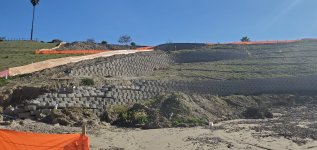
Brand new wall fails after a storm. This was right around the corner from the wall we built (ours didn't fail but obviously wasn't this large).
 

Attachments

  • IMG-20220104-WA0000.jpg
    IMG-20220104-WA0000.jpg
    1.3 MB · Views: 166
  • IMG-20220104-WA0001.jpg
    IMG-20220104-WA0001.jpg
    1,011.4 KB · Views: 151
   / Who knows about stacked-block retaining walls? #37  
CE here. Let's assume for the sake of argument the soil is held in place by the geotextile fabric. Then this is not a retaining wall just a decorative face for the embankment. That's part 1. Part 2 is water. As others have mentioned your wall will act like a dam when the earth behind it gets saturated. Even a 'normal' retaining wall with reinforced steel and a wide footing isn't designed for that. You need to drain the water.

This is normally done by a 'french drain' which is basically a perforated pipe in gravel at the base of the footing that drains out to daylight on one or both ends. To further help you can have a 'swale' which is a shallow ditch running parallel at the top of the wall to divert surface run off to one or both ends like the french drain.

You may not need a properly designed retaining wall that can resit overturning but without controlling the water pressure behind it will be worse than having water in your walkway - it will fail eventually.

I will add you can drain the bottom of the wall right through the wall to relieve the water pressure (several 1" dia drains for example). That avoids room for a drain pipe behind but you will have to deal with the water in the walkway - and still put that swale at the top. Assuming there is no pressure at all from the soil is probably a little risky - that's what the tie backs help with.
 
Last edited:
   / Who knows about stacked-block retaining walls? #39  
I'm putting up a stacked block retaining wall (6x17x12") blocks.
25 ft long, 7 courses, 42" high.
It's going up against an embankment of geotextile layers.
The lower 3 geotextile lifts are (very) sandy soil.
The dark layer is sandy topsoil.
Inn the end I'll just slope soil down to the 42" top of the wall.

Do I need tiebacks to the wall blocks?
Can I backfill it with sand?
You can see a test-stack of 7 blocks.
View attachment 2423010
I suggest putting in a 4” PVC drain tile (the pipe with holes) a few inches below your final level. Put elbows at the end and ‘T’s every six feet. These will connect with a duplicate run of drain tile three feet above the bottom one. You have created a vertical drain field. It is water, the freezing and thawing, that can kill your wall.

I did this behind a 36’ long, 10’ high block wall built into very heavy clay soil in Pennsylvania and never had a problem. I covered the bottom pipe with ‘landscaping fabric’, but not the top one which was 4’ up from the bottom. (10” block filled with concrete and rebar)

The dirt will stay pretty much where you put it if you control the water and get something to grow in it.
 
   / Who knows about stacked-block retaining walls? #40  
^^^^ The main water source is off the eaves (w/o gutters and down the bank.

gg
 

Marketplace Items

KBH Water Trailer BNT-1 (A61306)
KBH Water Trailer...
FUTURE MB27-27" HYD MIXING BUCKET (A60432)
FUTURE MB27-27"...
HYD QUICK ATTACH STUMP GRINDER (A52706)
HYD QUICK ATTACH...
Rockport Mobile Command Center (A59230)
Rockport Mobile...
2017 John Deere 825i XUV Gas Utility Cart (A59228)
2017 John Deere...
Year: 2015 Make: Ram Model: 5500 Chassis Vehicle Type: Truck Mileage: Plate: Body Type: 2 Door Cab; (A55852)
Year: 2015 Make...
 
Top