Lathe Motor Amperage Rating

/ Lathe Motor Amperage Rating #1  

npalen

Elite Member
Joined
Nov 17, 2009
Messages
3,607
Location
Beloit, KS
Tractor
Kubota B9200 HSTD and Mahindra 3015
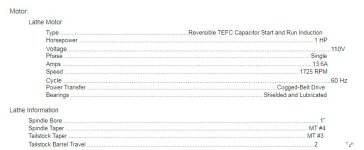
Attached are the motor specs for my Grizzly G0602 metal lathe which is listed as 1.0 HP. I'm trying to understand why the amperage shown is so high. Testing the draw with an amprobe shows about 8.0 amps under no load and about 11.0 amps under as much load as I could put on it with a turning tool.

Looking at other 1.0 HP motors on the web, I see that 8.0 amps, give or take is typical of that size motor. I get the feeling that this motor should be rated at closer to 2.0 HP based on the higher amperage rating. Please help me understand the difference.

The reason I'm questioning this is looking at replacing the single phase motor with a three phase and VFD to get variable speed, reversing etc.
GRIZZLY-G0602-LATHE-MOTOR.JPG
 
/ Lathe Motor Amperage Rating #2  
My trusty Square D motor data calculator says that a 1 hp motor at 115 volts should draw 16 amps. That seems a bit high to me also.
Remember that going to a 3 phase motor will reduce that and most of the inverters convert the 115v input to 230 volts out. That is what I did with my drill press several years ago to get variable speed and reversing for tapping holes.
 
/ Lathe Motor Amperage Rating
  • Thread Starter
#3  
Yes, when you figure 1.0 HP as 0.75 KW and then do the math, the 15 or 16 amps does seem high but then again my understanding is that a 1.0 to 1.5 HP motor is about all that a 120VAC 20AMP circuit will normally handle.

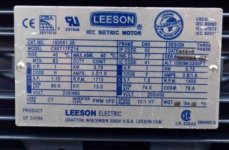
Attached is the nameplate of the motor I'm looking at using:
LEESON-MOTOR.JPG
LEESON-MOTOR.JPG
 
/ Lathe Motor Amperage Rating #4  
If you are seeing 8A on a rating plate, it's for 240V, not 120V. The lower draw you are seeing (11A out of 16A max) is just because you aren't fully loading the motor. Power draw will track load.
 
/ Lathe Motor Amperage Rating
  • Thread Starter
#5  
Yes, I would have to agree. But looking at the three phase Leeson motor above, it shows only 3.2 amp on 230 VAC for 1.0 HP. Is there that much difference between single and three phase amp draw?
 
/ Lathe Motor Amperage Rating #6  
There is a significant difference between current draw for single phase versus three phase as well as for 240 volt versus 120 volt. Just remember you are feeding the freq drive from a single phase source and calculate your breaker accordingly.
 
/ Lathe Motor Amperage Rating
  • Thread Starter
#7  
I understand the current draw for a 240 versus 120 being half. Didn't realize that much difference between single and three phase for the same HP, however.

Something else that surprises me is a fellow suggesting that a 120VAC 30 amp service is needed to run a VFD with 120 VAC input to powerthe Leeson 230 VAC 3-phase motor, shown above. I had never heard of more than 20 amps to feed a 120 VAC circuit. Learn something everyday, I guess.
 
/ Lathe Motor Amperage Rating #8  
The reason I'm questioning this is looking at replacing the single phase motor with a three phase and VFD to get variable speed, reversing etc.

I converted my Craftsman drill press to a 3 phase motor and VFD a couple of years ago, and love it. No more moving belts around, just dial in the speed I want and drill holes. I used a Teco 510 VFD and a Connex 1 HP 3 phase motor I picked up at a local motor repair shop, made a new control panel and added a tach display to it.
I'm looking at doing the same to my Jet B920N lath
IMG_20210130_134703023 (Custom).jpg
e.

IMG_20210125_170028469 (Custom).jpg
IMG_20210125_171736130_HDR (Custom).jpg
 
/ Lathe Motor Amperage Rating #9  
13.6A is about right for a 1HP motor on 120V single phase. Per this:
  • 115 volts motor - single-phase : 14 amps/hp
  • 230 volts motor - single-phase : 7 amps/hp
  • 230 volts motor - 3-phase : 2.5 amps/hp
  • 460 volts motor - 3-phase : 1.25 amps/hp
An equivalent 3ph motor on a VFD will require just a little more since the VFD introduces a bit of inefficiency.

Whoever told you 30A is required, is wrong. It should work on a 20A breaker, and probably even a 15A breaker.
 
/ Lathe Motor Amperage Rating
  • Thread Starter
#12  
Another option would be a DC motor and controller.
I do use a DC motor and controller on my round column mill/drill but it doesn't have much torque at low speed. I'm told that inverter powered three phase will have more low end torque than DC but not sure if that's true.

I've found that low end torque is needed on a mill for operations such as large hole sawing, boring head etc. There is the option of changing belt position on the stepped sheaves for more torque but that is the reason for retrofitting variable speed in the first place.
 
/ Lathe Motor Amperage Rating
  • Thread Starter
#13  
I converted my Craftsman drill press to a 3 phase motor and VFD a couple of years ago, and love it. No more moving belts around, just dial in the speed I want and drill holes. I used a Teco 510 VFD and a Connex 1 HP 3 phase motor I picked up at a local motor repair shop, made a new control panel and added a tach display to it.
I'm looking at doing the same to my Jet B920N lathView attachment 780201e.

View attachment 780198View attachment 780200
Very nice work on the control console!
 
/ Lathe Motor Amperage Rating #14  
As someone else mentioned....its the whole sq root of 3 thing.

The motor you show being 3.2a @ 230 3-phase is equal to 5.5a @ 230 single phase and 11a at 115 single phase. Not accounting for any power factor or efficiency.

So yes....there really is that much difference in amperage going to 3 phase. Partly why its so popular in industrial stuff. Like the motor you show can be ran of 1.6a at the higher 460/480 voltage common in factories. But would require ~11a if a 110 single phase. And amperage is what you base wire sizing on. You can run a 10hp motor on 3phase 460/480 on less than 15a and 14ga wiring. But on 240 single phase would require 40a and 8ga. Not to mention motor directions and start caps. But thats all off topic.

To simply answer the question.....YES there is that much difference....and YES the motor you are looking at is just as powerful at 3.2a as your current 1hp single phase motor is at 11a with 115v supply.

You probably WILL have to supply the VFD with 230/240v though. I have a bigger VFD that will power up to a 3hp motor....I plug it into my welder circuit. But my mill and lathe run off the rotarty phase converter
 
/ Lathe Motor Amperage Rating #15  
3 phase ampacities reduce by the square root of 3 or 1.732 at the same voltage.
This is true for the motor itself. But 1hp is 1hp whether 1ph or 3 ph and since you're generating that 3rd phase with the VFD, the single phase side will need to deliver the same amps as before and the breaker size requirement won't change. Amps between the VFD and the motor will be lower but amps between the breaker panel and the VFD will likely be a little higher as the VFD isn't 100% efficient.

NOTE that what I said refers to loaded amps, not no-load amps. Induction motors draw 99% reactive current at no load. You measure 8A at no load. That isn't Real Power, it's Apparent Power. You can think of it like two circus acrobats jumping off platforms onto a see-saw. The energy of a 150lb dude falling from 2 stories is appreciable, but the pair can do it all day with little effort because that energy is drawn from and returned to the system each time they trade places.

Once the VFD is installed, the reactive current will flow between the VFD and the motor, not the wall and the VFD. So amp measurements taken from the breaker panel will indicate that no-load amps went down by a great deal. But when you load up the motor you will see a slightly higher value than before.
 
/ Lathe Motor Amperage Rating #16  
I do use a DC motor and controller on my round column mill/drill but it doesn't have much torque at low speed. I'm told that inverter powered three phase will have more low end torque than DC but not sure if that's true.

I've found that low end torque is needed on a mill for operations such as large hole sawing, boring head etc. There is the option of changing belt position on the stepped sheaves for more torque but that is the reason for retrofitting variable speed in the first place.

When comparing the same size motors, DC motors will always have more low speed torque than AC motors. Torque is proportional to armature current.
 
/ Lathe Motor Amperage Rating #17  
When comparing the same size motors, DC motors will always have more low speed torque than AC motors. Torque is proportional to armature current.
True.

Speaking of torque, it is worth mentioning that having a variable speed drive (AC or DC) is not a reason in and of itself to ditch any step pulleys or variator, or whatever mechanical means might be varying speed currently. Decreasing speed by mechanical means has the benefit of offering a proportionally higher available torque. A VFD or DC drive does not offer this.

I knew this before I converted my own lathe but I didn't think it would matter much, and one of my reasons for doing the conversation was that the intermediate shaft of my step pulley arrangement was damaged. So I just removed it, and went straight to the spindle with a belt from the motor shaft. The old motor was 1Hp and the new one was 2HP. My thoughts were that "I should have plenty of torque for most things I'll do, and if I need more, I still have a back gear." That was true, but the instances in which I have to engage the back gear are more numerous than I anticipated.

I suggest you keep your mechanical speed change mechanism in addition to adding a variable speed motor/drive. Just pick a ratio near the center and leave it there (until you need to change it). After a little while you'll find the appropriate gear to remain in, that serves the widest range of speeds you need to accommodate.
 
/ Lathe Motor Amperage Rating #18  
Also to add to strantor's comment ... almost all VFD drives will allow motor speeds approaching twice the motor's rated rpm. This will allow you can run a higher gear reduction to get more torque at the same spindle rpm with a higher motor rpm.
 
/ Lathe Motor Amperage Rating #19  
Also to add to strantor's comment ... almost all VFD drives will allow motor speeds approaching twice the motor's rated rpm. This will allow you can run a higher gear reduction to get more torque at the same spindle rpm with a higher motor rpm.
Yes and this is a good thing to list in the "pros" section when comparing AC and DC motors. DC can also do field weakening but only if it's a wound field motor and those are not common anymore in the 1HP range.

Most VFDs will go up to 400Hz (6.7X rated speed) and some even higher. But most motors won't go that fast with disassembling themselves. VFD-rated motors will typically have a "maximum safe RPM" spec that is typically double the rated speed. But if a motor does not have this spec, then there is no guarantee that they won't self-disassemble even at only double speed. They probably won't, but...
 
/ Lathe Motor Amperage Rating #20  
Very nice work on the control console!
Thanks, I 3D printed it on my QiDi Tech printer that has two extruders, so I could print the white lettering on it.
 

Marketplace Items

2022 Takeuchi TL12R2 (A60462)
2022 Takeuchi...
Mini Excavator Grapple (A60463)
Mini Excavator...
Mower King ECSSTR072 (A60463)
Mower King...
2005 Sterling Acterra Tender Truck (A61307)
2005 Sterling...
2017 New Holland T4.110 Cab 4WD w/ 655TL Loader – 1,619 hrs – Excellent Condition
2017 New Holland...
2023 FORD F750 CAB & CHASSIS (A57880)
2023 FORD F750 CAB...
 
Top