Our barn build

   / Our barn build #1  

rbstern

Platinum Member
Joined
May 23, 2011
Messages
751
Location
GA
Tractor
LS MT225E, Yanmar 2210
Started construction this weekend. 36x36 monitor style, derived from this plan from the Univ. of Tennesse extension: http://web.utk.edu/~ggrandle/Programs/Plans/T4161.pdf

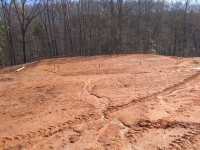
My neighbor is a semi-retired grader/earth mover. He dug the foundation for our house, and has done some other land clearing for us. Had him clear some space at the edge of our woods and form a pad. Last weekend I laid out the dimensions of the building with masonry line. We've had some heavy rain in the meantime, and the water went exactly where intended. An experienced, semi-retired grader makes an excellent neighbor!
grading and layout.png

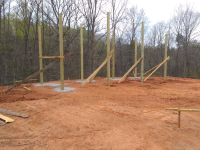
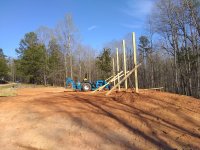
This weekend, beautiful weather with the exception of some heavy wind. The wife and I were able to get the first row of posts (back of barn) stood up. We had some family obligations and were also doing garden prep work, and the first post was definitely a "let's go slow and figure out our methods" process. Feel pretty comfortable we can do about 4 posts in a day, including digging, placement, bracing, removing the spoils, mixing and pouring concrete, and resting our tired, creaky bodies. Expect a couple of more weekends to stand all sixteen posts, which is fine, since we are not in a particular hurry.
first row of poles.jpg

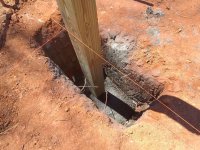
Nearly rented an auger to do the post holes, but after a lot of reading, pondering, and digging a test hole, decided to dig them with the backhoe on my LS. It's a much bigger hole than an auger makes, but I chose to use a variation of a "collar" style method that the experts over at the Hansen pole building blog describe. Their preferred method is using some sort of fixture (imagine a heavy wire basket) to stand the post 6" off the ground so wet concrete flows under it, and then 18" of depth/contact with the post itself. Didn't have a good way to do the stand off, so instead poured an 80lb. bag dry, in the hole as the base, well tamped, set the post on that, and then another four to five bags of mixed concrete to get 18" of contact with the post. Used a concrete vibrator to max consistency and adhesion to the post. I've decided not to backfill with the red clay. Waiting on our local gravel and rock guy to bring a load of crusher run for the backfill. It's a couple more bags of concrete than I planned per hole, but like the result I am getting and think it will have good resistance to both settling and uplift.
poured concrete.jpg

Couple of tool notes: The concrete vibrator is the $120 Harbor Freight version. It's pure chinesium, but it works great. Ran it with a Sportsman 1000w generator. The tool works well, feels solidly built, and has a long power cord so I could keep the genny well away from the hole without an extension cord. Also, on the topic of Harbor Freight, I bought the smaller (60lb) Central Machinery concrete mixer a couple of years ago. My wife likes to do masonry projects on the property. We probably mixed a half dozen bags of mason cement before the motor quit. Very poor quality motor. I replaced that motor with a more powerful American made motor, and now that thing runs great and easily mixes an 80lb sack. Mixed 20 bags this weekend, never missed a beat. Last but not least: Bought a Swanson post level for this project. Will never set another post without one.

Some supplier and material notes: We use a local building supplies store called Yoders (Fair Play, SC). Great vendor; super friendly and customer service oriented, and very good pricing. They charge a whopping $11 for delivery, any size order, and they are 20 miles from us. They special ordered the 20' and 18' posts (UC4B...ground contact/burial, structural applications), and had them to us in less than a week. The pallet of concrete turned out to be Sakrete. I'm used to buying Quickrete at Home Depot. I now like the Sakrete MUCH better. It was far more consistent than what I've gotten from Home Depot.

So, that's it. Started. Will post updates to the thread as this progresses.
 
Last edited:
   / Our barn build #2  
Looks like a good start. Look forward to seeing it come together.
 
   / Our barn build #4  
I'm looking forward to following your progress.

Why didn't you fill the hole with concrete? 99% of the time when a post rots, it's right at the surface because that's where moisture sits. Having the concrete come out of the hole a little bit, and sloping away makes it impossible for water to remain around the base of the post.
 
   / Our barn build
  • Thread Starter
#5  
I'm looking forward to following your progress.

Why didn't you fill the hole with concrete? 99% of the time when a post rots, it's right at the surface because that's where moisture sits. Having the concrete come out of the hole a little bit, and sloping away makes it impossible for water to remain around the base of the post.

Eddie, that would be a lot of concrete. Way too much to mix a bag at a time. Could certainly be done with a mixer truck, but since we're on a go slow plan and not digging and setting all posts at the same time, we'd have to have multiple, short load deliveries, and that would be silly expensive. My understanding is that no practical benefit is gained from that much concrete.

The pad is constructed to keep water away, and we'll landscape around the barn to keep the drainage working well. The crusher run backfill will compact and drain well. Even if the backfill was something that didn't drain well (our native red clay), my reading indicates that UC4B treated posts can withstand even poor drainage conditions for decades. When we rebuilt our front entrance last year, I pulled the existing two 6x6 gate posts. They were set with very minimal concrete, with red clay backfill, in 1994. They were the 1994 equivalent of the current UC4B "burial/ground contact/structural duty" standard. The posts were in such good shape, I was able to pressure wash them and reuse them as decorative posts at the ends of the new gate/fence.

I think there's a lot of misconception out there about the levels of chemical treatment in posts. The posts that are treated to the higher, structural duty standard can take a lot of abuse, for a long time. The problems that do happen are more often than not with the UC4A treatment posts, sold as "burial and ground contact," at the big box stores. They aren't as durable.
 
   / Our barn build #6  
There will be moisture getting into the ground at every exterior post. The hole that you dug for the posts will act like a swimming pool and hold water. Water will always go where there is no resistance. The area around your post that does not have concrete will be a vacuum for the moisture in the soil around it. Filling with compacted soil, or gravel, will provide a place for moisture to remain over an extended period of time.

I understand that it's a lot of work to fill in the hole you dug for your posts, but when you dig an oversized hole, you have to consider what additional steps need to be taken to deal with such a huge hole. If it was me, I would have dumped the concrete into the hole dry, then for the top six inches or so, mixed it and created a slope to keep water away from the post.

You could be fine doing it this way, but if a post ever fails, it will be because you created a wet area at the base of the posts that could of been avoided. Expecting every post to last as long as the others isn't realistic. There is always that odd ball that rots faster then the others.
 
   / Our barn build
  • Thread Starter
#7  
There will be moisture getting into the ground at every exterior post. The hole that you dug for the posts will act like a swimming pool and hold water. Water will always go where there is no resistance. The area around your post that does not have concrete will be a vacuum for the moisture in the soil around it. Filling with compacted soil, or gravel, will provide a place for moisture to remain over an extended period of time.

I understand that it's a lot of work to fill in the hole you dug for your posts, but when you dig an oversized hole, you have to consider what additional steps need to be taken to deal with such a huge hole. If it was me, I would have dumped the concrete into the hole dry, then for the top six inches or so, mixed it and created a slope to keep water away from the post.

You could be fine doing it this way, but if a post ever fails, it will be because you created a wet area at the base of the posts that could of been avoided. Expecting every post to last as long as the others isn't realistic. There is always that odd ball that rots faster then the others.

I understand where you are coming from. Was in the same place until I did a lot more reading. With the UC4B standard, the posts are designed to be used in immersed fresh water applications (think dock piers). Also, our clay does drain. Slower than sand, for sure, but it does drain.

Let's revisit this thread in 25 to 30 years, and we'll see what happened. :)
 
   / Our barn build
  • Thread Starter
#8  
Another sunny Saturday, another four posts set. It's heavy work, but quite enjoyable when doing it without the pressure of a schedule. Getting better at digging tighter holes with the backhoe, so less cement and less fill needed per hole. No substitute for time on the sticks. Also hit sizable rocks in three of the holes. Fortunately, they were sandstone; soft enough to break up with a pick axe and 8lb. sledge, when the backhoe teeth couldn't get enough of a bite to break them. Between that, shoveling cement, gravel, and clay, my arms haven't had this much of a workout since I last belonged to a gym (1980s).

Hope to set another couple of posts tomorrow.

IMG_20220402_172755980.png
 
   / Our barn build
  • Thread Starter
#9  
Got the remaining eight posts in the ground this weekend. Tired and sore, but in a good way. Beautiful weather. 39 degrees when I got started, and mid-seventies by late morning.

IMG_20220410_181409449.png
 
   / Our barn build #11  
Also, our clay does drain. Slower than sand, for sure, but it does drain.

Let's revisit this thread in 25 to 30 years, and we'll see what happened. :)
You'll be totally fine. If you have the drainage around the building flowing well away (roof overhang/gutters/downspouts/slopes away from building on all sides), then your posts will be dry all the time anyway. Even if one oddball post does rot at ground level, it's not like the building will be in any jeopardy. 100+ years no problem, would be my bet.
 
   / Our barn build
  • Thread Starter
#12  
Project is progressing. Skirts, girts, some side roof plates are up, and and getting started on side shed rafters. The wife and I are having a lot of fun doing this, despite our middle-aged aches and pains.

Some random thoughts about the build and process:

Structural screws rock. So much easier than thru-drilling and bolting. Brushless 18v drivers (Ryobi) are awesome for driving big structural screws. What a great way to build.

Was sure I would buy a nail gun for this project. Didn't get around to it, and I've been hammering 16D galv. ring shank common nails, and while it's a chore, it's a long time since using a hammer this much. I'm enjoying it.

We've substituted 2x8 lumber for 2x6 in a bunch of places. For reasons that only the marketplace gods understand, the larger boards are about 25% less expensive.

Ratchet straps have been essential for squaring up the dimensions, higher on the posts.

We've been using a pallet on the LS FEL w/ forks as a work platform when our ladders leave us feeling vertically challenged. It's worked great.

IMG_20220417_125747356.png

platform shot.png
 
   / Our barn build
  • Thread Starter
#13  
Next questions: The concrete.

Based on an online calculator, a 5" slab for this 36x36 structure is going to be right at 20 cubic yards. My plan is to reinforce the skirts with hammered-in rebar around the perimeter, and then have the mixer truck access the bays from the front, where there is plenty of clearance. We have no overhead obstruction in the center bay until the loft joists go in. The side sheds have rafters sloped from 9.5' to 12.5'. No idea what kind of clearance a mixer truck needs.

My plan is to pour right on the dirt, with fiber reinforced cement, I assume 3000 to 4000psi, but I haven't talked to a concrete company yet.

Should I recess the dirt a few inches at the front of the building to create an edge ramp?

What else do I need to think about?
 
Last edited:
   / Our barn build #14  
Great progress!!!

In regards to concrete, there are a LOT of options. The final method is down to personal preferences.

Regardless how good your dirt guy was, your pad is going to have areas where it settles more than others. When that happens it is imperative that the concrete be stable.

For that reason I would never consider pouring concrete without rebar. At the most 24" squares. Elevated and sitting on chairs. And add the edge ramp at the doorways.

I prefer to pour on gravel. But it's too late on this project.

Looking forward to pics and progress!!!
 
   / Our barn build #15  
Nice project. (y)

In regards to pouring the pad, are you doing that yourself, have you ever done flat work before, and/or are you going to have knowledgeable and adequate people there to help you?

We put up a 24x24 garage addition two summers ago. I did it in three 8' x 24' pours because there was no way I and my family could do a 24x24 area in one pour. 8' x 24' at a time was just right for us.

Good luck with the project. ;)
 
   / Our barn build
  • Thread Starter
#16  
Great progress!!!

In regards to concrete, there are a LOT of options. The final method is down to personal preferences.

Regardless how good your dirt guy was, your pad is going to have areas where it settles more than others. When that happens it is imperative that the concrete be stable.

For that reason I would never consider pouring concrete without rebar. At the most 24" squares. Elevated and sitting on chairs. And add the edge ramp at the doorways.

I prefer to pour on gravel. But it's too late on this project.

Looking forward to pics and progress!!!

Regarding stability: I've watched two pours with fiber mesh on this property, by two different, experienced concrete companies, that were done directly on dirt.

A 6' wide walkway, about 150 feet long, poured in 2011. Foot traffic, golf cart traffic, and maybe a couple of times a year, 2000 to 3000lb. tractors. That walkway is still perfect; it still has no visible cracks. It was dug by hand, formed, and poured in a day.

Our driveway, poured in 2018, on a clay pad prepped by the same grader who did the new barn site. That driveway is routinely parked on by vehicles weighing as much as 6000lbs, and also sees some tractor traffic. Has a couple of small, hairline cracks at this point. Nothing that would indicate a problem with the dirt below.

Hence my confidence in the soil/fiber mesh combo. Anticipated weight on the barn floor expected to be no different than the driveway. I don't have a problem doing rebar or wire mesh, but I see these previous fiber mesh projects as having worked extremely well. One of the advantages we have is a very shallow frost line. Ground freezes aren't very common and don't heave very much, if at all.

EDIT to add: I just remembered I did a 10x20 pad under my shooting bench with the excess from the driveway pour. Also on dirt. Foot traffic only. No cracking after 4.5 years. Not a great test because it doesn't bear much weight, but the ground underneath hasn't moved, either.
 
   / Our barn build
  • Thread Starter
#17  
Nice project. (y)

In regards to pouring the pad, are you doing that yourself, have you ever done flat work before, and/or are you going to have knowledgeable and adequate people there to help you?

We put up a 24x24 garage addition two summers ago. I did it in three 8' x 24' pours because there was no way I and my family could do a 24x24 area in one pour. 8' x 24' at a time was just right for us.

Good luck with the project. ;)

Thank you.

Haven't done flat work on this scale. Largest I've done was a 10x20 pad.

My plan is to call in all of my neighborhood labor I.O.U.s :) That should net me 2 or 3 strong bodies, along with 3 family members.
 
   / Our barn build #18  
Next questions: The concrete.

Based on an online calculator, a 5" slab for this 36x36 structure is going to be right at 20 cubic yards. My plan is to reinforce the skirts with hammered-in rebar around the perimeter, and then have the mixer truck access the bays from the front, where there is plenty of clearance. We have no overhead obstruction in the center bay until the loft joists go in. The side sheds have rafters sloped from 9.5' to 12.5'. No idea what kind of clearance a mixer truck needs.

My plan is to pour right on the dirt, with fiber reinforced cement, I assume 3000 to 4000psi, but I haven't talked to a concrete company yet.
Standard concrete truck is 12 feet tall. Check with the company, to be sure. 4000psi is standard here, fiber reinforcement, not so much.
 
   / Our barn build #19  
What length post did you use, and what was your method for setting them? I am getting ready to do a barn build and am putting 20' post in the ground and am wondering if I should make a boom pole for the front end loader to set the post. My tractor bucket will go 13' off the ground on it's own.
 
   / Our barn build
  • Thread Starter
#20  
What length post did you use, and what was your method for setting them? I am getting ready to do a barn build and am putting 20' post in the ground and am wondering if I should make a boom pole for the front end loader to set the post. My tractor bucket will go 13' off the ground on it's own.

8 20' posts and 8 18' posts. Dug a 4' deep hole with my tractor backhoe, set the post atop 6" of compacted, dry poured concrete, then wet set them with 5 80lb bags of mixed Sakrete. Vibrated the concrete for uniformity. Backfilled after concrete set (usually next day) with crush-n-run.

As far as placing the poles: Set them down alongside the hole, with one end over the hole, then hand hoisted them (me, wife, sometimes with my son). One of us would hold to keep stable while the other would brace the posts. We'd then reset our layout strings and move the post in the hole with a sledgehammer, and used a post level to get the post plumb. Not hard to do with two physically capable adults. We did some on a windy day, and that was a little bit adventurous.

Before all of that, I spent a sleepless night concocting a pallet fork-and-chains method for the hoisting. But we set the first one by hand, didn't have too much trouble doing it, and decided to skip the tractor, so I never got around to actually using the tractor for that task.

I have no doubt, as long as you have a reasonable method for lassoing the post to your bucket, you can lift them that way.
 

Tractor & Equipment Auctions

CATERPILLAR 255 SKID STEER (A52709)
CATERPILLAR 255...
Alamo SHD96 Flail Mower
Alamo SHD96 Flail...
2024 CATERPILLAR 930 AG HANDLER WHEEL LOADER (A52709)
2024 CATERPILLAR...
2021 Polaris Ranger Electric Utility Bed UTV (A56859)
2021 Polaris...
2022 CATERPILLAR D6XE LGP HIGH TRACK CRAWLER DOZER (A60429)
2022 CATERPILLAR...
2019 KOMATSU D61PXI-24 CRAWLER DOZER (A60429)
2019 KOMATSU...
 
Top