GC2410 Rear Light Weirdness

/ GC2410 Rear Light Weirdness #1  

mgstevens

Silver Member
Joined
May 5, 2019
Messages
242
Location
Nelson, BC, Canada
Tractor
MF GC2410 "Cliffy", JD R72 "Moe Greene"
I have a situation where the left side rear light unit has gone troppo. All bulbs work (ie: not burned out..) but when I turn on the headlights, I get one of the signal indicators (left) lit up on the dash, and the red light for that side is out, but flashes when I turn on the turn signal. The yellow part is not lit under any conditions (signal or flashers).

I went after this problem the other day and while disconnecting and reconnecting the harness connectors at the rear of the machine, the entire unit began working as it should. Then today, I sorted out the bad ground on a couple of worklights mounted to the protector rings and the left-side-malfunction-state returned.

The wiring for the worklights and the taillights are in no way intermingled. Totally separate wiring from fuse box back.

Any ideas how to begin tracking down the issue? When it began working properly the other day, I have no idea what I did to make it work, I was just opening a couple of connectors. Today, I cleaned those connectors with some CRC electronic cleaner, to no avail.

:confused3:
 
/ GC2410 Rear Light Weirdness #2  
If it's not a connector, or damaged wiring that only leaves a bad ground, or an internal short in the bulb.

Sometimes one filament in a double filament bulb breaks and makes contact with the secondary filament. It can then illuminate giving the impression it is working, when it is actually shorting. This problem can be interment as well. One way to test for this, is to remove the bulb and while looking at the filaments, flick it with your finger watching for movement inside. a broken one will vibrate. Or, just try another bulb if you have one handy.
 
/ GC2410 Rear Light Weirdness
  • Thread Starter
#3  
The bulbs have proven themselves by working properly a few days ago, but I will check them as you suggested.

After seeing that the entire left-hand light assy works as intended when a clean circuit-state is achieved, I recall that after testing the left-hand connector for voltage, I lost headlights completely. I must have shorted a circuit as the fuse was blown. After replacement, the entire tail light/signal/hazard system worked. Then I worked on the work lights, which entailed chasing the circuit for continuity until finding a bad ground. Fixed the ground, reinstalled the fuse tap for the hot side and everything worked fine. Alas, the tail light/signal/hazard issue was back.

I will also check the appropriate fuse again, and test again for voltage and continuity in the tail light/signal/hazard circuit. The schematic shows a relay in the circuit, but I haven't located that physically yet.
 
/ GC2410 Rear Light Weirdness #4  
The bulbs have proven themselves by working properly a few days ago, but I will check them as you suggested.

After seeing that the entire left-hand light assy works as intended when a clean circuit-state is achieved, I recall that after testing the left-hand connector for voltage, I lost headlights completely. I must have shorted a circuit as the fuse was blown. After replacement, the entire tail light/signal/hazard system worked. Then I worked on the work lights, which entailed chasing the circuit for continuity until finding a bad ground. Fixed the ground, reinstalled the fuse tap for the hot side and everything worked fine. Alas, the tail light/signal/hazard issue was back.

I will also check the appropriate fuse again, and test again for voltage and continuity in the tail light/signal/hazard circuit. The schematic shows a relay in the circuit, but I haven't located that physically yet.

Generally when lights go bizarre it is usually bad grounds.... If you are experiencing corrosion in bulb sockets or connectors, clean them well and apply some dielectric grease to contact points, it keeps moisture and oxygen away from the contacts therefore prevents corrosion....

24503845553_8510134414_o.jpg


IF your 2410 is similar to my 1715 the relays are of right side of console on upright between dash and frame... Probably going to have to remove the panel below dash to get to them....

MF relays.jpg
(GC 1705 to 1720)

Dale
 
/ GC2410 Rear Light Weirdness
  • Thread Starter
#5  
Thanks for the relay locale, I will check. Also, if not in the supplies already, I will add dielectric grease to the kit, and the contacts.

When I was originally testing the bulb sockets, I was not getting 12V on the left side, I moved to the next connector and also did not get 12V - although I was getting it on the right side. Then lights out, then change fuse, then all work again. I will see if I can get continuity in all branches of that left-side circuit.

Thank goodness for schematics.

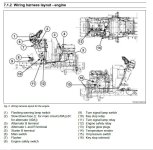
PS: What document are you getting this Section 7.1.2 page from?
 
/ GC2410 Rear Light Weirdness #6  
Thanks for the relay locale, I will check. Also, if not in the supplies already, I will add dielectric grease to the kit, and the contacts.

When I was originally testing the bulb sockets, I was not getting 12V on the left side, I moved to the next connector and also did not get 12V - although I was getting it on the right side. Then lights out, then change fuse, then all work again. I will see if I can get continuity in all branches of that left-side circuit.

Thank goodness for schematics.

PS: What document are you getting this Section 7.1.2 page from?

Service Manual for MF GC 1705 to 1720.... #42383491M1...

Dale
 
/ GC2410 Rear Light Weirdness #7  
I like these electrical problems! In my experience working on semis, with these unexplained cross bleeding lights, it is almost always a bad ground.
One of the most basic ways to prove that out is as follows:
Find a good ground location. The best one is the negative battery post. Otherwise, the tractor frame itself might suffice. Clamp a vise grip on the selected ground location. Wiggle it around to scratch thru the rust and paint, or grind or scrape a bare spot somewhere. Then use a jumper cable from there to a small screwdriver or sharp awl.
Take the lense off the offending light and touch the brass base of the bulb with the probe of the new ground system. Most times, everything works properly. Remove the probe and the problem usually returns.
So now we have determined that there is a bad ground, but how to find it? Keep probing different components, wires, frames and see if you can correct the problem. Keep going downstream towards the ground post of the battery.
Do not trust a connection that looks good and/or clean. Remove it, wire brush it or grind it bare, then reattach.
On heavy draw situations, a poor ground will generate heat. I have loaded a poor connection solely to make heat, then go along and feel the different connections. None should be warm.
There are ways to do this with a digital ohm meter, but that will be for another day.
 
/ GC2410 Rear Light Weirdness #8  
Dont rule out a dirty or corroded switch at the dash panel especially if its intermittent.
 
/ GC2410 Rear Light Weirdness #9  
Yes, for sure. Switches can cause headaches,.
But if you are experiencing odd performance, like the semi trailer clearance lights blinking when a turn signal is activated, that is more likely poor ground rather than poor supply. One would think that these two functions would have nothing in common, but they do, in fact, have a common link. That link is the return path (ground) back to the power source. That is where they are related.
Keep in mind that the supply path is exactly one half of a circuit. The other half is getting those used electrons (every one of them!) back to where they came from.
 
/ GC2410 Rear Light Weirdness #10  
Want some real fun?... Try shooting grounding problems on fiberglass bodied (kit) cars.... Specially after 2 or 3 know nothing have worked on it before it comes to you....

Dale
 
Last edited:
/ GC2410 Rear Light Weirdness
  • Thread Starter
#11  
I'm liking the "consensus" of ground-related issues. That was the issue with the work lights. Two bolts a half-inch from each other, one a great ground, the other a poor one. And when you test for continuity (especially with my older multimeter) on a poor ground, you get a reading that is 'close' to a good ground, but not exact. I will begin chasing ground issues on this rear light.
 
/ GC2410 Rear Light Weirdness #12  
mg,
Here is how to use your digital voltmeter to measure how much ground is missing. Create a PARALLEL PATH, thru your voltmeter, with the suspected poor circuit. For example, from the negative battery post to the the light bulb ground connector. Turn on the light. You must power the bulb or whatever load you are trying to test.
Since the volt meter needs NO power to power itself, the reading you get is what you are MISSING.. In a perfect connection, the voltmeter will read zero, because your wires and connectors would be carrying every electron they are supposed to. No voltage would need to flow thru the meter, because the wires would be doing the job.
In reality, they do not.
Works the same way on the positive side of things. Hook up to the plus terminal of the battery and put the other clip to the light bulb positive. (Create a parallel path) What your digital meter reads (maybe 1.09 volts, for example) is the volts that ARE NOT getting to the bulb. The loss is in connections, fuses, switches, relays, etc. The heavier the load, the more voltage drop you will see in the same circuit. In other words, if you measure 1.09 running 2 headlights and you unplug one, the voltage drop will be less, because there is less power required to flow thru the same circuit.
You can check portions of a circuit the same way. Just create a parallel path thru the digital voltmeter.
You can check the voltage drop thru just a switch, to see if there is resistance due to poor contacts or an undersized switch. Just clip the meter on each switch terminal, then turn it on. (Load the circuit)
Pretty fascinating stuff, at least to me.
 
/ GC2410 Rear Light Weirdness
  • Thread Starter
#13  
mg,
Here is how to use your digital voltmeter to measure how much ground is missing...
Pretty fascinating stuff, at least to me.

I'm with you on being keen to have the knowledge! Of course, I'd rather it just worked, but I'm up for solving the problem and in this case it is a ground issue.

My multimeter is older so I test continuity with the diode setting. Where "1" is open and 0.001 is a decent continuity reading. I find that as little of a difference as 0.003 is enough to be considered a bad ground. The left-hand light unit is a puzzler. The top bulb (red: running, signal) lights in both states, even though the ground is less than ideal, whereas the two lower bulbs do not.

If I run a separate ground from battery to the ground strip in the fixture, all is good. The right-hand unit, for comparison, enjoys an 0.001 ground-continuity reading while the left is around 0.004. I am left to diagnose and restore a clean ground to the left-hand strip.

I am moving through the circuit to see where the degradation happens. I will incorporate your parallel drain-measuring method.
 
/ GC2410 Rear Light Weirdness
  • Thread Starter
#14  
Fortunately I did not have to go far to find the weak link. First connector below the light had a corroded pin and a loose clasp, which have been addressed and now the light unit works as it should.

Very grounding experience...
 
/ GC2410 Rear Light Weirdness #15  
VERY HAPPY to have helped! Your post made my day!
Does it not feel good to have the knowledge to help yourself in future issues?

Resistance of an UNPOWERED circuit always remains the same, but voltage DROP (varies) (increases) as more electrons try to pass thru, either on their way to the job (+) , or on their trip back home(-). So measuring resistance is OK, but voltage drop is much clearer and more telling.
It has been my 71 year old experience that knowledge builds upon itself, small steps by small steps.
You can not add 245 plus 107 until you discover that 2+2=4.......
Not real sure, but I think you could put your hands on a voltmeter reading in hundredths (12.63, for example) for less than $20. Just reading in tenths is not nearly as good.
 
/ GC2410 Rear Light Weirdness
  • Thread Starter
#16  
Not sure if I understood your suggestion on multimeter measurement levels, but as old as mine is, it is still digital and registers thousandths.

The other question is about returning electrons: Is there not a consumption of electricity at the load affecting the quantity of the flow returning to the battery? It's been 45 years since my last electronic course, so it feels dumb to ask, but I really don't quite get that..
 
/ GC2410 Rear Light Weirdness #17  
I can see what you are saying-some power is converted to heat or light or rotary motion, so does it need to return to the source?
Not sure what to say here about that. I do not want to give false info, nor try to explain things I don’t understand, but I know that the battery ground cable is always as big or bigger than the positive cable. That indicates to me that each side of the load carries the same amount of amps, somehow.

Yes, I think you will get a lower voltage reading on the ground side of a filament as compared to the powered side.

When I am trying to describe voltage drop, the actual voltage reading is really not that important. What we are doing is comparing the voltage reading of a theoretically perfect connection with the actual reading, under load. The number seen on the meter reflects how much is MISSING due to an imperfect path, whether it’s on the powered side or the ground side.

Just for your own entertainment, set your meter to register at least 2 volts, 12 volts will work fine as long as the resolution is hundredths or more, as yours seems to be. We are talking volts here, not ohms, OK?
Hook up a parallel path on some steady load, like a bulb. (The digital meter doesn’t work so well on something like starter draw or a turn signal, because the meter does not find the correct number and display it before the number changes. The meter continually hunts for the right reading.)

I have a scar on my chin from my jaw hitting the floor the first time I saw how simple and valuable this voltage drop reading is.
If the meter reads something like O.21 you have a pretty good connection. More than a volt, or a volt and a half, indicates you can make some improvements.

I discovered this working on snowplow headlights on our Highway Department plow trucks. Mine was a tri-axle, 12 foot main plow, 10 foot wing and a sander on the back. When the plow was off, the regular headlights were pretty good, but when the plow was mounted, we switched to auxiliary headlights mounted up higher than the hood, so they would shine over the moldboard. These lights were so dim you could hardly see at night, especially in heavy snow.
When voltage drop was measured, first on the power side, then on the ground side, we were missing about 3 volts total. That makes a nominal 12 volt headlight run at 9 volts!
The problem was power from the OEM headlight switch was intercepted near the OEM headlight and routed back to the cab, into a selector switch, then back out another wire to the aux lights. Too light of a wire gauge, long distances, several connections, an extra switch, high-low beam connections, etc. degraded the voltage a volt or more.
The bigger culprit was the ground path.
I remember preparing a bigger, better ground wire, from the headlights ground terminal to a bare spot on the frame. This was in a pretty dark, dingy building. Since I did not remove the existing ground wire, the plow lights would shine on the far wall at what we had considered normal brightness. When I touched the new ground wire to the bare spot on the frame, it was like night and day difference. I could make the lights go from dim to bright by touching and removing the new ground wire from the frame. Every driver out of our shop wanted a better ground wire.

Since it was much more complicated to improve the power supply side, I never did do anything more there, but I would have liked to hook up a relay, powered (and fused) from the alternator output terminal, the output going directly to the headlights, then use the OEM wire to merely trigger the relay. That would bypass ALL the wires, switches, connections, etc. being used and replace them with one heavy, short wire from the alternator, thru the relay, then on to the sealed beams. These relays, called ice cube relays, can be had for $3-5.
Never did. Retired now, so it does not matter.
 
Last edited:
/ GC2410 Rear Light Weirdness #18  
Hook up a parallel path on some steady load, like a bulb. (The digital meter doesn’t work so well on something like starter draw or a turn signal, because the meter does not find the correct number and display it before the number changes. The meter continually hunts for the right reading.).

very easy to check starter volt drop set to 12V setting. hook leads to + and - of battery. read voltage. say sits at 13.1v.
turn key (do not use glow plugs) let crank few seconds before stoping read volts.
subtract from start.
thats starter voltage drop.
if battery 10.5 or so while cranking starter should be ok.
what you do NOT want to do with a normal multimeter is starter AMP draw.
you can ruin meter. I had old one I messed around with, wanted to see if fuse would blow in time to prevent damage on starter amp draw. maybe it did but the 14 gauge wires on fire killed it....
 
/ GC2410 Rear Light Weirdness #19  
Not sure if I understood your suggestion on multimeter measurement levels, but as old as mine is, it is still digital and registers thousandths.

The other question is about returning electrons: Is there not a consumption of electricity at the load affecting the quantity of the flow returning to the battery? It's been 45 years since my last electronic course, so it feels dumb to ask, but I really don't quite get that..

The current in the loop is constant and is set by the total resistance found in all the consumers in the loop. A guy by the name of Kirchoff discovered this principle. The voltage across the different loads, including the loss in the wiring, varies by the particular resistance. In automotive/tractor systems which are mostly powered by 12VDC systems, the source voltage is 12. All the voltage drops across all the different loads in the loop must be added together and will then equal 12 volts - the source voltage. This too is part of Kirchoff's discovery.

When there is a bad connection, then the connection creates a voltage drop that is not intended in the system. It my cause a several volt drop and it will get hot if there are a few amps flowing through the connection. That voltage has to affect the other consumers in the loop. If we drop a couple volts at a connection point, then we have 12-(couple volts) available for the real desired consumers.. If these are designed to run at near 12 volts, they will get wonky at less than 12 volts.

As to electrons being lost? No, that does not happen. They just move around bumping into objects that resist their movement. The bumping causes voltage drop and corresponding heat.
 
/ GC2410 Rear Light Weirdness #20  
I remember preparing a bigger, better ground wire, from the headlights ground terminal to a bare spot on the frame. This was in a pretty dark, dingy building. Since I did not remove the existing ground wire, the plow lights would shine on the far wall at what we had considered normal brightness. When I touched the new ground wire to the bare spot on the frame, it was like night and day difference. I could make the lights go from dim to bright by touching and removing the new ground wire from the frame. Every driver out of our shop wanted a better ground wire.

After reading this, I decided to clean up the connectors from the wiring harness to the marker lights. They have never been apart since new (2004). Remarkable difference in brightness after the connectors were cleaned.
Thank you for the post.
 
 
Top