Thinking about a new Gooseneck trailer

/ Thinking about a new Gooseneck trailer #21  
You Sir, are an exception. :)


But that trailer by itself is a good load on a pickup. It’s over 1000 pounds on the hitch empty. There’s no way I’d pull it with much of a load behind a ton truck. I’ve hauled a full size backhoe on a 10 ton GN behind a ton dually and it worked pretty good.
 
/ Thinking about a new Gooseneck trailer
  • Thread Starter
#22  
You have to have a WIDE approach at the end of your driveway for a 30' GN.

Even though its only 8' longer the simple fact that its a GN is a game changer. It cuts corners WAY shorter and doesnt track the truck as well as a BP when making a tight turn.

Everyone always says GN trailers are more maneuverable....well....yes and no. You can turn a GN around in a much tighter spot with being able to jackknife.....sure. But if you got a standard driveway made for car and truck traffic.....where a bumper pull would follow you in the drive nicely.....a GN is gonna be off the drive turning in. Which is bad if you have a road ditch, and culverts, etc.

For a standard rural road, you really need a driveway approach as wide as the trailer is long. Otherwise the trailer tires or the truck tires are gonna be off the driveway

Thank you for pointing that out. I was worried about the hunting land, and may not even be able to get in and out of my driveway. Trees on one side and a water meter on the other. Will have to do some measuring before I go any further. I have had no trouble with a 28' camper, but I knew the gooseneck would be different.
 
/ Thinking about a new Gooseneck trailer #23  
Thank you for pointing that out. I was worried about the hunting land, and may not even be able to get in and out of my driveway. Trees on one side and a water meter on the other. Will have to do some measuring before I go any further. I have had no trouble with a 28' camper, but I knew the gooseneck would be different.

was the camper 5th wheel or BP
 
/ Thinking about a new Gooseneck trailer #24  
Ok, I do a lot of trailer pulling, being a truck driver by trade. I own an F350 with a gooseneck 20 plus 5 Big Tex trailer. I typically don't compare the trailers that I pull behind my F350 because they are so much smaller than the 53 and 57 foot trailers I pull in my work. While reading these posts, when I read the first one saying a bumper pull trailer would corner better than a gooseneck, it made me wonder. Then another agreed with him, so it made me question my own thoughts. Geometry is what controls the turning radius of a trailer. The distance the axles are from the rear axle on the truck is what controls the turning radius. Now, if you put 2 identical trucks with the axles exactly in line with each other, will one corner better than the other? I have my doubts, but am willing to be open about that. Now, what I do know, if I am putting either a bumper pull, or a gooseneck into a really tight area, with the bumper pull, I am restricted by just how far I can jack-knife the trailer, such as in making a U-turn, by the tongue of the trailer. Jack-knife a bumper pull trailer too far and you have bent tongues, twisted couplings, bent truck bumpers, etc. With the gooseneck, I can literally turn my truck to almost a 90 degree angle from the trailer allowing me to turn a whole lot tighter. If I need to turn into a really tight driveway, I go past it with my truck, and then jack-knife the truck into a 90 degree position and then pull into the driveway. I can't do that with a bumper pull, it would bend the bumper, etc. Without going out and buying 2 separate identical trailers, there is almost no way for me to make this decision, but I do know that if I were in the market for a new/used trailer, I would take my truck to a trailer place, and hook to both styles! Have someone stand by the hitch as you maneuver it to make sure you don't run into the "you break it, you bought it"!
I sure hope I didn't step on any toes!!
David from jax
 
/ Thinking about a new Gooseneck trailer #25  
Ok, I do a lot of trailer pulling, being a truck driver by trade. I own an F350 with a gooseneck 20 plus 5 Big Tex trailer. I typically don't compare the trailers that I pull behind my F350 because they are so much smaller than the 53 and 57 foot trailers I pull in my work. While reading these posts, when I read the first one saying a bumper pull trailer would corner better than a gooseneck, it made me wonder. Then another agreed with him, so it made me question my own thoughts. Geometry is what controls the turning radius of a trailer. The distance the axles are from the rear axle on the truck is what controls the turning radius. Now, if you put 2 identical trucks with the axles exactly in line with each other, will one corner better than the other? I have my doubts, but am willing to be open about that. Now, what I do know, if I am putting either a bumper pull, or a gooseneck into a really tight area, with the bumper pull, I am restricted by just how far I can jack-knife the trailer, such as in making a U-turn, by the tongue of the trailer. Jack-knife a bumper pull trailer too far and you have bent tongues, twisted couplings, bent truck bumpers, etc. With the gooseneck, I can literally turn my truck to almost a 90 degree angle from the trailer allowing me to turn a whole lot tighter. If I need to turn into a really tight driveway, I go past it with my truck, and then jack-knife the truck into a 90 degree position and then pull into the driveway. I can't do that with a bumper pull, it would bend the bumper, etc. Without going out and buying 2 separate identical trailers, there is almost no way for me to make this decision, but I do know that if I were in the market for a new/used trailer, I would take my truck to a trailer place, and hook to both styles! Have someone stand by the hitch as you maneuver it to make sure you don't run into the "you break it, you bought it"!
I sure hope I didn't step on any toes!!
David from jax

Everyone knows you can back the truck at a sharper angle with a GN. But how useful is that? Semis do it all the time but what about pickups and smaller trailers. I don’t recall ever having done that with a GN trailer. I don’t have any proof either because I don’t own 2 identical trucks and trailers but I know for a fact I can circle my 6500 truck with my 24’ trailer in a tighter circle than I could my 25” GN and a pickup. I can back my ton truck or suburban and 20’ trailer out of most driveways onto the road without backing off the other side of the road. I couldn’t come close to doing that with my GN trailer.
 
/ Thinking about a new Gooseneck trailer #26  
Gooseneck trailers also have a tighter turn radius. This lets you cut corners tighter than a bumper pull trailer and lets you maneuver the trailer in tighter spaces. This tight turn radius can be a double-edged sword, though. It takes a few tries to learn, and if you mess up you can take off the trailer’s fender, to say nothing of damaging street signs and other cars on the road.
This quote was from Featherlite Trailer website (Bumper Pull Trailers vs. Gooseneck Trailers | Featherlite.)
4570man, I understand your point of view, and it would be interesting to know what the two vehicles turning radius is, without a trailer. A lot of times the wheelbase and the amount that the wheels will actually turn has a lot to do with it. I had issues with a semi truck not being able to turn into my driveway without the trailer hitting the end of the culvert, and my crewleader told me to remove the bolt stops which would allow me to turn tighter. I drove another one that had them removed, and decided that I just needed to slow down a little more before turning into my driveway, which worked. For liability reasons, I did not want to be the one that actually removed a factory installed part. There are simple reasons for what we both "know", and I applaud you for discussing it opening.
I would be interesting in seeing a picture (or the measurements) of the 6500 with trailer and the 1 ton sitting side by side. Where do the trailer axles actually fall? Bumper pull trailers "typically" have the axles further forward to reduce tongue weight, whereas a GN is designed to put more on the tongue because the weight is partially split with the front axle of the tow vehicle. Shorter wheelbase definitely makes a difference and is easy to miss when just pulling different trailers with different vehicles. I have a gun nut friend who has a bumper pull trailer, 20 plus 3 I think, and my 20 plus 5 should be very close, but for my thoughts, I think his axles are way more forward than mine are.
David from jax
 
/ Thinking about a new Gooseneck trailer #27  
Ok, I do a lot of trailer pulling, being a truck driver by trade. I own an F350 with a gooseneck 20 plus 5 Big Tex trailer. I typically don't compare the trailers that I pull behind my F350 because they are so much smaller than the 53 and 57 foot trailers I pull in my work. While reading these posts, when I read the first one saying a bumper pull trailer would corner better than a gooseneck, it made me wonder. Then another agreed with him, so it made me question my own thoughts. Geometry is what controls the turning radius of a trailer. The distance the axles are from the rear axle on the truck is what controls the turning radius. Now, if you put 2 identical trucks with the axles exactly in line with each other, will one corner better than the other? I have my doubts, but am willing to be open about that. Now, what I do know, if I am putting either a bumper pull, or a gooseneck into a really tight area, with the bumper pull, I am restricted by just how far I can jack-knife the trailer, such as in making a U-turn, by the tongue of the trailer. Jack-knife a bumper pull trailer too far and you have bent tongues, twisted couplings, bent truck bumpers, etc. With the gooseneck, I can literally turn my truck to almost a 90 degree angle from the trailer allowing me to turn a whole lot tighter. If I need to turn into a really tight driveway, I go past it with my truck, and then jack-knife the truck into a 90 degree position and then pull into the driveway. I can't do that with a bumper pull, it would bend the bumper, etc. Without going out and buying 2 separate identical trailers, there is almost no way for me to make this decision, but I do know that if I were in the market for a new/used trailer, I would take my truck to a trailer place, and hook to both styles! Have someone stand by the hitch as you maneuver it to make sure you don't run into the "you break it, you bought it"!
I sure hope I didn't step on any toes!!
David from jax

Its abut the hitch point.

With a GN, the hitch is FORWARD of the rear axle. So the VERY MOMENT you start turning into a driveway....the Trailer starts heading the same direction.

With a BP, the hitch is several feet behind the rear axle. So you start a turn into a driveway....the trailer actually goes the opposite direction for a moment if you turn real sharp....and tracks much closer.
 
/ Thinking about a new Gooseneck trailer #28  
Gooseneck trailers also have a tighter turn radius. This lets you cut corners tighter than a bumper pull trailer and lets you maneuver the trailer in tighter spaces. This tight turn radius can be a double-edged sword, though. It takes a few tries to learn, and if you mess up you can take off the trailer’s fender, to say nothing of damaging street signs and other cars on the road.
This quote was from Featherlite Trailer website (Bumper Pull Trailers vs. Gooseneck Trailers | Featherlite.)
4570man, I understand your point of view, and it would be interesting to know what the two vehicles turning radius is, without a trailer. A lot of times the wheelbase and the amount that the wheels will actually turn has a lot to do with it. I had issues with a semi truck not being able to turn into my driveway without the trailer hitting the end of the culvert, and my crewleader told me to remove the bolt stops which would allow me to turn tighter. I drove another one that had them removed, and decided that I just needed to slow down a little more before turning into my driveway, which worked. For liability reasons, I did not want to be the one that actually removed a factory installed part. There are simple reasons for what we both "know", and I applaud you for discussing it opening.
I would be interesting in seeing a picture (or the measurements) of the 6500 with trailer and the 1 ton sitting side by side. Where do the trailer axles actually fall? Bumper pull trailers "typically" have the axles further forward to reduce tongue weight, whereas a GN is designed to put more on the tongue because the weight is partially split with the front axle of the tow vehicle. Shorter wheelbase definitely makes a difference and is easy to miss when just pulling different trailers with different vehicles. I have a gun nut friend who has a bumper pull trailer, 20 plus 3 I think, and my 20 plus 5 should be very close, but for my thoughts, I think his axles are way more forward than mine are.
David from jax

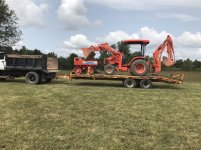
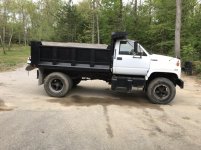
Here’s the 6500 and trailer. The one ton was a 4 door long bed GM truck. I don’t have the GN trailer anymore. But hitch weight wasn’t a concern for dump truck pintle trailers so the axels are pretty far back. The 6500 has a 10’ bed and the axel is almost at the back of the bed so I think the wheel base on the trucks would be pretty close. IMG_9079.JPGIMG_8703.JPG
 
/ Thinking about a new Gooseneck trailer #29  
I just did some looking at Big Tex website, and compared GN and Bumper Pull trailers. I looked at 20 foot trailers, but unfortunately they don't offer the same bed size in both trailers. I did notice that it appears to go along with my thoughts that trailers with GN axles are further back, which would mean a longer turning radius, but the fact that the tongue allows for a closer turn, kind of evens out some of that.
David from jax
 
/ Thinking about a new Gooseneck trailer #30  
I just did some looking at Big Tex website, and compared GN and Bumper Pull trailers. I looked at 20 foot trailers, but unfortunately they don't offer the same bed size in both trailers. I did notice that it appears to go along with my thoughts that trailers with GN axles are further back, which would mean a longer turning radius, but the fact that the tongue allows for a closer turn, kind of evens out some of that.
David from jax

But how useful is that in a forward only turn? Can you cut the truck into the trailer going forward only with a BP trailer?
 
/ Thinking about a new Gooseneck trailer #31  
Here’s the 6500 and trailer. The one ton was a 4 door long bed GM truck. I don’t have the GN trailer anymore. But hitch weight wasn’t a concern for dump truck pintle trailers so the axels are pretty far back. The 6500 has a 10’ bed and the axel is almost at the back of the bed so I think the wheel base on the trucks would be pretty close. View attachment 672633View attachment 672634

Throw a tape on the center axle to center axle on the truck and I will throw one on my extended cab F350, or maybe someone else can with a four door. (Although F350 wheelbase is probably on the net somewhere). The best way for us to confirm this would be to find 2 same size trailers and drive in a circle behind the same truck. I think axle position is going to be the reason for any differences.
David from jax
 
/ Thinking about a new Gooseneck trailer #32  
I know for a fact a leaf spring ford can’t match the turning radius of the 6500. My regular cab long bed IFS ton would be a close match. I don’t know how they managed it but that straight axle, leaf spring, 40” tire truck will flat turn.
 
/ Thinking about a new Gooseneck trailer #33  
Throw a tape on the center axle to center axle on the truck and I will throw one on my extended cab F350, or maybe someone else can with a four door. (Although F350 wheelbase is probably on the net somewhere). The best way for us to confirm this would be to find 2 same size trailers and drive in a circle behind the same truck. I think axle position is going to be the reason for any differences.
David from jax

Nothing to confirm other than to yourself.

BP tracks truck better than a GN. Its about where the hitch is (which is what the trailer follows/pivots around). And on a GN it is slightly FORWARD of the axle. On a BP it is BEHIND.

PS....this is also why a BP trailer reacts much faster to steering input;)
 
/ Thinking about a new Gooseneck trailer #34  
Everywhere I am reading on the web says that a GN will turn in a smaller radius than a bumper pull. This was what we were wondering, right?
David from jax
 
/ Thinking about a new Gooseneck trailer #35  
Everywhere I am reading on the web says that a GN will turn in a smaller radius than a bumper pull. This was what we were wondering, right?
David from jax

You might be able to with several forward and backwards movements turn around in a smaller area. I doubt it but maybe. If you just cut the truck wheels as far as they’ll go and drive in a circle the BP will track tighter to the path the truck drove. So I guess technically the GN is driving in a tighter radius but that’s not what you want. Tighter tracking to the same path the truck drove would give a greater ability to make turns while staying on the road.
 
/ Thinking about a new Gooseneck trailer #36  
You might be able to with several forward and backwards movements turn around in a smaller area. I doubt it but maybe. If you just cut the truck wheels as far as they’ll go and drive in a circle the BP will track tighter to the path the truck drove. So I guess technically the GN is driving in a tighter radius but that’s not what you want. Tighter tracking to the same path the truck drove would give a greater ability to make turns while staying on the road.

Yes.

Its tighter tracking to the trucks wheels is what you want.

Sure, a GN may turn inside a smaller circle, because no worry of jacknifing into a bumper.

But when you are doing that tight circle, look how far inside the trucks tracks that the GN is.

IF you set up a 90 degree turn.....an equal length BP will do it in a SMALLER area than a GN.

That is why it is a yes and no answer as to which is most manueverable....as I mentioned in my first post.
 
/ Thinking about a new Gooseneck trailer #37  
Its abut the hitch point.

With a GN, the hitch is FORWARD of the rear axle. So the VERY MOMENT you start turning into a driveway....the Trailer starts heading the same direction.

With a BP, the hitch is several feet behind the rear axle. So you start a turn into a driveway....the trailer actually goes the opposite direction for a moment if you turn real sharp....and tracks much closer.


I agree, the two trailers are apples and oranges. They both react different to what the tow vehicle is doing. If the tow vehicle pivots on it's rear axle there is no steering english applied to the gooseneck hitch, the drive axle has to move sideways first. On a bumper pull the tail swing of the tow vehicle steers the trailer hitch immediately. On a narrow crooked driveway, lined with railroad ties for example, I can back the bumper pull mostly anywhere I can tow it forward. Not so with a gooseneck, not enough room for the tow vehicle to swing and get the needed steering input to the gooseneck hitch.

Not taking anything away from sandman, when you need a 90 degree turn the gooseneck wins that one, however it is hard on the trailer axles to pivot on themselves. But, the room needs to be there for the tow truck or it wont work. Trees, fence post, buildings, rocks all play a part. Any slight movement of the tow vehicles front axle will help make the bumper pull start to follow with no side movement of the drive axle, so it stays centered in the driveway.

Hard for me to explain but if the truck has a stinger hitch 15' from the center of the drive axle and the trailer has a reach hitch the same length from it's axles, it will follow in the trucks footsteps. Such as a long log truck and trailer. That's the only way you can navigate tight switchbacks on a spur road. The standard fifth wheel truck/trailer will not.
 
/ Thinking about a new Gooseneck trailer #39  
I have several gooseneck and several bumper pull trailors of various sizes. For stability on the road a bumper pull cannot compete with a gooseneck. Perhaps not every one needs to worry about that issue.

I agree that bumper pulls follow the same tracks as the pulling vehicle better than a gooseneck. When pulling, goosenecks need more attention on tight corners as some have pointed out.

However, working construction for a living and mostly on residential and some light comercial jobs I have to deal with limited room to back into or park trailors almost every day I work. Often times its a choice of making multiple trips walking and hauling tools from a distance to use on the job or hauling debris from the job to the trailor. The effort, time and the expense of paying employees to carry things back and forth is a major factor. When comparing equal trailor bed area to carry your load or tools in, and for tight quarters I will pick the gooseneck every single time.
 
/ Thinking about a new Gooseneck trailer #40  
I have a 35 GN and when I bought it, I was dreading it wouldn稚 make it into a few of my tighter driveways, especially ones with pillars, but it does.
I simply drive to the point where it feels like the nose of my truck is past the driveway, then turn hard back towards the driveway and hug the edge of the driveway. The GN makes it easily. I previously had a Big Tex 30 GN and I could turn that into literally any driveway no matter how tight it was.
A 30 footer can go about anywhere a 35 footer is a little tougher.
The OP should be ok unless he has a crazy-tight driveway.

I have 2 bumper pull trailers and have owned several GNs including my 35 Kaufman. It has a GVWR of 38500. The difference between bumper pull and GN for handling, loading and operating is like night and day. GN is superior in 10 ways to maybe 1 maneuvering advantage of the bumper pull.
Its why tractor trailers are primarily a GN design, not a bumper pull design.
If you really need a GN, get one and you wont regret it. If youre concerned about getting in/out driveway, find someone who has one and ask them to do a trial run with their truck & trailer.
Then its settled.
 

Marketplace Items

2013 Freightliner CASCADIA DAY CAB (A59575)
2013 Freightliner...
(10) 24' Free Standing Panels w/8' Gate (A60463)
(10) 24' Free...
2008 MACK CHU613 DAYCAB (INOPERABLE) (A58214)
2008 MACK CHU613...
2015 Freightliner M2 106 AWD Altec AT37G 37ft. Insulated Bucket Truck (A60460)
2015 Freightliner...
2006 CATERPILLAR 304C (A58214)
2006 CATERPILLAR...
Iranch IRET13 (A60463)
 
Top