Newbie terror, need experienced advice

   / Newbie terror, need experienced advice #21  
A backhoe is not a good choice for ballast, especially for a newbie. They are usually more weight than needed and can get you in a lot of trouble real quick. .

Agreed
 
   / Newbie terror, need experienced advice #22  
DO NOT buy ericm979's ballast box, it's on clearance for a reason - it's not quick hitch compatible, this one is
Ballast Box 3 Point Category 1 Tractor Attachment | Quick Hitch Compatible | Titan Attachments

If you load it up, it will be heavy and hard to connect when needed. You will want to make a "parking stand" for it to raise it off the ground and make it easier to hook up. This can be as simple as cement or wooden blocks in front of a tree or something that can be moved around.

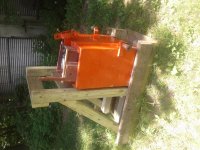
20200705_134456.jpg

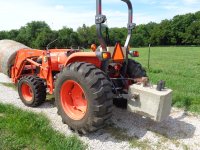
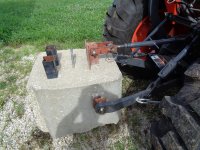
This is the non QH compatible box, bought it off Amazon. The top link needed to be lower and moved forward. Since I lack welding skills, I'm happy with my mod.

Here are some of my other implement mods
Ideas to make implements QH compatible | OrangeTractorTalks - Everything Kubota
 
   / Newbie terror, need experienced advice #23  
If in doubt use stone boat or drag the rock if you can.
 
   / Newbie terror, need experienced advice #24  
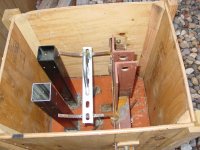
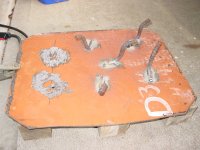
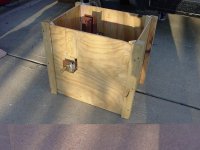
This is the counter weight I made during building my new house. I build a box as pictured and had them dump leftover concrete in there rather on the site. It is about 1000 lbs and it is nice and compact and close to the rear so it make turning and backing out a bit safer. Like everyone said, never lift for more than you need for travel and higher if needed only when tractor is stopped.


DSC07829.JPGDSC07802.JPGDSC07797.JPG

DSC05688.JPGDSC05685.JPG
 
   / Newbie terror, need experienced advice #25  
Small tractors and large rocks do not play well. You are smart to be wary. I am careful lifting even 2000 lbs with my tractor and it weighs 4500 lbs, has loaded oversize turfs, and over 800 lbs of counter weight on the carry all.

Just looked up your specs. Your tractor is half the weight with half the FEL capacity. A rock 2x2x3 is way too large for you to handle safely...it will weigh about 2000 lbs.
 
   / Newbie terror, need experienced advice #26  
A box blade gives you weight and an implement you can use for various tasks.
 
   / Newbie terror, need experienced advice
  • Thread Starter
#27  
Well, I learned a lot today, and I'm still alive. So, overall a good day!
Thank you all again for the advice, and for the product or DIY recommendations. I'm going to look into getting a box blade and I'm also going to either buy or make a ballast box. It depends upon whether I can find a construction site with some extra cement to dump!
Take care everybody. And feel free to add comments or PM me if you have other suggestions or advice on the box blade use.
I really appreciate the kindness of you all.
 
   / Newbie terror, need experienced advice #28  
Just my opinion, but if your tractor will pick it up, it is ok to move it if you have enough counter weight. This assumes some basic safety rules, like flat ground, keep the load low etc.
 
   / Newbie terror, need experienced advice #29  
Mixing your own concrete is inexpensive and easy. Knock a box together from scrap lumber, put a strategically located pipe of sufficient diameter to slide a drawbar through, and a vertical flat bar protruding from the top to attach a top link bracket. Go to any hardware store and you can pick up premix for under $4 for a 60 lb bag... in the long run probably cheaper than chasing around at construction sites.
 
   / Newbie terror, need experienced advice #30  
OK, that makes sense. As an aside, I think it's a shame that these lessons are learned the hard way. I'm not trying to avoid my own responsibility to educate myself. but there is only so much you can learn watching youtube videos. I think there should be some responsibility for dealers to offer safety information. I

Stay off the 'tube. Most of it is made by idiots. (Hey Bubba, lookit this .... and hold muh beer!!!)


Check your owner's manual. It's very clearly discussed in mine.

As noted, a backhoe is for digging, not for a counterweight. It's too high and long and can create more of an issue. I don't have use for a back or box blade, but I do for a tiller, which adds weight and keeps it low and close to the tractor.

Keep in mind that frequent excess weight on the front, not properly counterbalanced can break expensive front axle parts.
 
   / Newbie terror, need experienced advice #31  
There are lots of threads on TBN about homemade ballast boxes. If you're clever, you have a receiver hitch sticking out the back, embed PVC pipe to make carriers for long handle tools, something to carry your chainsaw, logging chain, etc. Think of it as a heavy carryall.
 
Last edited:
   / Newbie terror, need experienced advice #32  
Well, I learned a lot today, and I'm still alive. So, overall a good day!
Thank you all again for the advice, and for the product or DIY recommendations. I'm going to look into getting a box blade and I'm also going to either buy or make a ballast box. It depends upon whether I can find a construction site with some extra cement to dump!
Take care everybody. And feel free to add comments or PM me if you have other suggestions or advice on the box blade use.
I really appreciate the kindness of you all.

A handy thing to add with your ballast box is to put some 2 inch PVC sticking up in the box than pour the concrete. It is very useful for handle tools. Sure it takes a bit of the weight out, but more than makes up for it in utility. If you carry a chainsaw a lot, a chainsaw scabbard can be "molded" in also. I also have some 4 inch short PVC on top to hold chains with their hooks hooked on the inside rim of the PVC. Even your little tractor probably needs an additional 600 to 700 lbs on the 3 point. The feelings you will get in the seat of your pants will be sooo much better than what you are feeling now.

As an aside, and it was mentioned above, but if you do go down a slope even on a gravel road, let alone a grassy hill, with weight in the FEL, you are in for the "wild ride", where the rear tires get light and slip on the ground, and if your not in 4wd when this happens, you go flying down the slope and picking up speed and the ONLY thing that can stop you is drop the bucket and anything on the 3pt hitch to drag on the ground, because brakes are NOT going to help you a bit as the tires contact patch is not making contact any more with the ground.

You can avoid this by making sure you stay in 4wd on slopes and also as pointed out above, by going down bad slopes backwards. And I know you are doing it now, but don't ever forget, the terms "low and slow". When you have a load in the FEL, keep it as low as safely possible. when moving and move slow. Raising the FEL is the number one reason for tractor roll overs. Remember that front axle, even on a 4 WD tractor is on a center pivot and you can roll over in a heartbeat with a high center of gravity which the FEL puts you on as soon as you raise it. When the rear tires come off of the ground and the front axle pivots to one side or the other, drop that FEL to the dirt instantly. Better yet don't ever let that happen to you. Run suffiecent ballast on the 3pt to prevent the rears from ever getting light.

Your instincts have served you well. May they continue to do so. If you little inner voice says. "hey maybe I shouldn't do this" Then don't do that.
 
   / Newbie terror, need experienced advice #33  
A backhoe is not a good choice for ballast, especially for a newbie. They are usually more weight than needed and can get you in a lot of trouble real quick. Their place is digging trenches etc on flat ground. I have one for my B7800 and live on a very steep piece of property. If I need to travel on steep slopes I have enough experience to know that you need to swing the hoe to the uphill side so that it helps weight distribution rather than cause a run away or roll over. For me the box blade is usually plenty but more often than not I have a mower on the back and that works too. Also,very important, if you are going up or down a slope always have your tractor in 4 wheel drive.

A backhoe is too expensive to really be considered a counter weight but it’s excellent at the task IMO. You’d need a counter weight that weighs as much as the tractor to get the same effect. And as mentioned you can swing the backhoe to the high side for added stability. My M59 will lift a 3500 pound bundle of plywood with the backhoe on and with the backhoe off even with loaded tires it’s only good for about 1000 pounds. Both of my other tractors would still tip with loaded tires and a 500 pound box blade. The blade was a lot better than no weight like the OP is running but I still wasn’t enough.
 
   / Newbie terror, need experienced advice #34  
My Kubota M6040 weighs 10,050#. A lot of that is due to the HD Rhino 950 rear blade and the RimGuard in the rear tires. Yet - I can still attempt to lift a large rock with my grapple and feel a rear wheel begin to rise up. This is my signal. Do I really want to move this rock and do I want to go to all the trouble of chaining the rock up and dragging it.

My Rhino rear blade( 1015#) is ALWAYS on the 3-point. Or, in the spring, it might be my Wallenstein chipper. I never run the tractor with a bare 3-point unless I'm pulling my farm wagon.

I suggest you consider a useful 3-point implement as counter weight. Maybe a rear blade, box blade or LPGS( land plane grading scraper ). Why put something on the 3-point that will only serve as counter balance.
 
   / Newbie terror, need experienced advice #35  
Traveling up and down a slope with or without a load can be a challenge. I would rather be facing downhill on an unknown slope. If things go south I would rather be facing the direction of travel, rather than going backwards with a loss of control/traction.

When I use a box blade to level an area I like to cross the area in different directions. It seems to help. Using a box blade on a slope may not offer that opportunity.

Doug in SW IA
 
   / Newbie terror, need experienced advice
  • Thread Starter
#36  
Wow. Lots to think about. The idea of a rock sled had not occurred to me, and that sounds like a good idea. As far as abllast, I will explore heavy implements first. I could certainly build the ballast box easily, and may do that until I've learned enough about implements. Thanks for the great ideas of putting PVC in to hold tools.
I actually did read a lot on the apparent controversy of whether to go forwards or backwards down a hill with a front load. There are many ag websites that advise going forwards. I feel safer going backwards because if I have to drop my front loader, it will drag me to a stop. If I'm going forward and drop the loader, it could cause me to fishtail.
 
   / Newbie terror, need experienced advice #38  
When going downhill with a loaded FEL you should be travelling in reverse.

Travel forward up a hill with load.

I forgot to add: always travel with your load low to the ground.

And keep your 4WD engaged so you have brakes on the front wheels, suppose you have a manual 4WD without automatic engagement when braking.

Also,very important, if you are going up or down a slope always have your tractor in 4 wheel drive.

As an aside, and it was mentioned above, but if you do go down a slope even on a gravel road, let alone a grassy hill, with weight in the FEL, you are in for the "wild ride", where the rear tires get light and slip on the ground, and if your not in 4wd when this happens, you go flying down the slope and picking up speed and the ONLY thing that can stop you is drop the bucket and anything on the 3pt hitch to drag on the ground, because brakes are NOT going to help you a bit as the tires contact patch is not making contact any more with the ground.

You can avoid this by making sure you stay in 4wd on slopes and also as pointed out above, by going down bad slopes backwards. And I know you are doing it now, but don't ever forget, the terms "low and slow". When you have a load in the FEL, keep it as low as safely possible. when moving and move slow. Raising the FEL is the number one reason for tractor roll overs. Remember that front axle, even on a 4 WD tractor is on a center pivot and you can roll over in a heartbeat with a high center of gravity which the FEL puts you on as soon as you raise it.

Traveling up and down a slope with or without a load can be a challenge. I would rather be facing downhill on an unknown slope. If things go south I would rather be facing the direction of travel, rather than going backwards with a loss of control/traction.

I actually did read a lot on the apparent controversy of whether to go forwards or backwards down a hill with a front load. There are many ag websites that advise going forwards. I feel safer going backwards because if I have to drop my front loader, it will drag me to a stop. If I'm going forward and drop the loader, it could cause me to fishtail.


It may seem counter intuitive to have the load uphill until you try it a couple of times and feel the difference. A load in the bucket pulls the front down and with the smaller front tires downhill, it adds that much more to the risk of lightening the rear wheels too much. There's a cantilever effect there that becomes really evident .... and scary.
 
   / Newbie terror, need experienced advice #39  
If you ever do take the "wild ride" downhill, you will never forget it. You can stand on the brakes all you want, and it won't help even one little bit. You are headed for the bottom and picking up speed. And if there is a tree or something else in your way, oh well. The reason for going down slope always in 4WD is because then your front wheels by virtue of the driveline being hooked directly and mechanically to the rear driveline so that there is some braking effect on the front wheels when you press on the rear brakes. There are only two rear brakes on a CUT tractor, one on each side of the rear axle. There are NO front brakes at all, but since the driving components are all hooked together when you are in 4WD you can than slow down the front wheels when you push on the brakes. As for going down really bad slopes backward, the rear wheels/tires will have more weight on them in that position as they are "downhill"and the normal weight transfer will occur as you tilt a tractor downhill. Only now this weight transfer at an angle is working for you instead of against you and putting more weight on the rear wheels/tires for a greater contact patch with the ground instead of removing weight from the rears. If you never lose contact patch in the first place, then your tractor will be under control of the operator.

Remember a tractor is like a teeter-totter only instead of having only one fulcrum point is has two fulcrums. They are directly in line with the front axle and directly in line with the rear axle. The rear axle is many times stronger than the front axle. Now think about his, when you put a large load in the bucket, the loader arms are like a lever because they are in front of the front axle center line. They and the load are prying down due to the force of gravity. This tends to put more downward force on the front axle fulcrum center line and it takes weight off of the rear axle to the point if the load is heavy enough the rear tires come completely off the ground. Now think about this, the entire load and the entire weight of the tractor is completely now on that front axle.
Now just imagine that you put 10,000 lbs of weight on the 3 point hitch, of course you could not lift it, but this is a thought experiment so just imagine. What would happen, well the rear tires would go back to the ground and the 3pt hitch load would fall to the ground rotating the tractor around the rear axle which would raise the tractor with its FEL load and all into the air. So there is your 2 fulcrum points. Now you have so much weight on the rear that the front tires off off of the ground and so is the load in the FEL bucket.

What your goal should be is to help "unload" that much weaker front axle by having sufficient ballast on the 3pt so that its "lever arm" is always "unloading" the weight on the center line of the front axle. This will make the weaker front end components last much longer than always having a lot of weight on them. Not only will the tractor be much more stable, but the added benefit is with the 3pt always prying the front up a bit, the stress on the front is much less.

Operating your FEL without sufficient 3 point ballast as you can now see is not only dangerous from a operational standpoint but also injurious to the tractor itself.
 
   / Newbie terror, need experienced advice #40  
I agree 100% with nybirdman....smaller rocks or a larger tractor! I have a small CUT with a bucket and I can tell you first hand, there are limits, and if your wheels are off the ground you have exceeded the limits by a lot!
 

Tractor & Equipment Auctions

2006 INTERNATIONAL 7400 6X4 DUMP TRUCK (A52706)
2006 INTERNATIONAL...
500 BBL FRAC TANK (A58214)
500 BBL FRAC TANK...
PARTS ONLY - Has Title - 2023 Ram 1500 Classic Pickup Truck - Hemi 5.7L - Automatic Transmission (A56438)
PARTS ONLY - Has...
2014 AMERITRAIL LAY FLAT HOSE TUGGER TRAILER (A58214)
2014 AMERITRAIL...
2007 FREIGHTLINER M2 26FT CDL REQUIRED BOX TRUCK (A59905)
2007 FREIGHTLINER...
2009 Skeeter SL190 19ft Boat with 21ft Boat Trailer (A59231)
2009 Skeeter SL190...
 
Top