Grading Gravel Road Maintenance

   / Gravel Road Maintenance #61  
Still waiting on winter. It should be in the 40's today with some moisture but no snow. I'm holding off on changing to studs on the truck and chains on the tractor until we get some accumulation in the forecast.

We've had three small snows already, first was 28 October. Very unusual for us. Long term looks good for next two weeks.
 
   / Gravel Road Maintenance #62  
I did notice that pretty quick. The biggest thing I seen about grading a dry road is all the fine dust blows away instead of locking in the rock. Our road has some hills, a low water crossing (that has a concrete pad), some areas just need more material. The asphalt grind made a good difference, but I also seen that I needed to make sure the bed was near form before, so I spent a few days getting a crown before the materials came.

Decided to reply after reading many of your posts, so thanks for the validation. It feels great to have made an accomplishment


You have the right mental approach. Moving a lot of material a few times a year does not work. Moving minimal material many, many times per year is the best approach.

And as you mentioned, different sections of the road have different requirements. I've graded my 50 miles of roads for 30 years. I know their personalities very well. They are never all ready to be worked at the same time. May find myself driving over a few miles of road to get to the one that's ready to grade.

Your neighbors are fortunate to have you!!!

Welcome to TBN!!!
 
   / Gravel Road Maintenance #63  
We maintained 3.5 miles of hilly gravel road for about 12 years.
Our tool was a 3 bladed drag that had the blades at different angles and we'd pull with an old jeep at slow speeds.
3 blades because 2 always established the level while the 3rd would cut or scalp the highs and angled so that the slicing action would move material sideways to fill the lows.
Different angles allowed 'sliced' material' to move from side to side and back again.
The last or 3 rd blade was relatively straight across the road bed as it acted as the 'finishing' blade.

Main problems were hills and the washboard always started wherever an automatic shifted and grew worst with time.
The trick was to use a lower gear and accelerate B4 the hill and not midway.

Later on we uses recycled asphalt (cheaper than crushed stone) and hot sun would re fuse the recycle which in turn would not wash out in heavy rains.

Now days the city uses a grader (but without any better results than our old DIY drag).
They also adopted the crushed/recycled asphalt approach for all our hills.

Oiling* for dust control has also helped bond the gravel road base.

*special environmental product based on wood resins
 
   / Gravel Road Maintenance #64  
We maintained 3.5 miles of hilly gravel road for about 12 years.
Our tool was a 3 bladed drag that had the blades at different angles and we'd pull with an old jeep at slow speeds.
3 blades because 2 always established the level while the 3rd would cut or scalp the highs and angled so that the slicing action would move material sideways to fill the lows.
Different angles allowed 'sliced' material' to move from side to side and back again.
The last or 3 rd blade was relatively straight across the road bed as it acted as the 'finishing' blade.

Main problems were hills and the washboard always started wherever an automatic shifted and grew worst with time.
The trick was to use a lower gear and accelerate B4 the hill and not midway.


Later on we uses recycled asphalt (cheaper than crushed stone) and hot sun would re fuse the recycle which in turn would not wash out in heavy rains.

Now days the city uses a grader (but without any better results than our old DIY drag).
They also adopted the crushed/recycled asphalt approach for all our hills.

Oiling* for dust control has also helped bond the gravel road base.

*special environmental product based on wood resins

Three decades ago I built a drag using a chunk of truck frame and bolted bridge planks to it. Worked great since that was what I could afford.

The bold statement above exactly explains washboarding on a gravel road. And yes, you can truly see where the average vehicle shifts gears at. And no, the general public doesn't understand and won't adapt the habit described above. :(
 
   / Gravel Road Maintenance #65  
I help maintain our private road. We use crushed rock with rock dust binder. Spread gravel when it's wet using back blade. Compact by backdragging with bucket angled with increasing down pressure. Grade road when it rains and compact after grading back dragging with bucket. I find angled blade best for crowning and backdragging one side at a time firms up surface to encourage runoff and prevent potholes. In summer grade and recompact every 4-6 weeks after rain. I own a harbor freight compactor and use it in my driveway and parking area once per season. Makes very flat surface that keeps it's shape and sheds water. Have used it to help neighbors shape their driveways. Very little effort to push on level surfaces.
 
   / Gravel Road Maintenance #66  
I learned a lesson, you can't just fill trenched out roadway.
You need to open up the whole area and then level it out.
Unless you fill the trenched out area with crushed stone and topped with fill material.

Strats first, then raise the Strats and make both blades hit the ground together.

BUT... I am now using the Grader/Scraper, after each rain, I am removing about two inches of material off the road each time and hoping for approximately 12" total... then replace the removed materials with about 3" of base stone and 3" of 3/4+ stone. I may need a roller to pack, maybe a rental.

I have one rock in the way, if I hit it with the BH it doesn't move, I do have a smaller BH but I would think the rock should move some but it sounds solid... so I thinking bed rock.
It is now sticking out of the roadway approximately 2", we will have to see where that goes.

Thanks for the input to this thread, it is helping me out !

Ltr
 
   / Gravel Road Maintenance #67  
I help maintain our private road. We use crushed rock with rock dust binder. Spread gravel when it's wet using back blade. Compact by backdragging with bucket angled with increasing down pressure. Grade road when it rains and compact after grading back dragging with bucket. I find angled blade best for crowning and backdragging one side at a time firms up surface to encourage runoff and prevent potholes. In summer grade and recompact every 4-6 weeks after rain. I own a harbor freight compactor and use it in my driveway and parking area once per season. Makes very flat surface that keeps it's shape and sheds water. Have used it to help neighbors shape their driveways. Very little effort to push on level surfaces.

Good stuff right there.
 
   / Gravel Road Maintenance #68  
I learned a lesson, you can't just fill trenched out roadway.
You need to open up the whole area and then level it out.
Unless you fill the trenched out area with crushed stone and topped with fill material.

Strats first, then raise the Strats and make both blades hit the ground together.

BUT... I am now using the Grader/Scraper, after each rain, I am removing about two inches of material off the road each time and hoping for approximately 12" total... then replace the removed materials with about 3" of base stone and 3" of 3/4+ stone. I may need a roller to pack, maybe a rental.

I have one rock in the way, if I hit it with the BH it doesn't move, I do have a smaller BH but I would think the rock should move some but it sounds solid... so I thinking bed rock.
It is now sticking out of the roadway approximately 2", we will have to see where that goes.

Thanks for the input to this thread, it is helping me out !

Ltr

I've removed hundreds of rocks from roadbeds. I've hit rocks with the grader that don't budge, blade jumps over it. Thinking ow wow, this is a big one!!! Hook it with the end of the blade and pop it out. It's bowling ball size.....

I've got six places on my roadbeds that have exposed limestone bedrock. That really, really sucks. Requires constant maintenance. After enough erosion the only fix is get a large Excavator onsite and tear out the bedrock a foot or so below the roadbed. Then replace the material and rebuild the roadbed. Problem solved for another 10-15 years depending on how deep you go.
 
   / Gravel Road Maintenance #69  
Somewhat. Cat only offered high tech joystick equipment that is expensive and unnecessary. Cat has figured that out after 12 years and in 2020 will offer their graders with standard rack controls. Sales loss has driven that.

Thanks.
I was rather curious.
 
   / Gravel Road Maintenance #70  
No doubt about potholes forming again after filling. If you have a box blade with ripper shanks, lower shanks and rip up a few feet around the hold, fill and compact with repeated wheel travel.

I scarified potholes for many years and no doubt in my experience it made things worse in the long run. Disturb the least amount of already compacted material while improving proper grade is the way to go. The deeper you go the more work and money you may make for yourself in the long run if working by the hour.
 
   / Gravel Road Maintenance #71  
I have read where lots of folks rip through the entire road to remove pot holes. Several times a year ripping and smoothing the road or drive. I thought pot holes are caused by standing water in low spots. It would appear that grading corrections are needed to reduce pot holes. I agree with the above poster that once you have a well shaped roadway the less you disturb it the better. Rolling packer and limited grade work is better than constant ripping and smoothing.
 
   / Gravel Road Maintenance #72  
I only rip out potholes that I cannot get rid of any other way. That's rare.

Repetition and proper drainage grade is best method to control potholes.

This year we have been plagued with several heavy, fast rains. A lot of road erosion. So for the last two months I've been trying to get on top of that. Requires moving more loose material than I like. So I have roadbeds that are rough from traffic packing that loose material unevenly. Now when I grade it's a very delicate touch. Don't move any more material than absolutely necessary. Trying to get everything smooth and stuck down before we freeze up for the Winter. Much, much easier to push snow off a smooth gravel road. Much, much less gravel loss as well.
 
   / Gravel Road Maintenance #73  
I only rip out potholes that I cannot get rid of any other way. That's rare.

Repetition and proper drainage grade is best method to control potholes.

This year we have been plagued with several heavy, fast rains. A lot of road erosion. So for the last two months I've been trying to get on top of that. Requires moving more loose material than I like. So I have roadbeds that are rough from traffic packing that loose material unevenly. Now when I grade it's a very delicate touch. Don't move any more material than absolutely necessary. Trying to get everything smooth and stuck down before we freeze up for the Winter. Much, much easier to push snow off a smooth gravel road. Much, much less gravel loss as well.

When I first purchased my property the driveway, 1/4 mile, was in a state of disrepair and all I had for a tool, besides myself, was the FEL on a smaller Tractor. It worked well enough, got the road so it was easily traversable and have maintained the road since that way filling as I went along. I purchased a Grader/Scraper (GS) over a year back, and didn't use it for what ever reason, but finally did, as stated in other postings, and I am a happy camper; and I think the road looks great, how do I slant the to one side. :duh:

The road turned out better than anything I thought I could ever do using the GS, but it is still need the finesse of experience and the finer points ! I leveled the road, had no way to compact it other than driven on it, rain came again, more trenching, not as bad but they is still there.
So I need to watch more videos, or watch someone else doing their road so I can get the idea planted in my head and hope that something grows.

Thanks for reading, Merry Christmas !
 
   / Gravel Road Maintenance #74  
How much crown do you have?

A flat road is doable, but requires a lot more maintenance. Almost every time it rains enough for runoff.

Hypothetically, if my driveway was 12ft wide, I'd want at least a 4" crown. Even then I'd hafta maintain the ridge just outside the tracks to prevent erosion down the track.

Steeper crown eliminates some of the maintenance. Down side is it's harder to stay on a steep crowned road if you get off the center.

Your GS is a very, very good tool for maintaining your type of driveway. Would it be possible to gain some crown by cranking the right side down so it cuts more and then always drive with the right side at the shoulder of the roadbed???

I'm not familiar with the use of a GS and have only operated one an hour or so.
 
   / Gravel Road Maintenance #75  
A nice crown has been, for me, the most important feature of our 1/8 mile driveway. No crown = puddling and washouts. Before I had a nice crown, it seemed I was always having to attend to the road. Now, not so much.
 
   / Gravel Road Maintenance #76  
I scarified potholes for many years and no doubt in my experience it made things worse in the long run. Disturb the least amount of already compacted material while improving proper grade is the way to go. The deeper you go the more work and money you may make for yourself in the long run if working by the hour.

I think we are saying same thing-note I said "rip up a few feet around hole". Keep in mind-the road is frozen and NOT bringing in fresh material. So you have to get material from some place. When I did this last week I had 4-6" chunks of surface material that broke up. making repeated passes with shanks down broke up to a degree but then put the heavy compactor on it (WackerNeuson-first rate $$$)and in a few passes it is all broken up) then put shanks back down for couple passes to "stir up" the fines, then grade and final compaction with plate.

And again, most important thing-maintain crown to get water off road as soon as possible. Speed? I've told guy who oversees for homeowners-he is one of 6-they rotate the "responsibility" every two years, put up speed limit signs -15 MPH. And also get off your asses and take your trash to dump -excuse me-transfer station, instead of paying guys to drive down with their tandem rear packers, but I get no where with that.
 
   / Gravel Road Maintenance #77  
How much crown do you have?

A flat road is doable, but requires a lot more maintenance. Almost every time it rains enough for runoff.

Hypothetically, if my driveway was 12ft wide, I'd want at least a 4" crown. Even then I'd hafta maintain the ridge just outside the tracks to prevent erosion down the track.

Steeper crown eliminates some of the maintenance. Down side is it's harder to stay on a steep crowned road if you get off the center.

Your GS is a very, very good tool for maintaining your type of driveway. Would it be possible to gain some crown by cranking the right side down so it cuts more and then always drive with the right side at the shoulder of the roadbed???

I'm not familiar with the use of a GS and have only operated one an hour or so.

The driveway has three distinct sections, the upper, the down hit mid section, and the lower muddy section.

The upper section I am trying to lower about 12 to 18 inches, this section has no crown but a very slight slant to the roadway towards the left.
The mid section is all down hill, usually it doesn't get as affected by the water run off. It is at more of a slant than the upper section but still has slight snaking effect of the water. No crown there just the slant in the road bed.
The lower section, the mud problem and with the way all of the upper land drains, I am thinking I need to address the water before determining how to grade the lower section. The lower section has not crown, it has a slant to the hog side of the land so drain off let the water go one way and then it drains to the lowest section and runs across the road.

When I first purchased the land and started by addressing the road, I dug up a cross section in the wettest p art of the lower section and put in some heavy gauge flexible sheet plastic I had hanging around, added some larger crushed stone, maybe 3"+, and then added some 3/4"+ on top. Let it stay that way and so far that is still intact but the area around it is still the mud hole.

Talking about this raised my awareness in two areas, one being the crowning and/or slanting of the roadway and the other is in my knowledge of the water in the area, I need to do what I canid crowning the top section, and the lower section but I think my main effort, after the rain stops, is to find a way to put in a better water drain no the side of the road. :banghead::punch:

Time to put the BHon and start moveing some dirt and adding some stone to the drainage system. :duh:

OK so I've had a revelation,:cool2: I need to build a drain on the side of the WHOLE driveway, (1/4+ mile of drain, 12" wide, min., and 12" deep, min., some larger stone 3 or 4 inches, some heavy weed block but maybe some sort of heavy gauge flexible plastic, and some time !

Another job to add to the list but I think this will get the job done.

Thanks / Later
 
   / Gravel Road Maintenance #78  
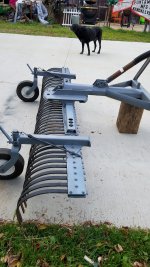
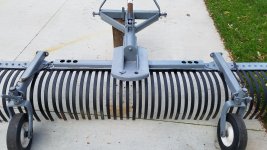
This is all you need. This is 8'. I add weights to the toothbar when needed. The key ingredient here are the gauge wheels and the floating upper link (Use a chain and keep it loose when grading the driveway. You make a 3 stage crown by swinging the rake 45 degrees with a slight angle on the hitch attachment. Then polish it off with a run down the center with 20191105_141816.jpg20191105_141805.jpgzero rake angle.
 
   / Gravel Road Maintenance #79  
This has been a very good thread you got started, Griesheimer. Lots of good information. Thought I would add my 2 cents. Gravel roads are not all the same. Just the difference in gravel can be astounding, not to mention other differences such as depth of gravel, type of subgrade, crown, dirt content, etc. The shape and size distribution of the gravel affects how well it compacts, how easily potholes and/or washboarding forms. I have taken care of the roads at two different locations, each with 3/4" minus. One has flat pieces of rock and it works so much better than the other where the pieces are rounder and less variable in size.

I find that the proper moisture content is extremely important for good grading. Grade when it is too wet will make it pretty but it won't last long. Too dry it becomes hard-packed and difficult to cut. There is a moisture balance point that happens maybe 30 days or so out of the year where I am at now where it is perfect, usually a couple days after a rain.

It was mentioned that repetition is the key. That is so true. I think that is because with either a land plane or a box blade, cutting too deep will result in gravel that is too soft and will go bad again more quickly. Multiple thin cuts leave the base compacted and the road holds up longer.

I find pick-up trucks on uphills are the worst for creating washboarding. With no weight in their bed, they loose traction easily. When the truck starts to looses traction, the rear tire winds up on the suspension and jumps, repeatedly grabbing and then loosing traction, resulting in the washboard to be made. Once the washboard gets started it makes the traction oscillation situation worse and the washboards grow in depth. The washboards in my area have longer spacing on the uphills than on the flats. It is weird how one flat section of road may be seemingly identical to another, but only one forms washboards. I think the total dynamics of washboarding, as well as potholes, is actually quite complex.
 
   / Gravel Road Maintenance #80  
In summarizing the above posts:

First off, no standing water, period! If you have pot holes with water, cut the side forcing the hole to drain and give it time to dry out.

Best to have some "Finds" (rock powder of varying sizes) in with your rocks and materials to be damp and select a non setting material.....recycled concrete roadway material is perfect. The damp Finds will pack nicely after you run your "Land Plane" through your deposited aggregate to the point that you are satisfied with the result.

Use the tractor tires to pack your smoothed out material (just raise you plane and drive up and down the driveway till you have covered the surface with tire marks). Once you have it all pressed down, come back for another lap with the plane and do it all over again.

If you can put a crown on the road you are better off as it allows the water to roll off rather than puddle and ditches along the side to keep the water from standing and seeping back into your road base. Last, schedule your heavy truck traffic for dry times of the year.

That's my 2c.
 

Tractor & Equipment Auctions

2023 KRT ST900HD STAND-ON SKID STEER (A60429)
2023 KRT ST900HD...
2014 Aerway Aerator (A55973)
2014 Aerway...
2024 CATERPILLAR 305 CR EXCAVATOR (A60429)
2024 CATERPILLAR...
72" ROCK BUCKET (A52706)
72" ROCK BUCKET...
1762 (A60430)
1762 (A60430)
2021 XCMG CV123PDU ROLLER (A60429)
2021 XCMG CV123PDU...
 
Top