What am I doing wrong?

/ What am I doing wrong? #1  

Pilot

Veteran Member
Joined
Nov 20, 2004
Messages
1,224
Location
Oregon
Tractor
JD 770, Yanmar 180D, JD 420 (not running), had a Kubota B6200
New to stick welding, Lincoln 225 set for 90 amps. Rod is 6011. Practicing on steel about 1/32 inch thick. Can run an arc for about 10 inches ( some of the time) which uses up most of the rod but burns a hole in the part much of the time. On some passes it deposits metal and on other passes or if I try to join 2 pieces or if I try to fill a hole, I get more holes.
I'm doing something wrong, what is it?
Thanks
 
/ What am I doing wrong? #2  
Are you joking? If not, the amperage is too high and the metal is really too thin for stick welding.
 
/ What am I doing wrong? #3  
1/32 is too thin for stick welding.
 
/ What am I doing wrong? #4  
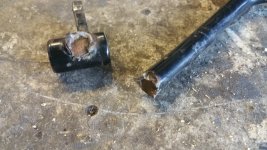
old oak has a point here, if you want to stick weld thin stuff, you really need an inverter welder, thin rod , low amps, (40 to 60) and need to lay 1/4 inch , pull off, let it cool chip slag and start again. this is exactly how i fives my shuttle drive lever yesterday.

lever.jpg
 
/ What am I doing wrong? #5  
If you need to weld thin gauge you should look into either TIG or oxy-acetylene welding.
 
/ What am I doing wrong? #6  
You couldn't go that far with any stick rod on 1/32 material. Redial and re-ask. There are some pretty cool 5/64" and 1/16 stick rods out there but 1/32 has to be a typo.
 
/ What am I doing wrong? #7  
New to stick welding, Lincoln 225 set for 90 amps. Rod is 6011. Practicing on steel about 1/32 inch thick. Can run an arc for about 10 inches ( some of the time) which uses up most of the rod but burns a hole in the part much of the time. On some passes it deposits metal and on other passes or if I try to join 2 pieces or if I try to fill a hole, I get more holes.
I'm doing something wrong, what is it?
Thanks
What diameter rod are you using? I might set for 90 amps while using 1/8" 6011 rod on much thicker plate, but, would never use 1/8" on thin plate. Thinner rod will use less amps...even less amps with thin material. Also, I use a whip/pause technique to control depth.

6011 rod is a digging rod good for burning through rust and good for penetration. If your plate is only 1/32, you don't have far for the rod to penetrate through.

6:) Root Pass - Whip and Pause Technique - Plate/Pipe - YouTube
 
Last edited:
/ What am I doing wrong? #8  
Surely that was a typo... surely... "quit calling me Shirley"
 
/ What am I doing wrong? #9  
Maybe he intended to use the 1/8 inch 6011 at 90 amps as a crude method to cut the metal not weld it? (though he did mention trying to weld 2 pieces together..hmmm).

Miller has a nice welding calculator that you can use on their web site or load on your smartphone as an app (I recommend doing that)

Stick Weld Setting Calculator | MillerWelds

If you get some 1/16 inch 6013 rods, (6013 has lower penetration, and was made for thin metal) and set for 25 amps or so, and DO NOT linger, but always keep moving, you might be able to do a fair job . BUT this is not a beginner technique. When you start out, don't start with steel much smaller than 3/16, and 1/4 is better. Also don't start with the 1/8 inch rods, use 3/32 rods to start, and if you are having control issues cut the rods in half to make them less "whippy" If you truly are trying to weld 1/32 material, you are pizzing up the proverbial rope with large rods and 90 amps.
 
/ What am I doing wrong? #10  
You couldn't go that far with any stick rod on 1/32 material. Redial and re-ask. There are some pretty cool 5/64" and 1/16 stick rods out there but 1/32 has to be a typo.

I would definitely have switched to TIG for 1/32 sheet metal. :shocked:
 
/ What am I doing wrong? #11  
I would definitely have switched to TIG for 1/32 sheet metal. :shocked:

Correct....but beginners make lots of mistakes and many don't have a choice of different welders. Each failure is a chance to learn how not to do it. Stay with it, learn, and weld.
 
/ What am I doing wrong? #12  
I'm with the camp of don't let this discourage you. I've been there where you don't have much around for scrap metal to play with, but if you are limited to that get yourself some smaller rod to play with. The 1/16" rods are flimsy and hard to work with at times though, but they're short to compensate...

Burning through is usually from high amps, on thin material that can make it difficult, lowering the amperage especially with large rods makes starting and maintaining an arc difficult... it's a balance especially on A/C...
 
/ What am I doing wrong? #13  
Both Lowes and Harbor Freight have 1/16" 6013. Lot better choice for thin material.Keep it moving and angle the rod toward the puddle just made. I have a block of copper I us as a heat sink under a joint that has a little gap. Always butt thin stuff tight together. problem with thin material is it gets a lot of heat wrinkles. Another reason to use the lowest amps that will sustain the puddle w/o blowing through. O/A is easier to control the puddle but the heat wrinkles expand. Again, use the smallest tip turned down soft that will maintain the puddle. Practice (a lot) is essential to getting a decent result. Thinnest I have done is 16 gauge with 1/16" rod both arc and O/A.

Ron
 
/ What am I doing wrong? #15  
I weld metal that thin ALL the time with stick welding,, even with the rod and amperage the OP used,,
I simply clamp the steel to a piece of copper,, then the steel will act as though it were thick, the copper takes away the excess heat.

I have more than a dozen pieces of copper in various shapes and sizes I have collected just for thin metal welding,,

A few pieces of copper, and a few clamps costs WAY less than a TIG or MIG welding setup,,
and, as a bonus, I do not have to worry about the breeze blowing away my shielding gas if I am working outside!! :thumbsup:
 
/ What am I doing wrong? #18  
I weld metal that thin ALL the time with stick welding,, even with the rod and amperage the OP used,,
I simply clamp the steel to a piece of copper,, then the steel will act as though it were thick, the copper takes away the excess heat.

I have more than a dozen pieces of copper in various shapes and sizes I have collected just for thin metal welding,,

A few pieces of copper, and a few clamps costs WAY less than a TIG or MIG welding setup,,
and, as a bonus, I do not have to worry about the breeze blowing away my shielding gas if I am working outside!! :thumbsup:

I never heard of that. Good tip.
 
/ What am I doing wrong? #19  
I weld metal that thin ALL the time with stick welding,, even with the rod and amperage the OP used,,
I simply clamp the steel to a piece of copper,, then the steel will act as though it were thick, the copper takes away the excess heat.

I have more than a dozen pieces of copper in various shapes and sizes I have collected just for thin metal welding,,

A few pieces of copper, and a few clamps costs WAY less than a TIG or MIG welding setup,,
and, as a bonus, I do not have to worry about the breeze blowing away my shielding gas if I am working outside!! :thumbsup:

Tnx for info..
 
/ What am I doing wrong? #20  
I weld metal that thin ALL the time with stick welding,, even with the rod and amperage the OP used,,
I simply clamp the steel to a piece of copper,, then the steel will act as though it were thick, the copper takes away the excess heat.

I have more than a dozen pieces of copper in various shapes and sizes I have collected just for thin metal welding,,

A few pieces of copper, and a few clamps costs WAY less than a TIG or MIG welding setup,,
and, as a bonus, I do not have to worry about the breeze blowing away my shielding gas if I am working outside!! :thumbsup:

Tnx for info..
 
 
Top