This Old Barn

/ This Old Barn #1  

quicksandfarmer

Elite Member
Joined
Dec 2, 2006
Messages
2,624
Location
Coastal Rhode Island
Tractor
Jinma 354, purchased 2007
P1060555.JPG

My place has been a farm since the 1680's, but the oldest buildings are from the mid-19th century. The most prominent building is the barn, which was built as a dairy barn. According to the tax records it was built in 1850. When I bought the property the barn was in pretty bad shape, I was worried that a big winter snowstorm would bring it down. Since then I've done a number of things to preserve and restore it, although I still have a ways to go.

The barn is what's called a "suspension barn." I haven't been able to find out much about suspension barns other than they are rare. This website: Suspension Barn shows the construction of a suspension barn similar to mine, although there are some differences. My barn has three levels: a basement that is about 10' deep, a main floor, and a hay loft (or "hay mow" as they call it around here, rhymes with cow.) The reason it's called a suspension barn is that the main floor and the loft are suspended from the framing by wrought iron poles. In the original design the basement was completely open.

Like all old buildings around here it was built facing the sun, with the ridge going east-west. The basement floor is at the original grade with a wide door in the western wall. The stone foundation was built above ground, and then dirt was brought in to fill in the north and south sides up to the level of the main floor. There are big sliding doors on the north and south walls, and they used to drive wagons up the dirt ramp and through the barn. In the summer the lofts would be filled with hay this way.

The east side of the barn contained nine stalls for milking cows. The west side had two box stalls for horses. In the center of the floor is a trap door leading to the basement. Hay would be forked from the loft down to the cows and horses, and the stalls would be shoveled out into the trap door. A wagon would be parked in the basement below the trap door, and the manure would be taken out to the fields.

The construction is post and beam with wooden pegs. The lumber is sawn, and from the saw marks it was sawn by a pit saw, not a circular saw. According to the local historical society the circular saw had become common by the time of the Civil War, and prior to 1800 timbers were more likely to have been worked by hand. So mid-19th century is probably an accurate date. It's sheathed with pine planks that are about 24" wide. The siding is cedar shingles.
 
/ This Old Barn
  • Thread Starter
#3  
The floors are supported by post and beam structures called bents. Each bent consists of two 16' posts that rest on the sills and run the height of the wall, and three beams that run the width of the building. The wrought iron suspension rods run from the bottom beam to the top beam. The top beam carries the weight of all of the floors, and transmits it to the posts. The middle beam, which holds the loft, is supported by posts resting on the bottom beam.

The most pressing issue was that three of the four suspension rods had rusted through and failed. On the west side of the barn one suspension rod was still holding, but the bottom beam had sagged significanly where the other one had failed. The east side was even worse. Both rods had failed, and the beam was rotted out between the rods and largely missing. Previous owners had put a forest of 4x4 posts in the basement to hold up the floor, but it was precarious. The east side had held the cow stalls and I think all those years of manure had taken a toll on the framing.

It didn't help that a previous owner had driven a tractor onto the floor and collapsed the manure shoot. A neighbor told me that the only thing that kept him from falling into the basement was that he had a mower on the tractor at the time. In typical thrifty New England style he nailed a piece of plywood over the hole and driven the tractor back in again.

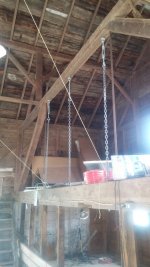
Repairing the east beam was the first priority. In order to do anything I had to get the weight of the loft off of it. I ran three chains with turnbuckles from the top beam to the middle beam, and by tightening the turnbuckles I shifted the weight of the loft to the upper beam:

eastbent.jpg

In this picture you can see the two suspension rods outside the outer chains.
 
/ This Old Barn
  • Thread Starter
#4  
At some point, I think around 1950, when the floor of the cow stalls started to fail, the owner had poured 2" of concrete to try and stabilize it. I know this was done after the beam failed by the shape of the concrete. To repair the beam I had to take up all that concrete, which made for long sessions with the sledgehammer. On summer evenings, after the kids had gone to bed I'd go out and turn on the baseball game on the radio and spend a few hours swinging the hammer.

Under the concrete the floor was completely rotten, as the concrete came up I was worried I would fall through into the basement, and I worked on sheets of plywood. Once the concrete was out I took out the original flooring, 2x12 rough-sawn planks, and the joists, which were 3x7's on 22 inch centers.

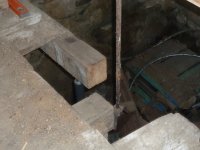
With the floor gone, I could start removing the forest of posts supporting the beams, put a jack post under each side, then cut away the rotten parts:
P1050732.JPG

Then the work of reconstruction began. On each side I put a jack post, then ran a 2x8 across and started jacking up to get the two sides level and aligned with each other:
P1050736.JPG
 
/ This Old Barn
  • Thread Starter
#5  
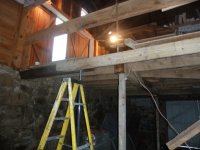
The beam with the missing piece is 6 inches wide and 7 inches deep. A modern 2x8 is 7 1/4 by 1 1/2, so four of them make up the same dimensions, if you trim a quarter inch off of the width. So I replaced the missing section with four pieces of 2x8, trimmed. There is a local sawmill that would cut me a beam, but it was much easier to build it up in sections. Under the joints I put a 6x6 post. Since the suspension rods had failed there was going to have to be some sort of support from below, although I am trying to keep as much of the original design as possible. For the posts I had to dig concrete footings in the barn floor and set post anchors into them.

I also put another 2x8 on the outside of each side, overlapping the joint by a couple of feet. I nailed it all together as I went, and then put a few long bolts through the whole thing. The 2x8 serves two purposes. It strengthens the joint, but it also thickens the beam. There is another beam near each rod that runs perpendicular to the other floor beam, together they hold up the center of the barn floor, you can see it in the pictures above. The end of this beam rotted out where it met the main beam. I cut an inch and a half off of the face and got to solid wood. With the addition of the 2x8 it met the beam again. I attached it with a modern beam hanger.

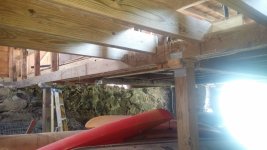
Here's a picture of the repaired beam with posts:
beam.jpg
 
/ This Old Barn #6  
If only the barn could talk. :)
 
/ This Old Barn #7  
View attachment 619522

My place has been a farm since the 1680's, but the oldest buildings are from the mid-19th century. The most prominent building is the barn, which was built as a dairy barn. According to the tax records it was built in 1850. When I bought the property the barn was in pretty bad shape, I was worried that a big winter snowstorm would bring it down. Since then I've done a number of things to preserve and restore it, although I still have a ways to go.

The barn is what's called a "suspension barn." I haven't been able to find out much about suspension barns other than they are rare. This website: Suspension Barn shows the construction of a suspension barn similar to mine, although there are some differences. My barn has three levels: a basement that is about 10' deep, a main floor, and a hay loft (or "hay mow" as they call it around here, rhymes with cow.) The reason it's called a suspension barn is that the main floor and the loft are suspended from the framing by wrought iron poles. In the original design the basement was completely open.

Like all old buildings around here it was built facing the sun, with the ridge going east-west. The basement floor is at the original grade with a wide door in the western wall. The stone foundation was built above ground, and then dirt was brought in to fill in the north and south sides up to the level of the main floor. There are big sliding doors on the north and south walls, and they used to drive wagons up the dirt ramp and through the barn. In the summer the lofts would be filled with hay this way.

The east side of the barn contained nine stalls for milking cows. The west side had two box stalls for horses. In the center of the floor is a trap door leading to the basement. Hay would be forked from the loft down to the cows and horses, and the stalls would be shoveled out into the trap door. A wagon would be parked in the basement below the trap door, and the manure would be taken out to the fields.

The construction is post and beam with wooden pegs. The lumber is sawn, and from the saw marks it was sawn by a pit saw, not a circular saw. According to the local historical society the circular saw had become common by the time of the Civil War, and prior to 1800 timbers were more likely to have been worked by hand. So mid-19th century is probably an accurate date. It's sheathed with pine planks that are about 24" wide. The siding is cedar shingles.

Nice work!

I am about 100 miles East of you, and grew up in a 3/4 Cape house built in 1730.
Still own, and use it,..... though only Summers now.
House is in great condition for it's 289 year age.
Of course, much work has also been done over those years, and there is always more needed.

Had a new red cedar shingle roof, done this Summer.
Big $$$$ !
 
/ This Old Barn #8  
Thanks for sharing. Do you know what wood was used for the original post and beams?
 
/ This Old Barn #11  
WOW!. you must really love woodworking and have a good bank account to fix this, you also have a lot of courage to work on this in the condition it was in!.. why was the barn built like this instead of having the floors supported by a foundation, though?..
 
/ This Old Barn #12  
That is quite some project you have there. Much much work & dedication required.
 
/ This Old Barn #13  
If this was mine, I would add joist hangers under those beams to ensure that they did not split in the future.

Really nice barn!!!!

^^^^^^ ABSOLUTELY....YES!!!
 
/ This Old Barn
  • Thread Starter
#14  
WOW!. you must really love woodworking and have a good bank account to fix this
When I bought the barn the siding on two sides was failing, and I hired real carpenters to replace it. They discovered that the sill on one side had rotted out, and they jacked it up and replaced it. That was expensive enough that I decided that from now on whatever gets done has to be done by me! The work that I'm doing now isn't that expensive, just a few pieces of treated 2x8's. The biggest expense of this phase was the dumpster to take away the concrete that I broke up. But it's incredibly time-consuming. To the extent possible I'm trying to recreate the original wood work, which means that each piece of wood has to be shaped and fitted, sometimes I'll spend a couple of hours on a single piece. What I'm detailing here is the compression of about five years of intermittent work.

, you also have a lot of courage to work on this in the condition it was in!..
I have been very careful not to do anything that I considered dangerous. Once I got the loft supported from above it was all working down. Despite everything looking crazy, I knew it had some strength. When I bought it tractors were still being parked in it and several tons of hay was going into the loft each summer. When the carpenters replaced the sill they had jacked up the wall from the floor. I think about that now and I mutter "holy ***!" to myself.

why was the barn built like this instead of having the floors supported by a foundation, though?..

I can only speculate. They seemed to value having the open basement. Accounts differ on whether animals were kept in the basement during the winter for warmth, or whether it was just used for storage and manure management. Also, they didn't have any treated lumber, and this is a very humid climate where wood rots quickly. Having fewer points where the framing touches the ground would make for a longer-lasting building.
 
/ This Old Barn
  • Thread Starter
#15  
Thanks for sharing. Do you know what wood was used for the original post and beams?

I don't. It's some sort of pine, maybe hemlock. Most of the framing and sheathing is white pine but the beams seem to be more rot-resistant. It's old growth and the rings are incredibly close together.
 
/ This Old Barn #20  
Fantastic project you have going there!
 

Marketplace Items

KUBOTA BX2380 TRACTOR (A62130)
KUBOTA BX2380...
2025 Pabreak Hydraulic Brush Cutter Skid Steer Attachment (A61567)
2025 Pabreak...
ALLMAND LIGHT TOWER (A60736)
ALLMAND LIGHT...
2013 GMC SIERRA (INOPERABLE) (A60736)
2013 GMC SIERRA...
(INOP) POLARIS RANGER 300 EFI RTV (A59823)
(INOP) POLARIS...
2018 Chevrolet Cruze Passenger Car, VIN # 1G1BC5SM5J7145503 (A61165)
2018 Chevrolet...
 
Top