Loader lift capacity and ballast

/ Loader lift capacity and ballast #1  

sideskraft

Silver Member
Joined
Dec 17, 2017
Messages
107
Location
West Olive, MI
Tractor
Mahindra 2540
Recently I had 44 yards of fill sand hauled in that I'm using to level an area that I will use as a parking area. On several occasions, the loader wouldn't pick up the sand. This happened when I stuffed the loader into the pile with the bucket just above ground level and attempted to lift. I can understand that the sand above the bucket was over the loader's "breakout force" of 3430lb and lift capacity of 2041lb (at pivot pin), but what surprised me is that the back wheels of the tractor didn't come off the ground. I only had a 6' back blade attached to the hitch, but the tires are filled with beet juice. Everything that I've read online about using loaders on compact tractors convinced me that I'd need filled tires AND a filled ballast box to keep the back end on the ground when doing serious loader work. So either this isn't true, or else my loader's capacity is well under spec. I'm new to tractors and loaders, so maybe I'm misunderstanding something.
 
/ Loader lift capacity and ballast #2  
Most STANDARD contemporary loader buckets can pick up a load of DRY material without the rear coming up, without Three Point Hitch ballast. This varies somewhat between tractor models. If you have an extra capacity LIGHT MATERIALS BUCKET heaped full, FEL may not be up to lift.

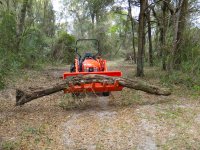
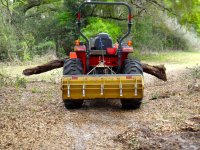
Heavier lifts than DRY sand, in my case Oak tree trunk sections to 50" diameter, will lift the rear tires before the FEL comes up without Three Point Hitch ballast.

Someone else will give you an estimate for weight of your sand if you provide cubic capacity of your bucket. That will give you a clue as to whether FEL cylinder pressure is up to spec.

I trust your FEL has been greased on a regular schedule throughout its service life. Kubota calls for greasing FEL every ten hours of operation. FEL pivot pin friction can reduce FEL lift substantially.

Look at the pins. If the grease oozed out around the pivot pins is dry, dusty, hard and opaque it has been a long time since the FEL was greased. If pivot pins have not been greased regularly, pins may be scored.
 

Attachments

  • DSC00177.jpg
    DSC00177.jpg
    1.2 MB · Views: 694
  • DSC00178.jpg
    DSC00178.jpg
    1.1 MB · Views: 390
Last edited:
/ Loader lift capacity and ballast #3  
My 1538 is the same way. I have the beet juice and keep a box scraper out back. I’ve never really felt the back end get light but I have ran out of lift. My model Mahindra was a bit longer (if I recall correctly) than the others which helps too.
 
/ Loader lift capacity and ballast #4  
In the case of mahindra, they are typically ALOT heavier than similar machines. Mahindra touts this as a benefit....which is debatable. Not sure on your specific model.

Still a good idea to ballast well out back though. Because it takes weight OFF of your much smaller front axle
 
/ Loader lift capacity and ballast #5  
It's weird that your 2540 couldn't lift the sand .. I have the same model and I haven't had any trouble picking up dirt from a pile .. I don't have my back tires filled with anything but I do use my back blade as ballast, and I don't rev the engine . I usually use it at 1700 rpms when doing loader work.
 
/ Loader lift capacity and ballast #6  
While you enter into the pile, you should be making a curl/scooping motion with the bucket. If you drive the bucket into the material, then try to pick it up/curl... you are trying to move quite a bit more weight than the loader is designed. You have the weight of the bucket filled with sand, plus all the sand above it. Scooping up material with your FEL is a learned technique that you will master over time. You will still screw up once and awhile, even stall the tractor out sometimes, but most of the time you will be a pro operator....
 
/ Loader lift capacity and ballast #7  
While you enter into the pile, you should be making a curl/scooping motion with the bucket. If you drive the bucket into the material, then try to pick it up/curl... you are trying to move quite a bit more weight than the loader is designed. You have the weight of the bucket filled with sand, plus all the sand above it. Scooping up material with your FEL is a learned technique that you will master over time. You will still screw up once and awhile, even stall the tractor out sometimes, but most of the time you will be a pro operator....

What he said....once you go into the sand, start to curl your bucket upwards, ..it should do fine...if its still a tad iffy..don't take such a big bite...BobG in VA
 
/ Loader lift capacity and ballast #8  
Are you running at full throttle? Are the relief valves set correctly? :confused3:
 
/ Loader lift capacity and ballast #9  
That is the problem with reading posts by folk with OLD IDEAS.
Whatever politics you care to believe in ...LIABILITY ISSUES have caused loader capacity to not exceed stability.
Even 20 years ago a local dealer had a sales rule of; Won't sell that tractor with a loader unless the customer also orders the rear tires loaded.
Never mind the particular tractor brand and model, that dealer believed that tractor/loader combination was potentially unstable.

Sure, plenty of posts here about the "NEED" to fill a 55 gallon plastic drum with concrete or gravel and hang it on the back - largely "feel good" nonsense.
 
/ Loader lift capacity and ballast #10  
Jerry's comments are right on. Its a trick to pick up a max load. With the little tractor pictured below, I could readily get the bucket fully loaded via the lift and curl method, (farm kids already knew how to do this;-) but then the rear tires had little or no weight on them, so it was a balancing act.
 

Attachments

  • pats gravel.arlyn.a.jpg
    pats gravel.arlyn.a.jpg
    433.6 KB · Views: 279
/ Loader lift capacity and ballast #12  
The deal with ballast hanging on the 3 point, is that it is there for several reasons. While loaded tires, and an overly heavy operator help you with traction/feel good feeling of the rear planted on tera ferma.... it does nothing to remove some of the stress on your front axle. As you pick up a bucket capacity load and lift it, a lot of stress is put on your front end. The weight way ahead of your axle acts like a teeter totter, and actually takes a little weight off your rear axle and places it all on your feeble front end. If your loader capacity was high enough, you could actually lift the rear of the tractor off the ground. This would load the front axle with the load you are trying to lift and all the weight of the tractor. [ and you ample arse ] Placing weight hanging off the rear on your 3pt also acts as a teeter totter, this time with the rear axle as the pivot point. Place enough back there/if your 3pt would lift it .... and the front of the tractor would be in the air. While your front axle will handle the weight of your tractor and load... it probably won't last long. That is why most folks put 3pt weight on when working the loader. The rear axle can handle the weight shift. As far as how much on the 3pt, the more the merrier. Think big and heavy.... unless you like rebuilding front axles.
 
/ Loader lift capacity and ballast #13  
Recently I had 44 yards of fill sand hauled in that I'm using to level an area that I will use as a parking area. On several occasions, the loader wouldn't pick up the sand. This happened when I stuffed the loader into the pile with the bucket just above ground level and attempted to lift. I can understand that the sand above the bucket was over the loader's "breakout force" of 3430lb and lift capacity of 2041lb (at pivot pin), but what surprised me is that the back wheels of the tractor didn't come off the ground. I only had a 6' back blade attached to the hitch, but the tires are filled with beet juice. Everything that I've read online about using loaders on compact tractors convinced me that I'd need filled tires AND a filled ballast box to keep the back end on the ground when doing serious loader work. So either this isn't true, or else my loader's capacity is well under spec. I'm new to tractors and loaders, so maybe I'm misunderstanding something.

It's lot harder to lift both rear wheels at the same time, compared to only lifting one rear wheel. One rear wheel lifted can cause a number of safety hazards.

If you are lifting material out of a pile, both edges of the loader bucket are held stable. The load is centered, and there is no force attempting to twist the tractor. It is very difficult to lift the entire back end of the machine, but it is not so difficult to lift only one tire, with a load that is offset.

Rear ballast will help to keep both tires planted, with uneven loads and uneven terrain. You were attempting to lift the rear in the most controlled manner possible. Start operating on slopes, with an offset or raised load, and the equation changes pretty drastically. My tractor has been on 3 wheels more times than I can count (with the backhoe or 2k pounds of counterweight), but I have only had it on 2 wheels a handful of times.

As far as moving material, I sometimes find that pulling some of the top of the pile off toward you, so that you are scooping loose material will help with getting a full bucket. If it's a big pile of wet sand, it doesn't surprise me that you can't lift from the bottom of the pile with a full bucket. Alternating lift and curl will sometimes help to loosen the material also, breaking the bucket load free of the rest of the pile.
 
/ Loader lift capacity and ballast #14  
Recently I had 44 yards of fill sand hauled in that I'm using to level an area that I will use as a parking area. On several occasions, the loader wouldn't pick up the sand. This happened when I stuffed the loader into the pile with the bucket just above ground level and attempted to lift. I can understand that the sand above the bucket was over the loader's "breakout force" of 3430lb and lift capacity of 2041lb (at pivot pin), but what surprised me is that the back wheels of the tractor didn't come off the ground. I only had a 6' back blade attached to the hitch, but the tires are filled with beet juice. Everything that I've read online about using loaders on compact tractors convinced me that I'd need filled tires AND a filled ballast box to keep the back end on the ground when doing serious loader work. So either this isn't true, or else my loader's capacity is well under spec. I'm new to tractors and loaders, so maybe I'm misunderstanding something.
The biggest factor with a rear ballast is when you're doing heavy loader work on DECLINES. Max load the FEL and drive down a steep hill. Even with Loaded tires, your rear tires will start to lift. They may not come off the ground but they will definitely get "light" and just skid with brakes locked. ALWAYS be in 4wd when doing heavy loader work on a decline. You're probably doing everything on a relatively flat work area, I wouldn't expect the back tires to lift. It's the safety factor when working on hills where a rear ballast is critical.
 
/ Loader lift capacity and ballast #15  
While you enter into the pile, you should be making a curl/scooping motion with the bucket. If you drive the bucket into the material, then try to pick it up/curl... you are trying to move quite a bit more weight than the loader is designed. You have the weight of the bucket filled with sand, plus all the sand above it. Scooping up material with your FEL is a learned technique that you will master over time. You will still screw up once and awhile, even stall the tractor out sometimes, but most of the time you will be a pro operator....
A very good explanation of why some people say they can't lift a bucket full of this or that and others say there shouldn't be any problem in doing so. :thumbsup:
 
/ Loader lift capacity and ballast
  • Thread Starter
#16  
Thanks everyone for all the useful posts and suggestions. All of my loader work is done on flat ground, so no slopes. I've been doing mainly trailer moving recently and it's so much easier than with a pickup, whether I'm using the loader pallet fork/hitch receiver attachment or the 3-point hitch receiver. I'm also very pleased with the sub-soiler "ripper" I bought from Northern Tool, which does a fantastic job of pulling up small tree roots (up to 2 inches), pieces of buried concrete, and other stuff in an area about 30 x 150 that was overrun by scrub trees and bushes and we're now reclaiming. Overall I'm extremely pleased with my tractor and what it's allowed us to do, without hiring someone to bring in equipment and do it.
 
/ Loader lift capacity and ballast #17  
That is the problem with reading posts by folk with OLD IDEAS.
Whatever politics you care to believe in ...LIABILITY ISSUES have caused loader capacity to not exceed stability.
Even 20 years ago a local dealer had a sales rule of; Won't sell that tractor with a loader unless the customer also orders the rear tires loaded.
Never mind the particular tractor brand and model, that dealer believed that tractor/loader combination was potentially unstable.

Sure, plenty of posts here about the "NEED" to fill a 55 gallon plastic drum with concrete or gravel and hang it on the back - largely "feel good" nonsense.


my 2655 with beet juice and 7'box blade lifts the back end off the ground
 
/ Loader lift capacity and ballast #18  
.....................................................................................
Sure, plenty of posts here about the "NEED" to fill a 55 gallon plastic drum with concrete or gravel and hang it on the back - largely "feel good" nonsense.
I take it you never read the Operators Manuals that come with new tractors that emphasize the fact that rear ballast is necessary when operating a F.E.L. Or do you know better than the manufacturers? :rolleyes:
 
/ Loader lift capacity and ballast #19  
I take it you never read the Operators Manuals that come with new tractors that emphasize the fact that rear ballast is necessary when operating a F.E.L. Or do you know better than the manufacturers? :rolleyes:

My "point" was more about the shear stupidity of overloading a tractor to the point of instability _ just because it CAN be lifted doesn't mean you SHOULD lift it - and CARRYING it is where the real problems starts.

Sure, you can get it "stable" again (to some extent, note only in the fore/aft direction) by hanging more weight off the back, but at what point do you stop ?
{See other thread on how to break a Kubota in half}

I believe in operating within, WELL WITHIN the stability of the tractor and yes, my rear R4 tires are loaded, my set of turfs are not, but I don't do loader work with those.
 
/ Loader lift capacity and ballast #20  
Recently I had 44 yards of fill sand hauled in that I'm using to level an area that I will use as a parking area. On several occasions, the loader wouldn't pick up the sand. This happened when I stuffed the loader into the pile with the bucket just above ground level and attempted to lift. I can understand that the sand above the bucket was over the loader's "breakout force" of 3430lb and lift capacity of 2041lb (at pivot pin), but what surprised me is that the back wheels of the tractor didn't come off the ground. I only had a 6' back blade attached to the hitch, but the tires are filled with beet juice. Everything that I've read online about using loaders on compact tractors convinced me that I'd need filled tires AND a filled ballast box to keep the back end on the ground when doing serious loader work. So either this isn't true, or else my loader's capacity is well under spec. I'm new to tractors and loaders, so maybe I'm misunderstanding something.
I read through and didnt see noted in the thread:
When you are lifting from at or near ground level the motion of the bucket is forward and up. ... Significantly forward on some loaders.​
This will significantly affect lift from a pile because the tractor must be pushed back or the pile be pushed away for the bucket to rise.​
 
 
Top