You are using an out of date browser. It may not display this or other websites correctly.
You should upgrade or use an alternative browser.
You should upgrade or use an alternative browser.
camp house floor insulation
- Thread starter joeu235
- Start date
- Views: 13199
More options
Who Replied?
/ camp house floor insulation
#21

OP

joeu235
Platinum Member
- Joined
- Mar 27, 2014
- Messages
- 724
- Location
- Little River, TX
- Tractor
- John Deere 4020 / 6403 / 317 Ford 5600
I hope your neighbor with the ranch doesn't mind that you are building that close to him.
It's my father in law's place and he's quite the character
OP
joeu235
Platinum Member
- Joined
- Mar 27, 2014
- Messages
- 724
- Location
- Little River, TX
- Tractor
- John Deere 4020 / 6403 / 317 Ford 5600
Thanks for all the feedback everyone. The next time myself and my brother-in-laws are working on the cabin is Feb 10 so I've got time to figure it out.
Little Tractor
New member
Been a while since I last posted here but this tread head a nail on the head. I build sheds and small houses with this exact same problem. Solution is to build the floor in sections (called platforms) each is 4 by 8 feet with "upside down" floor joist then 1/4" plywood, next turn back over and install a 4x8 sheet of subfloor plywood (usually 3/4") with only four screws, then install to the support piers or blocks. wait for it.
Next install "grade beams" completely around the outside edge of building on the piers to hold all the platforms in place, next install walls on the outside beams, then the roof, and wall cladding.
Now back to the floor, it is nicely dry no water in the insulation, lift the subfloor from the first row of platforms install insulation (usually mineral wool - Roxel), roll out vapor barrier one row at a time and then reinstall plywood sheets and firmly fasten down.
Note, often times go the extra and paint everything before installing to provide extra protection (white - the pencil lines show up better).
This helps in our neck of the woods due it rains just when you don't want it and also makes a very strong floor system (double floor joist every four feet.
Yes, cost a little more but also uses smaller components which a easier to handle and place.
Cheers and post pictures of your project.
Next install "grade beams" completely around the outside edge of building on the piers to hold all the platforms in place, next install walls on the outside beams, then the roof, and wall cladding.
Now back to the floor, it is nicely dry no water in the insulation, lift the subfloor from the first row of platforms install insulation (usually mineral wool - Roxel), roll out vapor barrier one row at a time and then reinstall plywood sheets and firmly fasten down.
Note, often times go the extra and paint everything before installing to provide extra protection (white - the pencil lines show up better).
This helps in our neck of the woods due it rains just when you don't want it and also makes a very strong floor system (double floor joist every four feet.
Yes, cost a little more but also uses smaller components which a easier to handle and place.
Cheers and post pictures of your project.
BLSXJ
Gold Member
Considering this is a camp house. I'd frame your floor normally, then sheet it with the cheapest stuff you can find (1/4" OSB?), then lay down a 1" layer of rigid foam. Then sheet with 5/8 or 3/4 T&G sheets, or go directly to wood planks for a finished floor.
Is this in Texas? are you heating or cooling the camp?
Is this in Texas? are you heating or cooling the camp?
Just my 2 cents here, put your sub-flooring on, then 1 or 1&1/2" rigid foam, then 1/2 inch or better plywood. Your floors will be nice and comfy. When you install your doors, etc. you will need to take into consideration the raised floor height. I have done this and know it works. This is when I lived in NJ. Bob

RNeumann
Elite Member
Been a while since I last posted here but this tread head a nail on the head. I build sheds and small houses with this exact same problem. Solution is to build the floor in sections (called platforms) each is 4 by 8 feet with "upside down" floor joist then 1/4" plywood, next turn back over and install a 4x8 sheet of subfloor plywood (usually 3/4") with only four screws, then install to the support piers or blocks. wait for it.
Next install "grade beams" completely around the outside edge of building on the piers to hold all the platforms in place, next install walls on the outside beams, then the roof, and wall cladding.
Now back to the floor, it is nicely dry no water in the insulation, lift the subfloor from the first row of platforms install insulation (usually mineral wool - Roxel), roll out vapor barrier one row at a time and then reinstall plywood sheets and firmly fasten down.
Note, often times go the extra and paint everything before installing to provide extra protection (white - the pencil lines show up better).
This helps in our neck of the woods due it rains just when you don't want it and also makes a very strong floor system (double floor joist every four feet.
Yes, cost a little more but also uses smaller components which a easier to handle and place.
Cheers and post pictures of your project.
I had to read this a few times to get it. The way this is built it sounds like a rim joist and the the beam on the outside of that- where I’m from a grade beam is concrete and used for an entirely different thing.
Anyway I like the concept. I’d probably just block the joists at the ends and hold the subfloor off the edges the thickness of the rough framed walls. This would save having a rim joist and then a beam outside that.

Einthewoods
Platinum Member
I just skimmed this thread, so not sure if someone has already mentioned this. If you go onto YouTube and check out "Boss of the Swamp" you will hear him swear by multiple times about a product for this exact purpose.
Shop Reflectix 2-sq ft Reflective Roll Insulation (24-in W x 1-ft L) at Lowes.com
Shop Reflectix 2-sq ft Reflective Roll Insulation (24-in W x 1-ft L) at Lowes.com

quicksandfarmer
Elite Member
Just my 2 cents here, put your sub-flooring on, then 1 or 1&1/2" rigid foam, then 1/2 inch or better plywood. Your floors will be nice and comfy. When you install your doors, etc. you will need to take into consideration the raised floor height. I have done this and know it works. This is when I lived in NJ. Bob
I assume this is after the walls are framed? So walls go on sub-floor, then insulation around them?
Little Tractor
New member
RNeumann see PM.
quicksandfarmer
Elite Member
Some thoughts:
You will never regret having a building well-insulated. Even if you only use it seasonally, the ability to be comfortable at the edges of the season is something you will appreciate. Even if it's unheated, if it's tight you can close it up and stay reasonably comfortable with just the heat from your activity in cool weather. The nature of these kinds of places is either you use them a lot less than you expected, or a lot more. If it ends up being a lot more you'll find yourself going there in all kinds of weather.
Keeping rodents out is always a concern and particularly with seasonal-use buildings. Even if you can't keep them completely out you want to limit the amount of harborage you give them. So everything should be as tight as possible. A mouse can go through a hole the size of a dime, a rat through a hole the size of a quarter. So I like the idea of boxing the bottoms of the floor joists with plywood. Since by the look of the pictures it doesn't seem like you have much clearance below, I like the idea of running cleats along the joists and doing all of the work from above. But I see some issues. Whenever you insulate you have to worry about moisture. If any gets in there it's not going to have a way out. There is a constant debate about whether it is better to seal things up completely and keep moisture out, or give it a way out. I would consider using 7/16" Zip board for the bottom, it's about the same price as 1/4" CDX plywood around here, but has better weather resistance. It also is less likely to warp so it will stay tight. If you decide you want moisture to have a way out you might put a round vent at each end of each bay.
A lot of people around here are using wood I-beams for joists, if you used them the cleats would be built in. I don't know how they compare price wise.
It's going to be really important to keep the insulation dry until the building is sealed. It's going to be a challenge though and it may be your biggest issue. The idea of building the sub-floor so it can be removed is intriguing, but I think having a solid subfloor gives a better building. If nothing else you have a solid barrier against rodents.
Roxul insulation has better moisture resistance than fiberglass, but is somewhat more expensive. This might be a good use for it.
What about plumbing and electrical? Are you going to have those? With the joist bays sealed it's going to be very hard to run those.
I would do it so that if you had to, you could come in from below later and get into the joist bays. If the plywood isn't fastened to the cleats, I think with 2x8 or larger joists you could lift the plywood from below and angle it and pull it out. You could also just pick up a piece and slide it over a neighboring piece. Think of like a suspended ceiling.
It may end up being easiest to put the sheets of plywood in while you're framing, but not the insulation. Once the building is sealed, crawl under, slide the plywood to one end, put up the insulation and slide the boards back. It depends a lot on how much clearance you have.
You will never regret having a building well-insulated. Even if you only use it seasonally, the ability to be comfortable at the edges of the season is something you will appreciate. Even if it's unheated, if it's tight you can close it up and stay reasonably comfortable with just the heat from your activity in cool weather. The nature of these kinds of places is either you use them a lot less than you expected, or a lot more. If it ends up being a lot more you'll find yourself going there in all kinds of weather.
Keeping rodents out is always a concern and particularly with seasonal-use buildings. Even if you can't keep them completely out you want to limit the amount of harborage you give them. So everything should be as tight as possible. A mouse can go through a hole the size of a dime, a rat through a hole the size of a quarter. So I like the idea of boxing the bottoms of the floor joists with plywood. Since by the look of the pictures it doesn't seem like you have much clearance below, I like the idea of running cleats along the joists and doing all of the work from above. But I see some issues. Whenever you insulate you have to worry about moisture. If any gets in there it's not going to have a way out. There is a constant debate about whether it is better to seal things up completely and keep moisture out, or give it a way out. I would consider using 7/16" Zip board for the bottom, it's about the same price as 1/4" CDX plywood around here, but has better weather resistance. It also is less likely to warp so it will stay tight. If you decide you want moisture to have a way out you might put a round vent at each end of each bay.
A lot of people around here are using wood I-beams for joists, if you used them the cleats would be built in. I don't know how they compare price wise.
It's going to be really important to keep the insulation dry until the building is sealed. It's going to be a challenge though and it may be your biggest issue. The idea of building the sub-floor so it can be removed is intriguing, but I think having a solid subfloor gives a better building. If nothing else you have a solid barrier against rodents.
Roxul insulation has better moisture resistance than fiberglass, but is somewhat more expensive. This might be a good use for it.
What about plumbing and electrical? Are you going to have those? With the joist bays sealed it's going to be very hard to run those.
I would do it so that if you had to, you could come in from below later and get into the joist bays. If the plywood isn't fastened to the cleats, I think with 2x8 or larger joists you could lift the plywood from below and angle it and pull it out. You could also just pick up a piece and slide it over a neighboring piece. Think of like a suspended ceiling.
It may end up being easiest to put the sheets of plywood in while you're framing, but not the insulation. Once the building is sealed, crawl under, slide the plywood to one end, put up the insulation and slide the boards back. It depends a lot on how much clearance you have.

Snobdds
Super Member
I just skimmed this thread, so not sure if someone has already mentioned this. If you go onto YouTube and check out "Boss of the Swamp" you will hear him swear by multiple times about a product for this exact purpose.
Shop Reflectix 2-sq ft Reflective Roll Insulation (24-in W x 1-ft L) at Lowes.com
This works, if the temperature extremes are not that great.
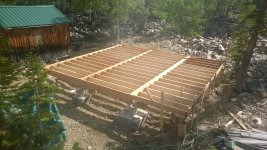
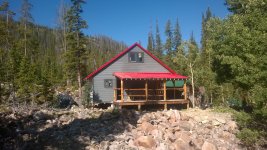
I am in the same boat. I have temperature extreams to deal with and I want to be able to use it in the winter when I snowmobile in. The best for me in my situation is spray foam. I will have to bite the bullet and pay for the closed cell spray foam kits and get about 4 inches of depth. It's a one and done deal, will never have to mess with it again. The foam can be sprayed with a bittering agent that will prevent mice from eating it, pluse I've never had a problem with mice and closed cell foam. They must think that since it's hard, it's not nesting material. I have not spray foamed it yet because I still have to run plumbing and electrical, but I want to do the floor this summer just to get an idea how it is going to go. Luckily since I have to deal with heavy snow, 20+ feet sometimes, I built 4 feet off the ground to keep things dry for a longer window of the year.
PILOON
Super Star Member
We get some real colds here.
I have had 3" of spray foam applied to 4 jobs** and that has been most satisfactory, costlier than other methods but a final solution*.
That foam sticks and they block each and every possible air gap.
Barefoot is OK even when it is -30 outdoors.
* Best yet they do the job in an hour or so and you don't need to crawl around and cuss.
Better equipped applicators will come with their own generator in their truck so any cabin can be sprayed, others need to direct wire into your entry panel to get 220 hi amp voltage.
Most efficient is warmer weather applications as the foam expands more so you get more coverage for less $$'s.
**Jobs were originally summer porches that became 4 season.
PS, just be sure to run all plumbing and electrics B4 foaming!
I have had 3" of spray foam applied to 4 jobs** and that has been most satisfactory, costlier than other methods but a final solution*.
That foam sticks and they block each and every possible air gap.
Barefoot is OK even when it is -30 outdoors.
* Best yet they do the job in an hour or so and you don't need to crawl around and cuss.
Better equipped applicators will come with their own generator in their truck so any cabin can be sprayed, others need to direct wire into your entry panel to get 220 hi amp voltage.
Most efficient is warmer weather applications as the foam expands more so you get more coverage for less $$'s.
**Jobs were originally summer porches that became 4 season.
PS, just be sure to run all plumbing and electrics B4 foaming!

WoodChuckDad
Elite Member
- Joined
- Jul 15, 2015
- Messages
- 2,938
- Location
- Free Union, VA
- Tractor
- Kioti RX7320 Power Shuttle Cab, Komatsu PC130-6
This works, if the temperature extremes are not that great.
I am in the same boat. I have temperature extreams to deal with and I want to be able to use it in the winter when I snowmobile in. The best for me in my situation is spray foam. I will have to bite the bullet and pay for the closed cell spray foam kits and get about 4 inches of depth. It's a one and done deal, will never have to mess with it again. The foam can be sprayed with a bittering agent that will prevent mice from eating it, pluse I've never had a problem with mice and closed cell foam. They must think that since it's hard, it's not nesting material. I have not spray foamed it yet because I still have to run plumbing and electrical, but I want to do the floor this summer just to get an idea how it is going to go. Luckily since I have to deal with heavy snow, 20+ feet sometimes, I built 4 feet off the ground to keep things dry for a longer window of the year.
View attachment 536240
View attachment 536241
That is a fantastic looking cabin, Heck of a view.

EddieWalker
Epic Contributor
Just to follow up on my previous post about putting the plywood down before the joists that I saw on one of those building in Alaska shows. They set their posts in the ground similar to the picture shown. Then they installed their beams on the posts. They they attached the plywood to the beams. This held the plywood in place while the installed their floor joists on top of the plywood. Once that was done, they filled the floor with bat insulation. They may have put plastic over the insulation, and then nailed down the sub floor. I'm not sure about that on that show, but I did see that somewhere. Either way, putting plastic over the insulation should solve any moisture issues if it rains on you before you get your roof on.
Keep it simple.
Keep it simple.
I did something similar, except that I framed and sheathed, then laid 1" styrofoam inside the sill; then put 1/2 inch plywood over it. you can then do whatever you want for a floor. My current camp has Styrofoam between the floor joists which worked great for the first year; but this fall was the first time that I ever had mice chew blue Styrofoam.Considering this is a camp house. I'd frame your floor normally, then sheet it with the cheapest stuff you can find (1/4" OSB?), then lay down a 1" layer of rigid foam. Then sheet with 5/8 or 3/4 T&G sheets, or go directly to wood planks for a finished floor.
Is this in Texas? are you heating or cooling the camp?

oosik
Epic Contributor
When we built our cabin in Alaska we reached a point, very similar to the OP pic in post #4. We inquired about insulation under the flooring and were advised that almost nothing would keep the rodents/insects out. The rodents would go right thru plywood to reach the space between joists.
In the end we put down 2 x 6 T&G planking with no insulation. We put large throw rugs on the floor to help with the cold. It all worked out fine - my feet were always warm.
In the end we put down 2 x 6 T&G planking with no insulation. We put large throw rugs on the floor to help with the cold. It all worked out fine - my feet were always warm.
OP
joeu235
Platinum Member
- Joined
- Mar 27, 2014
- Messages
- 724
- Location
- Little River, TX
- Tractor
- John Deere 4020 / 6403 / 317 Ford 5600
I think I'm going to go with 1/4 plywood attached to the bottom of the floor joists and fiberglass insulation. I've found enough lightly used 1/4 inch on Craigslist for 8 dollars a sheet.
Thanks for all the responses!
Thanks for all the responses!
Last edited:


