Why do most tractors with FEL's.........................

/ Why do most tractors with FEL's......................... #1  

oldpilgrim

Elite Member
Joined
Apr 17, 2014
Messages
3,080
Location
SE Ma
Tractor
2014 Mahindra 3016HST
have the lift cylinders mounted so the rod is fixed to the frame and the cylinder goes up to lift the arm instead of being turned around so the cylinder is fixed to the frame and the rod pushes up the arm?

This means the hoses have to move to follow the cylinder as it moves up and the system requires a little more 'juice' to push the weigh of the cylinders up.

My old Ferguson had the cylinder fixed and the rod went out like I would expect, but newer machines, not so much.

Any ideas?

Example borrowed for clarity:
466465d1461811118-weak-loader-curl-possible-solution-p1030786-jpg
 
/ Why do most tractors with FEL's......................... #2  
My guess is ease of running hoses for quick disconnect reasons. If hoses were at base of mast, hose would have to run all around the frame to other side.
 
/ Why do most tractors with FEL's......................... #3  
Makes perfectly good since to me. Besides the action is pushing the load away from rod(hence physics of hydraulics):rolleyes: I guess. Except for curl
 
/ Why do most tractors with FEL's......................... #4  
Rod up or rod down, it is still pushing the load when extending.

Bruce
 
/ Why do most tractors with FEL's......................... #5  
Could be the difference between a loader that has a quick disconnect verses a loader that doesn't. My lift cylinders have the tube attached to the frame.
 
/ Why do most tractors with FEL's......................... #6  
possibly trying to protect the rod from debris which could cause scratches in the rod.
 
/ Why do most tractors with FEL's......................... #7  
possibly trying to protect the rod from debris which could cause scratches in the rod.

Best answer so far. IMO.

It protects the seal being on the back side of the load.
 
/ Why do most tractors with FEL's......................... #8  
Cylinders will push more from the bored side. More oil can fill the space. They push less on the side with the rod in it which usually turned to the direction of less demand. Look at excavators and backhoes etc.
 
/ Why do most tractors with FEL's......................... #9  
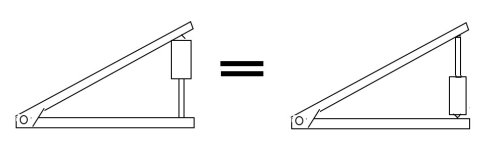
Doesn't matter which way it is turned. Push is the exact same.

Bruce


Rod-up-down-equal.jpg
 
Last edited:
/ Why do most tractors with FEL's......................... #10  
Doesn't matter which way it is turned. Push is the exact same. Bruce

Read up on calculating hydraulic force which takes into account piston on area. One side of the piston has less area for the oil to push against thus will have less applied from that side.
 
/ Why do most tractors with FEL's......................... #11  
Read up on calculating hydraulic force which takes into account piston on area. One side of the piston has less area for the oil to push against thus will have less applied from that side.

Think again. The cylinders extend to raise the boom regardless of orientation.
 
/ Why do most tractors with FEL's......................... #12  
The area is the same no matter how the cylinder is pointed.

You CANNOT apply pressure to the rod end and make the cylinder PUSH!

Bruce
 
/ Why do most tractors with FEL's......................... #13  
Extending is typically stronger than retracting, due to the larger area the fluid had to push on... but it doesn't care if the fixed cylinder part is top or bottom.

From a design and manufacturing standpoint, I assume the reasoning for the orientation is shorter hydraulic lines, cheapest.
 
/ Why do most tractors with FEL's......................... #14  
You are right in this application that the push is from the bore side regardless of rotation of the cylinder itself. I was not clear in my initial post on my thought and was thinking a different configuration. But for the cylinder itself I am accurate that more force is applied one way then the other on the rod.
 
/ Why do most tractors with FEL's......................... #15  
I think that's because the rod takes up some space but on the other side there's no rod-just a flat piston head thus giving you an inch or two more area.
 
/ Why do most tractors with FEL's......................... #16  
It's also nice to have the rod seal(s) facing down if stuff spills from the bucket.

I wouldn't want such to accumulate there & score the rod(s).
 
/ Why do most tractors with FEL's......................... #18  
You are right in this application that the push is from the bore side regardless of rotation of the cylinder itself. I was not clear in my initial post on my thought and was thinking a different configuration. But for the cylinder itself I am accurate that more force is applied one way then the other on the rod.

True but not germaine to the initial question.
 
/ Why do most tractors with FEL's......................... #19  
I agree on it being for ease of hose placement on quick detach loaders, I was designing a loader a while back and it definitely simplified the plumbing with the base connected to the loaders arm.

If you look at Kubota for axample, the quick detach loaders are oriented this way, the dedicated loaders/ TLB's have the cylinder base mounted to the frame.
 
/ Why do most tractors with FEL's......................... #20  
have the lift cylinders mounted so the rod is fixed to the frame and the cylinder goes up to lift the arm instead of being turned around so the cylinder is fixed to the frame and the rod pushes up the arm?

This means the hoses have to move to follow the cylinder as it moves up and the system requires a little more 'juice' to push the weigh of the cylinders up.

My old Ferguson had the cylinder fixed and the rod went out like I would expect, but newer machines, not so much.

Any ideas?

Example borrowed for clarity:
466465d1461811118-weak-loader-curl-possible-solution-p1030786-jpg

I'm still wondering why there's a cylinder hanging by its hoses out in space in that pic! :)
 
 
Top