You need balast or you will trash your front axle!!!! really?

/ You need balast or you will trash your front axle!!!! really? #41  
I have to admit . . And have in my pists . . If an operator is willing to operate with only one axle in contact with the ground . . Then you can shift weight. But that is neither an acceprable ir safe operating condition by tractor definition. I believe that definition requires each axle and tire have ground contact. Would anyone disagree with that definition to operate the tractor ?

So at that point . . . Math is not a function because unless you add or remove air in tires . . Or alter the pitch/slope of the land . . You can't get "down" any lower than tires and wheels and axles being in ground contact. And all the leverage you use stops when you can't go down on one side and up on the other. Now you can alter the height the weight is carried at just as you can change the ground slope or air pressures in tires . . . But all ballast does is keep the 2 axles and 4 tires in ground contact and if 2 axles and 4 tires are in the exact same spot . . . More ballast on the rear increases the rear axle load but thats the ballast doing it. But I see no way for front axle load to be reduced by ballast.

As I opinioned before . . more ballast on one end of the tractor gives the operator a choice to add more weight on the front end but i see no way to lessen the weight that already exists on that front axle UNLESS you are willing to violate the tractor definition of 2 axles and 4 wheels in ground contact.

Now I'll be happy to read and listen to other viewpoints as long as the one standard is a tractor definition of all 4 wheels and 2 axles in ground contact.

Who knows . . uf this debate has often repeated in the past . . maybe I'll have to say I'm in error. Lol
 
/ You need balast or you will trash your front axle!!!! really? #42  
I have to admit . . And have in my pists . . If an operator is willing to operate with only one axle in contact with the ground . . Then you can shift weight. But that is neither an acceprable ir safe operating condition by tractor definition. I believe that definition requires each axle having ground contact. Would anyone disagree with that definition to operate the tractor ?

So at that point . . . Math is not a function because unless you add or remove air in tires . . Yor alter the pitch/slope of the land . . You can't get "down" any lower than tires and wheels and axles being in ground contact. And all the leverage you use stops when you can't go down on one side and up on the other. Now you can alter the height the weight is carried at just as you can change the ground slope or air pressures in tires . . . But all ballast does is keep the 2 axles and 4 tires in ground contact and if 2 axles and 4 tires are in the exact same spot . . . More ballast on the rear increases the rear axle load but thats the ballast doing it. But I see no way for front axle load to be reduced by ballast.

As I opinioned before . . more ballast on one end of the tractor gives the operator a choice to add more weight on the front end but i see no way to lessen the weight that already exists on that front axle UNLESS you are willing to violate the tractor definition of 2 axles and 4 wheels in ground contact.

Now I'll be happy to read and listen to other viewpoints as long as the one standard is a tractor definition of all 4 wheels and 2 axles in ground contact.

Who knows . . uf this debate has often repeated in the past . . maybe I'll have to say I'm in error. Lol

If your analysis is correct then why do the rear tires come off the ground when you overload the FEL.
 
/ You need balast or you will trash your front axle!!!! really? #43  
If your analysis is correct then why do the rear tires come off the ground when you overload the FEL.

Great question? You've added greater weight load to the front axle so the rear wheels are no longer meeting the tractor definition of 2 axles and 4 wheels in ground contact. So adding ballast in the rear allows that definition to again work. HOWEVER . . . the weight on the front axle doesn't reduce if 2 axles and 4 wheels are in ground contact and you add 400 pounds ballast to the rear.

Simply stated . . I define the ONLY safe way to operate the tractor is with 4 wheels and 2 axles in ground contact so all stress changes made that violate that rule need to be corrected first. At that point adding weight to the front axle and tires is adding weight to those. If 500 more pounds or rear ballast get added and no change to 4 wheels and 2 axle contacts . . . you have not reduced the front end axle strain . . . unless you want to create a way you can have "more than ground contact".

Jmho
 
/ You need balast or you will trash your front axle!!!! really? #44  
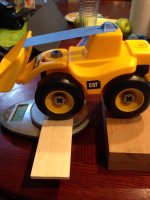
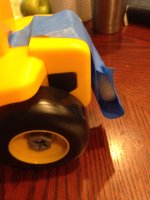
I did a small scale test using a toy loader and a kitchen scale. Let's pretend the lift capacity of the loader is 1 pound.

Machine weight with no ballast 17.1 oz
Front axel weight with no ballast 10.3 oz
Front axel weight with bucket loaded to tipping load with no ballast 27.1 oz
Tipping load was 9.2 oz. this is pretty accurate since most tractors will tip before maximum load is reached.
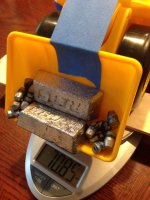
Now I added 11 oz of ballast.
New front axel weight 4 oz.
weight of front axel with previous tipping load 21 oz.
Here is the problem, I can now lift much more.
Weight of front axel with 1 pound load 34 oz.
weight of front axle with the ballasted tipping load 70.oz
Weight of tipping load 41 oz.

image-2022434417.jpg


image-2865945707.jpg


image-3290590150.jpg
 
/ You need balast or you will trash your front axle!!!! really? #45  
One more attempt to simplify. The basis of my opinion is the definition of how leverage and pulleys and levers work. Its about distance and movement combined to alter weight locations. But if all 4 wheels and both axles are in ground contact . . . Movement doesnt exist . . and without movement, levers and fulcrums and pulleys can't work.

Jmho. . . . I'll let others present their side.
 
/ You need balast or you will trash your front axle!!!! really? #46  
Great question? You've added greater weight load to the front axle so the rear wheels are no longer meeting the tractor definition of 2 axles and 4 wheels in ground contact. So adding ballast in the rear allows that definition to again work. HOWEVER . . . the weight on the front axle doesn't reduce if 2 axles and 4 wheels are in ground contact and you add 400 pounds ballast to the rear.

Simply stated . . I define the ONLY safe way to operate the tractor is with 4 wheels and 2 axles in ground contact so all stress changes made that violate that rule need to be corrected first. At that point adding weight to the front axle and tires is adding weight to those. If 500 more pounds or rear ballast get added and no change to 4 wheels and 2 axle contacts . . . you have not reduced the front end axle strain . . . unless you want to create a way you can have "more than ground contact".

Jmho

If you load the FEL till it raises the rear wheels off the ground you have reduce the weight on the rear tires, then add rear weight the rear wheels go back down. Now continue adding weight to the rear and when enough is loaded the front wheels will lift off the ground. Now the only way that can happen is if you reduce the weight on the front axle. Otherwise the front tires would not come off the ground.
 
/ You need balast or you will trash your front axle!!!! really?
  • Thread Starter
#47  
The simplest way to look at the math/physics is to consider the "additional" load on the front axle as a function of loads on the front loader and loads on the three point. This will be the load above and beyond the basic contribution of the tractor weight. When perfectly ballasted, let's say there will be no more load on the front axle than usual. For that to happen:

F * LF = R * LR

where:

F is the load on the front loader
LF is the length from the front loader's load to the rear axle
R is the load on the three point
LR is the length from the three point's load to the rear axle

That tells us that the rear ballast load must be:

R = (F * LF)/LR

As an example, say I lift 1000# in my L3200. LF is about 7'. LR is about 4'. That means:

R = (1000 * 7)/4 = 1750#

In other words, it would take a heck of a lot of ballast not to add additional load over the front axle. More ballast than the load itself!!!

Much more ballast and this was exactly my point. :)
 
/ You need balast or you will trash your front axle!!!! really? #48  
One more attempt to simplify. The basis of my opinion is the definition of how leverage and pulleys and levers work. Its about distance and movement combined to alter weight locations. But if all 4 wheels and both axles are in ground contact . . . Movement doesnt exist . . and without movement, levers and fulcrums and pulleys can't work.

Jmho. . . . I'll let others present their side.
 
/ You need balast or you will trash your front axle!!!! really? #49  
You don't need movement to balance out weight.
 
/ You need balast or you will trash your front axle!!!! really?
  • Thread Starter
#50  
Great question? You've added greater weight load to the front axle so the rear wheels are no longer meeting the tractor definition of 2 axles and 4 wheels in ground contact. So adding ballast in the rear allows that definition to again work. HOWEVER . . . the weight on the front axle doesn't reduce if 2 axles and 4 wheels are in ground contact and you add 400 pounds ballast to the rear.

Simply stated . . I define the ONLY safe way to operate the tractor is with 4 wheels and 2 axles in ground contact so all stress changes made that violate that rule need to be corrected first. At that point adding weight to the front axle and tires is adding weight to those. If 500 more pounds or rear ballast get added and no change to 4 wheels and 2 axle contacts . . . you have not reduced the front end axle strain . . . unless you want to create a way you can have "more than ground contact".

Jmho

Axle - there are different degrees of "gound contact". The term that is generally used is called "ground pressure". Adding weight to the 3pt hitch reduces "ground pressure" on the front wheels all things being equal.
 
/ You need balast or you will trash your front axle!!!! really?
  • Thread Starter
#51  
One more attempt to simplify. The basis of my opinion is the definition of how leverage and pulleys and levers work. Its about distance and movement combined to alter weight locations. But if all 4 wheels and both axles are in ground contact . . . Movement doesnt exist . . and without movement, levers and fulcrums and pulleys can't work.

Jmho. . . . I'll let others present their side.

Others have presented their side over, and over and in different ways. I strongly suggest that you get a toy tractor loader and do your own experiments with a small scale so you can see what's happening. At this point, I think that is the only way you are going to understand.

I can explain it for you. But I can't understand it for you. Good luck!
 
/ You need balast or you will trash your front axle!!!! really?
  • Thread Starter
#52  
without movement, levers and fulcrums and pulleys can't work.

The quoted statement is false. Your belief in this statement may be why you're struggling to get this.
 
/ You need balast or you will trash your front axle!!!! really? #53  
One more attempt to simplify. The basis of my opinion is the definition of how leverage and pulleys and levers work. Its about distance and movement combined to alter weight locations. But if all 4 wheels and both axles are in ground contact . . . Movement doesnt exist . . and without movement, levers and fulcrums and pulleys can't work.

Jmho. . . . I'll let others present their side.


Sum of Forces = Mass*Acceleration. When there is no acceleration (which means constant velocity, including zero velocity) then the sum of forces equals zero. You can have any combination or forces but they have to add to zero.

There is a similar law for angular momentum, and when something is rotating at constant speed (including zero speed) the sum of all moments (leverages) must equal zero. You can have any combination of moments but they have to add to zero.

In both cases, movement or motion has nothing to do with it.

Let's say you use the back of a hammer to try and pull out a stubborn nail. So stubborn that you pull with all your might but the nail doesn't budge. You will eventually turn red in the face from exertion, and obviously you are exerting a force and a leverage. But the nail is stuck enough to react and cancel out your efforts. Nothing is moving, there is zero motion but you are clearly exerting force and leverage. If you think you're not, just hang out like that indefinitely and I bet you will change your mind.

Bottom line, forces and moments can be applied with or without motion. This is all high school physics BTW. I won't fault you for forgetting some HS physics, but it's not something you should be arguing about.
 
/ You need balast or you will trash your front axle!!!! really? #54  
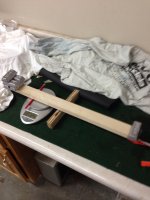
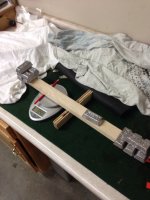
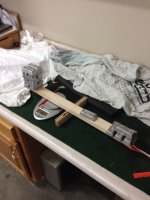
Here is a simpler experiment. The fulcrum over the scale represents the front axel.

In this picture the load is close to balanced with 107 oz over the front axel.

image-66167496.jpg

Now without moving either fulcrum or reducing the front load I can reduce the load over the scale to .9 oz.

image-3634684285.jpg

The problem comes in is now I can stack way more weight in the front bucket without changing the fulcrum or changing the rear load I pegged the 10 pound scale.

image-354334042.jpg
 
/ You need balast or you will trash your front axle!!!! really?
  • Thread Starter
#55  
Here is a simpler experiment. The fulcrum over the scale represents the front axel.

In this picture the load is close to balanced with 107 oz over the front axel.

View attachment 458079

Now without moving either fulcrum or reducing the front load I can reduce the load over the scale to .9 oz.

View attachment 458080

The problem comes in is now I can stack way more weight in the front bucket without changing the fulcrum or changing the rear load I pegged the 10 pound scale.

View attachment 458081


Hard to trump an empirical demonstration like that. Very nice!
 
/ You need balast or you will trash your front axle!!!! really? #56  
Here is a simpler experiment. The fulcrum over the scale represents the front axel.

In this picture the load is close to balanced with 107 oz over the front axel.

View attachment 458079

Now without moving either fulcrum or reducing the front load I can reduce the load over the scale to .9 oz.

View attachment 458080

The problem comes in is now I can stack way more weight in the front bucket without changing the fulcrum or changing the rear load I pegged the 10 pound scale.

View attachment 458081

Well, there you go. If he don't get it after seeing this, he is never going to get it.
 
/ You need balast or you will trash your front axle!!!! really? #57  
Well, there you go. If he don't get it after seeing this, he is never going to get it.

Remember getting Richard on board? He is the one to use the scales. Took me a bit too.
 
/ You need balast or you will trash your front axle!!!! really? #58  
Remember getting Richard on board? He is the one to use the scales. Took me a bit too.

And there was a heated discussion about 3 years ago too. I can't remember who all was in on that one. But some scales whether with a tractor model or even a big set of scales and actually weigh the tractor is what it takes for some guys.
 
/ You need balast or you will trash your front axle!!!! really? #59  
Well there are people who still believe the earth is flat. Better known as the Flat Earth Society.
 
/ You need balast or you will trash your front axle!!!! really?
  • Thread Starter
#60  
So now getting back on topic - this thread was never supposed to be about the physics of ballast. I actually assumed that everyone was on the same page with the general principles.

I still want to know if anyone has actually "trashed" a front axle, or had premature wear issues, from running too little ballast on the 3pt?

We have one broken axle example so far but that sounds like ballast on the 3pt might not help if you decide to wedge the front end between the earth and a tree trunk and keep driving forward.

(That example would actually be fun to talk about in terms of physics because I can see how several multiples of the tractor's actual weight could be applied to the front axle.)
 

Marketplace Items

1999 International 9200 Day Cab Truck, VIN # 2HSFMAHR0XC036739 (A57453)
1999 International...
Year: 2017 Make: Ford Model: Explorer Vehicle Type: Multipurpose Vehicle (MPV) Mileage: 82349 Pla... (A59231)
Year: 2017 Make...
2010 Ford F-150 Pickup Truck, VIN # 1FTEX1CW9AFC54781 (A61165)
2010 Ford F-150...
2004 John Deere 310G 4x4 Loader Backhoe (A59228)
2004 John Deere...
2014 Chevrolet Silverado 1500 High Country 4x4 Crew Cab Pickup Truck (A56858)
2014 Chevrolet...
TEREX TH8440 TELEHANDLER (A60736)
TEREX TH8440...
 
Top