Metal Cutting Saw

   / Metal Cutting Saw #61  
On JJ's question, I have done it both ways now. With the two milling machine clamps (see picture) to stabilize the work, and the 3/8x12tpi lead screw to stabilize the saw, I don't see a difference in ease of control. That being so, going forward, I will use it the traditional way (pull into work). I agree that is generally accepted RAS practice and also closer to the motion of the metal cutting chop saws.

By the way JJ, while I have you on the phone, so to speak, I have been researching my next task which is a thumb for the backhoe. In doing so I have been reading back through many TBN threads. THANKS for your longstanding support on hydraulic questions which I am now benefiting from.

On use of the radial arm saw more generally, I agree with pretty much everything James has said. What I would add is that the radial arm saw is likely at its best in a cabinet shop environment where it doesn't get moved around, and generally is not used on wood with knots, crooked grain, warp, or twist. Or wood that looks nice but has hidden stresses just waiting for the blade to release. There are a lot of things that can make the saw want to jump, perhaps encountered more frequently in a worksite environment. I used mine a lot - for several years - when I was just getting started, and I don't think my technique was any worse than others. I pulled when I could, pushed when necessary. But I quickly learned it could not be safely used for ripping, no matter what you did, so I got a table saw for that. Then, as soon as they were generally available, I got one of those Rockwell motorized miter boxes with the particle board table for small trim. And then a few years after that, one of the first Bosch sliding miter saws for just about everything else. Somewhere along there I gave away my first DeWalt, and didn't think of it for 20 years. That is because no matter how good a technique you might use with it, for almost all purposes there are easier, safer alternatives.

The heart of the matter is what Bukit says about safe and dangerous tools. Much of this thread as it turns out is about safety. I am extremely appreciative of these comments, which are based on many years of collective experience and a spirit of helpfulness.

View attachment 355169

When you design a thumb I can help you skip over many errors showing you how to not do it. I built one for a Case 580K with extend a hoe. I thought I would re purpose log loader components. This worked, it wasn't the easy way. Begin with a bucket pin pivot. The rest is negotiable.
 
   / Metal Cutting Saw
  • Thread Starter
#62  
Willie thanks! Well timed. I'm about ready to move on from the saw project now, it works as I wanted, even better thanks to TBN input.

So thanks to all for the help.

Before closing this chapter, there is a question that has puzzled me for years and I never found anyone with a good answer. Based on the conversation we just had, the TBN community might be just the right group to ask.

Both sliding miter saws and radial arm saws use crosscut blades with low to negative hook. So, same blade.

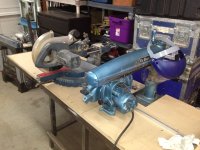
Here is a picture of the two machines side by side.

ms2.jpg

If I go to the machine on the left, hold a piece of wood against the fence with my left hand, and push the motor head through the work with my right hand, my technique is good.

But if I go to the machine on the right, hold a piece of wood against the fence with my left hand, and push the motor head through the work with my right hand, my technique is bad.

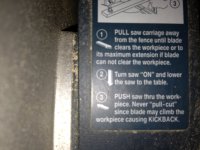
We know the instructions for radial arm saws say, always pull through the work.

The Bosch of course says just the opposite:

ms1.jpg

So the question is, why is pushing good form on the miter saw but bad form on the radial arm saw? :confused:
 
   / Metal Cutting Saw #63  
Pat, I'll give this a shot - let's assume a pretty wide board in each case, since that's where more of the differences lie.

Chop saw - You start off with the blade ABOVE the surface of the board, so initially there would be a DOWN pressure on the board along with the blade pushing INTO the fence. Once the blade has plunged thru the board at the outer edge, the force would be trying to LIFT the board at the outer edge but still PUSHING it toward the fence.

A good hold-down would help control this, but I've yet to see a saw that offers a MOVABLE hold-down that can be located at the FRONT of the cut, where the lift is more pronounced. So YOU need to be that hold-down.

Lift force doesn't seem to be so drastic that this isn't doable. Board width is limited to about 12-14 inches, even on the 12" saws - I have two chop saws, a 10" Hitachi and the 12" Dewalt slider.

Radial Saw - You adjust the blade depth BEFORE you start the cut, and there's no SAFE way to CHANGE that during the cut, because you're using BOTH hands - one to control the saw, and the other to hold the work piece.

This means that, if you PUSH cut, the blade must be all the way toward you so there's enough room to get the work piece between the fence and the blade, WITHOUT the blade in contact with ANYTHING until the cut has started.

Sooo, if you PUSH cut with the RAS, you will START with maximum UP force (with some force toward the fence), giving the work piece the most chance of being LIFTED by the blade - especially if you get impatient.

Keeping the saw BEHIND the fence keeps the blade further away when the saw is started, makes sure the piece is NEVER subjected to lifting force, instead it's ALWAYS being pushed DOWN and BACK.

In the event that you use the prescribed method and DO get impatient, the blade will try to climb the piece and "take a run at you" - I've had this happen a time or two over the years, and it has NEVER MADE IT THAT FAR - I guess if you were cutting stuff thinner than maybe 1/2 inch that it COULD happen - but normally it just stalls the saw and "wakes you up" that you were getting too impatient.

That last part is probably NOT true of the fire breathing, TRUE CONTRACTOR saws with maybe 5 horse motors - they most likely COULD overcome the resistance when the operator gets in a hurry and the saw tries to climb the work - and since contractors are pretty much ALWAYS in a hurry, I can see where some of the stigma on RAS's probably came from.

Another minor plus for the RAS - marking. IF you have the saw properly aligned, you can set the miter to zero degrees, park it behind the fence, make ONE LITTLE TIC MARK on your piece, and with your fingers NOWHERE NEAR THE POWER SWITCH, pull the saw forward til you can align one left-leaning tooth with your tic mark, then push the saw back CLEAR of the work, power on, hold the board against the fence, and pull thru the cut.

If you've done everything right and the saw is aligned properly, you should have a perfectly square cut.

Try that with a chop saw, whether fixed or slider - good luck finding the right distance from the edge of your board so you can line up the left-leaning tooth that's actually in CONTACT with the board to get away with just a tic mark. I've done it, but it's always a guess unless you're **** enough to make some sort of jig to mark your boards with. Of course, if you're just using your chop saw for framing, close enough is a lot easier than if you're doing cabinet work.

I've looked at a few lasers, and wasn't impressed. Marketers will put a laser on a DONUT if they think it'll sell more donuts.

Recently I saw a possible exception to this - DeWalt has a "shadow" type dual laser on the new 12" sliders, appears to be retrofittable to older 12" saws. Don't know much about it yet but sounds like it might eliminate the laser-blade alignment issues most of them seem to have.

There's probably more that could be said (and I'm sure it will :rolleyes: ) but this is getting long enough already... Steve
 
   / Metal Cutting Saw
  • Thread Starter
#64  
Steve, that sounds reasonable. I am sure you are right. Although this morning I was talking with my brother in law who is a builder in Finland. He says people there push their radial arm saws through the wood - he was surprised I was asking - because the kickback on pull is dangerous. he says that is just common sense. so there we are.

on marking you are absolutely right about the RAS. when I used to use it regularly, I replaced the fence often, so I could have a nice clean kerf to line up with. and repeat cuts are a piece of cake, just make a mark on the table. on miter saws I make a jig for a cabinet job but never otherwise. I make the mark on my side of the wood upper edge, with a regular sharp pencil. then as you say line up a left leaning tooth with the mark. on the middle of the mark, or left edge, or right edge, depending on fit you want.
 
   / Metal Cutting Saw #65  
The arm and motor mount on my radial arm saw were too stiff to let a blade overrun the work. There would have to be over 1.5 inch upward movement to overrun a 2x board, over .75 for a 1x board. If it grabbed, it always stalled.

Bruce
 
   / Metal Cutting Saw #66  
Having a laser on a power tool is a bloody nuisance, I've never seen one aimed at the cut. A laser on a hand gun is really cool. In daylight it is a tremendous aid to accuracy. In dark it is incredible.

A radial saw, at beginning of cut if pushed, uses up most of its travel, aside from that, the teeth lift the edge of the board. Once it lifts off the table, its about impossible to control. A sliding saw is lowered into the board the teeth push the board toward the fence. Like a chain saw, a circular saw doesn't kick until teeth stop severing wood fiber and stick in the wood. This is why big chain saws are less likely to kick than smaller saws. Extra power keeps the chain moving at speed through the wood, saws with less power can't maintain speed allowing teeth to stick to fibers. If the tooth is stuck in the wood and the chain keeps moving, an equal but opposite reaction occurs the bar is thrust up toward the operators face.
 
   / Metal Cutting Saw
  • Thread Starter
#67  
Thx all

Seems to be working fine now. Next task backhoe thumb. Willie did you write that up here?
 
   / Metal Cutting Saw #68  
When you design a thumb I can help you skip over many errors showing you how to not do it. I built one for a Case 580K with extend a hoe. I thought I would re purpose log loader components. This worked, it wasn't the easy way. Begin with a bucket pin pivot. The rest is negotiable.

Yes, what sort of thumb do you need, hydraulic or manual?
 
   / Metal Cutting Saw #69  
Steve, that sounds reasonable. I am sure you are right. Although this morning I was talking with my brother in law who is a builder in Finland. He says people there push their radial arm saws through the wood - he was surprised I was asking - because the kickback on pull is dangerous. he says that is just common sense. so there we are.

on marking you are absolutely right about the RAS. when I used to use it regularly, I replaced the fence often, so I could have a nice clean kerf to line up with. and repeat cuts are a piece of cake, just make a mark on the table. on miter saws I make a jig for a cabinet job but never otherwise. I make the mark on my side of the wood upper edge, with a regular sharp pencil. then as you say line up a left leaning tooth with the mark. on the middle of the mark, or left edge, or right edge, depending on fit you want.

Would you mind asking your brother what the instructions say about cutting procedure concerning the radial arm saw.

I find it hard to believe that another country would do something contrary to the manufacturer instructions. Unless their instructions are very different.

I also don't see a manufacturer putting out different instructions for different groups of people. Again, it is just not logical.

It is just not logical to push a RAS into the wood.

The logical answer in the pulling the saw is that the saw blade is pulling the material into the fence, and putting slight down pressure into/on the material.

You can either hold the material down or clamp the material down.

Those of you that push the blade into the wood have not convinced me that that is the correct thing to do under any circumstance.

Quote:

The proper technique is to leave the saw in the resting position as far away from your body as possible, position the stock, then pull the blade through the cut. When the cut is finished, return the saw to the original resting position and then move the stock.

I would also suggest that when cutting ferrous material, to put a magnet in the direction of the thrown chips.
 
   / Metal Cutting Saw #70  
It has been years since I used it, I cut most of a house frame of rough lumber with mine. I tried it both ways, narrow lumber 2x4, 2x6 worked acceptably pushed if I was cutting off a few inches to square a board. Wider or longer on waste side of cut it was too much a pain. Either way a stiff arm technique where the saw would have to suddenly move the mass of my body to catch helps to resist the natural tendency to grab. Cutting steel with one makes me want a suit of armor.
I have a commercial one set up with a router to make dadoes, sliding dovetails for shelving I like furniture that at least looks like it was handmade 200 years ago, yet my tool and machine addiction makes me magnetically drawn to machines like this.
 
   / Metal Cutting Saw
  • Thread Starter
#71  
Interesting this thread has a split personality - part of it adapting RAS to metal cutting, part of it proper use of RAS generally. I stopped using the tool 20 years ago in favor of other (in my view easier and safer) ways to cut wood. I got this DeWalt recently for pretty much the opposite reason. To see if it would be better for some metal cutting tasks than other alternatives. I am not sure it actually is better, but it does what I wanted it to do, and (as modified) safely. My current practice, which reflects feedback from all, is to clamp the workpiece, and draw the saw into the work in recommended RAS way. Using the lead screw to move the motor head. All suggestions for further functional and safety improvements are welcome.

So, on the last part of JJs question. I think the front-located magnet idea is a good one. The shroud I made does a pretty good job of keeping chips on the table, but anything to better manage the chips is worth trying. I am thinking of two other modifications. A rubber flap, that could stay right on the surface of the material, might help, especially in front, where JJ is suggesting a magnet could be placed. Also, I am thinking of routing a slot through the table where the blade travels, and installing a pan underneath. That might better contain the chips that travel with the blade.

Now on the first part of JJs question. You might learn more about our family than you wanted. I already asked my brother in law what the prevailing practice is, and he told me. So if I go back to him and ask for documentation suggesting he might be wrong, that will make him grumpy. Then my sister will get involved, and then we have a problem. Right now I am trying to talk them into moving back to California, so the whole thing would be a mess. That's a long way of saying why I don't want to go back to him on the radial arm saw question, but not to brush off the question.

To get some perspective on RAS practice I explored a bit. It turns out there are dozens of good threads on the woodworking sites. The points we have discussed are there, and more. I was surprised to learn so many people continue to use - and debate - a tool I personally thought was obsolete a couple decades ago.

Well now I am going to go see if I can fit a laser to my donut and get it into the coffee cup more accurately.
 
   / Metal Cutting Saw #72  
"see if I can fit a laser to my donut and get it into the coffee cup more accurately"

Good one, Pat - and here I thought you weren't paying attention... :D
 
   / Metal Cutting Saw #73  
------------- Also, I am thinking of routing a slot through the table where the blade travels, and installing a pan underneath. That might better contain the chips that travel with the blade.
------------------------------------
Do it to it! :thumbsup:

That is the way my metal cutting saw is made. It has a chip drawer under the slot. You pull it out from the back to dump the metal chips.
P4130011.JPG 14 inch DRY CUT SAW (Medium).jpg
 
   / Metal Cutting Saw #75  
Any time you are cutting metal with a circular blade of any kind, you need eye/face protection.

Harbor Freight has 7-1/4" metal cutting carbide tipped blades they sell for $20. I use them in an old Black & Decker circular saw & in a Harbor Freight 10" compound miter saw that has a piece of OSB with a 2x2 fastened on the back to allow the blade to reach through the metal. Take your time & you can get great accurate, repeatable, angled cuts. Note: Carbide tipped metal cutting blades are for mild steel & other soft metals they do not like cutting through torched & welded areas.

Soft metals like brass, copper, & aluminum have been cut with standard carbide tipped blade by contractors for years.

The only thing I use a RAS for any more is making dado cuts for shelving. You are able to have it cut a set depth & width with a single pass. Because of the volume of the bite & the shallow depth, the risk for climbing has greatly multiplied so trying to pull it into the wood is not an option. You have to push it into the wood. I can cut dado's at a 1/4 of the time it takes with a router & jig.
 

Attachments

  • Metal cutting blade.jpg
    Metal cutting blade.jpg
    56.4 KB · Views: 104
   / Metal Cutting Saw #76  
Hi -

You should be using a negative rake dado blade if you are going to use it in a radial arm saw. A positive rake blade is made for a traditional circular or table saw, not a radial arm saw. For example: Freud Tools - Super Dado Sets have a -12 degree angle on the cutting face.
 
   / Metal Cutting Saw #77  
You are correct, but even using a negative rake dado, I still greatly prefer pushing it into the wood.
 
   / Metal Cutting Saw
  • Thread Starter
#78  
Totally agree on face mask for metal cutting, picture in post #62 shows it hanging on the saw. I'm even thinking about a leather apron which will be a first for me.

Used to make dados on RAS. Agree on negative hook for radial saw. I don't remember what I was using except it came from Sears. Anyway it was just about impossible to dado by pulling vs OK pushing. Eventually I made up a European style sliding table and extended miter fence for my table saw, and used that. Never tried using RAS as a router for shelf slots, I imagine it would work well though.
 
   / Metal Cutting Saw #79  
I like the conversion to a metal cutting RAS, nice work. I had thought of doing something like this using a bridge type tile saw.

So bottom line I still use my old RAS a lot, but I sure use the other saws when they are much better for a particular purpose.

All I use my RAS for now-a-days is cutting dados. I keep a dado set mounted in there set for 3/4 plywood.
Whenever I need to cut a dado across a board within the crosscut capacity of my RAS that is what I use.
It saves me from having to mount a dado set in the TS and its faster and the cut is visible since you're
working on the top side of the board not the underside. Making half laps are also easy and fast on the RAS.
 
   / Metal Cutting Saw #80  
Lots of interesting reading in this thread...
There is still contention as to the safest method for using a radial arm saw...
I still pull the saw into the work piece and go at it slow and easy...
In my experience I leave my RAS set up square and use it only for straight cuts or dado's...
Too aggravating to set up for miters...
I think that years ago manufacturers built the RAS around the premise that it was a do-it-all saw for the homeowner...
Cross cutting, ripping, mitering, dado's, etc...could all be done on it...
With the advent of the sliding miter saw, the RAS has fell out of favor...
I still use mine but today but the sliding miter saw and table saw and more useful...

As far as metal cutting chop saws...
I purchased a harbor freight special last year and it has performed very well...
The blade is key as I have to change it out when needed...
I inherited an old Buffalo Tools metal cutting band saw from my dad that is over 30 years old...
With it and my cheapo harbor freight metal cutting saw I can take care of most anything that I need to cut...
On larger stuff I use the torch...
 

Tractor & Equipment Auctions

Tandem Axle Rear Trailer Frame (A55851)
Tandem Axle Rear...
2018 FREIGHTLINER CASCADIA TANDEM AXLE DAY CAB (A59905)
2018 FREIGHTLINER...
2020 Chevrolet Silverado 1500 Pickup Truck (A59230)
2020 Chevrolet...
2014 Kia Sedona Van (A59231)
2014 Kia Sedona...
2018 Autocar ACX Xpeditor T/A Hercules Front Loader Garbage Truck (A55852)
2018 Autocar ACX...
2019 Toyota Corolla Sedan (A55853)
2019 Toyota...
 
Top