DC amps vs AC amps

/ DC amps vs AC amps #1  

JB4310

Super Member
Joined
Feb 24, 2005
Messages
5,582
Location
Central CT
Tractor
J.D. 4310 E-hydro
First off let me say, after reading the threads in this forum, I never knew how much I never knew about welding :eek: If I ever knew what I never knew, I'd of never started!

Couple of questions,

Just wondering why on my ac/dc machine, max amps on the ac are higher than on the dc?
225 for ac and only 150 for dc, are they equivalent?? or is ac capable of welding heavier/thicker steel?

Also, just recently replaced my ground clamp, I had used a battery jumper cable clamp for all these years til the spring wore out, it had a little insulation on the handles, all the ground clamps I've seen have no insulation on them. What is the reason for no insulation on the ground? I find myself with both cables in my hands sometimes, and some times with no gloves. what's the rule, never hold both at once or never handle cables with no gloves?


What is the general consensus of a miller thunderbolt AC/DC. strictly homeowner/hobbyist or slightly better?

Couple of pics of my buzz boxes, I replaced the ac only with the ac/dc 2 years ago. I have not used ac since. Found that ac machine on the side of the road, in a pile of garbage, cobbled it back to life and it served my needs for 30 years!!!


Thanks JB.
 

Attachments

  • DSC04395.jpg
    DSC04395.jpg
    585.6 KB · Views: 2,879
  • DSCN6244.JPG
    DSCN6244.JPG
    984.2 KB · Views: 1,580
/ DC amps vs AC amps #2  
...Just wondering why on my ac/dc machine, max amps on the ac are higher than on the dc?
225 for ac and only 150 for dc, are they equivalent?? or is ac capable of welding heavier/thicker steel?...

What is the general consensus of a miller thunderbolt AC/DC. strictly homeowner/hobbyist or slightly better?

Both welders pictured are transformer based welders which means they transform your household power (lets approximately say 240 volts, 40 amp input power from your breaker panel which is AC power) to roughly (225 amps max , 75 volt open circuit voltage or about 30 volts when actual welding is happening still all in AC power though). From here to get DC power, diodes and bridge rectifiers are used inside the welder to convert the AC power to DC power. During this conversion process from AC to DC there is parasitic power loss. Kinda like how the motor in your JD 4310 has more hp at the motor flywheel, than it does hp at the rear wheels due to parasitic loss from the driveline, accessories like alternators and hydraulic pumps, and transmission parasite loss, etc.

Either of these two welders will weld thicker metal on AC than DC. If you happen to stop by a TSC that has the Hobart Stickmate AC/DC with the Hobart advertsing literature posted; it even states DC capability up to 1/4" material and for welding material over 1/4" thick then the use of AC power is recommended. (FYI the Hobart Stickmate is the same as the Miller Thunderbolt - both Miller and Hobart are owned by ITW).

That said, 100 amps on DC is stronger than 100 amps on AC all other variables being equal. The arc is going out 60 hertz on AC power just like your household lights are going out at 60 hertz even though it is hard to see this with human eye. On DC power the current is continuous in one direction and never goes out so DC is slightly more efficient. Very generally speaking, if you look at detailed weld charts for rods that are suitable for either AC or DC use: The manufacturers typically recommend a 10% to 15% higher amp setting when using an AC power source as compared to a DC power source for the same rod. (e.g. a rod that requires 100 amps on DC will probably require 110 to 115 amps on AC all other variables remaining constant of course). To aide my memory, I typically consider AC power to be the happy medium located inbetween DC Electrode Positive (70% of heat into rod and 30% of heat into work) and DC electrode Negative (30% heat into rod and 70% heat into work). No such thing as polarity on AC since AC is constantly switching back and forth on polarity at 60 hertz so in my mind that should put it roughly in the middle (50% heat into rod and 50% heat into work) - not exact science but helps me keep things somewhat in perspective.

The Miller Thunderbolt, Hobart Stickmates, and Lincoln AC/DC buzzboxes are all three considered very good and durable welders for a farm/hobby type shop. You can weld almost anything that a homebased shop would ever encounter with any of these units (excluding very thin metal under 1/16 of an inch or so which is better suited to MIG or TIG, but even thin metal can be done in a pinch with practice). You are pretty much limited to 1/8 rods or smaller on any of the 3 units on DC power, but you can easily burn bigger diameter rods up to about 3/16 or so on AC power if the need ever arises. In short, Lots of welder for very little money and they are all durable too. It is not uncommon to see welders like these 50 - 60 years old still in use when used as recommended.
 
Last edited:
/ DC amps vs AC amps
  • Thread Starter
#3  
Thanks, that explains alot.

I got pretty efficient with AC, but I do like the DC now, cleaner and quieter.

Mostly been running 7018 rod 1/8" got some Hobart rod that says it's good for dc or ac, man it is deep penetrating, but the slag is like ceramic and does not want to release. I might be running it a little to hot to help with the restrike that 7018 is known for.

JB
 
/ DC amps vs AC amps #4  
Mostly been running 7018 rod 1/8" got some Hobart rod that says it's good for dc or ac, man it is deep penetrating, but the slag is like ceramic and does not want to release

thats the weld, hanging onto it.:D

these are 5/32 and 1/8 7018 you need to let it cool at least until the colour has gone out of the slag. if the weld is smooth, the slag should just peel itself right off.:thumbsup:
 

Attachments

  • slagpeel.jpg
    slagpeel.jpg
    411.8 KB · Views: 577
  • slagpeel1.jpg
    slagpeel1.jpg
    302.2 KB · Views: 663
/ DC amps vs AC amps
  • Thread Starter
#5  
thats the weld, hanging onto it.:D

these are 5/32 and 1/8 7018 you need to let it cool at least until the colour has gone out of the slag. if the weld is smooth, the slag should just peel itself right off.:thumbsup:

The welds look pretty good, not quite as nice as yours, but the slag is not releasing except with alot of hammering and chipping. definitely getting good penetration, but not getting as much of that crowned look like in yours.

I've never gotten slag like this before, don't know if it's the brand of rod or what, but it looks like glazed tile.

7024 are known for self releasing slag, with those I get it curling up and off by itself :)

JB.
 
/ DC amps vs AC amps #7  
I've never gotten slag like this before, don't know if it's the brand of rod or what, but it looks like glazed tile.

that's normal, it's also why it's a bit harder to strike an arc with a partially burned rod... there is a layer of glass stuck to the end of the electrode. you have to break the glass off the end of the rod to close the circuit.

when the slag starts peeling itself off, then you are making some headway.:thumbsup:
 
/ DC amps vs AC amps
  • Thread Starter
#8  
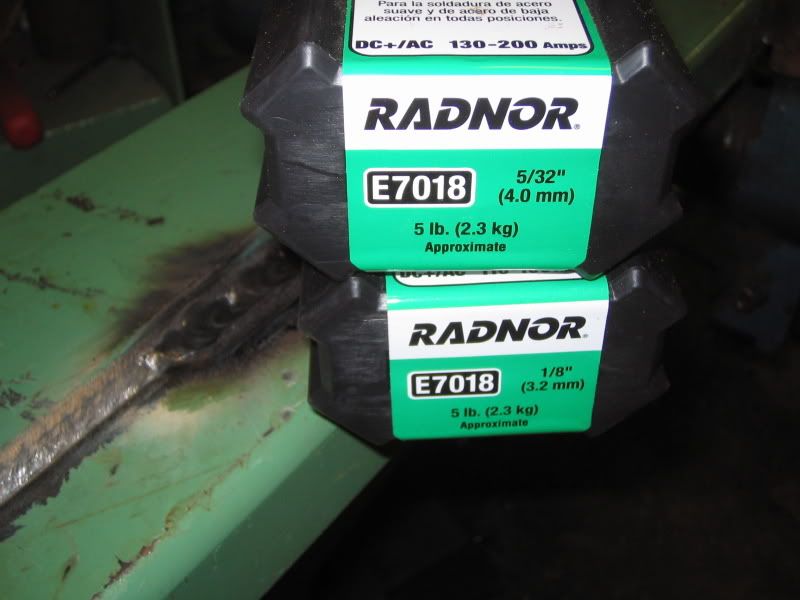
7018 slag. I think the rods were Radnor.

that's normal, it's also why it's a bit harder to strike an arc with a partially burned rod... there is a layer of glass stuck to the end of the electrode. you have to break the glass off the end of the rod to close the circuit.

when the slag starts peeling itself off, then you are making some headway.:thumbsup:


So is it more about the correct Amp setting dialed in or the experienced welding technique ?

Also I've always heard about DC only 7018, but I always see 7018's rated for both ac and dc. Is there a big difference in performance using the dc only rod ?

.
 
/ DC amps vs AC amps #9  
So is it more about the correct Amp setting dialed in or the experienced welding technique ?

experience tells you when you are too hot or cold.

the amp range is usually noted on the box 1/8 7018 max 125 amps. it's a good rule of thumb to weld as hot as you can.

Also I've always heard about DC only 7018, but I always see 7018's rated for both ac and dc. Is there a big difference in performance using the dc only rod ?

25 years, mostly construction, i've never seen a box of ac/dc rated 7018. i was always told (by pros) 'no self-respecting welder uses alternating current'.

i guess there are some exceptions, like hi frequency a/c for aluminum tig, but you never see a/c stick in industrial construction or fabrication. if you can't beat the arc blow on things like structural steel, they will get somebody else who can.
 

Attachments

  • slagpeel2.jpg
    slagpeel2.jpg
    328.1 KB · Views: 656
/ DC amps vs AC amps
  • Thread Starter
#10  
experience tells you when you are too hot or cold.

the amp range is usually noted on the box 1/8 7018 max 125 amps. it's a good rule of thumb to weld as hot as you can.

25 years, mostly construction, I've never seen a box of ac/dc rated 7018. i was always told (by pros) 'no self-respecting welder uses alternating current'.


All I see is the ac/dc 7018 in the home centers, even TSC. have to ask at the weld supply shop.

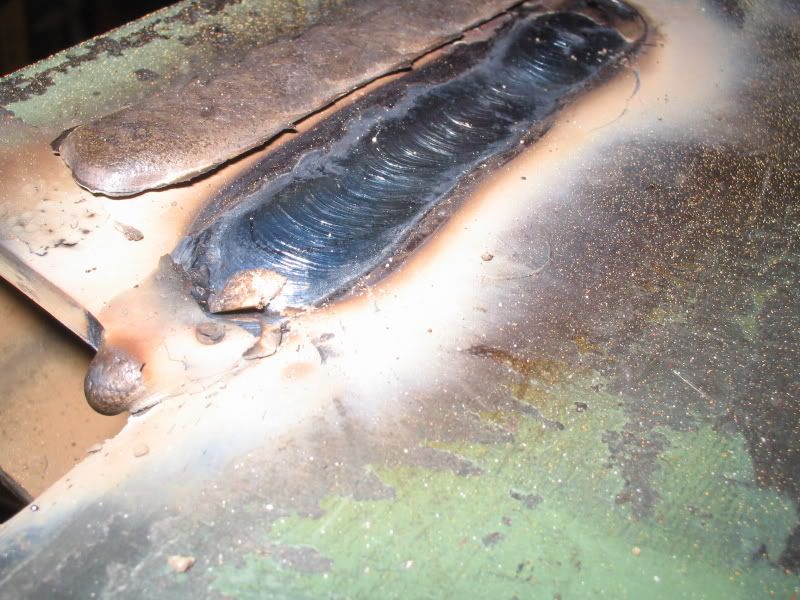
What rod, amp setting and thickness of steel are shown in your picture here? Looks like what I am typically working with, around 1/4 inch material.


Anyone wish to comment on the bare ground clamp, and standard protocol for handling welding leads ?

Also on my machine is a warning about electrocution hazard using AC. Why is there greater electrical shock hazard on AC ? I thought it was amps that kill.
JB
 
/ DC amps vs AC amps #11  
What rod, amp setting and thickness of steel are shown in your picture here?

that is 1/4x2x2 angle welded to 1/2x3x3 angle welded to 3x3x.188 hss.

welded fairly hot.

how about some pictures of the welds you are having trouble cleaning?
 
/ DC amps vs AC amps
  • Thread Starter
#12  
how about some pictures of the welds you are having trouble cleaning?


Well today it was totally different, turned the amps down a little, and the slag was almost coming off by itself. I was custom making square tubing to the size I wanted. Ripped some 4x4 length wise and spliced 2 pcs together to get 4x5.5" for storage boxes on my QH.

Took some pictures, not very flattering I know, but I knew I had to grind it flush, the finished product came out ok. when I was welding the box to the QH, both members corners are rounded, so the weld is down in a little bit of a hole. With those welds, the slag would not release again. didn't get any close up pics though, but you can see what I'm talking about in the finished product pic.

JB.
 

Attachments

  • DSC04422.jpg
    DSC04422.jpg
    471.4 KB · Views: 293
  • DSC04414.jpg
    DSC04414.jpg
    426.9 KB · Views: 236
  • DSC04420.jpg
    DSC04420.jpg
    640.9 KB · Views: 261
  • DSC04418.jpg
    DSC04418.jpg
    541.2 KB · Views: 254
/ DC amps vs AC amps #13  
My pic was 5/32 7018AC. It's all they had at National Welders. I don't remember the amps but it was on the high side using a DC inverter.

Your project turned out nice. It looks like you are over-manipulating the rod. Try just dragging the flux against the workpiece very slowly in a straight line, almost letting it lay there and welding at the rate it is consumed. With 7018 the puddle will spread by itself. If you leave cavities or porosity the slag might stick hard. With 7018 I get cavities if I go too fast, too cold, too much weaving. Porosity if I stick it and the flux flakes off. Too hot, too slow it might look like this.
 
/ DC amps vs AC amps #14  
when I was welding the box to the QH, both members corners are rounded, so the weld is down in a little bit of a hole. With those welds, the slag would not release again. didn't get any close up pics though, but you can see what I'm talking about in the finished product pic.

that's a common occurrence in that sort of joint, especially if you have undercut along one or both sides. i wouldn't worry about it falling off though.:)

every welder has their own ideas. some overlap, some don't. we generally seem to get the job done though.

one observation i have made over the years is that people will let the puddle chase them around (literally). experienced welders understand that it is vitally important to take immediate control of the puddle. inconsistent beads are often a sign that the puddle is chasing the welder... the welder doesn't understand how to control the puddle, so he/she runs away from it.

there is at least one demon that every welder has to face.;)
 
/ DC amps vs AC amps
  • Thread Starter
#15  
Your project turned out nice. It looks like you are over-manipulating the rod. Try just dragging the flux against the workpiece very slowly in a straight line, almost letting it lay there and welding at the rate it is consumed. With 7018 the puddle will spread by itself.

Thanks,
I have to remember that, I know I heard 7018 was a drag rod but yeah I guess i'm not practicing that.


that's a common occurrence in that sort of joint, especially if you have undercut along one or both sides. i wouldn't worry about it falling off though.:)

every welder has their own ideas. some overlap, some don't. we generally seem to get the job done though.

one observation i have made over the years is that people will let the puddle chase them around (literally). experienced welders understand that it is vitally important to take immediate control of the puddle. inconsistent beads are often a sign that the puddle is chasing the welder... the welder doesn't understand how to control the puddle, so he/she runs away from it.

there is at least one demon that every welder has to face.;)

That one problem I have, I can't always see the puddle that well. I hear everyone talking about watching the puddle. Maybe the way I'm holding the rod, which is all over the place, or maybe my shield is to dark. I have an auto dark helmet now, I think it's set to mid settings.

Another problem I have is so basic, I have trouble holding steady, especially on longer welds, some times I catch myself holding my breath, not holding the rod close enough etc etc.

Then sometimes a demon takes over me and I get a weld that surprises me :laughing:

Pics of some decent looking beads on 1" and 1/2" thick snowplow parts and 3/4" 3pt lift arms. Don't remember what rod was used, but often if I could use 7024 I would. lately 7018 has been the rod of choice, if I can get better with it, it would probably be all I would ever need.

JB.
 

Attachments

  • DSCN6802.JPG
    DSCN6802.JPG
    886.1 KB · Views: 190
  • DSCN6797.JPG
    DSCN6797.JPG
    888.1 KB · Views: 201
  • DSCN6788.JPG
    DSCN6788.JPG
    993.1 KB · Views: 207
  • DSCN6782.JPG
    DSCN6782.JPG
    975.1 KB · Views: 234
  • DSCN5886.JPG
    DSCN5886.JPG
    984.8 KB · Views: 204
  • DSCN5891.JPG
    DSCN5891.JPG
    964.3 KB · Views: 220
Last edited:
/ DC amps vs AC amps #16  
To each his own, but I never just drag 7018.
 

Attachments

  • Overhead weld.jpg
    Overhead weld.jpg
    35.6 KB · Views: 403
/ DC amps vs AC amps #17  
Thanks,
I have to remember that, I know I heard 7018 was a drag rod but yeah I guess i'm not practicing that.


That one problem I have, I can't always see the puddle that well. I hear everyone talking about watching the puddle. Maybe the way I'm holding the rod, which is all over the place, or maybe my shield is to dark. I have an auto dark helmet now, I think it's set to mid settings.

Another problem I have is so basic, I have trouble holding steady, especially on longer welds, some times I catch myself holding my breath, not holding the rod close enough etc etc.

Then sometimes a demon takes over me and I get a weld that surprises me :laughing:

Pics of some decent looking beads on 1" and 1/2" thick snowplow parts and 3/4" 3pt lift arms. Don't remember what rod was used, but often if I could use 7024 I would. lately 7018 has been the rod of choice, if I can get better with it, it would probably be all I would ever need.

JB.

I weld two-handed--that really helps controlling the rod.
I use a Hobart Stickmate AC/DC welder. DC+ for 1/8" 7018 rod. Set the amps according to material thickness. Tap the rod on the side of my weld table to remove the flux on the tip of a new rod. Then start the bead. Drag the rod SLOWLY and watch the edges of the puddle to be sure you're getting good tie-in. The flux pops off with light taps from the hammer.
 
/ DC amps vs AC amps #18  
That one problem I have, I can't always see the puddle that well.

i don't know what your vision is like, but maybe try a set of reading glasses, or a cheater lense in your hood. if you can't see, you can't weld. :)
 
/ DC amps vs AC amps
  • Thread Starter
#19  
I weld two-handed--that really helps controlling the rod.
I use a Hobart Stickmate AC/DC welder. DC+ for 1/8" 7018 rod. Set the amps according to material thickness. Tap the rod on the side of my weld table to remove the flux on the tip of a new rod. Then start the bead. Drag the rod SLOWLY and watch the edges of the puddle to be sure you're getting good tie-in. The flux pops off with light taps from the hammer.

I use to weld one handed, but after seeing pictures of welders in the catalogs, all using both hands, I realised if they use 2 hands I should too, definitely helps.

i don't know what your vision is like, but maybe try a set of reading glasses, or a cheater lense in your hood. if you can't see, you can't weld. :)

I do wear glasses, but I can see good enough, it's more like I can't see through the arc, probably has to do with the way I hold the stick.

Just now thinking about it, Probably also has to do with my AC upbringing and the shower of sparks/spatter, kinda like spray and pray. Never really trained myself to focus on the weld puddle.

JB
 
/ DC amps vs AC amps #20  
This may help you.
 

Attachments

  • Lens Shade Selection.jpg
    Lens Shade Selection.jpg
    232 KB · Views: 244
  • Lens Shade Selection 2.jpg
    Lens Shade Selection 2.jpg
    196 KB · Views: 210

Marketplace Items

John Deere 4040 Tractor (A64047)
John Deere 4040...
2025 Unused SDLGC80 60v Electric Golf Cart (A64194)
2025 Unused...
2014 Nissan Frontier Ext Cab Pickup Truck (A61573)
2014 Nissan...
YALE VERACITOR 50VX STRAIGHT MAST FORKLIFT (A63276)
YALE VERACITOR...
IRET13 Tricycle (A64047)
IRET13 Tricycle...
2007 INTERNATIONAL 7400 SBA 4X2 VACUUM TRUCK (A63276)
2007 INTERNATIONAL...
 
Top