Generator Electrical Engineering Question

   / Electrical Engineering Question #21  
I had a spun bearing in the front wheel hub of a car once, and peening the hub left it pretty loose. I went to a machine shop and they used "shim stock" to fill in around the loose bearing. It was a roll of paper thin material, I think brass, and tightned the bearing up really well. It think it comes in different thickness. It was not the greatest fix in the world, but it was a restored show car and didn't get driven a lot. For a generator that doesn't get used a lot, it may fix your bearing problem.

 
   / Electrical Engineering Question #22  
I am confused, on a 120 / 240 v system shouldn稚 each phase be 120 degrees out, not 180 degrees?

E/S
 
   / Electrical Engineering Question
  • Thread Starter
#23  
Meant to say .020" slop-my error. The end bell has a steel sleeve in it now. Sounds like the best idea at this point.
 
   / Electrical Engineering Question #24  
I am confused, on a 120 / 240 v system shouldn稚 each phase be 120 degrees out, not 180 degrees?

E/S

Should be 180 degrees. For a 3 phase system it is 120 degrees.

127 to 129 is not a real high voltage. By the time you run some wire between it and the load you will loose some voltage. I have not heard, does this unit has a voltage regulator? Is it adjustable?

My generator runs at 62 hertz when unloaded and drops down as you load. Of course if you run yours at higher hertz (and it has no regulator) it will put out even more voltage.
 
   / Electrical Engineering Question #25  
If it is 180 degrees, tell me how that is possible?
On normal electrical service 120 v. is 1 leg of the 3 phase line, 240 v. is 2 legs of the 3 phases and then you have 240 v. 3 phases with all 3 legs.
I see no conceivable way you could change the phasing, short of some kind of equipment not normally used in electrical services.


E/S
 
   / Electrical Engineering Question #26  
If it is 180 degrees, tell me how that is possible?
On normal electrical service 120 v. is 1 leg of the 3 phase line, 240 v. is 2 legs of the 3 phases and then you have 240 v. 3 phases with all 3 legs.


E/S

Because that is incorrect.

I dont understand exactally how it all works either, but 3-phase power lines running down the road have the 3 main wires (each phase) and then the ground. If you have 3 phase service, it requires 3 transformers.

Out here in the rural sticks, we only have single phase power. 1 Hot wire, and then the ground (neutral). I only have those two wires comming to my house, and I only have 1 transformer, but still have 240v and not the 120 as you suggest anly 1 phase would be.
 
   / Electrical Engineering Question #27  
Sychronizing the phases is important in that if you are indeed adding the phases together to get 240, each phase must be 120 volts, and at the correct timing and polarity. a phase is determined by the timing of the magnetic field. If you think of two identical roller coasters moving in tandem, their combined height at the top in that instant of time is the total of their respective heights. If one has already gone past top in that moment in time, the combined height(voltage) is less. If they are 180 degrees apart, and have the same polarity, they will cancel each other out. I would think they are 180 degrees apart, and opposite polarity. I'm no generator tech, but I do have quite a bit of theory in my education. I would think generator sine waves are dirty, and most modern circuits should invert them, and then generate their own clean sine wave, like a windmill would. A tech will have the solution.
 
   / Electrical Engineering Question #28  
If it is 180 degrees, tell me how that is possible?
On normal electrical service 120 v. is 1 leg of the 3 phase line, 240 v. is 2 legs of the 3 phases and then you have 240 v. 3 phases with all 3 legs.
I see no conceivable way you could change the phasing, short of some kind of equipment not normally used in electrical services.


E/S

If the two generators are in phase (0 degrees) then the voltages track each other. i.e. they are both positive at the same time and both negative at the times time. If you put these generators in series and they are at 0 degrees then the voltage between the two will read zero since they are at the same volts. This is like taking two D cell batteries and put the negatives together. If they are both new, then you will read very close to zero volts between the two positive terminals. What you want is 180 degrees out of phase. So when one is negative then the other is positive. This way the voltages add and you get 240 volts between the two hot legs of the generator. This is like two D cell batteries with the negative of one connected to the positive of the other. The unconnected terminals will have about 3 volts between them.

I hope this helps. Drawings would be better.
 
   / Electrical Engineering Question
  • Thread Starter
#29  
BobRip-This unit has what I think are voltage regulators that are sealed (no adjustment that I can see).

Going tomorrow to Warrenton, VA, looking to find a machine shop to replace the bearing sleave.
 
   / Electrical Engineering Question #30  
BobRip-This unit has what I think are voltage regulators that are sealed (no adjustment that I can see).

Going tomorrow to Warrenton, VA, looking to find a machine shop to replace the bearing sleave.

Can you talk to the manufacture? Sometimes things that are sealed don't have to stay that way, but I bet they are alright.

If the voltage on each generator is 1/2 of the total voltage then you have it set up right.
 
   / Electrical Engineering Question
  • Thread Starter
#31  
BobRip-"If the two generators are in phase (0 degrees) then the voltages track each other. i.e. they are both positive at the same time and both negative at the times time. If you put these generators in series and they are at 0 degrees then the voltage between the two will read zero since they are at the same volts. This is like taking two D cell batteries and put the negatives together. If they are both new, then you will read very close to zero volts between the two positive terminals. What you want is 180 degrees out of phase. So when one is negative then the other is positive. This way the voltages add and you get 240 volts between the two hot legs of the generator. This is like two D cell batteries with the negative of one connected to the positive of the other. The unconnected terminals will have about 3 volts between them."

My thoughts exactly. That is why I was concerned about the armatures being "right on" each other. They are either 180 degrees from each other or 0 degrees at this point. When it was running yesterday, it was producing the high voltages under a 5000 watt load at 60 Cycles. I think I need to assume that they are at 180 degrees since they were generating power for the 250 volt load. Otherwise they would not support the load. When I get the bearings right, I plan to have the unit "scoped" to verify the sine wave. I stopped at the 5000 watt load as my old 2n would not carry the next 5000 watt load bank. I have an old heat pump indoor unit with three switchable 5000 watt heating coils and fan used for load testing and emergency heat if needed.
David
 
   / Electrical Engineering Question #32  
If your two waveforms are not in phase, your voltage and power will suffer. I would talk to a generac tech and get their input.

I Think this is about right and good advice too.

Rob
 
   / Electrical Engineering Question #33  
Because that is incorrect.

I dont understand exactally how it all works either, but 3-phase power lines running down the road have the 3 main wires (each phase) and then the ground. If you have 3 phase service, it requires 3 transformers.

Out here in the rural sticks, we only have single phase power. 1 Hot wire, and then the ground (neutral). I only have those two wires comming to my house, and I only have 1 transformer, but still have 240v and not the 120 as you suggest anly 1 phase would be.

True, a single phase transformer is feeding your home. 240 volts with a center grounding tap, That gives you 120v either side of the ground and 240v across the lines.
 
   / Electrical Engineering Question #34  
True, a single phase transformer is feeding your home. 240 volts with a center grounding tap, That gives you 120v either side of the ground and 240v across the lines.

Yep, and if the 'neutral' has a loose connection or intermittent connection, each leg of that two leg (120VAC) voltage will increase above neutral as the other will decrease proportionately.
 
   / Electrical Engineering Question #35  
Basic alternating current 101.

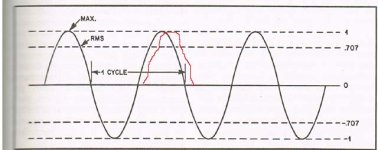
the generators produces a wave that goes positive and negative at 60cycles per second. The peak voltage is higher than the RMS voltage. Useful voltage is measured as .707 of peak this is RMS and where you would normally have your 120v.

If the two generator heads are out of phase by just a few degrees this will cause the period of peak voltage to last longer and thus the RMS will also increase. I ain't a whiz at drawing but in my picture the second generator is the red line and you can see how the peak voltage would last longer and thus cause the RMS to be higher. In three phase current the three peaks would be spaced exactly 120 degrees apart and thus cause the RMS to be considerably higher. You have the two heads slightly out of phase. Believe it or not if they were not geared together but running via separate engines the would synchronize their self.
 

Attachments

  • rms2.jpg
    rms2.jpg
    36 KB · Views: 129
   / Electrical Engineering Question #36  
Just thought of something else-We have a 1500 watt ups for the computer, router, and satellite equipment. The last January's power outage, the ups did not like the power from the generator and would not switch over. Had not had an extended power outage before and didn't notice that. We have extended capacity batteries and they last a day or two.
In checking the 60 cps, my meter is reading a solid 60 cps on utility power. I can run the meter all around and zero in at 60 cps easily with the rpm adjustment, so I think the meter is close enough.

We have all kinds of UPS at work [90 at my last count, 50 more to find], 120, 120/240 volt, single phase 600 va to 6,000 va, 3 phase 120/208/240 volt, 10,000 to 250,000 va with 208, 240, 480 volt 3 phase input from the utility; with 2,000+ Hp generators and all are sensitive to ground and neutral miswriting. Gas engines are the worse with spark noise confusing the UPS.:confused2:
 
   / Electrical Engineering Question #37  
Basic alternating current 101.

the generators produces a wave that goes positive and negative at 60cycles per second. The peak voltage is higher than the RMS voltage. Useful voltage is measured as .707 of peak this is RMS and where you would normally have your 120v.

If the two generator heads are out of phase by just a few degrees this will cause the period of peak voltage to last longer and thus the RMS will also increase. I ain't a whiz at drawing but in my picture the second generator is the red line and you can see how the peak voltage would last longer and thus cause the RMS to be higher. In three phase current the three peaks would be spaced exactly 120 degrees apart and thus cause the RMS to be considerably higher. You have the two heads slightly out of phase. Believe it or not if they were not geared together but running via separate engines the would synchronize their self.


Not arguing, just interested in this last sentence, I know that the small Honda gensets such as the 2000 and 3000 inverter units tie the outputs together when you chain them together. Always thought that odd is this the same priciple?
 
   / Electrical Engineering Question #38  
Because that is incorrect.

I dont understand exactally how it all works either, but 3-phase power lines running down the road have the 3 main wires (each phase) and then the ground. If you have 3 phase service, it requires 3 transformers.

Out here in the rural sticks, we only have single phase power. 1 Hot wire, and then the ground (neutral). I only have those two wires comming to my house, and I only have 1 transformer, but still have 240v and not the 120 as you suggest anly 1 phase would be.

You don't have to have 3 transformers to have a 3 phase service, 2 transformers can be banked together and wired Delta on the secondary side to give you 120/240 out of the lighting pot and 208 out of the power pot, these are used often for smaller 3 phase load such as jiffy stores or mini marts, these delta wired banks also allow you to feed a single phase customer off of them as well.:D
 
   / Electrical Engineering Question #39  
No, the peak would not last longer. Across a common load, the voltages would add vectorially. This is why I brought up the 208 volt 3 phase comment as an example.


In parallel, yes. In series, no. Diesel generators that are put on-line for additional increases in power are often done this way. However, you had better make sure that they are almost in phase when they are combined.


We use to use KVAR meters for the very purpose of bringing motors on line. The older drilling rigs used EMD (train engines) and 1.5 megawatt generators and were kind of scary to add on line, had to catch the dial pointers at 12 o'clock and slam those 2500 amp breakers on by hand.
 
   / Electrical Engineering Question #40  
Sir
I have been reading the comments about the generator. I would let this one pass into history. My concern is if it is tied to a residence how good is the voltage regulation going to be. Fuel consumpation from a tractor is going to be high for the load. There would be no savings if you blew out our frig , furnace ,etc. I posted an article about Vehicle mounted generators and this could be used in that way to supply cord connected devices at 120 VAC.
Craig Clayton


Tractor & Equipment Auctions

2014 INTERNATIONAL PROSTAR+ (A58214)
2014 INTERNATIONAL...
2019 GALYEAN EQUIPMENT CO. 150BBL STEEL (A58214)
2019 GALYEAN...
2018 KOMATSU WA200-8 WHEEL LOADER (A60429)
2018 KOMATSU...
500 BBL FRAC TANK (A58214)
500 BBL FRAC TANK...
2015 Forest River Rockwood Freedom S/A Pop Up Trailer (A59231)
2015 Forest River...
UNKNOWN 500BBL WHEELED FRAC TANK (A58214)
UNKNOWN 500BBL...
 
Top