Monitoring water depth in a well?

/ Monitoring water depth in a well? #21  
if it were me, I'd contact whatever State/Federal agency that monitors groundwater in your state/area... talk to them about your concerns. Static water levels can change drastically in karst (limestone) aquifers. Determine what type aquifer your well is completed in.
In Texas, the Texas Water Development Board, does this .. they have water level monitoring wells scattered across the state and normally these wells are measured once each year.. additionally, they have automatic water level recorders that monitor the water levels year-round.
These folks can help you and if you insist on monitoring your water well, they can suggest vendors that you may talk to. Good luck..
 
/ Monitoring water depth in a well? #22  
If you are worrying about the pump running dry you might measure the current draw of the pump and trip it if it is lower that the set point. When running dry the current will be much less than during normal operation.
 
/ Monitoring water depth in a well? #23  
If running the pump dry is a concern there are controls you can add that will prevent this. Google pumptech. It's an option.
 
/ Monitoring water depth in a well? #24  
If running the pump dry is a concern there are controls you can add that will prevent this. Google pumptech. It's an option.

This may be the simplest option.:D

Added to the reservoir level the local draw down cone of the well may have to be taken into account.:D
 
/ Monitoring water depth in a well? #26  
I just don't see why you would need to know the length of tube for the bubbler option. It doesn't matter if the tube is a mile long or if it is perfectly vertical, the pressure of the water at the outlet of the bubbler will tell you exactly how much water is above the outlet. Attach the outlet to the pump and you can easily check the water depth above the pump. You can use a tire pump if you want.

The only reasons I can see fo rnot setting the pump near the bottom of the well casing are: to save materials cost for the extra drop pipe and wire, make it easier to remove the pump, and to prevent sucking mud up from the bottom of the casing.

I would tend to always set it as low as possible for the sake of water storage in the casing.
 
/ Monitoring water depth in a well? #27  
I just don't see why you would need to know the length of tube for the bubbler option. It doesn't matter if the tube is a mile long or if it is perfectly vertical, the pressure of the water at the outlet of the bubbler will tell you exactly how much water is above the outlet. Attach the outlet to the pump and you can easily check the water depth above the pump. You can use a tire pump if you want.

The only reasons I can see fo rnot setting the pump near the bottom of the well casing are: to save materials cost for the extra drop pipe and wire, make it easier to remove the pump, and to prevent sucking mud up from the bottom of the casing.

I would tend to always set it as low as possible for the sake of water storage in the casing.


I agree with highbeam on all the points.
The only concern is to have the tube in the water length dosen't matter because with no flow no friction loss no pressure reduction.

tom
 
/ Monitoring water depth in a well? #29  
I beg to differ

try this link

Level sensor - Wikipedia, the free encyclopedia


Quote from the link

Air bubbler

An air bubbler system uses a tube with an opening below the surface of the liquid level. A fixed flow of air is passed through the tube. Pressure in the tube is proportional to the depth (and density) of the liquid over the outlet of the tube.
Air bubbler systems contain no moving parts, making them suitable for measuring the level of sewage, drainage water, sewage sludge, night soil, or water with large quantities of suspended solids. The only part of the sensor that contacts the liquid is a bubble tube which is chemically compatible with the material whose level is to be measured. Since the point of measurement has no electrical components, the technique is a good choice for classified æ»´azardous Areas? The control portion of the system can be located safely away, with the pneumatic plumbing isolating the hazardous from the safe area.
Air bubbler systems are a good choice for open tanks at atmospheric pressure and can be built so that high-pressure air is routed through a bypass valve to dislodge solids that may clog the bubble tube. The technique is inherently 都elf-cleaning? It is highly recommended for liquid level measurement applications where ultrasonic, float or microwave techniques have proved undependable.
 
/ Monitoring water depth in a well? #30  
It's okay to disagree... I have spent most of my adult life measuring water levels in wells, and believe me, if there was an easier way to do it, I'd have known about it. Again, I don't have a dog in this fight and have only been offering my assistance.
 
/ Monitoring water depth in a well? #31  
We appreciate your well experience. That doesn't change the physics though. I think the confusion comes from the OP wanting to know the amount of water above the pump intake. That can be done without knowing the length of the bubbler tube. If you want to know the depth from a surface reference point to the pump then you would need to use the bubbler tube as a measuring tape also. If you measured the tube length you could know the distance from the surface to the water level and from the water level to the pump.

I am not concerned with anything but the amount of water in the casing above my pump so I do not need to know the length of the bubbler tube.

If you wanted to get fancy, you could actually run this bubbler tube to the home and mount the gauge there. Pump air into the tube until the pressure stops rising and then calc the water column height above the pump.
 
/ Monitoring water depth in a well?
  • Thread Starter
#32  
Here are some of the specifics for our well.

It is located 25 feet from the bottom of a pit-run hillside. The ground is as follows. 6" of peat over 25 ft of glacial silt. Beneath that is blue clay. As we drilled we hit 3 or 4 thin layers of sand, some dry and some with low volumes of water. If I remember correctly, all of these were within 100 feet of the surface. After that we drilled through over 200 feet of straight blue clay. At the end of the second or third day they quit at 340 feet of depth and it looked like they were starting to get into sandstone with a little bit of water. From what they told me, experiance in our area left them with little hope of good water. When they returned the next morning, they were suprised to find the water in the shaft was 13 feet below ground level. Since they couldn't reach me, they pushed another 20 feet of pipe to see what they would find. A foot or two past where they had stopped for the night they hit a sand/gravel pocket about 10 feet thick full of water. We set a 3 foot tail shaft into the clay below the gravel pocket with 10 feet of screen on top of the tail shaft and pulled the pipe back to expose the screen.

My pump puts out an unrestricted flow of 40 GPM (measured by timing the filling of a 5 gallon bucket). They conducted a draw down test with the pump for one hour and never got the water more than 100 feet from the surface. They left the pump hanging at 150 feet since that left a 50 foot buffer at full flow. I've never had an issue with running out of water, but I know others who have. With the depth of my well, and since my contractor checked and there are no other wells in my area anywhere near this depth (all are around 50 feet) we really have no idea where this aquafer comes from or what its charateristics are. I probably will never have a problem, but I figure that it never hurts to have a means of monitoring it since I have no way to reference it to other wells.
 
/ Monitoring water depth in a well? #33  
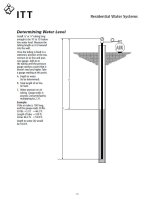
Here is a diagram I found from Goulds.

14
Install 1⁄8" or ¼" tubing long enough to be 10' to 15' below low water level. Measure the tubing length as it is lowered into the well.
Once the tubing is fixed in a stationary position at the top,
connect an air line and pressure gauge. Add air to the tubing until the pressure gauge reaches a point that it doesn't read any higher. Take
a gauge reading at this point.

A. Depth to water
(to be determined).
B. Total length of air line
(in feet).
C. Water pressure on air
tubing.

Gauge reads in pounds. Convert to feet by multiplying by 2.31.
Example:
If the air tube is 100' long, and the gauge reads 20 lbs.
20 lbs. x 2.31 = 46.2 ft.
Length of tube = 100 ft.
minus 46.2 ft. = 53.8 ft.
Depth to water (A) would be 53.8 ft.
C
A
B
 

Attachments

  • Water Level ITT.JPG
    Water Level ITT.JPG
    45.9 KB · Views: 137
/ Monitoring water depth in a well? #34  
Since the device can generate relatively large force it could be connected to large arrow visible from distance or operate switches etc.

The way to reliably and inexpensively turn this into an IP signal is to aim a web camera at it.

The web camera aimed at a pressure gauge would also let you monitor depth using a bubbler system.
 
/ Monitoring water depth in a well? #35  
I think they meant I to P, which is an I&E term.

Since the device can generate relatively large force it could be connected to large arrow visible from distance or operate switches etc.

The way to reliably and inexpensively turn this into an IP signal is to aim a web camera at it.

The web camera aimed at a pressure gauge would also let you monitor depth using a bubbler system.
 
/ Monitoring water depth in a well? #36  
I think it would be an PI pressure to milliamp current transmitter spaned to the range of the well lowest psi = 4 ma highest psi 20 ma.

I work with that type hardware at work.
you would need transmitter power supply and meter

tom
 
/ Monitoring water depth in a well? #37  
I think they meant I to P, which is an I&E term.

I think it would be an PI pressure to milliamp current transmitter...


Go back & read the original post. He wants a signal that can be monitored remotely, over the internet. He already has a LAN (Local Area Network) connection.

The problem with anything fancy is the cost.
 
/ Monitoring water depth in a well?
  • Thread Starter
#38  
I think they meant I to P, which is an I&E term.

I think it would be an PI pressure to milliamp current transmitter...


Go back & read the original post. He wants a signal that can be monitored remotely, over the internet. He already has a LAN (Local Area Network) connection.

The problem with anything fancy is the cost.

That's for sure. My biggest problem is my champaigne taste and ice water budget. Even beer seams expensive these days. I like the idea of the camera, as I already have several spares and that portion would be easy. Idealy, it would be a monitoring system similar to home weather stations such as this: WeatherHawk weather station buyer's guide which can be displayed live or in graph form over time and accessed remotely.
 

Marketplace Items

3pt 4' Disc Harrow (A64119)
3pt 4' Disc Harrow...
2014 VOLVO A40G WATER TRUCK (A62129)
2014 VOLVO A40G...
2008 Genie AWP-30 Single Manlift (A61572)
2008 Genie AWP-30...
Trailmobile Van Trailer (A63689)
Trailmobile Van...
New Holland TC21 (A62177)
New Holland TC21...
KUBOTA RTV900 ULTILITY CART (A64276)
KUBOTA RTV900...
 
Top