Quick easy electrical question

/ Quick easy electrical question #1  

JB4310

Super Member
Joined
Feb 24, 2005
Messages
5,582
Location
Central CT
Tractor
J.D. 4310 E-hydro
I think...

I found 2 aux 12 volt truck lights in a dumpster, they don't look like much from the outside, just a plastic housing, but inside they looked pretty nice with twin bulb assemblies in a ceramic inner housing.

Water got in there and messed up the connectors. Fixed that and want to (did) mount one to my canopy to help with night vision when snow plow is raised and blocks headlights.

They are twin 55 watt bulbs, beautiful bright wide pattern way better than the front or rear lights that came with the machine.

Question is how many amp fuse do I need for them?
I figured 110 watts divided by 12 volts comes to 9.2 amps.
I've got a 10 amp circuit available, but it was close enough I figured I better ask.

Is this formula correct? I think it's Ohm's law but not sure if it works the same for dc as ac.

Thanks, JB.

 

Attachments

  • DSCN6187.JPG
    DSCN6187.JPG
    741.7 KB · Views: 147
/ Quick easy electrical question #2  
Your formula is correct. Also given that you're probably running at higher than 12V, you'd be at a lower amperage yet. If you really want to know, you can hook up an amp meter to a single light and see what its "actual" draw will be.

-r-
 
/ Quick easy electrical question
  • Thread Starter
#4  
Thanks Rus geek,

I have a multi tester and should start using it for more than just volts and continuity. Does it matter what side of the circuit you test between (+or-).

I had a beautiful professional Fluke brand tester for 1 day last month, the guy from the power company left it at my house when checking for a voltage loss on my UG service, I wasn't gonna call them to tell them they left it since all you get is automated answering system, but when the same guy came 2 days later to follow up on the problem I felt guilty and gave it back to him. then he tells me I embarrassed him in front of another worker, cause he forgot something. Should of just kept it, it was nice with long leads, back lit display, "rush in" feature, and of course the fluke jaws. ~$200. tester.


Thanks Redneck,
Going by that chart 18 gauge wire should be fine, was wondering that also.


JB.
 
/ Quick easy electrical question #5  
You did right by giving the meter back. Glad you got your answers
 
/ Quick easy electrical question #6  
Your formula is correct. Also given that you're probably running at higher than 12V, you'd be at a lower amperage yet. If you really want to know, you can hook up an amp meter to a single light and see what its "actual" draw will be.

-r-

Higher voltage will result in increased current and higher wattage. That's why lights get brighter when revving the engine.
 
/ Quick easy electrical question
  • Thread Starter
#7  
Higher voltage will result in increased current and higher wattage. That's why lights get brighter when revving the engine.


I know the lights get brighter but what about the Ohm's law?

110 watts divided by 12 volts = 9.16 amps

110 watts divided by 13.5 volts = 8.14 amps

If this is what Rus Geek is getting at, makes sense.

But your point makes sense to me to, seems brighter light would mean more amps???

now I'm confused :(
JB.
 
/ Quick easy electrical question #8  
Way back in my my college years, I remember an electrical engineer telling me that a circuit should be sized for about twice the expected current draw.

If you expect 8-9 amps draw, you should size wires and fuse for 20 A.

This has worked well for me for 45 years.
 
/ Quick easy electrical question #9  
I know the lights get brighter but what about the Ohm's law?

110 watts divided by 12 volts = 9.16 amps

110 watts divided by 13.5 volts = 8.14 amps

If this is what Rus Geek is getting at, makes sense.

But your point makes sense to me to, seems brighter light would mean more amps???

now I'm confused :(
JB.

You are leaving out one very important component of Ohm's Law - resistance. Let's just say for easy numbers you have a 60 watt bulb (rated 60 watts at 12 volts) The bulb would draw 5 amps AT 12 volts. It's resistance would equal the voltage divided by the current (12/5) or 2.4 ohms. For our discussion lets say that doesn't change (it doesn't change much). At 14 volts the current draw would be 14/2.4 or 5.83 amps. The wattage of the bulb would then be 14*5.83 or 81.6 watts.

In reality I believe auto bulbs are rated (wattage) at 13.6 volts. The formulas don't change just the numbers.
 
/ Quick easy electrical question #10  
Nice job ctgoldwing! It's easy to overlook the obvious.

Dave, I would oversize the fuse to probably 15 amps instead of 20, but 20 is fine if the wire can handle it.
 
/ Quick easy electrical question #11  
I know the lights get brighter but what about the Ohm's law?

110 watts divided by 12 volts = 9.16 amps

110 watts divided by 13.5 volts = 8.14 amps

If this is what Rus Geek is getting at, makes sense.

But your point makes sense to me to, seems brighter light would mean more amps???

now I'm confused :(
JB.
It actually is confusing and hard to give a definitive answer, but here are the issues:
1] As a conductor gets hotter its Resistance goes up.
2] When it gets very hot it reaches a point where thermal runaway occurs - the resistance goes up faster and faster as T continues to rise.
3] Incandescent light bulb filaments operate in this region of thermal runaway.
4] So... what happens when you turn on a bulb is that the current is way high and then plummets [too quickly to blo the fuse] as the filament heats.
5] Now you have the bulb running at its 12V brilliance and outputting P=IE Watts. When you suddenly increase E to 13.5V there is an initial corresponding increase in I. This causes a spike in P because both I&E are up. The spike in P lasts for a couple milliSeconds while the filament heats. The energy in this spike region goes into heating the filament.
6] ... but while the filament is gaining T its Resistance is avalanching upward
and making I drop back to essentially the same value that it was at 12V.
7] The P spike subsides to a steady higher plateau than was there at 12V. Even tho the current is almost identical to original the light burns brighter because the E value is 13.5 instead of 12.
larry
 
/ Quick easy electrical question #12  
Ohm's Law Calculators

See if this link opens for you. It is pretty handy. I would go with a 12-15 amp fuse for your lights. You have a bit of a current surge when you first turn them on. Or use a slow blow fuse. It is always safer not to max out your wiring capacity. If your wire is warm at all to the touch then you are going to have problems.
 
/ Quick easy electrical question #13  
It actually is confusing and hard to give a definitive answer, but here are the issues:
1] As a conductor gets hotter its Resistance goes up.
2] When it gets very hot it reaches a point where thermal runaway occurs - the resistance goes up faster and faster as T continues to rise.
3] Incandescent light bulb filaments operate in this region of thermal runaway.
4] So... what happens when you turn on a bulb is that the current is way high and then plummets [too quickly to blo the fuse] as the filament heats.
5] Now you have the bulb running at its 12V brilliance and outputting P=IE Watts. When you suddenly increase E to 13.5V there is an initial corresponding increase in I. This causes a spike in P because both I&E are up. The spike in P lasts for a couple milliSeconds while the filament heats. The energy in this spike region goes into heating the filament.
6] ... but while the filament is gaining T its Resistance is avalanching upward
and making I drop back to essentially the same value that it was at 12V.
7] The P spike subsides to a steady higher plateau than was there at 12V. Even tho the current is almost identical to original the light burns brighter because the E value is 13.5 instead of 12.
larry

Larry you are partly correct. As the voltage applied to the bulb goes up the resistance increases SOME due to the increased temperature of the filament which is now drawing more current. If the voltage is increased 10% the current increases by something a little less than 10% because, as you pointed out, the resistance goes up some (not much).

Here is a link to a good discussion on incandescant bulbs. About 1/3 the way down the page there is a (too small) chart showing the effect of changing the voltage applied vs current drawn.

Lamp Life (La vita è bella) | Lighting Futures | Programs | LRC
 
/ Quick easy electrical question
  • Thread Starter
#14  
Some of you guys should be working on the next manned moon mission!!! NOT lawn mowers :)

But thanks for the help, looks like I'll be all set with a 10 -15 amp fuse and 16-18 gauge wire.

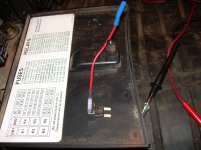
I'm using a blank spot (F4) on my fuse block that says "never used" it's on the top row where all the others are 30 amp, I put one of those little piggy back fuse things in there to make it simple to wire a cigarette lighter type outlet, allows you to have 2 circuits in one slot but since it was an unused slot I just have 1 fuse in there now (normally would have 2 if you were sharing the slot) got a 10 amp in there now, this circuit is always hot regardless of key position.

JB.
 

Attachments

  • DSCN0529.jpg
    DSCN0529.jpg
    342.6 KB · Views: 103
/ Quick easy electrical question #15  
Unfortunately, most of these posts turn into an "I'm smarter than you" competition. Just remember, this is like running in the special olympics. You know the last part.
 
/ Quick easy electrical question #16  
Some of you guys should be working on the next manned moon mission!!! NOT lawn mowers :)

But thanks for the help, looks like I'll be all set with a 10 -15 amp fuse and 16-18 gauge wire.

I'm using a blank spot (F4) on my fuse block that says "never used" it's on the top row where all the others are 30 amp, I put one of those little piggy back fuse things in there to make it simple to wire a cigarette lighter type outlet, allows you to have 2 circuits in one slot but since it was an unused slot I just have 1 fuse in there now (normally would have 2 if you were sharing the slot) got a 10 amp in there now, this circuit is always hot regardless of key position.

JB.
Current carying capacity is one thing but mechanical strenght is another. There is no point to use the smallest wire that would take the load. Use wire that will take the abuse and last.
 
/ Quick easy electrical question #17  
Both bulbs will draw 9.166 amps, and you should double the wire gage. Running the bulbs at 14 v, the bulbs will be brighter, because the resistance is the same. The bulbs will give longer service at 12 v.

Add a switch for each light, and only use what is necessary.
 
/ Quick easy electrical question #18  
something you may not have thought of - whats your alternator sized at? If you are pulling more amps than the engine is putting out, you can get it from the battery for a while, then you'll have issues...
 
/ Quick easy electrical question #19  
There's another thing you might want to consider when choosing wire size and that's the difference in voltage drop you will experience between two different gauges of wire. While 18 gauge might be adequate for the application, 14 gauge will have much less voltage drop and you will have higher voltage at the lights themselves, and more light as a result. For example, with the same load and distance, 18 gauge might gave a 10.97% voltage drop whereas 14 gauge would give a 4.33% voltage drop. Since it's literally pennies more per foot for 14 gauge, why not go for the heavier gauge? As for the fuse size..is there nothing else on that 10 amp circuit already? If not you might get by with a 10 amp fuse and you could probably increase it without undue risk to a 12 amp if the 10 blows. No doubt the factory would say never ever oversize the fuse and if you do, you do so at your own risk. Myself... I wouldn't hesitate to increase the fuse size to just enough to not blow when using them. Live dangerously! :D
Nice find btw! :)
 
/ Quick easy electrical question #20  
I regularly work on electric forklifts with voltages from 12 to 72 vdc. Funny, they all run the same control circuit fuse, 14a. I install worklights on these, all with the same 55w bulb, just rated at the voltage the truck runs at. The fuse size on every one of them? 14a. Yep, 12v 55w bulb? 14amp fuse. 72v 55w bulb? 14amp fuse. Notice a pattern? In a man-up forklift, the power also runs through as much as 50' of 18 gauge wire, to and from the bulb so over 100' of 18 gauge wire. These fuses aren't sized so much to their load as they are to protect the circuit from shorts. Dead shorts. Just throw in a 15a fuse and forget about it. Don't make it more complicated than it is. Quit making mountains out of mole hills. The poor OP is going to sit there drooling on himself sifting through all this nonsense.
 

Marketplace Items

120 GALLON WATER TANK (A62131)
120 GALLON WATER...
BUNDLE OF ASSORTED, PINE & RED CEDAR (A62131)
BUNDLE OF...
2013 Lincoln MKZ Sedan (A61569)
2013 Lincoln MKZ...
Ratchet Straps (A61569)
Ratchet Straps...
2006 KAWASAKI BAYOU 250 ATV (A60430)
2006 KAWASAKI...
UNUSED IRANCH WROUGHT IRON SITE FENCE (A62131)
UNUSED IRANCH...
 
Top