You need balast or you will trash your front axle!!!! really?

   / You need balast or you will trash your front axle!!!! really? #381  
I know that a lot of you want to link the vertical position of the front bucket load into this, but all that does is add another layer that obscures the pure physics. Generally, when deriving the equations you want to keep driving things simpler and simpler, not get more complex.

An equation I posted back in #39, was:

F * LF = R * LR

This equation has to hold in order for no additional load to be applied to the front axle. In other words, you can think of this as a way to calculate the required rear counterweight so that no added load is placed on the front axle.

Here:

F is the load on the front loader
LF is the horizontal distance from the front loader's load to the rear axle
R is the load on the three point
LR is the horizontal distance from the three point's load to the rear axle

That tells us that the rear counterbalance load must be:

R = (F * LF)/LR

So that gets it down to forces and horizontal distances, and you cannot get it simpler than that.

Now, of course LF is geometrically related to the angle of the loader, so I could rewrite it as:

LF = LA + R * cos(theta)

Where: LA is the horizontal length from the rear axle to the front loader arm pivot, R is the "radius" that the front load arcs through, and theta is the angle from horizontal. With that, the equation would become:

R = (F * (LA + R * cos(theta)))/LR

If you instead want this in terms of the height of the bucket load H, it becomes:

R = (F * (LA +H /tan(theta)))/LR

All of these equations give the same result, just using different variables. But we had to pull geometry and complexity into this to express it in terms of something other than the horizontal lever arm. Complexity is the enemy of fundamental understanding. If you require complexity to understand the physics, you blew it!

Also note in this case we can use a single variable of horizontal distance, LF. But if we want to rework the equation to get away from that most fundamental form, we now back up to something that requires three variables, LA, vertical distance (H), and angle from horizontal (theta). We'll never be able to make this depend purely on the vertical distance, because it's not in the physics. If you want this to depend purely on a single length variable, that will have to be horizontal distance LF.

Exactly what I was going to say....:) Some smart folks on this forum!
 
   / You need balast or you will trash your front axle!!!! really? #382  
I'll ask the inevitable question to get this started. Is a wide front axle tractor more stable than a narrow (tricycle) front axle tractor? If your answer is yes, please explain why??

yes, if there is no axle pivot point, but no, if there is a pivot.


this is a lot of conversation about horizontal and vertical considerations, but there is, in reality, actually nothing that is truly horizontal or vertical as we are all sitting on a round ball. :)
 
   / You need balast or you will trash your front axle!!!! really? #383  
I am sure that some would think that having the fel bucket close to the axle would be best. Anyone who has to load a dump truck knows how important dump clearance is too. You need clearance between the front end to prevent bumping into the side of the truck.

Yep. I think we covered that when discussing why a SS has it's lift arms at the back of the machine. They need that length to get any considerable useable lift height.
 
   / You need balast or you will trash your front axle!!!! really? #384  
I think farmers, lumberjacks, riggers, and other practical folks who incorporate physics into their work (whether they know it or not) are doing the same thing without the equations or the physics. They can look at a practical problem and know the physics.

Admittedly, this is me. I only see the physical things going on. I rarely see equations in my mind of what's going on. When it works, it works. When it doesn't, I try something different. :)
 
   / You need balast or you will trash your front axle!!!! really? #385  
yes, if there is no axle pivot point, but no, if there is a pivot.


this is a lot of conversation about horizontal and vertical considerations, but there is, in reality, actually nothing that is truly horizontal or vertical as we are all sitting on a round ball. :)

Doubly wrong.

Wide axle setups can be more stable because even if they have a pivot, there will be a stop that limits how much travel the axle has. At the end of that pivot travel the axle has a fairly long arm resisting any amount of roll the tractor has. The question becomes whether the tractor can roll before the axle runs out of travel.

Second, just because the earth is round (oval) it's still possible to have perfectly flat surfaces...common really.
 
   / You need balast or you will trash your front axle!!!! really? #386  
Doubly wrong.

Wide axle setups can be more stable because even if they have a pivot, there will be a stop that limits how much travel the axle has. At the end of that pivot travel the axle has a fairly long arm resisting any amount of roll the tractor has. The question becomes whether the tractor can roll before the axle runs out of travel.

Second, just because the earth is round (oval) it's still possible to have perfectly flat surfaces...common really.

I'll give oldpilgrim half credit. :)

As you stated, when the axle reaches the end of it's pivot travel it adds to stability. And then it becomes an axle with no pivot point, just as he said.
 
   / You need balast or you will trash your front axle!!!! really? #387  
Fair enough 😊
 
   / You need balast or you will trash your front axle!!!! really? #388  
Second, just because the earth is round (oval) it's still possible to have perfectly flat surfaces...common really.

No you can't. The only truly flat surface you can have is a point on a rounded object. Anything larger than a point will follow the surface of the 'ball' taking it's curved shape.

If you have a 'flat' surface at point X and another 'flat' surface at point Y, a 90 degree point at each location, projected upward, or downward, will not be parallel to each other so they are in effect not perfectly vertical. They will come together going down and spread apart the higher they go.
 
   / You need balast or you will trash your front axle!!!! really? #389  
No you can't. The only truly flat surface you can have is a point on a rounded object. Anything larger than a point will follow the surface of the 'ball' taking it's curved shape.

If you have a 'flat' surface at point X and another 'flat' surface at point Y, a 90 degree point at each location, projected upward, or downward, will not be parallel to each other so they are in effect not perfectly vertical. They will come together going down and spread apart the higher they go.


I'm going to give GmanBart half credit on this one. But the catch would be his flat surface would not appear flat. :)
 
   / You need balast or you will trash your front axle!!!! really? #390  
I dunno about the 1/2 point, but since you're awarding it, it's ok with me. :)

The same thing applies to straight and parallel. Take a straight length of pipe and hold it parallel to the ground. Lengthen it so it's still parallel and straight and keep lengthening it. Sooner or later the other end of that straight pipe, parallel to the ground will poke you in the azz.
 
   / You need balast or you will trash your front axle!!!! really? #391  
Interesting. ...but as soon as you move the forklift backwards, doesn't Newton's First law say you're much more likely to tip the fork truck off it's rear wheels (that is: the horizontal force required to move the raised load backwards has a torque effect about the front axle that is multiplied by this raised height?)
Yes, but you can simply tilt the mast backwards. I forklift has pretty a decent tilt back angle which also moves the load reward as it raises. My forklift still has 2600 pounds on the rear axle with the rated capacity on the forks. On flat ground it would be pretty unlikely the you could move backwards hard enough to tip. Now, the forklift will lift more than the rated capacity which would make this possible. You would be more likely to tip it if you were moving forward and hit the brakes.
 
   / You need balast or you will trash your front axle!!!! really? #392  
S219 stated:

F is the load on the front loader
LF is the horizontal distance from the front loader's load to the rear axle
R is the load on the three point
LR is the horizontal distance from the three point's load to the rear axle


But that is exactly what I was saying in my post of 2 additional points (point 1). Glade 's calculation specified wheelbase as the front side from rear axle to front axle. And I indicated that the distance from where the front load was located was much further than just front axle. . . . All the way out to point of load. Thus requiring much more weight to effect the front axle down pressure to decrease. In other words the lever is less efficient than Glade stated.

Isn't s219's formula merely agreeing with my viewpoint ?
 
   / You need balast or you will trash your front axle!!!! really? #393  
No you can't. The only truly flat surface you can have is a point on a rounded object. Anything larger than a point will follow the surface of the 'ball' taking it's curved shape.

If you have a 'flat' surface at point X and another 'flat' surface at point Y, a 90 degree point at each location, projected upward, or downward, will not be parallel to each other so they are in effect not perfectly vertical. They will come together going down and spread apart the higher they go.

It's not possible to have a perfectly flat surface? A level or straight edge would prove you wrong. The underlying shape of the earth has nothing to do with it. Taken to the extreme you could cut a perfect sphere in half, and have the cut half be perfectly flat.

It's this kind of exaggerated, ridiculous discussion that ruins threads, wastes space, and does absolutely nothing constructive.

Ignore....
 
   / You need balast or you will trash your front axle!!!! really? #394  
Talk about wasted space ..This whole thread could have been settled with less than 10 posts. No need to get feisty.:eek:
 
   / You need balast or you will trash your front axle!!!! really?
  • Thread Starter
#395  
Talk about wasted space ..This whole thread could have been settled with less than 10 posts. No need to get feisty.:eek:

I've been laughing my tail off as this comes back to the same things over and over again!
 
   / You need balast or you will trash your front axle!!!! really?
  • Thread Starter
#396  
S219 stated:

F is the load on the front loader
LF is the horizontal distance from the front loader's load to the rear axle
R is the load on the three point
LR is the horizontal distance from the three point's load to the rear axle


But that is exactly what I was saying in my post of 2 additional points (point 1). Glade 's calculation specified wheelbase as the front side from rear axle to front axle. And I indicated that the distance from where the front load was located was much further than just front axle. . . . All the way out to point of load. Thus requiring much more weight to effect the front axle down pressure to decrease. In other words the lever is less efficient than Glade stated.

Isn't s219's formula merely agreeing with my viewpoint ?

Others have explained both the math and the physics very well. I do not think I can add anything to clarify. My request to you is that you attempt to understand my posts (both in this thread and others) before making claims about what did not consider. You arn't bringing up any points that havn't already been discussed at length. I discused horizontal load distance from front axle in Post # 1
 
Last edited:
   / You need balast or you will trash your front axle!!!! really? #397  
It's not possible to have a perfectly flat surface? A level or straight edge would prove you wrong. The underlying shape of the earth has nothing to do with it. Taken to the extreme you could cut a perfect sphere in half, and have the cut half be perfectly flat.

It's this kind of exaggerated, ridiculous discussion that ruins threads, wastes space, and does absolutely nothing constructive.

Ignore....

Whoa Skippy. Calm down, this is a relaxed discussion. No competition. It's all just casual debate. No conquering allowed. :)
 
   / You need balast or you will trash your front axle!!!! really? #398  
I've been laughing my tail off as this comes back to the same things over and over again!


Very entertaining thread as I mentioned many pages back.
 
   / You need balast or you will trash your front axle!!!! really? #399  
   / You need balast or you will trash your front axle!!!! really? #400  
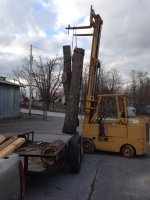
Anyone care to calculate the load on this front axle? Don't forget to account for the mast being tilted behind the axel. The forklift weighs 11,800 pounds. Let's assume the load weighs 1500 pounds and is held 30 inches from the back of the fork. image-998419571.jpg
 

Marketplace Items

405 (A52706)
405 (A52706)
2021 Ford Mustang Mach-E AWD SUV (A59231)
2021 Ford Mustang...
1770 (A58375)
1770 (A58375)
Kubota M6 131 HP
Kubota M6 131 HP
2016 PALADIN 22197MM SWEEPSTER 97" HYD BROOM (A60429)
2016 PALADIN...
2019 F150 (A61306)
2019 F150 (A61306)
 
Top