Would I have enough amps?

   / Would I have enough amps? #1  

MoreCowbell

Silver Member
Joined
Jun 22, 2010
Messages
124
Location
Clayton, NC
Tractor
Kubota BX2350
I've posted many times to this site, but this time it feels a little weird since it has nothing to do with my tractor. However, I always get great feedback, so here it goes:

I am fabricating new steel columns for my crawlspace-to-basement conversion project. I am using 1/2" steel for the top and bottom plates with 3.5" schedule 40 steel pipe in the middle (walls just shy of 1/4" thick).

I am a novice, self-taught, stick welder. I use a 240v AC-only Harbor Freight special I got on eBay for $38. I had it set at about 95A and used 3/32" 7013 rods to weld the top plates on.

My problem is that it looks like I will need to weld the base plates to the pipes once everything is in place below the house. I do not have a 240v/50A outlet down there. However, I do have several 120v outlets. I would love to use this as an excuse to pick up a 120v wire feeder and learn how to use it. My question is whether a 120v unit would have the power to weld the thickness material I am working with. I should note that these welds would not be structural in terms of supporting the house. They only need to provide lateral resistance if the columns get knocked into.

Thanks.
 
   / Would I have enough amps? #2  
How about renting an engine drive for this project? That way you're sure it is done correctly.
 
   / Would I have enough amps? #3  
I personally dont think you will get the weld you need from a 110v welder..

You must have a dryer outlet.. Thats good for 30amp and more than enough to run any 220v stick welder.. That was all i used when i was a broke teenager living at home..Had a length heavy duty extension cord i got from work and used a dryer plug solder onto it..I will never forget Mom yelling at me every time for not pluging the dryer back in..:eek:

or just run a pig tail from your house panel and use 12 gauge heater wire as a temp extension cord..

Come to think of it i still have the extension cord I made as a kid but sold the welder..
 
   / Would I have enough amps? #4  
A 120v wire feed is definitely NOT what you need for something like that. They work great for sheet metal though :)
 
   / Would I have enough amps?
  • Thread Starter
#5  
Thanks for the replies. I may give that extension cord idea a try. The receptical is really not that far away, but there is a foundation wall in the way. However, I think I may be able to drill through the joist on top of it to run the wire.
 
   / Would I have enough amps? #6  
I used 100 feet of 240V extension cables with my AC welder no problems at all.
 
   / Would I have enough amps? #8  
i have one of them little 140 everlasts.i think it will get close to 100 amps on 110.that should be enough for 1/8 6011,for sure 3/32 6011.the duty cycle is short but it should get the job done.
 
   / Would I have enough amps? #9  
Not to discourage a welding project, but those plates are generally not welded in on residential jobs. Lumber yards have them with dimples that hold the column. They're around 3/16".
 
   / Would I have enough amps? #10  
I think all replies have a valid point but I think what your looking to do would
be ok to do. Like you said there is no real structural stress on the weld but only to hold the verticals in place in case they are bumped. I have welded things with my miller 140 that should of had a bigger welder but prep is very important. If concerned I would bevel the edge and run root pass and then a couple of cover passes. I would suggest flux core which burns a lot hotter and avoid cords . If you need a cord then minimum of 12 gauge, preferably a 10 gauge cord.
 
   / Would I have enough amps? #11  
Lumber yards have them with dimples that hold the column. They're around 3/16".
You could get a very strong, similar result by welding stubs of pipe to the plates which slip-fit into your columns. Then you can simply bring the parts into the basement, set the plates on the floor, set the columns on the plates, and slide in place.

If you want bolted connections there are plenty of ways to do that, such as weldng "ears" on the columns and tapping some holes in your base plates.

Welding is nice, but careful use of welding in combination with other appropriate solutions is nicer.

I would figure a way not to weld in the basement because I'm lazy. That's a wonderful incentive to efficiency!
 
   / Would I have enough amps?
  • Thread Starter
#12  
Thanks for all the replies. Definitely a few good ideas. The stub pipe method seems to be very practical. The only drawback for me is that I would like to fill the pipes with concrete for added strength.

Maybe I can put the stub on the outside of the pipe. My pipes are nominal 3.5" sched 40 (4" O.D.). I did some research and found out that nominal 4" sched 40 steel pipe has an I.D. of 4.026". That should slide over the column pipes real nice. I think that may be the way to go. Thanks again for the brainstorming session! :thumbsup:
 
   / Would I have enough amps? #13  
The only drawback for me is that I would like to fill the pipes with concrete for added strength.
What are the numbers on "strength" improvement under what loads with concrete fill, or is that just for giggles?
 
   / Would I have enough amps?
  • Thread Starter
#14  
There is definitely an increase in strength when filling a steel column with concrete. The concrete not only provides additional compressive resistance to the load, but it also increases the buckling resistance of the steel pipe as well. It also increases the fire resistance of the column.

I'm primarily looking for the benefit of the added buckling resistance, because I'm thinking that it will be very difficult to exactly set the base plate perpendicular to the column. Even if I'm a small fraction of an inch off, the weight will still all be on one edge of the column.

Anyway, I'm probably being overly paranoid but concrete is cheap.
 
   / Would I have enough amps? #15  
You should be very careful of any welding after it is concrete filled. The water in the concrete can heat up and cause the concrete to explode. It had happened to people just using their garage floor as a welding table... Probably best to fab something up first then fill it, then bolt it together. Or weld pins to the plate that stick into holes in the concrete or something, but do the welding before concrete.

And don't you find it ironic that someone who's screen name is More Cowbell wants to know if they have enough amps? The answer is Always MORE AMPS!!! :)
 
   / Would I have enough amps?
  • Thread Starter
#16  
You should be very careful of any welding after it is concrete filled. The water in the concrete can heat up and cause the concrete to explode. It had happened to people just using their garage floor as a welding table... Probably best to fab something up first then fill it, then bolt it together. Or weld pins to the plate that stick into holes in the concrete or something, but do the welding before concrete.

And don't you find it ironic that someone who's screen name is More Cowbell wants to know if they have enough amps? The answer is Always MORE AMPS!!! :)

I never thought of that. I'm fairly certain that I will be welding a stub pipe to the baseplate first and sliding the concrete filled pipe into it later on so I won't have to worry about that. Although as a novice/amateur welder I do almost all my welding on the slab in my garage. Maybe I should rethink that. :confused:

Good point on the More Amps rule. Now I just need to say it with a Christopher Walkin voice. :D
 
   / Would I have enough amps? #17  
I've got a fever...and the only cure is MORE AMPS! :)
 
   / Would I have enough amps?
  • Thread Starter
#18  
OK. I read all the expert opinion that everyone was nice enough to give, then went and bought that 110v wirefeeder anyway. :eek: (It was on sale at Northern Tool plus I had a coupon). My thinking was that I could do the job by making several passes.

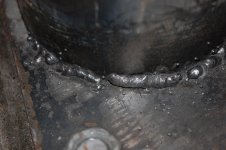
Since the metal is pretty thick (1/2" and 1/4") I set it to the higher of the two power settings and dialed in the wire speed on a pieced of scrap according to the instructions. I was getting some pretty nice test beads on the scrap, but when I tried to weld my pipe columns, it got real ugly. Here is a photo...

(get a barf bag ready...)

DSC_1508.JPG

It looks like I'm having difficulty getting penetration on the baseplate which is not suprising since it is 1/2" thick. Are there any tricks that could help me out? If there is no silver bullet for this, I'll probably just rig up that extension cord for my 240v stick welder and get it done with that. Thanks.
 
   / Would I have enough amps? #19  
OK. I read all the expert opinion that everyone was nice enough to give, then went and bought that 110v wirefeeder anyway. :eek: (It was on sale at Northern Tool plus I had a coupon). My thinking was that I could do the job by making several passes.

Since the metal is pretty thick (1/2" and 1/4") I set it to the higher of the two power settings and dialed in the wire speed on a pieced of scrap according to the instructions. I was getting some pretty nice test beads on the scrap, but when I tried to weld my pipe columns, it got real ugly. Here is a photo...

(get a barf bag ready...)

View attachment 264122


It looks like I'm having difficulty getting penetration on the baseplate which is not suprising since it is 1/2" thick. Are there any tricks that could help me out? If there is no silver bullet for this, I'll probably just rig up that extension cord for my 240v stick welder and get it done with that. Thanks.


Bird come by and left a deposit?:) Well I am not telling you anything you don't already know.. but part of the problem is you missed the joint, so that is just a practice thing,, BUT..it seems to be badly cold lapped also . Could you heat it up good first with an oxy-ace torch?, that may help. BUT if it was me, I would stick weld that puppy in a heartbeat.:thumbsup:

James K0UA
 
   / Would I have enough amps? #20  
220 welder.
 

Tractor & Equipment Auctions

2018 John Deere 245G LC Excavator - Hydraulic Thumb, Tooth Bucket, 56K LB Class (A56438)
2018 John Deere...
Towable Dewatering Pump (A59228)
Towable Dewatering...
12 X 20 CAR PORT (A58214)
12 X 20 CAR PORT...
Harlo HP6500 (A60462)
2003 FORD F150 HARLEY DAVIDSON TRUCK (A59575)
2003 FORD F150...
Kubota LX2620 (A53317)
 
Top