Why not sugar water in tires instead of beet juice?

   / Why not sugar water in tires instead of beet juice? #61  
metals like titanium.
high acids are usually handled by 316 but there are tougher grades yet still. I've built process equipment for the laboratory using Hastelloy and nickel 200 grade stainless They aren't quite inconell but they resist most everything but for hydrofluoric.
 
   / Why not sugar water in tires instead of beet juice? #62  
KennJ,

You are absolutely correct on "many things eat stainless". Stainless is corrosion resistant it is NOT corrosion proof because stainless steels ( all grades ) quickly form an oxide coating that prevents further oxidation/ corrosion. Any fluid carry solids which includes liquids saturated to point they can no "dissolve" any more of the material ( ie sugar ) then the solution becomes abrasive and removes the oxide coating coating as quickly as it forms. Quick pinholes. Most acids , even mild ones like citric acid, will have the same effect on the oxide coating and then pipe/ tubing failure.
That's a great explanation, thanks!
 
   / Why not sugar water in tires instead of beet juice? #63  
All good reasons & I doubt there are many people who use calcium chloride or methanol or antifreeze in their tires anymore. Way to corrosive and/or poisonous. One leak in a tire filled with any of the above will make a person into a believer for life.

I prefer to stay with just air in the tires. Nicer ride, and doesn't overstress the loader & front end. Adding weight to the tires will lower the center of gravity - but not by much. Whether loading the tires is an advantage or not on slopes is debateable. Loaded tires may offer CG stability, but are less flexible and tend to slide sideways.

Best thing on slopes is stay away.

When the M59 first came out, one of the options on the "build it" page was OEM cast iron wheel weights. There are probably still some of those around.
rScotty
rScotty,

I am going to nicely disagree with your statement on loaded tires does not lower the center of gravity by much and the debate-able advantage of loaded tires on slopes.

My M59 with backhoe and Paladin grapple scales ( run across multiple DOT and gravel pit scales ) at 11,200-11,500 pounds with only rear tires loaded with beet juice per Kubota recommendations. Each rear tire has 589ish pounds of beet juice in it. Tires have an air cushion at top of each tire so that when the tire valve is at the top of the rim then the beet juice level is 3-4 inches below the valve so ride is not noticeably affected due to air cushion. The CG of each loaded tire is below the axle center and the additional 1,178 pounds in rear wheels is 11% of the total machine weight. Regardless of where the CG of a new M59 TLB, unless it is lower than the centerline of the rear axles, the additional 11% of weight below the axle centerline manifests itself as a significant improvement in lowering the CG. The additional weight has many advantages. Filling the loader, especially rail road ballast, is easier because tire spin nearly nonexistent. Travel across level ground and up hills when the grapple of loader bucket is fully loaded is much safer with the additional loaded rear tire counterweight. Even with loaded rear tires the back end will get bouncy ( light ) at low speed when the grapple is loaded with 4,000 lbs plus of stone. I always back down a hill when grapple or bucket is fully loaded to keep CG below the load. I limit crossing slopes with ā€œheavyā€ loads as a matter of safety so no issues with sliding.

Swinging a heaped 24 inch bucket from far left to far right, at slow speed, loaded with mud/ silt is far less sphincter puckering with loaded tires. Watching the left outrigger pad come off the ground is always fun.

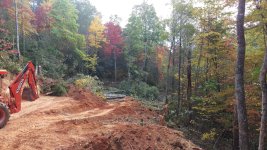
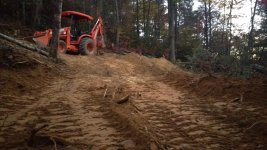
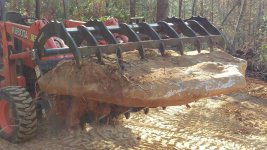
A few pics of loads, grades, and work.
 

Attachments

  • IMAG0561-Work.jpg
    IMAG0561-Work.jpg
    3.2 MB · Views: 184
  • IMAG0605-Work.jpg
    IMAG0605-Work.jpg
    1.7 MB · Views: 178
  • IMAG0687-Work.jpg
    IMAG0687-Work.jpg
    2.7 MB · Views: 186
   / Why not sugar water in tires instead of beet juice? #64  
I wouldn't consider running my tractor without LOADED back tires. 1st tractor 20+ yrs. with sodium chloride never a problem . Bought a new tractor nothing in tires used it for for 1 wk. to dangerous. Found where I could get the tires loaded with beat juice and had them filled . Safer on hill sides , helps with a full loader bucket but ballast as well is better. Does not effect the ride unless you over air them. My acreage is mt. side steep skid trails and I often travel on slopes putting an average of 600 hrs. a yr. on the tractor logging and brush hogging.
 
   / Why not sugar water in tires instead of beet juice? #65  
Lots of hours every year on numerous tractors, very few still have filled tires ( I think 3 out 14) most have iron bolted on.
I much prefer iron to liquid.
 
   / Why not sugar water in tires instead of beet juice? #67  
rScotty,

I am going to nicely disagree with your statement on loaded tires does not lower the center of gravity by much and the debate-able advantage of loaded tires on slopes.

My M59 with backhoe and Paladin grapple scales ( run across multiple DOT and gravel pit scales ) at 11,200-11,500 pounds with only rear tires loaded with beet juice per Kubota recommendations. Each rear tire has 589ish pounds of beet juice in it. Tires have an air cushion at top of each tire so that when the tire valve is at the top of the rim then the beet juice level is 3-4 inches below the valve so ride is not noticeably affected due to air cushion. The CG of each loaded tire is below the axle center and the additional 1,178 pounds in rear wheels is 11% of the total machine weight. Regardless of where the CG of a new M59 TLB, unless it is lower than the centerline of the rear axles, the additional 11% of weight below the axle centerline manifests itself as a significant improvement in lowering the CG. The additional weight has many advantages. Filling the loader, especially rail road ballast, is easier because tire spin nearly nonexistent. Travel across level ground and up hills when the grapple of loader bucket is fully loaded is much safer with the additional loaded rear tire counterweight. Even with loaded rear tires the back end will get bouncy ( light ) at low speed when the grapple is loaded with 4,000 lbs plus of stone. I always back down a hill when grapple or bucket is fully loaded to keep CG below the load. I limit crossing slopes with ā€œheavyā€ loads as a matter of safety so no issues with sliding.

Swinging a heaped 24 inch bucket from far left to far right, at slow speed, loaded with mud/ silt is far less sphincter puckering with loaded tires. Watching the left outrigger pad come off the ground is always fun.

A few pics of loads, grades, and work.

I don't disagree with the advantages of weight. I enjoy the posts, but disagree with descriptions like like "hugely, or "significant improvement", and "much" safer ".... and so on. It needs some arithmetic. Improvement? Sure, there's some. Significant? Well, maybe.

I intuitively doubt that moving 11% of the weight slightly below the axle is going to make a lot of difference in the position of the CG. I'll grant that moving half the weight below the axle might.
But I could be wrong. Way wrong. I'd be curious to know just how far the CG is moved.
Somebody please do the arithmetic.

BTW, that air cushion argument needs rethinking. Volume counts in air cushioning. I'd start by figuring out what percentage of air is reduced. Suppose for sake of argument that the energy from hitting a bump is equal in either case. But with the tires loaded, what percentage of the volume is no longer available to compress to disipate that bump energy?

rScotty
 
Last edited:
   / Why not sugar water in tires instead of beet juice? #68  
Lots of hours every year on numerous tractors, very few still have filled tires ( I think 3 out 14) most have iron bolted on.
I much prefer iron to liquid.

So do I. It only takes one leak to get a person thinking. Puncture it twice, and there goes the economic advantage as well.
 
   / Why not sugar water in tires instead of beet juice? #69  
I don't disagree with the advantages of weight. I enjoy the posts, but disagree with descriptions like like "hugely, or "significant improvement", and "much" safer ".... and so on. It needs some arithmetic. Improvement? Sure, there's some. Significant? Well, maybe.

I intuitively doubt that moving 11% of the weight slightly below the axle is going to make a lot of difference in the position of the CG. I'll grant that moving half the weight below the axle might.
But I could be wrong. Way wroing. I'd be curious to know how far the CG is moved.
Somebody please do the arithmetic.

BTW, that air cushion argument needs rethinking. Volume counts in air cushioning. I'd start by figuring out what percentage of air is reduced. Suppose for sake of argument that the energy from hitting a bump is equal in either case. But with the tires loaded, what percentage of the volume is no longer available to compress to disipate that bump energy?

rScotty
rScotty,

I wasn't sure whether to reply or not but here goes.

I too would like to know where the roll centers are on the M59 and have asked Kubota for that information with no response. Therefore, I am working from the position of every pound that I can place below the plane that runs thru the axels is a pound or percentage of total weight that is below the likely roll centers. I conclude the roll centers are probably above the plane that runs thru the axels based upon the significant bodies of weight ( backhoe, engine, front end loader frame ) are mostly above the plane of the axels. Since you have a M59, you know what kind of weights are involved. I consider moving 5% of weight below the axles to be a significant improvement in reducing the likelihood of roll over.

I have some idea of where the for-aft roll center is since I experienced a light rear end when grapple is maximally loaded. That is why loading the rear tires was a significant improvement in for-aft stability.

M59 travel speed is less than 5 mph when loaded and frequently 2-3 mph when really loaded so impacts are very low speed and there is little lost displacement. Kind of like gently squeezing a balloon. The tire carcass, when rolling slowly over a rock, bulges slightly at the point of contact and there appears to be very little internal pressure increase. However, I will afix a pressure guage to the tire stem and try a low roll over several different size rocks next time I am running the machine. Will be interested in learning the outcome.
 
   / Why not sugar water in tires instead of beet juice? #70  
etpm,

My used 2008 M59 came with beet juice loaded tires, which dealer didn't tell me about, and I only learned when I went to put air into a rear tire and purple juice ran out. I have never had any issues with tires, rims, or valves and would re-use the beet juice again if I have to replace the tires due to age or damage. Loaded tires are a huge improvement when carrying a full loader bucket ( pic below ) or when traveling over incline with full loader. Ballasted tires significantly lower the center of gravity of working machine. I have attached several data sheets for tire loading and tire volumes. I won't use the following :Salt because it enables galvanic corrosion and results in short rim life along as well as poisons ground when leaked. Methanol is a contact poison and doesn't really add weight since its sole purpose is to prevent water from freezing. Antifreeze ( ethylene glycol ) is sweet tasting and lethal to pets and local animals when it leaks onto ground.
Beet juice is thick, like syrup, so it is heavy per unit volume and must be put in with a gear pump. Most installers won't add beat juice when temps are cold because it gets thicker and hard to pump.

The left two pics are rock in a 84 inch wide bucket. Even with loaded rear tires ( 589 lbs beet juice per tire ) and a backhoe, the rear end got pretty light and would bounce. Not a pleasant sensation.

Hope this helps.
My dealer filled my tires with a new product named bio-ballast. It is non corrosive to rims and doesn’t harm rubber tires.

 
   / Why not sugar water in tires instead of beet juice? #72  
Sugar water doesn't help or hinder corrosion. Sugar water will sightly reduce freezing point but doesn't markedly affect density (1.06).

Rimguard claims their product weighs 10.7-11.0 pounds per gallon, or 1.29-1.33 density while being non-corrosive.

I don't know if plain water (density 1.0) is considered corrosive by these metrics; a wheel will eventually rust with water in the tire (I'm guessing water/alcohol and water/antifreeze blends will too, not sure if rimguard has anti rust capabilities or if it's just not seriously corrosive like calcium chloride).
 
   / Why not sugar water in tires instead of beet juice? #73  
Never had a tractor with filled rears and I'm on my 10th and 11th Kubota's. I used external weights on all of them including the 2 I own now. Kubota offers as an option, cast centers and I go with them.
 
   / Why not sugar water in tires instead of beet juice? #74  
Road gear with a 140-ish HP FWA JD with filled tires is a mushy, half inflated, bouncy house.
My 28 HP CUT rides like a go cart with just air.
Yeah, I know.
Never had an opportunity to compare apples to apples, but I'm curious.
 
   / Why not sugar water in tires instead of beet juice? #75  
rScotty,

I wasn't sure whether to reply or not but here goes.

I too would like to know where the roll centers are on the M59 and have asked Kubota for that information with no response. Therefore, I am working from the position of every pound that I can place below the plane that runs thru the axels is a pound or percentage of total weight that is below the likely roll centers. I conclude the roll centers are probably above the plane that runs thru the axels based upon the significant bodies of weight ( backhoe, engine, front end loader frame ) are mostly above the plane of the axels. Since you have a M59, you know what kind of weights are involved. I consider moving 5% of weight below the axles to be a significant improvement in reducing the likelihood of roll over.

I have some idea of where the for-aft roll center is since I experienced a light rear end when grapple is maximally loaded. That is why loading the rear tires was a significant improvement in for-aft stability.

M59 travel speed is less than 5 mph when loaded and frequently 2-3 mph when really loaded so impacts are very low speed and there is little lost displacement. Kind of like gently squeezing a balloon. The tire carcass, when rolling slowly over a rock, bulges slightly at the point of contact and there appears to be very little internal pressure increase. However, I will afix a pressure guage to the tire stem and try a low roll over several different size rocks next time I am running the machine. Will be interested in learning the outcome.

Interesting. Let us know if the pressure spikes.

It occurs to me that although the center of mass of the liquid is very slightly below the center of the axle (because of partial fill), I'd be surprised if any normal fluid fill moves the CG of the fluid down very far - maybe not even as far as the bottom of that axle. My guess is still that fluid fill doesn't move overall CG very far either, and as far as the CG of the fluid itself goes, I wonder if that fluid CG might still be within the axle diameter. Not sure it matters, but at least that fluid CG calc is one we don't need Kubota for.

Do you you agree that the critical calculation for side tipping is the change in distance from the ground up to the CG? It also seems to me that as you say, most of that mass is above the axle - although I haven't gotten out there and really taken a look at it. Hmm.... not sure of the significance of the axle here. How did we get on to that in the first place? The axle is a convenient point of reference for working out the center of mass of the rear end is about all it seems to me.

Now for fore & aft tipping there is no doubt that more weight aft does help. Just like putting a 3000 lb boulder in the front bucket enables lots more backhoe abuse - probably enough extra abuse to break things.

BTW. ability to withstand deliberate abuse is THE BIG DIFFERENCE between the M59 and a real commercial TLB. Counterweighting an M59 could break things, but counterweighting the JD310 probably won't.

1656603308367.jpeg
 
Last edited:
   / Why not sugar water in tires instead of beet juice? #76  
Interesting. Let us know if the pressure spikes.

It occurs to me that although the center of mass of the liquid is very slightly below the center of the axle (because of partial fill), I'd be surprised if any normal fluid fill moves the CG of the fluid down very far - maybe not even as far as the bottom of that axle. My guess is still that fluid fill doesn't move overall CG very far either, and as far as the CG of the fluid itself goes, I wonder if that fluid CG might still be within the axle diameter. Not sure it matters, but at least that fluid CG calc is one we don't need Kubota for.

Do you you agree that the critical calculation for side tipping is the change in distance from the ground up to the CG? It also seems to me that as you say, most of that mass is above the axle - although I haven't gotten out there and really taken a look at it. Hmm.... not sure of the significance of the axle here. How did we get on to that in the first place? The axle is a convenient point of reference for working out the center of mass of the rear end is about all it seems to me.

Now for fore & aft tipping there is no doubt that more weight aft does help. Just like putting a 3000 lb boulder in the front bucket enables lots more backhoe abuse - probably enough extra abuse to break things.

BTW. ability to withstand deliberate abuse is THE BIG DIFFERENCE between the M59 and a real commercial TLB. Counterweighting an M59 could break things, but counterweighting the JD310 probably won't.

View attachment 752254View attachment 752254
rScotty,

Thankyou for interesting point-counterpoint instead of flaming/ ranting. The mark of a gentlemen.

I have not taken measurements of the fluid level relative to rim and thus distance to interior of carcass in contact with ground, overall tire diameter when loaded (filled), nor carcass volume but based upon ratio of bare tire weight of 280 Lbs and fluid fill weight of 589ish Lbs, where CG of the bare tire on rim is certainly within the axle's diameter and the CG of the fluid fill is clearly below the axle's diameter by roughly half the distance of the unfilled upper portion. The next calculation involves the ratio of the masses relative to their centers of mass resulting in the loaded wheel center of mass moving below the axel diameter which I believe is roughly 2 inch but no more than 3 inch.

I will agree that the critical calculation is the distance from the ground to the roll center between port and starboard of the total machine in whatever dynamic configuration it is in. The machine's two roll centers do not both have to pass thru the CG point. One affects ( changes) the roll centers by changing the CG ( Center of Mass ). The axles are important and the plane that passes thru the front and rear axles is important because the action of tipping a machine onto its side has to act the axle which then loads the rim and then the tire carcass. Tipping only occurs when the port and starboard roll center is above and out beyond the end of the axle and or the point the tires make contact with the ground. This is what happens when people balance a car on two wheels and keep is upright. Notice they are controlling the roll center by steering the front wheel in contact with the ground.

I am meticulous about machine maintenance since a well maintained machine works better, is less tiring, and lasts much longer. Cost of ownership stuff and old adage about always work with sharp tools, you are less likely to hurt yourself by forcing it. It gets fed frequently with only molybdenum disulfide grease. My more used tractor tool is in pic.

I agree a JD310 and commercial backhoes in general are less likely to break when deliberately abused but they are also heavier and have higher working pressures so I could also be convinced they break at the same frequency as lesser machines given they are both worked to the same degree within or beyond their capacity.

I also know someone who bought a brand new 410, used it hard in gritty liquid environment, never greased any part of the machine including the swing frame main pin, and trashed a perfectly good machine in 6 months and it went for almost scrap price.

I will post back here when I am able to run the pressure test. Don't expect an answer on this until late July or early Aug.

Enjoying the chat. Hope others find it useful.
 

Attachments

  • Grease Bucket LocknLube.jpg
    Grease Bucket LocknLube.jpg
    3.5 MB · Views: 168
   / Why not sugar water in tires instead of beet juice? #77  
Sugar water doesn't help or hinder corrosion. Sugar water will sightly reduce freezing point but doesn't markedly affect density (1.06).

Rimguard claims their product weighs 10.7-11.0 pounds per gallon, or 1.29-1.33 density while being non-corrosive.

I don't know if plain water (density 1.0) is considered corrosive by these metrics; a wheel will eventually rust with water in the tire (I'm guessing water/alcohol and water/antifreeze blends will too, not sure if rimguard has anti rust capabilities or if it's just not seriously corrosive like calcium chloride).

From what I know, sugar is acidic and does contribute to corrosion of carbon steel, though not as much as salt. That being said, in a sealed environment with water, air and sugar corrosion would be much worse than just air, and somewhat worse than just water. Best to go with something non-corrosive. As you say, water causes rust, which is corrosion.

Of course, you could always add some cherry syrup; who wouldn't want to drive around on two giant cherry Slurpees in the wintertime! šŸ˜‰
 
   / Why not sugar water in tires instead of beet juice? #78  
All good points - and a break will give us a chance to think about the tipping problem & accumulate some numbers.
Even if the calculation shows that the CG is moved enough to significantly affect tipping or roll, there is still the question of fluid vs iron for weight.

From use - not from calculations - the 310SG seem to me that it is not just stronger due to size, it is also built to handle stresses far beyond the self-generated ones. It is simply more resistance to abuse & less likely to hurt itself in the hands of a novice.

The M59 doesn't have that safety factor against abuse. Still,we prefer the M59 to do most jobs. Plenty of power, and it's superior hydraulic controls coupled with operator visibility & the HST+ transmission make it more user friendly.

I hear some projects calling my name. See you in August.

rScotty

Buckets up for TBN.jpg
 
   / Why not sugar water in tires instead of beet juice? #79  

From what I know, sugar is acidic and does contribute to corrosion of carbon steel, though not as much as salt. That being said, in a sealed environment with water, air and sugar corrosion would be much worse than just air, and somewhat worse than just water. Best to go with something non-corrosive. As you say, water causes rust, which is corrosion.

Of course, you could always add some cherry syrup; who wouldn't want to drive around on two giant cherry Slurpees in the wintertime! šŸ˜‰
KennJ and ning,

Sugar by and in itself is not inherently corrosive but its by products are and the by products are hard to prevent. There actually is a case when flowing sugar solutions are corrosive and I covered that in an earlier comment.

Rather than go thru the chemistry myself, I am referring you to the following website where the acidification ( souring ) process is explained.

The above would be the process whereby sugar rich constrained solutions ( inside a tire ) could cause corrosion.
A earlier commenter made comment about the Russians coming and stealing your tires because you ended up making vodka. He wasn't far off.

Enjoy the day
 
   / Why not sugar water in tires instead of beet juice? #80  
KennJ and ning,

Sugar by and in itself is not inherently corrosive but its by products are and the by products are hard to prevent. There actually is a case when flowing sugar solutions are corrosive and I covered that in an earlier comment.

Rather than go thru the chemistry myself, I am referring you to the following website where the acidification ( souring ) process is explained.

The above would be the process whereby sugar rich constrained solutions ( inside a tire ) could cause corrosion.
A earlier commenter made comment about the Russians coming and stealing your tires because you ended up making vodka. He wasn't far off.

Enjoy the day
Thanks for the explanation!
 

Tractor & Equipment Auctions

Kuhn FC400RG (A60462)
2006 CATERPILLAR D8T HIGH TRACK CRAWLER DOZER (A60429)
2006 CATERPILLAR...
2018 Husqvarna 21in. Push Mower (A59231)
2018 Husqvarna...
2019 Toyota Corolla Sedan (A55853)
2019 Toyota...
2015 Ford Explorer AWD SUV (A59231)
2015 Ford Explorer...
2019 Chevrolet Tahoe SUV (A59231)
2019 Chevrolet...
 
Top