Water Softeners & snake oil

/ Water Softeners & snake oil #21  
My Dad's place had high iron content, and installed a water softener. The water came out "soft", but it really didn't do much for the iron content. I think you need something better than that. I think that RO would do the trick, but putting the whole house on it would have to be a sem-industrial unit.
 
/ Water Softeners & snake oil
  • Thread Starter
#22  
Egon,

Regarding ... <font color=blue>If you have septic and field system and do not reqire softening why overload the disposal system with salty water? </font color=blue>

Excellent question - that's one of the considerations. With 3 kids and #4 on the way, we are already loading up our drain field pretty well with all the wash and bathloads of dirty kids. That would be one of the pros for getting an iron filter only.

Patrick
 
/ Water Softeners & snake oil #23  
Patrick
As you have found they were not under softener. It's always interesting how treads start with one header and end up discussing all other types of subjects.
I have had several different types of softeners over the years. My latest one has been the best. It has two regeneration tanks. When its time to regenerate, the tanks switch. That way you are not using any water that has not been softened.
The softeners that have plastic valves (Sears is one of them) are not recommended for use with red out type softener salt.
 
/ Water Softeners & snake oil #24  
Patrick:
Also :
The salty water is not really environmently friendly if run out on the ground.
May effect the anerobic/ aerobic action of the septic tank and field.
The well must produce more water to support a softener.
The cation echange produced by the zeolite raises the sodium content of the water which would mean the addition of a reverse osmosis system for drinking or cooking water.
I have no knowledge of iron filters so will keep quiet on them.

Egon
 
/ Water Softeners & snake oil #25  
Patrick:
Forgot to mention that there are two types of iron, mineral iron or bacterial iron each needing a different treatment approach.
Egon
 
/ Water Softeners & snake oil #26  
>>and Potassium in your drinking water is better than sodium<<

Is this to say that the water that comes out of your faucets tastes salty?

I'm on a well, have calcium in my water and on my list of acquisitoins, is a softerner. Our water currently tastes very good, just has calcium. So, if we add the softner, will the taste change??

Richard
 
/ Water Softeners & snake oil #27  
The taste of my water didn't really change, and I too had calcium in the water. The water gets "slippery" with the sodium in it... No taste. If the softening level is too high, the water can get very soft. I backed my softening level down, just to the point of 0 hardness in the water. My fist setting was 25 grains per gallon (gpg) which was too soft. I went down to 15 gpg, and tested the water again. I noticed the hardness was back, so my final setting is 17 gpg. This has turned out to be perfect. According the the literature, a gallon of water has the same sodium content as a piece of bread. Some people with severe health problems are required to watch sodium intake, that is why potassium could be an alternative.

Joe
 
/ Water Softeners & snake oil #28  
I installed a Sears water softener (demand type) when we moved in 3 years ago.
It was really easy to do.
It has worked fine since. I've used the Potassium Chloride instead of Sodium Cl mainly because the discharge is easier to deal with. Like someone said, Potassium is a fertilizer. I only go thru a 40 lb bag every 2 months or so. There's only two of us so we don't use as much water as a big family.

For the first year, I just ran the discharge into the floor drain which goes out under the footer and away from the foundation in the footer drain. But I didn't think that was a long term solution (i.e. the footer drain is not really designed for 60 gallons of water every 7 or so days year round.). When I plumbed my basement bath, I re-routed the discharge to the effluent pump so it now goes up and out to my septic. This has the added effect of flushing out the effluent tank with "clean" water each week. This was another reason to use the Po instead of Sodium.

I have a lot of red-clay sediment in my well water, so I put two Omni-pur whole-house water filters in parallel ahead of the softener. I use the paper (R1, I think) filters so that the two in parallel leave me with plenty of flow. The outside faucets are plumbed out ahead of the filters/softener.
 
/ Water Softeners & snake oil #29  
Plumb the house so you have un-softened drinking water, especially if you like the taste now. I don't soften the drinking water, or the water going to the toilets or outside. I can tell the difference when drawing a glass of softened water, and much prefer the un-softened. It could be a developed taste though, if softened was the only choice.
 
/ Water Softeners & snake oil #30  
Beenthere,

Why do you not run softened to toilets? My toilet bowls and tanks would be rusty orange if I did not run softened water to them (they would turn orange in just a couple days before the softener was installed).
 
/ Water Softeners & snake oil #31  
Too much sodium in our bodies is not good. Too much potasium in our bodies is not good. We need a balance between the two. So, does anyone know if I could run a mix of potassium and sodium through the softener? Will I end up with water that has a balance of potassium/sodium? What will the effect be on a septic system?

My educationally "chemically challenged" mind wants to know...
 
/ Water Softeners & snake oil #32  
In 34 years, my toilets haven't turned orange. They are white as new. Must be the water. I don't soften that water because it would be more expensive.
 
/ Water Softeners & snake oil #33  
Am I understanding correctly, that you can run Potassium in any softner designed for salt?

Gary
 
/ Water Softeners & snake oil
  • Thread Starter
#34  
Chillimau,

I'd check with your manufacturer on that ... but every one that I have looked at can run both Sodium or Potassium. Of course, I am just looking at new units. One other point - the Potassium salt is sometimes referred to as 'salt substitute' - that may be what's in the literature for your softener.

Patrick
 
/ Water Softeners & snake oil #35  
RPM,

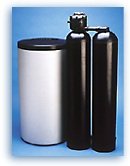
I do not remember the model that I have; however, it is the quad one (hour-glass shape) it removes chlorine as well. It is a little more than the basic one (see picture for a better idea of what I am talking about), which my dad has. Anyway, I paid just under $2,000 to have it installed and everything.

I also know a friend of mine just got one, and kinetico was running a deal. Buy the softner and get a reverse osmosis for free. That is like an $800+ deal, and I LOVE both the Reverse Osmosis and the Water Softner. In fact, the wife says they are both going with us whenever we sell the house.

/James
 

Attachments

  • 8-98602-Kinetico.jpg
    8-98602-Kinetico.jpg
    7.6 KB · Views: 143
/ Water Softeners & snake oil
  • Thread Starter
#36  
<font color=blue>Too much sodium in our bodies is not good. Too much potasium in our bodies is not good. We need a balance between the two. So, does anyone know if I could run a mix of potassium and sodium through the softener? Will I end up with water that has a balance of potassium/sodium? What will the effect be on a septic system?</font color=blue>

Great question - and I don't know the answer for sure. I do know that both Sodium (Na for Natrum) and Potassium (K for Kalium) are base metals and have the same reactive tendencies (did you do the science experiments in school where you put a little piece in water?). I also know that Potassium sits right above Sodium on the periodic table. You also see both Potassium Chloride and Sodium Chloride mixed together in some table salt substitutes.

There may be an issue with mixing them in solution with water though. Not that they would react together - but they may not mix well in solution. Some mixtures of salts in solution will stratify - it may be that all the Potassium Chloride sinks to the bottom of the container or some such thing - this may not be desirable. There may also be some wierd scavenging that goes on with the iron/Calcium on the resin beads. The Sodium may displace it first - but the Potassium may then displace the Sodium as it is slightly more reactive etc.

All in all, probably best left to the Chemists and Doctors (I'm not either). After all, Potassium Chloride is one of the three chemicals injected when you administer a lethal injection! /w3tcompact/icons/shocked.gif

Patrick
 
/ Water Softeners & snake oil #37  
<blockquote><font size=1>In reply to:</font><hr>

Regarding ... If you have septic and field system and do not reqire softening why overload the disposal system with salty water?

Excellent question - that's one of the considerations.

<hr></blockquote>

That would be one of my main considerations for a rural installation. We have hard water around these parts and the use of water softeners has increased the salinity of our sewer water to the point that they have to mix the output of the treatment plant with fresh water in order to get the salinity low enough to use the water for road-side irrigation.

I would be VERY reluctant to use a salt based (either sodium salt or potasium salt) re-ionizer agent water softener if I knew I was dumping that salt water into my ground.

I don't know anything about iron filters but I do know that the basic ion exchange water softeners are nasty on the environment (unless you happen to live by the ocean and can direct dump the salt water only into the sea :) ). The demand units are a little better in that they adjust to your usage and only flush hundreds of gallons of salty water into the waste water system when needed to recharge the ion exchanger. The timer based ones flush whenever programmed whether needed or not. Set too often and you waste water and salt. Set too infrequent and you go through periods of no treatment.

You might also consider whether your pump can handle the volume of water needed for the softener to cycle.
 
/ Water Softeners & snake oil #38  
Patrick,

My water test results were:

Iron: 1.1 mg/l
Hardness: 410 (not sure but believe units are mg/l)
pH: 7.4
Nitrates: None detected
Sulfate: 250 mg/l
Turbidity: 13 (turbidity units)
Total Dissolved Solids: 590 mg/l

Also had small amounts of manganese, sodium, zinc, and flouride. The test covered 94 different substances in addition to bacteria counts (none detected).

Let us know what you find in your iron removal quest.
 
/ Water Softeners & snake oil
  • Thread Starter
#39  
DVerbarg,

Thanks - all of the input has been helpful. I'm now waiting for the sales rep to send me information on the iron filter (he left behind a sheaf of literature on the softeners). Once I have that I'll better be able to judge between the two approaches (and look up more info on the web).

In the meantime, one thing I neglected to mention was that I did use the web site of the Water Quality Association (which I stumbled across while surfing the web) to try and find reputable people in the area. The guy who I found the best to deal with was registered / certified with them. The real snake oil guys were not (and hadn't heard of the WQA either). So it seems that the WQA may be a good place to start if any of you are looking ...

<A target="_blank" HREF=http://www.wqa.org/>http://www.wqa.org/</A>

Patrick
 
/ Water Softeners & snake oil #40  
The house I'm living in came with a water softener and
a reverse osmosis filter for our drinking water. Do you
know how much of the extra salt the reverse osmosis
unit will take out?

TIA.
 

Marketplace Items

2014 Peterbilt 337 S/A 18ft. Cab and Chassis Truck (A64194)
2014 Peterbilt 337...
Delta BS100 Shopmaster Bandsaw (A64553)
Delta BS100...
ACS PORTABLE AIR COMPRESSOR (A64276)
ACS PORTABLE AIR...
2022 EZ-GO ELITE ELECTRIC GOLF CART (A63276)
2022 EZ-GO ELITE...
2018 KOMATSU WA270-8 WHEEL LOADER (A65053)
2018 KOMATSU...
Star (A64557)
Star (A64557)
 
Top