Water in Basement.....Help

/ Water in Basement.....Help #21  
Sounds like you have the same problems I do. I also have started to accumlate woodworking tools and was looking to get my basement dry so I wouldn't have a pile of rusty tools from them sitting down there. Sounds like overall your quickest easiest way to solve this problem is to put in the interior perimeter drain going over to your sump pump. Like I said in the earlier posts I have one of these in my basement and by and large it works pretty good. The problem is that it doesn't prevent the water from getting in under the floor in the first place so you still have the issue of moisture coming up thru the concrete even if you don't have actual liquid water. What I was going to do in my basement is to lay down some of the Grace Bituthene foundation waterproofing membrane right on the floor and then pour some of the self leveling concrete over that in layer 1-2" thick. The floor in my basement is pretty uneven in most places so I can solve the moisture problem with the Bituthene membrane and then the self leveling concrete layer over that will both protect the membrane and level off the floor at the same time. I was going to then paint or put linoleam tiles on the concrete layer to finish off the floor.

Since the interior drain would be an easier solution than digging down the exterior foundation it sounds like that would be your best way to go at this point. Just make sure your sump empties somewhere away from the foundation. When I dug my foundation down and put in the footer drain I also put in a separate drain pipe for the sump and buried it underground in the trench with the footer drain. Once I finish the drain piping off this will all go out into my backyard and terminate in either a drain field or a drywell. Previously the sump pump was going out thru a window and had a hose just draining into the backyard. Problem with this was that whenever it got cold the hose would freeze up and then the sump had nowhere to go. This would happen quite a bit when we got weather like we have had recently where there is a lot of precipitation and fluctuating warm and cold weather.

As a side note even with all the precipitation we have had recently and the warm weather I have not had any water in my basement or the entryway foundation. Previously I would get up to 6 inches at the bottom of the entryway. Looks like the footer drain and the foundation waterproofing are doing something. I will know for sure if we get some heavy rains this spring. If I get a chance I will post some of the pics I took when I put the footer drains in this fall.
 
/ Water in Basement.....Help
  • Thread Starter
#22  
Hi Jim,
That self leveling concrete sounds interesting. Would info on that be available from the link you gave me the other day?
Yes, the sump pump drains out the left side of the basement and heads down the hill into the woods. Obviously, by putting those floor drains in and then putting that membrane material down on the floor and pouring the self leveling concrete on top of that may be the ticket. Do you have any more info on that jim? Sounds like some snow coming for tommorrow.

scotty
 
/ Water in Basement.....Help #23  
I haven't actually used any of the self leveling concrete yet myself but there are two places I know of off the top of my head where you might get more info. Quikrete makes a couple of different self leveling products - they have more info on their web site:

http://www.quikrete.com/catalog/catalog_commercial.html


The other place I have seen self leveling concrete products mentioned a number of times is by the people who do the radiant floor heating. Many of the radiant floor heating contractors will lay down the piping and then pour a couple of inches of self leveling concrete to encase the piping. There might be some info on this on the www.jlconline.com site too. I have never seen the Quikrete self leveling products at any of the big box home stores - you would probably have to go to a masonry supply store or a good local lumberyard that deals with contractors.
 
/ Water in Basement.....Help #24  
If the perimeter is filling with dirt then you have no protection that keeps the backfill around your house from being washed away. There must be some spots where you can see the soil lower than when the house was built.

Is it possible to have access to the drain so that you can get a garden hose in the weeping tile? You might be able to jet rod the drain clear. But the tile will probably fill again.

The normal way that weeping tile is installed is this. Once the basement wall is in place the water proof membrain is placed under the tile and up the wall to just above grade. The drain tile is then set so that the bottom of the tile is a bit above the footing bottom. Like has been pointed out some type of screening is then placed over the tile to keep soil from washing through the drain holes in the tile. This placement furnishes a low resistance to the flow of water from the outside of the basement wall to a drain. What it does is to keep the water table next to the house below the footing, or the basement floor.

I had a problem almost like yours. The contractor wasn't fussy about setting the blocks on the clay on the footing. The clay washed out over time and caused leaks. The other thing was that there was no waterproofing between the tile and the footing. In one place I cut through the floor and installed small tile inside under the floor. In the other section I dug up the outside tile and placed membrain between the tile and the footing/basement wall. Both fixes worked.

The last work I did on the house I used the 4"PVC tile. Over the tile I put a couple of feet of crushed concrete. Then covered that with 10 mill plastic film. Then backfilled the rest of the way with the clay that I had dug out originally. Using crushed concrete eliminates the need for a screen over the tile.

Best of luck to you.
 
/ Water in Basement.....Help
  • Thread Starter
#25  
Catmando,
That brings up a very good point. The original foundation drains still exits in the lower back left corner of the property. Im wondering if an outfit like roto rooter might be able to some how flush those lines clear? I might try that before ripping up the cellar floor.

scotty
 
/ Water in Basement.....Help
  • Thread Starter
#26  
Good Afternoon Guys,
I know this thread is close to being ancient history ;) but Im finally gettin around to doing something about the problem before the spring rains ! :)

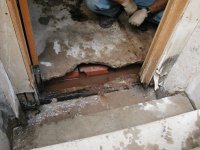
The west wall of the basement has allways had water issues since the foundation drains stopped working years ago ! I finally have some time to devote to this project and have just got started on rectifying a bad situation. I started by clearing the entire wall length of all the equipment that I had there and then using a masonry blade in my skill saw I scribed a 1/4" deep groove along the length of the floor out approxiamtely 16" from the base of the wall. Then I rented an electric powered jackhammer from HD to break up the floor in that area. The run was about 31' front to back, and I left one section about 18" long in the middle of the run.

The jack hammer worked like a charm, and Im guessing it only took me about an hour of actual jack hammering to do that whole run. The floor was between 2" to 3" thick from what I can tell, for the most part !

Now starts the tedious job of excavating all this mess up and removing it from the basement ! :( Something tells me its going to be a little at a time ! ;)

Here are a few pics of the operation !
 

Attachments

  • Jackhammer.jpg
    Jackhammer.jpg
    180.9 KB · Views: 419
  • FloorWetside.jpg
    FloorWetside.jpg
    169.3 KB · Views: 400
  • PlannedSumpArea.jpg
    PlannedSumpArea.jpg
    147.3 KB · Views: 341
/ Water in Basement.....Help #27  
I do not envy you that job, Scotty. Good luck with it.
 
/ Water in Basement.....Help
  • Thread Starter
#28  
Bird said:
I do not envy you that job, Scotty. Good luck with it.

Afternoon Bird,
Yeah, my back doesnt envy this job either !!! ;) :)
 
/ Water in Basement.....Help #29  
Funny thing about holes in the ground... I want a dry basement and the guy next door wants a water well...

mark
 
/ Water in Basement.....Help #30  
Scotty,
Your stealing my work, I just noticed this thread or I would have replied earlier, I've been doing basement drainage systems for 25 years, along with some other construction specialties.

Basement drainage is some what geographic specific in what is acceptable practice in a given location, since your house is here in CT I feel comfortable explaining a few things.
First of all you've gotten good advice as you are approaching it the same way that we (a fairly high priced contractor) would.
Also:
* we as contractors don't stop the water we only control it.
* water under a basement is normal, not a defect, anytime you dig a hole your gonna have water (well).
* The best way (the most accepted way here) is a perimeter drain under the basement floor along the footing, top of pipe even with top of footing, 4" perforated ads pipe set in 3/4 crushed stone trap and very critical that there be a 1-2" layer of stone between footing and floor. this system all tied into a basin and either a pipe out under the footing to daylight on the property (the ideal method) or if topography prevents this, then a sump pump.
* The water table is not rising, typically it's the water in the ground that is trying to perc down, in clay or other poorly drained soils the water moves very slowly, exerting hydrostatic pressure on the foundation finding passage through the cold joints, cracks etc.
* IMO outside footing drain systems should only be considered when a daylight discharge is possible, and never brought back into a sump inside the structure, you want to hold as much water back out of the basement with the foundation and have the drains inside at the point of need. in general outside systems are more expensive and less effective, impossible to maintain in the future and often cause more problems than prevent.

Don't over excavate, don't dig lower than the footing, a few inches of stone around the pipe is fine, and we do not recommend filter fabric, except in certain cases, seen it do more harm than good, I tell people that if the inside of the pipe gets blocked, we can clean it, if the outside of the system gets blocked than you have to open up the floor and redo. if you have water coming down the wall then you need to leave a weep joint between floor and wall, if you have water coming from hatchway stairwell then you need a threshold drain (our most common job).

PM me if you have any specific questions and good luck with the 5 gallon bucket brigade.
 

Attachments

  • P1045772.JPG
    P1045772.JPG
    421.5 KB · Views: 392
  • P2216002.JPG
    P2216002.JPG
    438.2 KB · Views: 395
  • P6016668.JPG
    P6016668.JPG
    427.6 KB · Views: 513
  • P8054844.JPG
    P8054844.JPG
    460.1 KB · Views: 387
/ Water in Basement.....Help
  • Thread Starter
#31  
Good Evenin John,
Thanks for that great post ! The excavation is going to take a bit longer than the jack hammering IMO ! ;)

Thanks for the tip on the excavating depth and such. I will certainly post on this thread as any updates become apparent, slowly Im sure ! I think I have to go to work tommorrow so I wont be doing much then, but I will try and keep at it !

John, I may PM you before its all over, and thanks for the offer !
 
/ Water in Basement.....Help #32  
Any chance there is straight in access to the basement where a plank and dolly system could be used to remove excess material?
 
/ Water in Basement.....Help
  • Thread Starter
#33  
Egon said:
Any chance there is straight in access to the basement where a plank and dolly system could be used to remove excess material?

Hello Egon,
The best I can do is the Bilco doors on the back side of the basement that goes out to the back yard, and then I have a low spot in the back corner of the property that I can dump the excess material !
 
/ Water in Basement.....Help #34  
scott_vt
Maybe I'm lazy why haul the concrete and stone out set it aside, dig the dirt out and haul it out put the stone back in, then the pipe with the sock put concrete back as lower fill maybe another fabric and more stone and new cement.

tom
 
/ Water in Basement.....Help #35  
Now I see why I didn't notice this post earlier, it was started before I became a member, anyway, Tom is right, on existing houses we do recycle the rubble and only use the new crushed stone to level the top of the trench to a uniform depth. as a contractor we have to do what we can to keep costs down, but that doesn't mean we are cutting corners by being cheap with materials, the whole idea of the stone is to leave air space between the aggregate leaving a path for water to flow, the smaller the aggregate the smaller the voids, the course concrete rubble allows for custom placement to allow the greatest amount of hollow space around the pipe.

That critical part between the top of the footing and the bottom of the floor I was referring to, is important because though most water comes from under the footing, some can come between the bottom of the foundation wall and the top of the footing and if there is no void or stone bridge there and the floor is poured tight on top of the footing, then that water will push up between the wall and the floor (cove joint), the reason being is that the concrete floor will shrink away from the wall but not off the footing, I have seen quite often where builders feel it's a better to pour the floor on top of the footing thinking it's necessary for support, when in fact they are sabotaging themselves, because even with an otherwise perfectly installed footing drain system, that particular source of water can not make it to the pipe, now the entire perimeter needs to be cut and redone with some sort of footing bridge put in. Could cost up to $10,000. for a large house, and be prevented with a couple wheel barrows of stone spread on top of the footing (1" min) before pouring the floor.

The plank method that Egon mentioned is nice as we use a wheel barrow, unfortunately we only see walk outs (level) or 2-3 steps on about 10% of the jobs, most of the time we're humping pails up the hatchway stairs, even worse, are the houses with no hatchway and everything has to come up a full flight of stairs into a kitchen and out the front or back door, that has to be figured into the cost of the job, made that mistake before!
Just need some heavy rains now, so I wouldn't have this much time for these long winded posts. Yup, I like bad weather, one old timer said I'm like an undertaker waiting for some ones basement to flood so I can get some work.
John,
 
/ Water in Basement.....Help #36  
Sitting here I'm wondering if drilling holes around the inside perimeter and installing vacuum points might be an easier solution as regards the amount of work required.:D :D :confused: :confused:
 
/ Water in Basement.....Help
  • Thread Starter
#37  
JB4310 said:
Yup, I like bad weather, one old timer said I'm like an undertaker waiting for some ones basement to flood so I can get some work.
John,

Evenin John,
Thanks for that long winded post ! :) You only have to mention $10,000 once and you get my attention real quick ! ;)
 
/ Water in Basement.....Help
  • Thread Starter
#38  
Egon said:
Sitting here I'm wondering if drilling holes around the inside perimeter and installing vacuum points might be an easier solution as regards the amount of work required.:D :D :confused: :confused:

Evenin Egon,
Youre cheering me up !!! ;) :)
 
/ Water in Basement.....Help #39  
Scott,
That dollar amount would be the high end for a very large house needing a complete system,
90% of the work we do is on existing houses with existing systems in the range of $1500. - $3,000. hatchway drains, window well drains, wall cracks, partial system failure/redo etc etc.

Egon,
The idea for the vacuum points would not be practical, the only way it would work is if there was already a pipe under the floor to allow the water to be drawn up from in a couple of places, could also get away with just a layer 4-8" deep of 3/4-1" crushed stone under the floor, that way a perforated sump pit (or a vacuum point I guess) could be placed anywhere in the floor and the water would perc into it, flowing latterly under the floor through the stone trap. Some builders chose to do it that way, wouldn't recommend it but it's better than no pipe and compacted fill under the floor.

On the subject of vacuums, we are thinking about how we could use vacuum excavation in our line of work, the units are still very large but are getting smaller, tow behinds vs truck mounted, all the utility crews are using them for excavating in the streets, a real time saver.
 

Attachments

  • P5228744.JPG
    P5228744.JPG
    439.7 KB · Views: 231
  • P5228750.JPG
    P5228750.JPG
    441.1 KB · Views: 223
  • Copy of P8039405.JPG
    Copy of P8039405.JPG
    426.1 KB · Views: 190
  • P8062195.JPG
    P8062195.JPG
    449.5 KB · Views: 200
  • P8062209.JPG
    P8062209.JPG
    411.3 KB · Views: 191
  • P8062216.JPG
    P8062216.JPG
    295.8 KB · Views: 207
/ Water in Basement.....Help #40  
:D
I really don't know why vacuum points would not work. They have been around for quite a few years.:D More years than I have.:D

As water is leaking into the basement there has to be porosity, permeability and water or pore pressure. Surely a number of holes drilled vertically through the floor and below would allow for the suction points to pick up water.:D

Of course the suction points would have to be sealed to the hole in the concrete floor.:D
 

Marketplace Items

2019 CUSHMAN HAULER PRO ELECTRIC GOLF CART (A58375)
2019 CUSHMAN...
30 Yard Roll Off Dumpster (A61165)
30 Yard Roll Off...
UNUSED CFG INDUSTRIAL MH12RX MINI EXCAVATOR (A62130)
UNUSED CFG...
Case 1083 20ft Corn Head (A63118)
Case 1083 20ft...
2007 TEREX ADVANCE MIXER FD3000 AWD 6X6 FRONT DISCHARGE MIXER (A59910)
2007 TEREX ADVANCE...
Arrow Quip MAN-STBR Sternum Bar (A64047)
Arrow Quip...
 
Top