Tree felling directional question

/ Tree felling directional question #1  

chopped

Veteran Member
Joined
Dec 6, 2008
Messages
1,857
Location
New England yankeee
Hello all,
I know there will be many opinions on how im doing this but ill try to lay out what Im doing and the question I have.

The tree in question is a beech tree. about 11 inches in diameter. I will be using two cables like I have done in the past.:thumbsup: One will pull it in the direction I want it to go. This usually works slick. I also hung a rope up there so if I run into trouble. I also have a secondary cable and winch attached. So this setup will defiently pull it the way I want ,

So the question is simply this.When i do the backcut into the birds mouth. is it best to go in straight or have one side cut ahead of the other side.? in which case if I wanted it to favor one way in the drop would O release the opposing side of the backcut. Leaving meat on the side that I want it to favor??

It would be trhe same without cables at all really. I know the direction of the birds mouth cut will dictate it mostly but wasnt sure if I am trying to fine tune it to much lol.
Thanks in Advance for this.:)
 
/ Tree felling directional question #2  
The back cut a a couple inches above the birds mouth to avoid having the tree come back at you and you can cut leaving a little more meat on the side you wish to pull the tree over too.
 
/ Tree felling directional question #3  
Couple notes:
When you start the backcut allowing the tree to flex, or lean towards, where the cable is pulling, and when the tree starts to fall, the cable will go slack. When this happens and there is no more tension in the cable, gravity will take back over and the tree will fall where it naturally wants to go (or "swing" to where the limits of the cable slack allows it). There has to be a balancing act between cutting and keeping cable tension. But not too much tension or you will create a "barberchair" tree cut.

Couple ways to lesson barberchair threat is: Plunge cut and cut back strap last, and/or put a chain around trunk above cut so trunk holds together when it starts to split.

Leave the thickest hinge on the side you want to hold the longest. But again, I think the benefits are minimal, with a danger of creating a situation where the top of the tree is a big lever falling over and too big of a bottom hinge is "holding/ not flexing" , and the trunk splits vertically (barberchairs).
 
/ Tree felling directional question #4  
Couple notes:
When you start the backcut allowing the tree to flex, or lean towards, where the cable is pulling, and when the tree starts to fall, the cable will go slack.

I like to use a nylon rope or 30-ft 2-inch recovery strap to give the tree several feet or more of pull when it starts to go.
 
/ Tree felling directional question #5  
So the question is simply this.When i do the backcut into the birds mouth. is it best to go in straight or have one side cut ahead of the other side.? in which case if I wanted it to favor one way in the drop would O release the opposing side of the backcut. Leaving meat on the side that I want it to favor??
)

Usually, a directional back cut is good for about a 5-10' deviation from the fall notch for the size tree that you have indicated. What provides the differential is the crown growth tendencies and I've seen species can also make a difference. Saw angle into the back cut can also alter such tendencies. In 2005 there was a "Prarie Dog" ISA paper totally refuting any efficacy a back cut has on fall direction. My experience states otherwise.
To answer your question, if this is a pulled directional fall, make the back cut straight. To make a directional back cut with a forced (pulled) directional fall is redundant and unnecessary. Just make the notch in the direction your pull is from and cut straight to the notch of course leaving a hinge.

As stated above about barber chairing, is a safer cut for the inexperienced. In this endeavor with a pull, timing is everything. People tend to start the pull way sooner than necessary which can lead to barber chairing of the stem. If the natural fall is the exact opposite of the subsequent drop, then I'd definitely use the relief type cut to prevent the stem split.
 
/ Tree felling directional question #6  
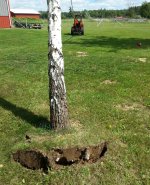
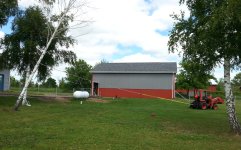
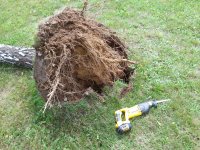
Don't mean to change the direction of the thread here, but just to give you a different idea to consider. This method is only applicable if you also want the stump out. The homestead property I bought 2 years ago had many dead and dying birch trees. Most were a little larger than 11 inches. First I used a ladder to wrap a chain around the tree, about 12-14 feet high. Then I used a sawsall with a carbide tipped blade to cut through the larger roots, about 1 1/2 to 2 feet away from the trunk. With extra lengths of chain and a recovery strap for shock absorption simply use your tractor to fell the tree, root base and all.

The added benefit in doing it this way, I discovered, is that the tree comes down slowly, so felling direction can actually be changed somewhat if necessary. I had a tree over about 45 degrees and I stopped pulling. The tree just stayed in that position.

I also helped a neighbor take down 6 of his birches this way. But being much younger and stronger than me, and with less patience using the sawsall, he opted to cut his roots with an ax. Hope this helps you.
 

Attachments

  • roots cut.jpg
    roots cut.jpg
    1.2 MB · Views: 406
  • tree pull.jpg
    tree pull.jpg
    744.4 KB · Views: 369
  • tree down.jpg
    tree down.jpg
    1.3 MB · Views: 333
/ Tree felling directional question #7  
Simple answer to the question is yes, direction cut can control the direction of fall, as others stated.

But Why do you need this? Is the tree naturally heavy or leaning in a direction you dont want it to go? Is there buildings around? Why not just notch in the exact direction you want it to fall and make a even back cut.

As to roping, typically they suggest that you have your line 90 degrees to the fall direction. IE: if you had a tree next to a house, and you didnt want the tree to fall on the house, you would attach an anchor line perpendicular out from the house. But then you would want to fell the tree parallel to the house, which can be aided by a second line. That first line isnt for pulling the tree, just for preventing it from going in an unwanted direction.
 
/ Tree felling directional question #8  
Simple answer to the question is yes, direction cut can control the direction of fall, as others stated.

But Why do you need this? Is the tree naturally heavy or leaning in a direction you dont want it to go? Is there buildings around? Why not just notch in the exact direction you want it to fall and make a even back cut.

As to roping, typically they suggest that you have your line 90 degrees to the fall direction. IE: if you had a tree next to a house, and you didnt want the tree to fall on the house, you would attach an anchor line perpendicular out from the house. But then you would want to fell the tree parallel to the house, which can be aided by a second line. That first line isnt for pulling the tree, just for preventing it from going in an unwanted direction.

That depends on the tree LD. If a tree is that close to a house, I'd call a professional tree service if I were him. The trouble with a 90 degree pull is it may work with smaller trees. Bigger ones can still have so much meat at the hinge that they will not necessarily move with 90* angle. If a tree was dangerously close to things, we'd top it first and pull the stem over with a 45* angle from the danger. This is where the notch would be as well. Worked every time.
 
/ Tree felling directional question #9  
I'll pile on and say, I'll never use a cable again. It works great when it doesn't slack. When slack, it's worthless. I'll be using a rope with some stretchy spring in it. Cutting down a very large and leaning mulberry I cabled in the direction of lean. Tree was completely uncooperative. Ended up falling 180deg from where I wanted. Not fun.
 
/ Tree felling directional question #10  
That depends on the tree LD. If a tree is that close to a house, I'd call a professional tree service if I were him. The trouble with a 90 degree pull is it may work with smaller trees. Bigger ones can still have so much meat at the hinge that they will not necessarily move with 90* angle. If a tree was dangerously close to things, we'd top it first and pull the stem over with a 45* angle from the danger. This is where the notch would be as well. Worked every time.

the 90 degree line isnt a pull line. Rather just a line to keep things from going wrong.

With a line (properly sized and tight) going perpendicular out from the house and properly anchored, there is absolutly no way the tree can fall on the house. That line gives the tree the ability to fall in a 180 degree arc. So no matter what goes wrong with the notch, or fell, it cannot fall on the house.

Another line, can be connected for a pull line.

I seen a good diagram awhile back Ill see if I can find it
 
/ Tree felling directional question #11  
Tree was completely uncooperative.

-Yes, those Mulberries are such a belligerent breed, whereas your Sugar Maples are bred for their docility and even temperament. :D

(Sorry, must be one of those days, something about your phrasing struck me as funny. But I know exactly what you're talking about. And learned it the hard way!!)
 
/ Tree felling directional question #12  
the 90 degree line isnt a pull line. Rather just a line to keep things from going wrong.

With a line (properly sized and tight) going perpendicular out from the house and properly anchored, there is absolutly no way the tree can fall on the house. That line gives the tree the ability to fall in a 180 degree arc. So no matter what goes wrong with the notch, or fell, it cannot fall on the house.

Another line, can be connected for a pull line.

I seen a good diagram awhile back Ill see if I can find it

Unless the anchor point gives of course. I'll never forget the job we once went to where we found the stem had fallen right through a second story window. I mean the tip was inside the room. We had to extricate the stem out of the window before we could do anything with the tree. The anchor point for the safety line you ask from what was supposed to be a "professional" tree service? On a cemented leg base of the kids swing set. Employees for such a profession have a quick turnover and a professional tree service is only as good as its weakest employee.

I understand now. Whoever thought to lay down a stem parallel to a house is baffling to me. We aligned everything we could to always allow the drop line to fall as far from the house as possible. Yes, most of those times tree stems were always felled as close to 90 degrees as possible. It also makes a huge difference with the proper equipment.
 
/ Tree felling directional question
  • Thread Starter
#13  
Thanks for all the ideas. Only obsticle in the way is a fence. and a small outbuilding.So Im concerned that I dont feel like fixin these.lol But I have found great luck with the cable and coma along idea. I crank it tight. then cut the bird cut in the way I want it to go. I then make the back cut and watch for slight slack in cable. then walk over to the winch and crank it tight again.then back to nibble the cut
basically pulling the tree in the direction ...usually two people make it easier as its not run back and forht. But today im doing it and i will be one manned. .
I have taken some small trees that were quite angled towards the house and used this method to bring them back up straight and then ove the 180 degrees to fall. Many time using a second person and an electric say to make the final cut. the electric is easier to nibble and then hear the second person tell me how tight it is.
Advantage of second person is I also have a rope on it that they can grab and pull when it finally does drop.
So the way it sounds leave more meat on the side I want it to favor . (on the backcut) thats what I had worked out in my mind. Its not much of a detail maybe but more comes under fine tuning the fell.
I will let you know how it goes today..In this case of the fence. its only a 100 dollars worth so if it goes wrong ....not a huge loss.
 
/ Tree felling directional question #14  
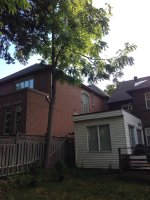
I have a similar problem with a Beech tree that is about a foot or so diameter at the base. I cannot drop the tree inside of the yard, or it will hit the fence. So, I'm going to drop it in sections, and there is a fourth about 12 feet off the ground that you can see in the attached photo.


image-494056956.jpg

I planned to chain the two forks to the main trunk before I cut, so that when the crowd hits the ground the trunk of the fork stays up in the air rather than coming crashing down at an angle and hitting the house.

Will use a sawzall, and cut my birds mouth first and then start the back cut in little bitty sections, going down off the ladder each time and trying to snap the hinge. Of course I have to do this a little bit at a time, so that the thing doesn't fall while I'm standing on the ladder. Have done this before, and it works well, as long as you only cut a little bit of your back cut at a time and then climb down and try breaking the hinge from the ground. If you cut too far and it starts to fall while you're on the ladder….��

One potential issue is the chains slipping off when the crowd hits the ground. So, I'm going to drill holes through the tree and attach the chain with a bolt so that it cannot possibly slip off. Any other ideas, guys? Any suggestions at all would be appreciated.
 
Last edited:
/ Tree felling directional question #17  
Eeesh! Cutting from ladders. :eek:

Generally frowned upon, but many have done it successfully...and likewise, many have injured themselves....

There are some good youtube videos of people cutting trees from ladders that show the limb swinging down, taking out the ladder and/or the person on it. (Google tree cutting fail). That's why a cheap climbing belt and spurs are preferred (IMHO), or even the OSHA non-approved method of cutting while sitting inside a tractor loader (FEL) is better (IMHO).

At least tie off the top of the ladder and/or yourself.
 
/ Tree felling directional question #18  
Thanks for all the ideas. Only obsticle in the way is a fence. and a small outbuilding.So Im concerned that I dont feel like fixin these.lol But I have found great luck with the cable and coma along idea. I crank it tight. then cut the bird cut in the way I want it to go. I then make the back cut and watch for slight slack in cable. then walk over to the winch and crank it tight again.then back to nibble the cut
basically pulling the tree in the direction ...usually two people make it easier as its not run back and forht. But today im doing it and i will be one manned. .
I have taken some small trees that were quite angled towards the house and used this method to bring them back up straight and then ove the 180 degrees to fall. Many time using a second person and an electric say to make the final cut. the electric is easier to nibble and then hear the second person tell me how tight it is.
Advantage of second person is I also have a rope on it that they can grab and pull when it finally does drop.
So the way it sounds leave more meat on the side I want it to favor . (on the backcut) thats what I had worked out in my mind. Its not much of a detail maybe but more comes under fine tuning the fell.
I will let you know how it goes today..In this case of the fence. its only a 100 dollars worth so if it goes wrong ....not a huge loss.

That is exactly the way I directionalize them. Two cables and come-a-longs. Crank the snot out of them and it will only go one way. But once I start cutting and I want to put more tension on it I will take a round about way back to the come-a-longs.

I had a 60'tall and 12+" diameter 10 feet from the house and the top was over the house by 10'. I cranked it back so it was leaning away from the house, then cut it. I went exactly in the direction it was supposed to go, but my saw stuck when it started falling so I left it and backed away.

The tree starting falling, the saw came unstuck and fell off to the side, the tree hit the ground and rolled right over the saw. Who knew metal was so flimsy?

I feel very comfortable with most trees using the ladder and cable method even though it is more time consuming than just cutting it.
 
/ Tree felling directional question #19  
Check, that's not a beech or birch tree shown in the picture. It should not be $590 to drop it. Maybe to haul the wood and chip the brush from a back yard.... Easy to climb and what appears to be plenty of drop zone. Looks like a 20-30 minute job to put it on the ground. Removing it all may be worth the $590 depending on how far the drag is and the access. Just sayin'.
 
/ Tree felling directional question #20  
So the way it sounds leave more meat on the side I want it to favor . (on the backcut) thats what I had worked out in my mind.
/QUOTE]

All you have to remember is that the back cut aligns with the way you want it to fall. The outcome of this cut is that there is more wood on the hinge remaining on the fall line side. To add some fine tuning to this type of cut, slightly drop the angle of the saw handle side so you finish above the notch on the far side and even with the notch on the fall side (about 1/2"-1"higher on far side)
 

Marketplace Items

2023 Kubota L3560 Compact Utility Tractor with LA805 Front Loader (A63689)
2023 Kubota L3560...
JOHN DEERE 606C - 6R30" CORN HEAD (A64277)
JOHN DEERE 606C -...
JCB 3TS-8T TELESKID SKID STEER (A65053)
JCB 3TS-8T...
New/Unused CFG Industrial H15R Mini Excavator (A65583)
New/Unused CFG...
John Deere Zero Turn Lawnmower (A65579)
John Deere Zero...
(1) 20 Yard Roll Off Dumpster and (1) 40 Yard Roll Off Dumpster (A65579)
(1) 20 Yard Roll...
 
Top