Time for a new bridge - how to engineer?

/ Time for a new bridge - how to engineer? #1  

JeremyL

Silver Member
Joined
Mar 19, 2002
Messages
190
Location
Louisville, KY
Tractor
Kubota MX5000 & L3800
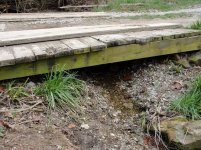
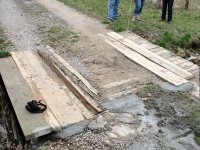
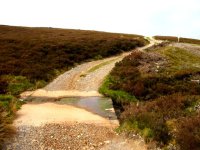
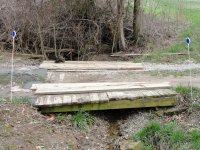
This old bridge needs replacing after a hard winter outside of Bowling Green, Kentucky. It usually has only this amount of water trickling under, but in a big, hard rain there is enough water to wash over the surface.

I want to building it so that a gravel truck can cross it with much needed loads for my driveway. I am thinking about treated 8" X8"s. How many would I need and at what spacing? Then treated 2X boards across the 8X8s. I will have no idea what the footing is like until I do the demolition. It is 8' long and 10' wide.

Suggestions? Links to plans or articles?

Thanks, JeremyL.
 

Attachments

  • DSC07921.jpg
    DSC07921.jpg
    1.1 MB · Views: 605
  • DSC07919.jpg
    DSC07919.jpg
    1.1 MB · Views: 497
  • DSC07918.jpg
    DSC07918.jpg
    1.1 MB · Views: 502
/ Time for a new bridge - how to engineer? #2  
Couple of culverts, side by side? Assuming you can fill enough over the top.

1999 JD 4600 MFWD
460 loader
Curtis cab
 
/ Time for a new bridge - how to engineer? #3  
I've always preferred large culverts or a concrete ford instead of a bridge. Use a bridge when the crossing is too high above the water for culverts or ford, or there is too much water flow.

3521866_b58cc2b9.jpg

Bruce
 
/ Time for a new bridge - how to engineer? #4  
An 8x8 wouldn't be better than multiple 4x8s spaced closer. Minimize the clear span as much as possible. The SPC (southern pine council) has or used to have good free info on beam strengths.

Another thought could be to find someone with small dump truck (8 or 12 ton) and make more trips, but expense will add up fast (if a mini wheeler is $60/hr; I doubt a tandem would be any less, and a 8 or 12 ton would be maybe $50/hr for truck and driver).

I do agree with the last post; maybe a double barrel 24" RCP. There about 32" OD; maybe close to 36" OD at the bell. Plenty strong, easy to install if you have a hoe or even a loader; and should last 50 years. Make it at least 3 joints of pipe (24 ft); 16 ft gets pretty narrow at times. Price I believe should be in the neighborhood of $10/inch/8 ft pipe (~$240/pipe; X3 pieces, X2 runs=$1440) so far from cheap.


Edit: I found a price on "allcostdata.info" that lists $43.92/lf; total installed with $25.30/lf as the material price. $25.30 ×24×2=$1214.40

Re-Edit: their labor rates aren't for small home owner projects, but part of large scale projects; don't expect someone to mobilize in and lay that pipe for $800, unless they are hungry and close by.
 
/ Time for a new bridge - how to engineer? #6  
Looks like an easy place for a culvert. Seems a better choice than a bridge
Agreed. The size needs to come from the drainage area upstream and your ability to let over flows wash over the road at a relief point. Just a 24"if you can relieve it and maybe a 30 or 36 inch if not.
 
/ Time for a new bridge - how to engineer? #7  
I agree with the culverts. Some pipe and some stone and call it good. I would do a rough flow calculation for the pipes size to oversize them a bit. Also, make sure that you can get enough cover over the pipes so that they do not crush with your max anticipated loading. This usually requires so many inches/inch of culvert size but I would have to look it up to make sure I didn't quote it wrong.

I think calculating the drainage area is a waste of time for a driveway or at least severely overkill. Figure out the max flow in the flood time and find the flow of the culverts to match. 36" is way to big. You will not be able to get enough cover over the pipe to protect it from stone truck deliveries. Using multiple small pipes is fine if they are sized correctly. And no, two 12" pipes do not equal a 24" pipe,
 
/ Time for a new bridge - how to engineer? #8  
The area of the waterway under the present structure appears to be a triangle about eight feet wide and three feet deep. 1/2 b*h = 12 sq. feet. A 36" pipe has a cross sectional area of 1.5 *1.5 *3.14159=7.07 sq ft. But a smooth bore pipe will flow more water then an open channel.
Another thing is you can look at the nearest pipe downstream and upstream and see how big they are.
 
/ Time for a new bridge - how to engineer? #9  
The area of the waterway under the present structure appears to be a triangle about eight feet wide and three feet deep. 1/2 b*h = 12 sq. feet. A 36" pipe has a cross sectional area of 1.5 *1.5 *3.14159=7.07 sq ft. But a smooth bore pipe will flow more water then an open channel.
Another thing is you can look at the nearest pipe downstream and upstream and see how big they are.

He's right, but consider what type of pipe you will use. 36" rcp isn't do able with a tractor mounted back hoe, and might not with a JD-310 sized machine.. probably want an 10 ton track hoe for concrete that size. ABS/HDPE/CMP/ACCMP that size will need pretty good coverage to avoid damage by a real dump truck.

Edit: of coarse you could use Elliptical pipe (squash pipe, ercp) and I think 36" nominal would be 22" x48"?
 
/ Time for a new bridge - how to engineer? #10  
Culvert does make sense. If you really want a bridge, build it higher ramping up on both sides. Pour substantial concrete footings and tie the beams to it somehow to keep it from floating. Use 2 x 12's for beams, not square sections, as many as required for your design load using beam tables.
 
/ Time for a new bridge - how to engineer? #11  
You asked about a bridge, so maybe you Want a bridge. I Google "agricultural bridge designs" and the first article is PDF from Alabama with a lot of food info. Little technical, but recommends 3" wood decking, 8"-10" wide. Gives some specs on steel W-beams, ect. No idea how to link a PDF.... many of the state agricultural schools have designs for barns ect free online to view
 
/ Time for a new bridge - how to engineer? #12  
Maybe it just needs a little help during the time the trucks are delivering gravel. Can you support the bridge at center with a stack of wood scrap lumber in the streambed (and let the stream just leak thru the wood). The remove it after your gravel is delivered? Maybe can set a steel pipe in with the wood stack to let the water pass easier.

It would be useful to know what size truck and if they are tandem or single axle.

Culverts make a creek look like a ditch. A bridge has more charm. But maybe it is a ditch.
 
Last edited:
/ Time for a new bridge - how to engineer? #13  
If the bridge think about beams that are much deeper than wide. They can also be laminated. For supporting heavier vehicles it might be best to get a standard plan to follow.
 
/ Time for a new bridge - how to engineer? #14  
Well if you want a quick short bridge consider a flatbed trailer with the wheels cut off.
 
/ Time for a new bridge - how to engineer? #15  
If you search under my name you can see the posts I did on building a new bridge on my property -twice! First time to replace one and the second time after an old footing I used gave way during a flood. I then moved the bridge to a new location using a crane.

The bridge has worked really well. Couple of things I learnt (without going into the engineering of beam and decking sizes etc)

Footings are very important! Think twice before using an existing one. Turned into an expensive mistake for me.
Make sure you anchor your beams to the footings. Water can exert tremendous force even in a small stream when flooding.
Be careful about where you place the footings. Ensure they are far enough back from the stream to prevent erosion under them. I stabilised my banks with a couple of rolls of chain link fence material pegged down and gabion baskets.
Ensure your beams are at the track width of the heaviest vehicles likely to use the bridge. I set mine for my tractor.
Put a rail on the edges for those times your neighbours are leaving late at night after a few beers....
Allow enough gap between the decking boards for expansion. Surprising amount.
Don't underestimate how much fill you will need to bring your track up to the level of the bridge. Have a look at the pics from my post re moving the bridge. Took many truckloads of road base to get up to the bridge deck height.

I really enjoyed doing my bridge even though it was a back breaking exercise. Still get a quiet sense of pride each time I drive over it.

Good luck

Mark
 
/ Time for a new bridge - how to engineer? #17  
My experience with building several bridges was that no commercial trucker would take the risk of crossing a wooden bridge, no matter what the tables say. I had to build a ford, a crossing from heavy rock, so they could bypass the bridge, of course only passable when the water is low, but they rather go through some water on solid soil then run any risk with an unknown bridge. If I had known that in advance, my bridge would have been more modest in capacity for cars, PU trucks and tractors and saved me a lot of worry.
 
/ Time for a new bridge - how to engineer? #18  
If you want a gravel truck to drive over, a culvert is the answer.
 
/ Time for a new bridge - how to engineer?
  • Thread Starter
#20  
While the preponderance of the recommendations are for a culvert, my wife really likes the bridge option since that it what has always been there (since her grandparents' day). Local lumber yard has #1 used railroad ties, 7" X 9" X 8'. If I use them as beams, I shouldn't have to worry about rotting, and can afford as many as it would take to make the deck sturdy. One possibility would be to use 4" X 6" X 10' posts for the decking.

Anyone know how I can calculate how many beams I need to carry the load of a small, loaded gravel truck?

Thanks for all the information!
 
 
Top